
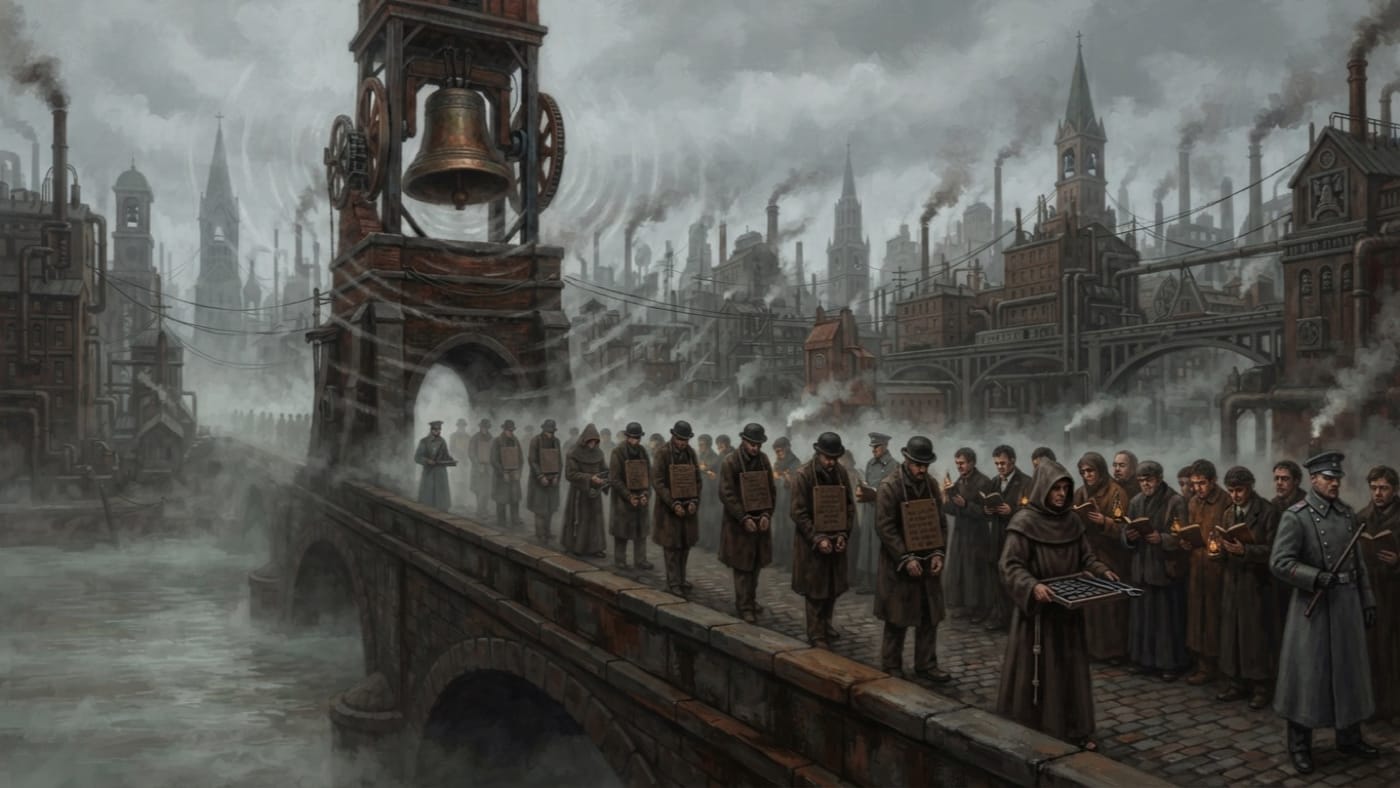
"The bell is final cause." — slogan of the Bell Monists, as chalked, recited, and entered into evidence
#On the Cause and the Toll
The Bell Monists teach that bells are the machinery of creation. Symbol, civic ornament, municipal clock: they reject all three as the timid readings of men who have never stood under a tenor bell at the Ninth Peal and felt their teeth agree with it. Sound, they say, is the First Cause. Heaven spoke through vibrations rather than scripture. Stone, flesh, the Synod and the vellum under my pen are, by their account, the long ringing-out of that first stroke.
Their slogan is shorter, and it contradicts them. The bell is final cause. A first cause stands at the beginning of things. A final cause waits at their end. The Monists hold both, chant both, and have filed no tract I can find that reconciles them. I have never counted this against them. A doctrine that begins in bronze and ends in bronze can at least claim consistent materials.
The record is silent about their origin. No founder has been filed. No founding year survives that I would put my seal under, and I have sealed worse. The Lore Book of the Synod lists them among the counter-currents that disturb the Church's supposed unanimity, next to the Integralists who march their ledgers and the Ledgerists who believe an unfiled wound cannot kill. It calls them a stranger sect than the first and every bit as zealous as the second. That is where they enter the archive: already formed, already chanting, already a nuisance with a slogan.
#On the Clerks and Their Forks
The teaching has found its keenest following among the clerks of the Bureau of Orison and Song. That will surprise nobody who has spent a day in a city governed by the Ninefold Peals.
At the First Peal the shutters open and the knees bend. At the Third the kitchens release their rationed steam. At the Fifth the scribe bends over his ledger and the foundryman over his reliquary iron. At the Ninth the Orison vents breathe curfew fog into the streets until the last tavern song dies in someone's throat. A citizen of Strasbourg eats, works, prays and goes quiet at the toll. Tell that citizen that sound made the world and you are describing his Tuesday.
The clerks have noticed the agreement between the doctrine and their budget. The Monist teaching gives them a convenient reason to raise the tithe for tuning forks. A fork that calibrates a choir is equipment, and the Bureau of Tithes haggles over equipment. A fork that calibrates the First Cause is a sacrament. Nobody haggles over a sacrament twice.
The comedy runs deeper than the forks. Orison governs the hymnals. It approves the printed word of every sung prayer from the Cloister of Calibrated Breath to the last parish loft on the Line. Its own clerks have warmed to a doctrine that holds Heaven never troubled itself with scripture. The men who license the page are the ones telling us the page is secondary, and they request a larger allowance for brass while they say it.
I call that vocation.
#On Three Official Judgments
The Church has looked at the Bell Monists and ruled three times. All three rulings are in force.
The Bureau of Purity calls them acoustical heretics. Purity's charge has a rough logic. A citizen who believes the bell made the world may start to wonder who made the bell, and at that point he has questions about the foundry, and Purity's work begins.
The Bureau of Orison and Song declares: "Bell Monism is the apex of orthodoxy." Orison owns the voices, the broadcasts and the hymnals, and it is pleased to hear that its instruments came before Genesis.
The Bureau of Doctrine, which holds the flame of interpretation and resents anyone else warming their hands at it, declares: "Bell Monism is to theology what mildew is to bread." It is the best sentence Doctrine has produced in a decade. I suspect a junior wrote it and was moved to a less visible desk.
The Bureau of Bells owns the bronze, the bell-masters and the right to every lawful peal. It has filed no opinion I can find. A bureau being told that its property is the engine of creation has no need to comment. It only has to wait for the requisitions.
Bell Monism is the apex of orthodoxy.
Withdrawn as a general classification. The sentence belongs to the Bureau of Orison and Song and binds only that Bureau. Purity's finding of acoustical heresy and Doctrine's finding of mildew stand in the same file with equal seals. No reader may cite the Orison ruling outside Orison premises as though it had been settled for the whole Church.
My own view is on record, and I have no intention of retracting it. I find the doctrine charming. What better proof of Providence could there be than a world that moves at the toll of a bell? I hold this view while serving under a Bureau that compares the doctrine to rot. I should note that the Archon of Bells once sent me a tuning fork with a death threat attached. I kept the fork. A man's theology may be shaped by his gifts, and mine has been shaped by a very handsome one.
#On Iron Throat's Use for Bronze
Canon Veyl "Iron Throat" took command of the Counter-Toll Corps in A.S. 135 and taught the Bureau of Bells that sound-space is occupied ground. The Bell Monists would have bored him. He belonged to the school that treated the bell as law, discipline and command. It was a tool for moving a frightened city, and he cared nothing for any cosmology built on it.
He never needed one. Veyl's whole doctrine fits into his maxim. Louder is cleaner. Strike the bell. Hear the answer. If the answer is wrong, strike harder. His operators learned to drown hostile peals under sanctioned bronze, to crack windows, to make infants scream and garrisons obey. Nothing in their training required them to believe the world had been rung into being. Belief would only have slowed them down.
That is the lesson Veyl leaves for any student of the Monists, though he never set it for them. Bronze can rule a city without the man pulling the rope thinking it made the city. Belief in a bell's sovereignty is a private matter. Obedience to it is compulsory, and the Synod has always cared more about the compulsory.
#On the Tongue Made Still
The Procession of Tongues was built for Rationalists. When the supply of living Rationalists ran low, the Bureau of Purity widened its taste. The condemned now include any heresy the Bureau considers public enough to deserve public correction. Ledgerists are on that list, along with Merciful Pragmatists, unlicensed sermon-speakers and tavern philosophers who went past the three-drink exemption. Bell Monists are named among them.
The rite in Prague does not change for them. I know of no special Monist version, and Purity would think one vulgar. The condemned gather at dawn in the courtyard of the Order of Saint Ephrath. Each receives an oak tablet with the Creed cut deep into both faces. In private, an Ephrath brother draws the tongue forward with iron tongs and drives a single square nail through it into the wood. Tarred cord binds the hands to the tablet's edges. At the second bell after dawn the column goes down the Chapterhouse hill, across the Charles Bridge and through the university quarter, past the old faculties where reason once had a lectern.
The Bureau of Bells times the peals so that each footfall of the condemned lands on the toll. Each step is a beat, and each beat is a syllable of the Gloria Patri. The Orison vents send fog across the street in thin sheets. A man who holds that sound is the First Cause walks the whole route inside the sound he worships. Every stroke of the bronze sets his pace and every breath of the vents is a gift from his patron Bureau. The one sound in Prague he is forbidden to make is his own.
When a marcher can no longer walk, he may kneel, but he may not stop. The brothers carry him on by the elbows, and the tablet swings from his ruined mouth in time with the peal. The Bureau calls this ambulatory confession. For the Monist it must also be a kind of argument. The bell goes on, as his doctrine said it would. It goes on without him, and that part of the doctrine he may have overlooked.
The festival variant in Lyon uses no nails. There the citizens chant the Creed until their voices fail, and a clerk gags each failure with oiled linen and writes vox defecit in the ledger. The two routes reach the same silence, and the bells keep ringing over both.
#On the Present Application
As of this survey, in A.S. 201, the Bell Monists still have the three things a heresy needs to last in the Synod. They are useful to one Bureau, they offend a second, and a third finds them too tedious to finish off. The Orison clerks still want their forks. Purity still keeps the tablets sanded. Doctrine is still sniffing at the bread. The Bell Codex, ratified in A.S. 115, still tells every bell-master in the Church when to strike. It does not say what the first stroke was for, and the Monists have been happy to fill that gap at Orison's expense.
The Bureau of Records files all three judgments under one heading and cross-indexes them to each other. A citizen consulting the file may learn, on a single page, that his belief is the summit of orthodoxy, a mildew and a nailing offence. He is advised to keep quiet about it. The bell will speak for him.