
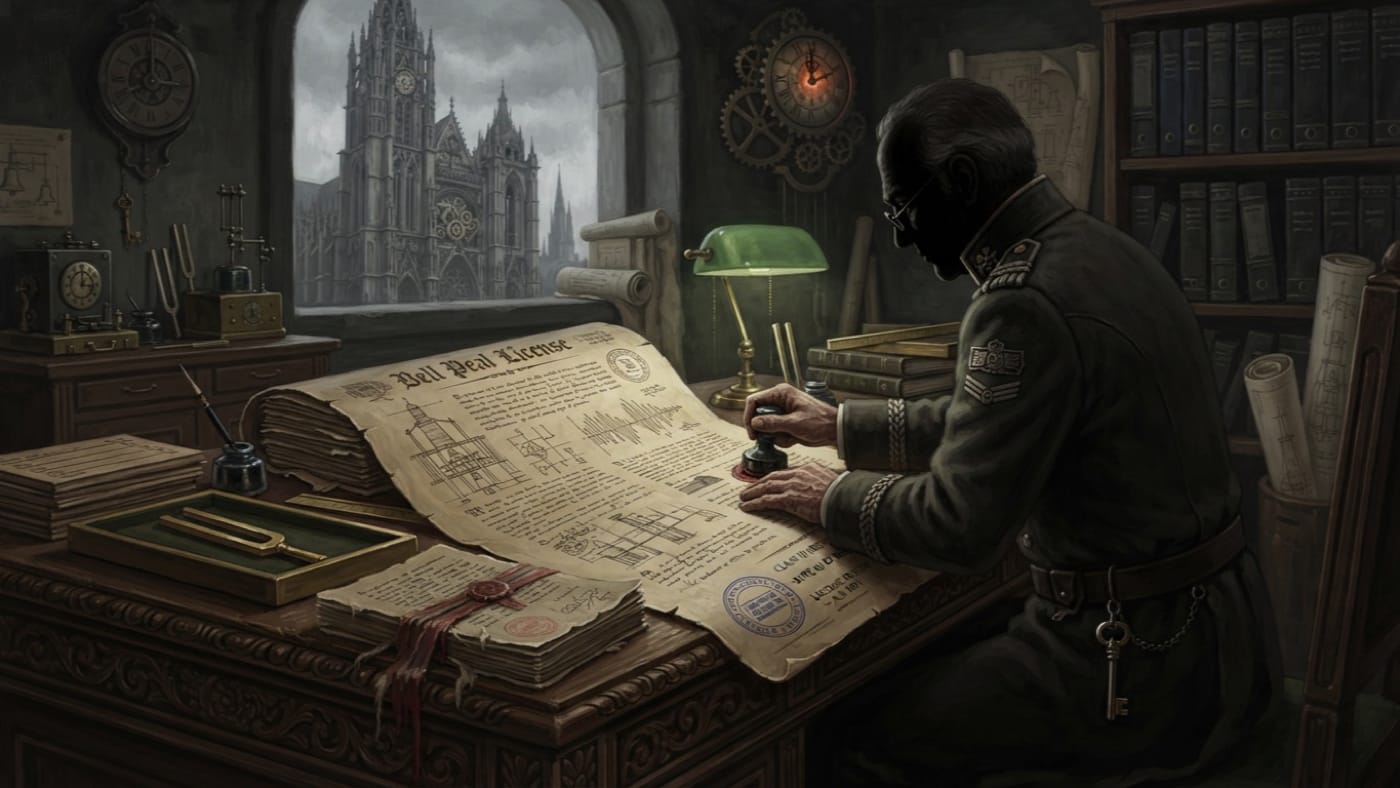
#On the Authority to Ring
"A bell is bronze until the Bureau says otherwise."
Owning a bell gives no one the right to ring it. The parish that cast it, the guild that paid for it and the farmer who hung it from a beam above his cattle each own some metal and a rope. The authority to make that metal speak sits elsewhere. The Bureau of Bells grants it on paper, under conditions, for a fee, and only for as long as a Bell-master is content. That grant is the Bell Peal License. The rest of this tract is commentary on a sentence the Bureau has never needed to write down: a peal is either permitted or trespass.
The Bureau prefers its history short, so I will keep it short. At the Miracle of Cologne, in A.S. 49, the cathedral bells rang with no schedule, no sequence and no sanction, and Wrath's Host broke against them. Three years later, in A.S. 52, the Office of Bells was constituted to make sure that nothing so effective would ever happen again without permission. The office later acquired a grander name, a Tower, and the habit of sealing its earlier acts after the fact. The present standard of lawful sound came with the ratification of the Bell Codex in A.S. 115. That gap holds the whole genius of our administration. The bells that saved Cologne would have failed inspection.
Several inventory entries in the Ledger give A.S. 115 as the founding year of the Bureau of Bells.
The Office of Bells was constituted in A.S. 52. A.S. 115 is the ratification of the present Bell Codex. The Bureau did not take sixty-three years to exist. It took sixty-three years to become legible.
#On What the License Permits
A Bell-master is ordained, and in this matter he outranks the priest whose bell it is. He does not bless a peal. He fences it in.
The published fields fall into four families. The first is count and hour: how many strokes, at which hours, and on which occasions. The second is the instrument itself: tonal range, clapper material, and the decay window within which the last note must die. A bell that hums past its window has gone on talking after it was dismissed. The third is meaning and reach: the purpose of the peal, its emotional register, and the parish radius it may cover. The fourth is the exceptions, festival and mourning. Each has its own field and each starts its own argument.
The register field is where the Bureau's theology becomes most exact and least pleasant. Bureau doctrine teaches that bells rung in joy and bells rung in grief produce different harmonic effects. Mixing the two without calibration is Class Two Tonal Heresy. A wedding peal that catches a widow's note is no longer a wedding peal. The Bureau of Doctrine says what each peal means, and the Bureau of Bells makes sure the bronze agrees. Whether Doctrine has ever endorsed the acoustics is another matter, and I leave it in its drawer.
Then comes the clause the Codex itself records: the maximum number of infants permitted to cry before the peal must be repeated for corrective coverage. No universal number is published. Each license names its own.
The form runs to twelve pages. The appendix is longer. The fee is devotional, and the Bureau of Tithes makes sure that devotion has a tariff. The Bureau of Records keeps the result, along with every later proof that the peal took place as licensed. So four Bureaus have an interest in one sound. That does not mean four signatures are required on one sheet. I have seen licenses with fewer, and I have not seen a sheet that lacked consequences.
Two warnings are owed to the provincial reader. First, the Codex's seven-second tolerance belongs to the schedule unless it is dispensed. It is no grace period for a missing license and no excuse for an extra stroke. Second, the license governs far more than striking. Clause 14-F of the Codex forbids anyone to imitate, dampen, invert, prolong, shorten, counterfeit, answer or anticipate a bell without schedule authority, and it names taverns, schools, infirmaries and private households alongside parishes and mines. The innkeeper who muffles the curfew bell with a wet sack has rung it falsely. The boy who whistles Matins an hour early has anticipated it. Changing a command is the same crime as giving one.
#On the Peal Under Inspection
A license proves that a peal was allowed. It does not prove that the peal was correct.
The Bellwarden who pulls the chain does not hold the license. He carries out a peal chart issued under it, and his day runs in a fixed order. He checks the chart against its schedule authority. He calibrates the bell: rope tension, pitch, strike intervals and resonance clearance. He rings what is prescribed. He logs every deviation in a calibration book that will outlive him and possibly convict him.
The Bureau's auditors come without warning. They strike test forks against the bronze and listen to how the tone dies. They lay the logs beside the physical wear on rope, clapper and bearing. A rope that has frayed faster than its entries allow is a witness, and it cannot be bribed. Then they question the crew, one at a time, about anything the logs leave out.
None of this is confined to the capital. In Rheinscarp, where people must be licensed to move and stamped to breathe, Bell Peal License inspections sit beside cargo seals and name registries as routine tempo policing. The stair-town's bells are small and its auditors are not.
#On the Fourth Stroke
That stamp belongs to one restricted class and binds only that class. Ninefold Matins strikes nine every dawn from Calais to Constantinople, and nobody is sent to doctrinal review for it. I record the limit because country clerks have been known to read the stamp as a general ceiling and fine the church at the next village for its own dawn peal.
The case the Bureau cites most often involves a farmer in Saxony. The Ledger gives no name and I will not supply one. He was licensed to ring a single bell on feast days only, and never more than three strokes. He struck a fourth. That night his barn collapsed, and his cattle suffocated under the timbers. The Bureau of Records stamped the incident report with one word: "Yes."
Sabotage, providence and coincidence each have their supporters. The stamp agrees with all three and settles none of them. I have read the file. It contains the license, the report and the stamp. It contains no investigator's name, no finding of cause and no sentence. The barn was the sentence, or the barn fell down. The Ledger does not say which.
The jurisdiction is just as unsettled. Under its own charter, the Bureau of Bells classes unlicensed ringing as heresy. The Bureau of Doctrine was not consulted about that classification and has never formally endorsed it. The Codex calls such sound heresy when Doctrine is in a good mood and treason when War is. Both Bureaus keep the question open with great care, because each knows that settling it would cost one of them a claim.
#On Necessity and Exceptions
The miners of Liège sounded their own shift bells in A.S. 108, without Synodal approval. That was seven years before the present Codex existed, under the older bell orders that came before it. They pleaded practical necessity. A shift bell in a mine tells men when to go down and when to come up, and those who miss it do not always come up. The Bureau held that necessity is a reason and gives no one authority. The scourging lasted three days. The mines reopened on the fourth. The bells were replaced with Bureau-sanctioned horns, which the miners may sound only at intervals set out in a document they are not allowed to read.
The festival and mourning exceptions are where this rigour becomes negotiable. Festival Chorus-Masters spend whole seasons asking for relief from curfew clauses. Their crowds want the joy to go on past Ninth Bell, and their permits can be revoked by anyone who hears it go on too long. Mourning is granted more grudgingly. The Codex allows grief one low note in the Widow's Toll and a measured interval in which grief may appear in public without turning into politics. Neither exception suspends the license. Each is a field on the form, filled in or left empty.
The license has a deeper limit, and the Bureau will not print it: a citizen cannot hear a license. He hears only the shape of a peal. On the Night of Borrowed Curfew, the enemy needed no unlicensed bells. It needed one lawful-sounding command at the right hour, and doors were locked because the sound was correct. Since then, Counter-Toll Operators have stood watch over curfew peals. They check the authority behind any tone that answers, drown out whatever has none, and file certificates afterwards to show that the lawful tone won. Parchment does not ring. Someone has to stand in the tower and enforce it.
#On Present Application
In A.S. 201 the licensed peal governs every hour of life. Prayer begins on a licensed stroke. Factory shifts turn on one. Curfew falls on one. Grief is let out on one low note and called back in. On the Sagittal Line and in the ration queues behind it, the kitchens unlock on a licensed bell and stay locked for those who miss it. All of it starts as a stack of leaves on a desk in Strasbourg, below the Bell Tower of Strasbourg Cathedral. The twelve pages sit on top, the thicker appendix underneath, and a tuning fork lies beside the inkwell. The Bell-master strikes the fork once before he signs and listens until the note is gone. If it lasts longer than he expects, he does not sign that day.