
#On the Breach at the Rhine
The Miracle of Cologne occurred in A.S. 49, four years after the Sundering cracked Europe open and taught mankind that Reason, having abolished Hell by pamphlet, had neglected to obtain Hell's countersignature. Cologne was then a frightened cathedral-city on the Rhine, rich in bones, poor in powder, full of refugees, priests, relic-custodians, discharged Rationalist functionaries, and that special civic arrogance by which Cologne has always mistaken survival for proof of merit.
Maldrake's vanguard came west wearing the char of a dozen townships. Wrath's Host did not besiege Cologne in the clean manner preferred by military historians. It struck, burned, withdrew, struck again, and left enough bodies outside the walls to make the dogs patriotic. The outer palisade fell on the third night. The river quays burned green. The western archive cellars filled with smoke. The garrison had spent its powder by the fifth hour before dawn.
The commanding officer's name is missing. This is the first scandal and the first proof that the event mattered. Records misplace paupers by accident; they misplace founders by policy. Later editions call him the Unnamed Captain, the Bell-Martyr, the Rhine Commander, or simply the Officer. The Bureau of Records maintains that no reliable name survives. Three family lines in Cologne maintain otherwise. None has produced a document that did not immediately catch fire during verification.
#On the Bell-Ropes
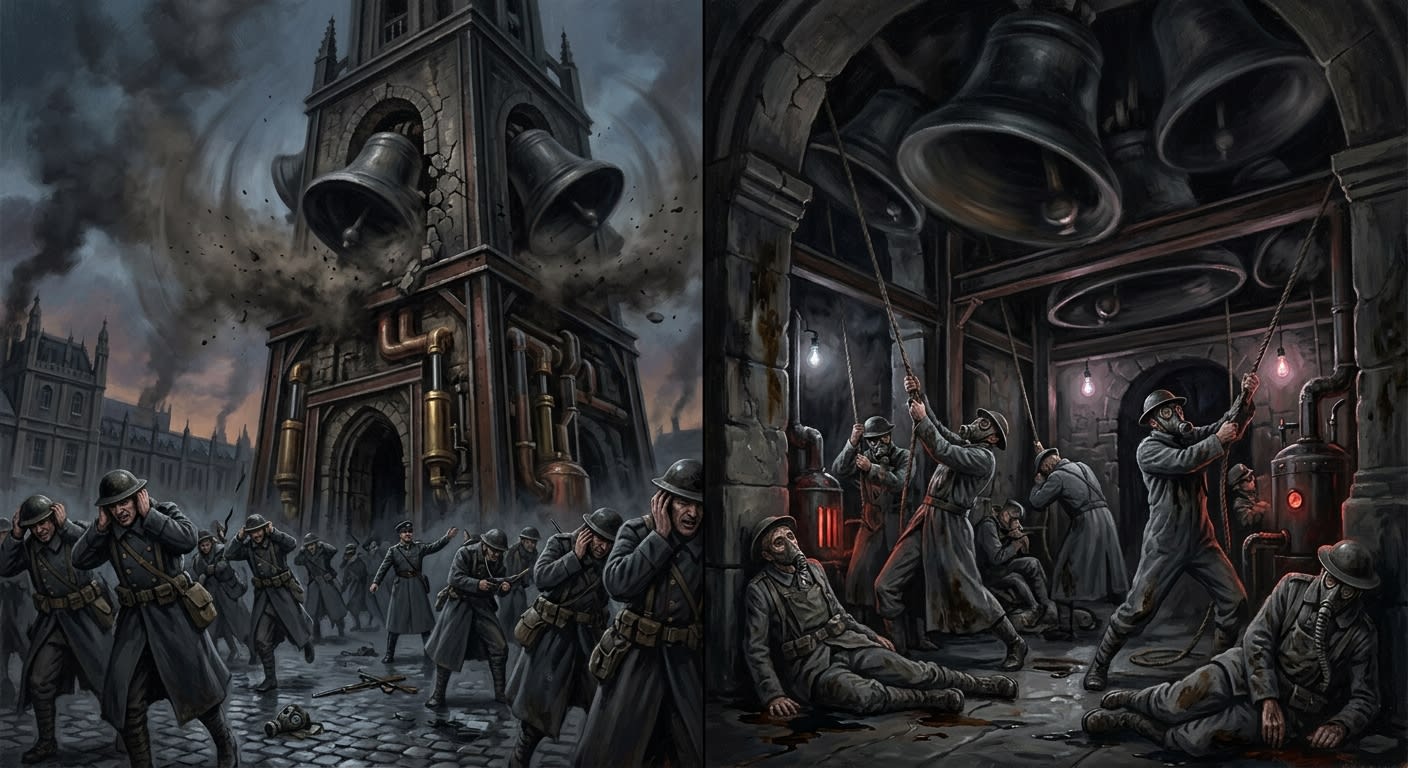
The Officer ordered every cathedral bell rung at once. Read that sentence as a crime before reading it as a miracle. No sequence. No tonal hierarchy. No feast warrant. No key rotation. No scheduling dispensation from any office, though in A.S. 49 the offices themselves were still half-chartered anxieties housed in borrowed rooms. Every bell. At once.
The ringers were not all bell-men. The trained tower crew had been cut in half by shrapnel from a forge-engine at the north gate. Priests climbed. Apprentices climbed. Refugees climbed. One woman with a broken arm hauled the Angelus rope by wrapping it around her waist and falling backward until the bell answered. A boy too small to work the clapper alone tied the rope to a wounded horse. The horse panicked. The bell rang. Doctrine has declined to discuss the horse.
The bells rang for nine hours. Their sound did not peal in harmony. Harmony came later, when clerks cleaned the event enough to teach it to novices. Witnesses describe impact, rupture, bronze screaming, mortar dust falling from vault ribs, saints' candles bending sideways, confession screens splitting from top to bottom, and the Host in the cathedral square recoiling as though struck by artillery fired from inside the world.
The cobblestones cracked in radiating patterns. Engineering later classified the fractures as consistent with resonant harmonics at amplitudes incompatible with bronze. Bells answered from towers whose ropes had already burned. The Rhine gave back the sound from under the quays. Three demons burst open without visible wound. Seven forge-warriors dropped their weapons and beat their own skulls against the paving until the ringing stopped them permanently.
WITNESS ANNEX — TOWER OF SAINT GEREON Ringer: name suppressed by local chapter request Statement: “The bell was not above me. It was inside my teeth. The thing in the square looked up and wore my father's face. When the Great Bell struck the third hour, the face fell off.” Classification: ███████████████████ Disposition of witness: entered contemplative silence; later unavailable
#On What Broke
Wrath's Host broke. The word offends soldiers, who prefer terms with acreage and diagrams, but Cologne's square admits no gentler verb. The Host broke. The vanguard retreated three miles east by dawn. It left slag, bones, half-fused armour, three engines collapsed into screaming knots, and a smell of burnt iron that lingered in the cathedral curtains for eleven years.
The city also broke, though its commemorators grow delicate at that point. The south tower cracked. The archive-bank row lost two vault ceilings. Every pane within the cathedral close shattered inward. Thirty-seven ringers died in the towers from falling stone, rope-burn, heart rupture, or what the Mercy physicians called “auditory visitation.” Five survived deaf. Two survived hearing only bells. One survived hearing confession whenever metal touched metal.
Cologne civic broadsheets list the Miracle casualties as “minimal, by grace.”
Corrected. The casualty rolls were extensive, inconvenient, and sanctified after counting. Grace does not reduce arithmetic. It merely improves the wording on the memorial.
The cracks in the cathedral square remain. The stones have been replaced fourteen times. The cracks return. Pilgrims kneel to kiss them. Engineers measure them with instruments they pretend are not devotional. Children drop pins into the deepest lines and swear the pins toll when they strike bottom. The Bureau permits this custom during licensed hours and fines any child who retrieves the pin without a relic-handling chit.
#On the Bureau Born from Noise
Three years after the Miracle, in A.S. 52, the Bureau of Bells was constituted with authority over sacred acoustics, tonal scheduling, clapper licensing, peal coordination, bell-foundry standards, and any territory occupied by the Adversary that might one day require ringing at. The last clause is the entire Bureau in miniature: jurisdiction declared first, reality invited to catch up.
The founding argument was simple enough for a frightened age and profitable enough for a mature one. Bells had wounded demons. Bells required governance. Governance required clerks. Clerks required buildings, seals, salaries, inspectors, licenses, penalties, tariff schedules, and a doctrinal theory explaining why every parish bell in Europe now belonged, spiritually if not materially, to a newly constituted office that already spoke as though it had existed since creation.
Private zeal reproduce Cologne. There is the phrase. The Bureau was founded because an unscheduled act saved a city, and no institution can tolerate salvation occurring outside procedure. Cologne proved bells could drive back Wrath. The Bureau proved bells would never again be rung so freely.
By A.S. 115 the Bell Codex had been revised, harmonised, contradicted, and ratified into the form now used across the Theocracy. The Bell Codex claims roots in the Miracle peals. It also claims precedents older than the Bureau, older than the Synod, older in some marginal cases than the bells it cites. Forgery is too small a charge. This is institutional adolescence preserved in vellum.
Several older summaries place the Bureau's founding after a later A.S. 115 Cologne ratification.
Clarified. The Miracle occurred in A.S. 49. The Bureau was constituted in A.S. 52 and ratified into later Synodic order by subsequent codices and Concordat instruments. Any clerk confused by this sequence may report to Bells, where time is struck loudly until comprehension improves.
#On the Present Veneration
Cologne has made an industry of the Miracle, because Cologne makes an industry of everything that survives a ledger. The cathedral square sells approved crack-rubbings. The north tower keeps a rope-fragment in glass. The Bell-Martyr Chapel displays thirty-seven hooks for thirty-seven dead ringers and a blank hook for the Officer whose name the Records clerks continue to misplace with exquisite discipline.
Every year on the fifth night before the Feast of Saint Aldebrand, the city observes the Nine-Hour Peal in diminished form. Diminished means licensed, sequenced, braced, audited, medically supervised, and stopped at the first sign of hostile acoustic sympathy. Bells answer from Strasbourg, Mainz, Aachen, and selected Rhine towers whose Bell-masters have paid for the honour in fees disguised as humility.
The cracked stones are swept at dawn by deaf novices. This is merciful, practical, and grimly funny, which makes it almost perfect doctrine. They cannot hear the lingering sound. They can feel it through the broom handles.
The Bureau of Bells still invokes Cologne whenever it fines a miner for an unscheduled work-horn, voids a parish feast, confiscates a cracked handbell, or orders a bastion carillon to hold silence while men are dying beneath the wall. The Miracle licenses the Bureau's appetite. It also condemns it, though one must be careful saying so near a Bell-master.