
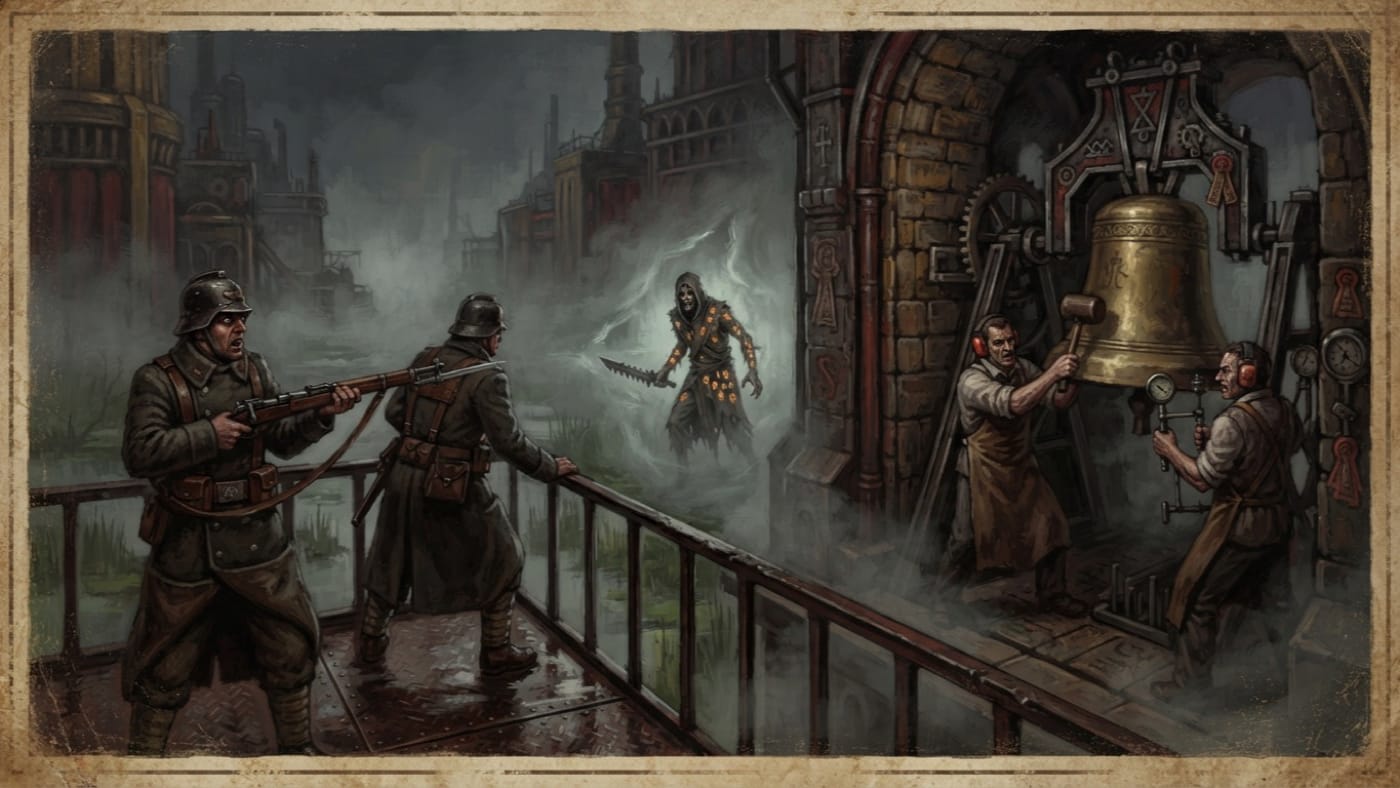
Being a Survey of the Percussive Discipline Kept Against Concealment-Inscribed Infiltrators on the Southern Line, With Particular Reference to Bastion-Shipka
#I. The Sentry Who Saw and Did Nothing
The Church teaches its sentries to look: at wire, at fog, at the faces of strangers. Every failure of looking is filed as negligence, cowardice or heresy, depending on the auditor's digestion. Against most of the Lie's soldiery this training is enough. Against the Veil-Stalkers of the Shadow Court it is a liability, because the Veil-Stalker has been cut and branded precisely to defeat it.
He is mortal. Keep hold of that. He is a starved conscript whose skin carries concealment glyphs, and those glyphs feed on whatever remains of his life. He bleeds when struck. He can be shot. The whole difficulty lies in persuading a man with a rifle that something in front of him deserves shooting.
The Fog-Walk mode, which the dossier assigns to Syrion, makes that persuasion almost impossible. The Fog-Walker projects a somnolence that reaches about an arm's length. The sentry inside it registers the intruder, and the registration leads nowhere. He sees a shape and feels no duty toward it. The knife arrives in the gap between noticing and caring, and the garrison loses a man whose eyes were open, whose rifle was loaded and whose hand was nowhere near the trigger.
Something had to reach past the eye.
#II. Nine Men in a Week
The dossier records the occasion without a year, and I decline to supply one. At Bastion-Shipka, which holds the Shipka Pass above its marsh approaches, the garrison lost nine men in a single week to Fog-Walk Stalkers. No inventor's name survives. The record credits the Bellwardens as a body. That is how Bellwardens prefer to be credited when a thing works, and they would prefer never to be blamed at all.
What they devised was an atonal counter-rhythm: a sharp peal, deliberately off the sanctioned tone, struck at intervals the ear could not anticipate. Bells were nothing new at the Pass. The Office of Bells was constituted in A.S. 52, the current standard of the Bell Codex was ratified in A.S. 115, and Shipka's towers already marked shifts, trains, curfews and pump-changes with tedious exactitude. The novelty was ringing wrong on purpose. The body learns to sleep through a bell tuned to the Codex. It cannot ignore a bell that strikes off-pitch and out of turn.
The practice hardened into regulation. At Shipka it is now governed by Standing Order 44-F, as revised in A.S. 198, and this survey describes the doctrine as it stands in A.S. 201. A.S. 198 is the year of the revision. It is not the method's birthday, and any clerk who cites it as one will have the citation returned with a note in my hand.
#III. What the Pulse Does
Two effects are reported. The Bureau has a habit of blending them, and the habit must be resisted.
The first effect is on the sentry. Against the Fog-Walk, the sharp stimulus jolts him past what the dossier calls Syrion's narcotic threshold. The drowsy indifference breaks. A man who had been regarding a shape with the placid interest of a cow regarding a fence is suddenly a soldier again, with a soldier's opinion of strangers in corridors.
The second effect is on the Stalker. A sharp, non-standard pulse disrupts the resonance of the concealment glyph-field, and the concealment flickers. The dossier puts the flicker at perhaps two seconds. For that interval the Stalker can be seen: the gaunt frame, the scars of inscription, the blade.
That is the whole of the reported mechanism. I have read the alchemical clerks' theories of why a wrong note should trouble a glyph. I will not reproduce them, because none has been ratified and several were plainly written after dinner. The pulse is no ward. It buys an opening of roughly two seconds, and the opening is worth exactly what the sentry does with it.
The file also does not show that every pulse exposes every Stalker, and it gives the flicker no fixed reach from the bell. No efficacy table exists for the five concealment modes. Officers who call the counter-rhythm a cure are speaking from enthusiasm, a condition the Bureau of Purity has not yet classified.
#IV. The Order As Administered
Standing Order 44-F forbids any Shipka sentry to stand post longer than ninety minutes without percussive stimulus. The duty Bellwarden administers the stimulus as three sharp peals at non-standard intervals. Ninety minutes is a ceiling: the longest a man may go unrung. It is not a shift length, and the clerks who tried to draw rosters from it produced rosters of singular stupidity.
The dossier records a separate practice. Dedicated Bellwarden teams at Shipka pulse at seventeen-minute intervals through the night watch. A careful reader will object that a seventeen-minute cycle is regular, and an irregular peal cannot keep a timetable. My reading is this. Each check falls on its cycle, but the three peals inside it are spaced off-pattern, so the ear expects a summons without being able to predict its shape. That is an interpretation. The file does not give the gaps, and I will not invent a peal chart to flatter it.
The operators are licensed Bellwardens, and they bring their whole trade to the work. They carry the toll-key on its chain and tuning forks to tell clean tone from deliberate filth. They work with tension gauges, strike mallets and chalk pitch-marks on the bell's lip. They also keep a calibration log, and every deviation goes into it. A Bellwarden who rings wrong and fails to log it is a saboteur. One who rings wrong and logs it is obeying orders. The bell cannot tell the difference. The ledger can.
The counter-rhythm is deployed at every bastion south of Bastion-Przemyśl: Sibiu, Irongate, Shipka and Constantinople. The seventeen-minute cycle is Shipka's reported practice. I have seen no evidence that the others keep the same clock, and I decline to give them one.
At Shipka the practice has revealed Stalkers on four occasions. Revealed is the dossier's word, and I keep it. Whether any of the four was taken, killed or merely glimpsed before the glyphs closed again is a matter for other reports.
It has also revealed rats, stray dogs, one sleepwalking chaplain, and a quantity of contraband personal effects. The Bureau of Purity seized the contraband with an energy it seldom brings to the enemy. The rats carried no glyphs. Neither did the chaplain. His explanation is on file.
#V. The Price of Being Rung
The counter-rhythm makes sleep impossible for everyone within earshot. The Bureau of Bells calls this "an acceptable secondary effect." I record the phrase with the reverence due to any sentence written by people who sleep elsewhere.
Consider the night at a bastion whose bells already ring for trains, pumps, curfew and prayer. On top of that clamour the counter-rhythm adds three wrong notes every cycle until dawn. Off-watch men lie in their bunks and count. So do the pump crews and the children of the rail quarter. A garrison kept from drowsiness by being forbidden to rest has achieved a kind of vigilance, and the infirmary records which kind.
The Bellwardens pay with their bodies. Their trade has always carried hearing loss, tinnitus, rope burns along the forearms, and the bell-sickness in which a warden hears peals no tower has struck. Compulsive counting is a known tell of the profession. I cannot divide these injuries between the counter-rhythm and the ordinary schedule, and no Shipka surgeon has tried. I note only that striking discords all night on a bell one has spent years keeping in tune cures none of them.
The marsh adds its own malice. Shipka's reports describe muffled bells and sound that arrives later in the fog than it should. A pulse that reaches the sentry late may reach him after the knife. Shipka's choir-broadcast wake-hymns are a separate instrument with their own uneven trials, and their failures are not to be charged to the bell. Nor is the counter-rhythm to be confused with counter-toll, which answers an enemy-seized command peal with a louder authorized one. The two share a syllable and nothing more.
The other countermeasures cover different ground rather than the bell's failures. Ash-dusting records where a body walked, but the Mirror-Fade leaves no print in soft ground. Reliquary Proximity Wards make glyphs flare within three metres of a relic. The Ravelin of Sorrow at Constantinople keeps one relic to every eight metres of corridor, a spacing that still leaves gaps, and the Bureau of Tithes charges for every bone. The bell is cheap. It is cheap because the garrison pays in sleep, and no one invoices the garrison.
ERRATUM (Bureau of Records, A.S. 199, applied to this survey): Shipka watch-reports that refer to "volunteer Stalkers" are amended in line with the Third Revision of the parent dossier. Inscription is classified as conscription under duress, Category 7-F. The sentry is still to fire.
#VI. Verdict
The counter-rhythm is retained. It has shown four Stalkers to the men they came to kill. In exchange it has cost the southern Line an uncounted quantity of sleep, hearing and temper. The Bureau of Bells accepted that cost on the garrison's behalf and judges the bargain favourable. The Bellwardens were not asked.
Duty Bellwardens will ring within the ninety-minute ceiling. Sentries will look when the bell is struck. Complaints will be filed where Standing Order 44-F directs.