
#I. On the Principle of Dust
"Ask the floor. The floor has no reason to lie." — chalked above a gallery door, Bastion-Brest
The Synod has raised many instruments against the Veil-Stalkers: the reliquary niche, the counter-rhythm bell, the paired checkpoint, the sealed finger-bone of a saint nobody outside his diocese remembers. Measured by the coin, the best of them is a sack of ash and a plank. I record this with some reluctance. My office maintains four thousand pages of doctrine on the discernment of spirits, and nobody at Brest needed any of them. They needed a broom.
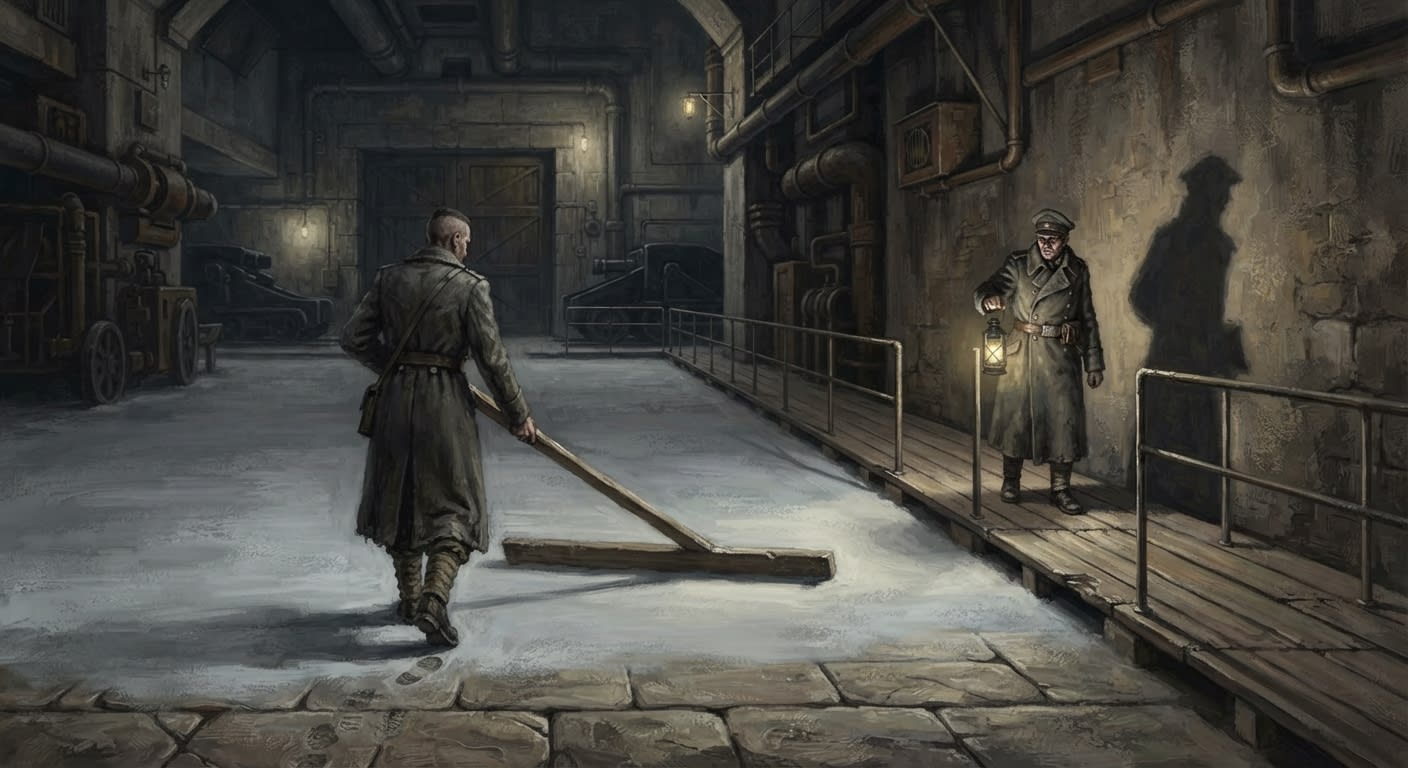
The principle fits on the back of a ration chit. A Veil-Stalker's glyphs quarrel with the eye and leave the ground alone. He can slide past a sentry's notice the way a stain slides past a housemaid's. He can flatten himself against the underside of a gun-carriage, or walk inside a pocket of borrowed drowsiness, or show the man at the door his own wife's face. He still weighs what he weighs. He still has feet, usually bare and often cut with sigils on the soles. When those feet cross a floor laid with fine pale ash, the floor keeps the receipt.
Ash-dusting does not reveal the Stalker, and cadets are made to copy that sentence twice. What it reveals is that something passed: a print, a scuff, a smear where a heel turned, a break in the board's smoothing-lines. The ash testifies to displacement and says nothing about where the thing is now. Everything useful about the practice follows from that limit, and so does everything disappointing about it.
#II. On Standing Order 88-H
"Lay it thin. Lay it even. Leave backward." — sweepers' rule, Casemate Galleries
At Bastion-Brest the practice is governed by Standing Order 88-H. The bridge obeys it the way it obeys everything, in duplicate, under seal and against a signature. Before the night watch, sweeping details go down into the Casemate Galleries, the service passages under the Confessional Lanes, the stair-heads of the Pylon Warrens, and the threshold of every chamber where an officer sleeps beside his fire keys. At each station they break the seal on a numbered sack, sign the number into the watch register, and scatter.
Scattering is the easy part. Then comes the board, a planed plank drawn across the ash until the layer is thin enough to show a cat's toes and pale enough against wet stone to be read by a shuttered lantern. The sweepers withdraw walking backward and smooth out their own prints as they go, so the last mark left on the layer belongs to the board. The corridor is then closed. Anyone with lawful business there before the dawn bell keeps to a marked plank-path along the wall. A second detail sweeps behind him, and its only duty is to erase the first.
Patrol readings follow at intervals the order leaves to the watch officer. A sentry with a lantern walks the plank-path and looks at the floor, and that is the whole rite. He is looking for anything the board did not put there.
By the garrison's register, 88-H has detected fourteen penetration attempts since A.S. 190. Eleven Stalkers were intercepted before they reached their targets. Where the register names those targets, they run to type: artillery officers, powder clerks, signal staff, Bellwardens. These are the men whose absence throws off a barrage or opens a gap in the bells. The other three were intercepted afterward.
The text of the order has travelled. Copies hang in the lower galleries of Bastion-Irongate, where threshold-dusting was drilled into Sergeant Elke Voss's generation along with the inspection of gun-shade and stair-angle. Irongate calls it 88-H too. Brest regards this as plagiarism, and would take the fact that nobody has challenged it as a compliment if Brest took compliments.
#III. On Procedure and Contamination
The worst enemy of ash-dusting is the garrison. A bridge holding fourteen thousand souls produces footprints the way the Bug produces mist. Clerks cut across closed galleries to reach the latrines. Runners forget the plank-path. A chaplain carrying the viaticum to a dying gunner goes wherever the gunner happens to be dying. Rats walk on everything and are sworn to nothing.
Every one of those marks has to be read, argued over and entered. At Brest the argument happens at a folding table in the gallery, with the lantern set on the floor and the watch officer presiding like a tribunal of one. The reading has a grammar. Bureau-issue boots leave a square toe, a nailed heel and the weight of a fed man. A Stalker's print is usually bare and narrow, and shallow in a way that unsettles the sweepers, because it carries the weight of a starved conscript with a knife and nothing else. Where the soles are inscribed, the ash sometimes takes the glyph-cuts as faint hatching. Stride also tells. A clerk walks straight to where he is going. A Stalker hugs the wall and stops at doors.
The ash witnesses against its keepers as readily as against the enemy. A man whose print turns up off the plank-path is held where he stands. His boot is pressed into a tray of ash beside the mark, and both impressions are compared under the lantern while he waits. Sweepers are suspects by trade. One who steps wrong while withdrawing has spoiled the layer, and one who spoils it twice has invited questions about why. A sentry who reports a track and then walks across it in his hurry has destroyed the only evidence the night produced, and the evidence was the reason he was standing there. The Purity inspector who collects samples for custody sometimes destroys it as well, and on those nights the register records the spoilage in a smaller hand.
#IV. On Limits
The Polish lowlands are wet, and wet ash clots. It clings in grey paste to boots and stone, where it records nothing except the humidity. On nights when the Bug breathes hard, the Casemate Galleries sweat and the layer has to be re-laid at mid-watch, which puts the sweepers back on the floor they were meant to have left. The open deck of the Ribwalk cannot be dusted at all. In convoy season, when families sleep between the guns, no layer lasts the hour. Panic is harder on it than rain. A garrison that has learned to fear the Stalker will run at the first reported print, and forty boots arriving together can turn a clean trail into a drill yard.
Then there is Mirror-Fade. The parent entry records that a Stalker in that mode leaves no impression in soft ground. Ash is softer than any ground. Some watch officers claim secondary tells: ash lifted at the edge of the Stalker's forty-centimetre field, a faint drift where nothing stepped, a line of scatter along the wall. The Bureau of Alchemical Standards classifies these as "unverified atmospheric disturbance." The register cannot say whether any of Brest's fourteen was a Mirror-Fade, because the register records prints and Mirror-Fade leaves none.
ERRATUM (Bureau of War, Tactical Intelligence Division): An earlier circular said ash-dusting "detects all known concealment modes." That is amended to "detects physical displacement by Peripheral Erasure, Shadow-Binding, Fog-Walk and Desire-Cloak variants; efficacy against Mirror-Fade unestablished." The earlier wording was the Division's. The confidence that went with it has been withdrawn.
The three late detections at Brest need no theory to explain them. In each case the trail ran from a stair or doorway the layer did not cover, crossed the dusted threshold of a sleeping man's room, came back out, and ended where the order's jurisdiction ended. The floor gave a complete account of the killing, and it gave it at dawn.
#V. On Ash, Relics, and Cost
Other methods are better, and cost more. At the Ravelin of Sorrow at Bastion-Constantinople, Bureau of Relics wards stand one to every eight metres of corridor. Concealment glyphs flare within three metres of a sealed bone. No Stalker has confirmed a penetration there since A.S. 196, and the ward density has tripled since then. The Ravelin still dusts. After the evening peal, two orderlies scatter blessed ash across the under-gallery floor, smooth it with boards and withdraw walking backward. A fortress with saints in its walls still does not trust the saints to cover the stair behind the latrine.
The bells cost something else. At Bastion-Shipka, under Standing Order 44-F as revised in A.S. 198, Bellwardens pulse at irregular intervals through the night watch. Each peal makes a glyph-field flicker for about two seconds. Each also wears down the Bellwarden who rings it and every sleeper within earshot, and the Bureau of Bells would rather not account for its exhausted men in public.
Ash costs labour, humiliation and paper. Even so it is not cheap enough to escape quarrels. The layer has to be blessed ash, and no Bureau agrees on who blesses it, who owns it, or where it comes from. War wants it drawn from quartermaster stock. Purity claims custody of anything swept from a crematory floor. Tithes wants it valued against the Ash Banks. Relics insists, loudly and correctly, that it must never be confused with certified saint-dust, which costs more than the officers it protects. None of them has settled the composition. What the sweepers care about is simpler: that it is fine, dry, pale against the stone, blessed, sealed and signed for. Purity has found sacks at Brest that were blessed on paper only. The prints showed up in them just the same, which Doctrine has asked me not to discuss.
#VI. The Verdict of the Floor
The Synod keeps its saints in niches and its bells in towers. At night, some of its survival rests on floors. A frightened sentry will swear to a face, a shadow, a cold draught or a Stalker in every corner, and the next morning he will swear to something else. A swept floor attests to exactly one thing, that weight passed over it. It has never been bribed, it has never been tempted, and no board of inquiry has made it revise its testimony.
The sweepers at Brest are paid less than the scribes who log their readings. I set that down without comment.