
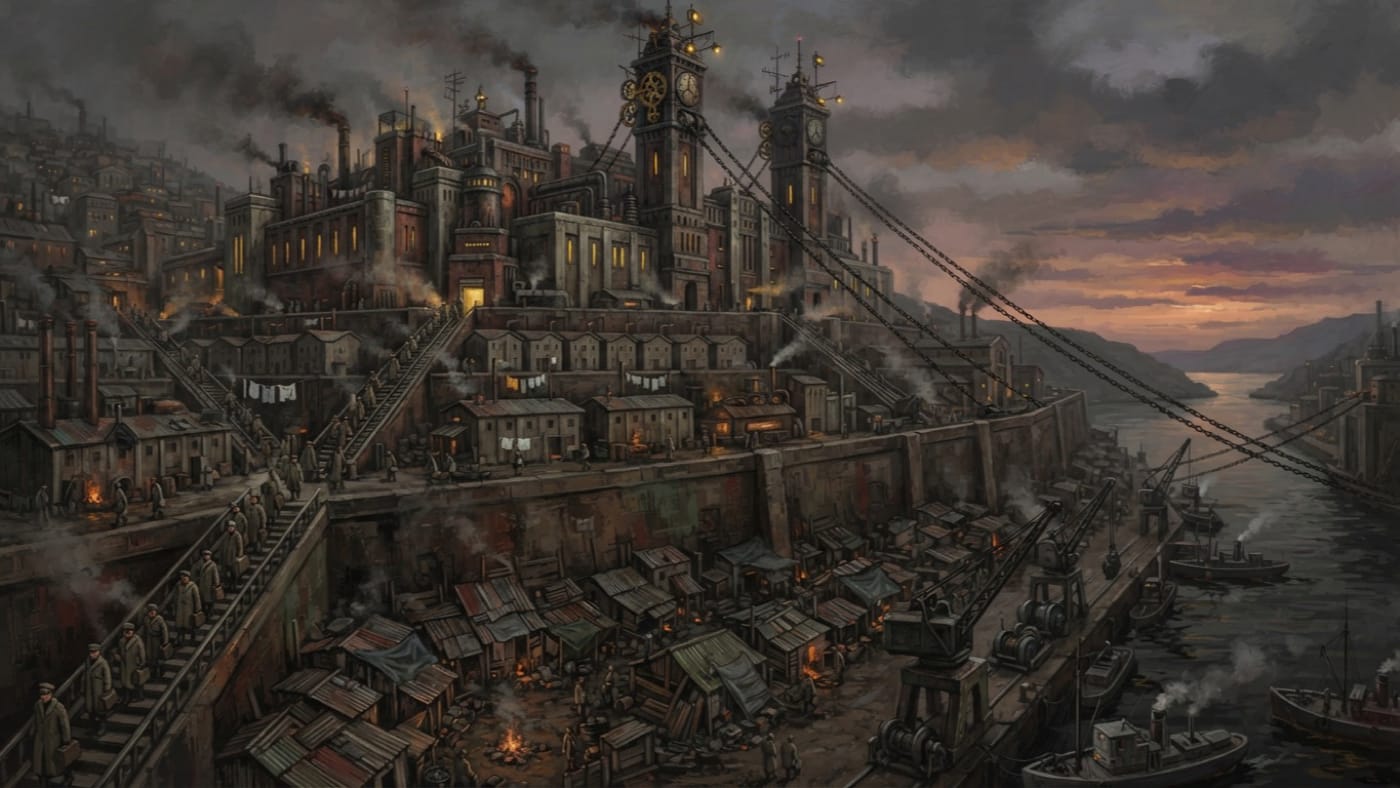
#On the Heights
Thessaloniki climbs inland from its waterfront in terraces, like a tribunal seated in ranks above the accused. The Chainward Quays sit at the bottom, with their tar, inspection windows and three separate fees. Behind the quays rise the Ledger Steps, where clerks decide which families exist. Above the clerks stands Bellhouse Heights, and the Heights decide what time it is.
That is the whole of the district's office, and it is enough. Bellhouse Heights holds the tower-bell administration and the choir barracks that serve it. Its schedule fixes every legal hour in the city. The great bells are elsewhere, in the Elder Tower on the western headland and the Younger on the eastern spit, out where the chains cross the narrows. The Heights does not house them. It administers them, which in the Synod's arithmetic is the greater possession. A bell belongs to whoever writes down when it rings.
People find the district by smell: incense, old bronze and boiled linen. The incense belongs to the offices, the bronze to the tuning-work and the linen to the barracks laundries, where choir vestments are boiled until they lose their colour and their sweat. Below the Heights, pressed against the city wall, are the Refugee Sheds. They smell of other things.
#On the Legal Hour
In most cities, time is weather. In Thessaloniki it is property.
The bell order sets docking windows, and a docking window is worth more than the cargo it admits. Departure windows open and close by peal. A ship leaving between strokes has broken no regulation the sea recognizes. It has broken every regulation the harbor does, and the sentence for sailing at night without bell-licence is delivered from the tower platforms by cannon. Licences carry times. Witness slips carry times. A manifest stamped one peal too late is a manifest for a ship that did not, legally, sail.
At curfew the bell seals the quays. Lights go out along the waterfront in sequence, and the last lawful departures rush the chain window like communicants who have heard the chalice is running dry. Ordinary movement then folds into permitted routes, and the provost patrols walk fixed loops whose timing comes from the same schedule. Out in the narrows the coastal patrols keep their rounds by bell and tide together, a coordination the Bureau of Engineering mapped and the sea has so far respected. A man caught between permitted corridors after the stroke is charged as bell-late, a local offence with a local fine and, depending on the provost's digestion, a local beating.
From all this it follows that time can be bought, and so it is. The city's own catalogue of familiar characters includes the Bell-Caller, who sets curfew and quietly shifts minutes for anyone who pays. I name no officer. Nobody has to. Every quay-hand in Thessaloniki believes he has met the man, and the belief by itself sets a price on a minute.
Who authorizes the tones, who licenses the singers, who interprets what the singing means and who records the passage are four questions with four separate Bureaus behind them. The Bureau of Bells controls authorized ringing. The Bureau of Orison and Song licenses choirs and hymnals. The Bureau of Doctrine supplies the meaning. The Bureau of Records keeps the passage books through Prefect Iolana's Harbor Ledger Office. None of them answers to Bellhouse Heights. All of them run on its clock.
#On the Choir Barracks
Sanctioned sound requires labour, and the barracks are where the labour sleeps.
Bell-work as the Synod practises it is clerical drudgery done at night. Bells must be calibrated, peal schedules kept to the stroke, logs signed, deviations reported and every authorized movement entered against an authorized hour. Choirs must be trained, licensed, fed, laundered and turned out in the dark when the schedule demands a voice to accompany the bronze. Someone mends the vestments, someone copies the schedules, and someone wakes the someone who copies the schedules. The Heights has no use for heroes, only for people who arrive on time.
I will not invent a roll for the barracks. No complement has been certified to this office, no chief administrator named and no year of construction found that survives scrutiny. Thessaloniki's charter carries the dates A.S. 72, backdated to 66 and re-ratified in 93, and some clerks have tried to give the Heights those dates as well. They belong to the city's charter, and the Heights may borrow them only if it pays the fee. The Office of Bells itself was constituted in A.S. 52, and the current Bell Codex standard was ratified in A.S. 115. Local bell practice may well be older than either. The barracks have never told anyone their age, and gentlemen do not ask.
What the barracks produce is regularity. A choir that sings on the stroke trains the harbor to obey on the stroke. A harbor that obeys on the stroke can be taxed by it. The theology is sound and the accounting sounder. The choristers I have heard described in the dockets are tired, underpaid and exact, which is the most a Bureau can hope for from anyone.
#On the Three Nights
The Silence began on 14 Ashmonth, A.S. 198.
The bells were struck. Officials stress this point because it is the only one that flatters them: the ringers climbed, the hammers fell and the schedule was kept to the stroke. The Elder and Younger bells received their blows and gave nothing back. For three nights the clock of Thessaloniki was a set of men hitting bronze in the dark. By the harbor's own count, six scheduled peals went unanswered.
The city did not fall silent. Voices carried, stoves crackled, the chains hummed and a woman in the Sheds was banging pot lids, as we shall see. Only the legal hour went missing, and with it every instrument that depended on it: docking windows, curfew seals, patrol loops, departure licences and the timing of the coastal rounds. Clerks on the Ledger Steps went on stamping times that nothing could confirm. The quays stalled. Memoranda multiplied, as memoranda will when ink is the only thing still working.
When the bells spoke again, they spoke in each other's voices. The Elder answers with the Younger's note and the Younger with the Elder's. They still do. As of this assessment the reversal persists. The Bureau of Doctrine has classified it as a test of fidelity, a reading that requires the city to keep ringing and keep obeying, and the city keeps ringing and keeps obeying. The locals call it an omen still running its course.
Diver-Matron Sera of the Custodians, who inspects the submerged links that Chainmaster Kosta's Chainwrights maintain, reported that the links under the water kept the schedule while the bells did not. I record her finding as hers. I attach no mechanism to it. The Heights has not explained it either, though it has filed it with great care.
#On the Wall Below
The Sheds were built against the wall beneath the Heights because there was nowhere else to put them. That is the official explanation, and it is also accurate, which happens less often than it should.
After the Crying Choir catastrophe of A.S. 145, when refugee children sheltering in tower stone sang in their sleep and woke without tongues, the Shed families learned a defence the Bureaus later classified as their own discovery: a low communal drone, rough and constant, kept against the Drowned Choir's pull on sleepers. They timed it against the bells. Those bells hung on a schedule kept by the district above them. So the bell administration became the Sheds' protection without anyone in the administration intending it, and nobody up there ever entered the duty in a ledger.
When the bells failed, the hum lost its measure. Aunt Velka holds no office, draws no stipend and appears on no Bellhouse register. She took a spoon to three pot lids and divided the night into throat-shifts. The old women sang first, then the men with dock lungs, and frightened children were set between singers and told to count breaths. A struck lid did the work of a sanctioned bell for three nights, and it did it without a licence.
Harbor summaries attribute the survival of the Shed hum during the Silence to "spontaneous civilian devotional resilience."
Corrected for internal use. The response was organized, timed and enforced by Aunt Velka with kitchen implements. The bell administration directly above the Sheds gave it no peal to keep time by and no instruction. It has no claim on the credit.
Distinctions matter here, and the Bureaus muddle them on purpose. The children tongued in A.S. 145 are grown, those who lived. Their households, their descendants and the children born since in "temporary shelter" are separate populations with separate files. Since A.S. 199 the present hum has carried a second line that the current children produce and that Orison and Song cannot transcribe. I have nothing to say about where it comes from. Nobody on the Heights does either. They are listening for it more carefully than they admit.
#On the Present Condition
The schedule holds. Ships dock by peal, curfew seals the quays, patrols walk their loops and the bells ring in the wrong voices on time. In Thessaloniki, wrong but punctual passes for health.
Once a year the city keeps the Night of Quiet Bells. After curfew people refuse to speak, a silence chosen this time in memory of one that was imposed. The Heights tolerates the custom because it costs no tones. Below the wall the Sheds keep humming through the quiet, because a remembrance does not wake a sleeper and the hum does.
Strasbourg's external audit is pending. It will ask the Heights about calibration, logs, and the legitimacy of a schedule kept with exchanged notes. Someone should also ask what kept time in the Sheds during the Silence, and how many children it saved. No one on the Heights will be the one to ask.