
#On the Sea That Requires Paper
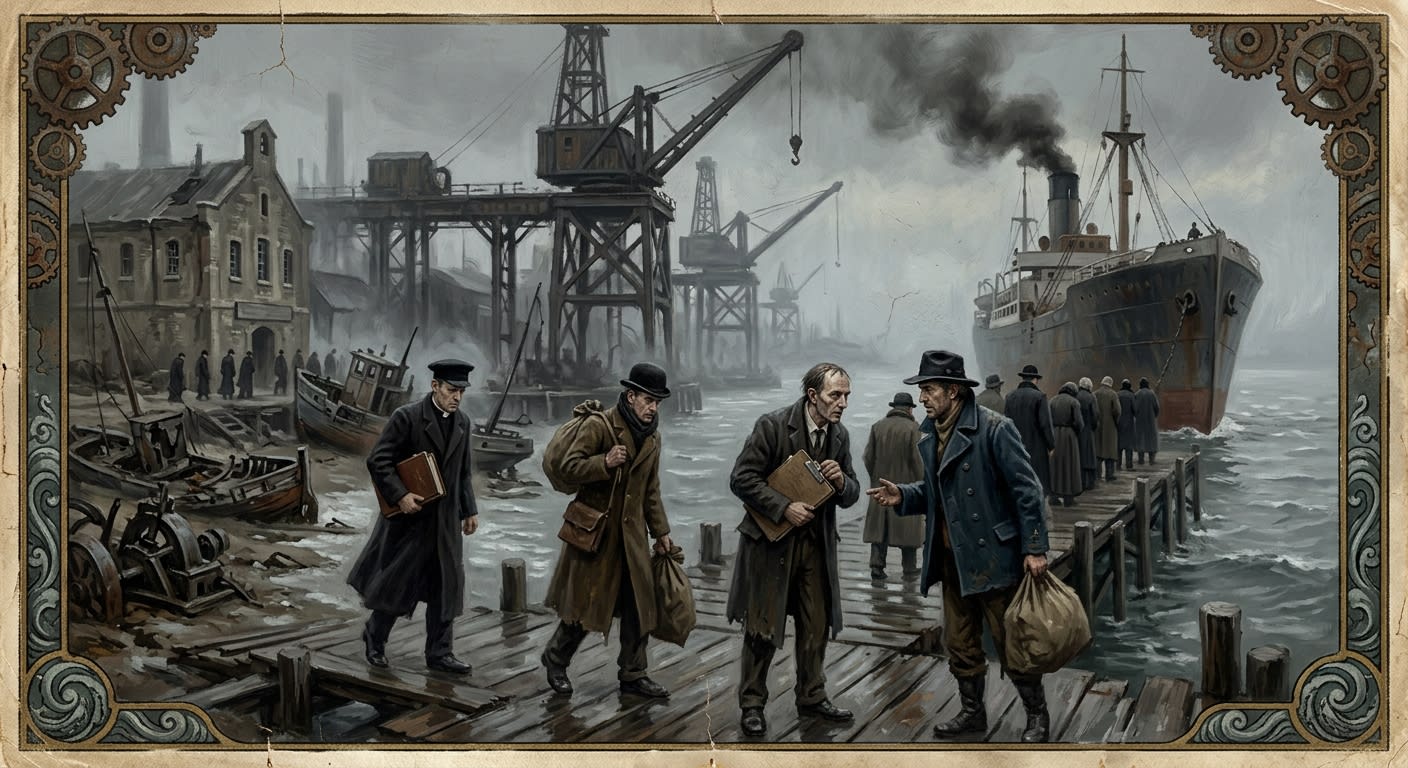
The Aegean is the Synod's southern salt-ledger: a sea, a supply lane, a pilgrim road, a smuggler's chapel, a drown-office, and a theological insult with gulls. It is filed under Zone 7, Southern Coast (Unregistered), which suggests adjacency, service, and a harmless blue strip along the map's lower edge. Cartographers are licensed liars. The Aegean refuses the map-edge. It is a mouth.
Every convoy feeding the southern flank tastes its brine eventually. Grain leaves Marseille dry and arrives under the Thessaloniki Harbor-Chain Towers damp with psalm-vapour, stamp-wax, and the suspicion of sailors who have slept badly near singing water. Pilgrim vessels pass under chains that glow at night. Ammunition barges wait for bell-windows. Quarantine cutters nose along the littoral like sniffing dogs. The Sister Trenches receive shells, rifles, brine masks, priest-cadres, replacement boots, and men whose mothers have been told coastal duty is safer than Line duty because someone in an office believes drowning is gentler than artillery.
The Aegean matters because the Sagittal Line extends past dry stone. It runs through passes, bastions, trenches, chains, bellways, harbours, tariffs, ship manifests, and those wet intervals where the Enemy learns that coast is merely battlefield with reflections. The Synod holds the southern coast by locking inlets, fortifying quays, counting hulls, blessing chains, licensing pilots, confiscating songs, and pretending that water respects jurisdiction because the paperwork says so.
#On Thessaloniki, the Chainmouth
Thessaloniki is the Aegean made bureaucratic. Two towers rise from the narrows, Elder and Younger, with reliquary chains stretched between them in arcs of consecrated iron. A ship passing beneath is counted by chain-hum, bell-sequence, Harbor Ledger, Purity inspection, garrison witness, dock tithe, arrival confession, and the private judgment of every dockman who knows which crates ring when struck. The sea enters the port as water and leaves as paperwork.
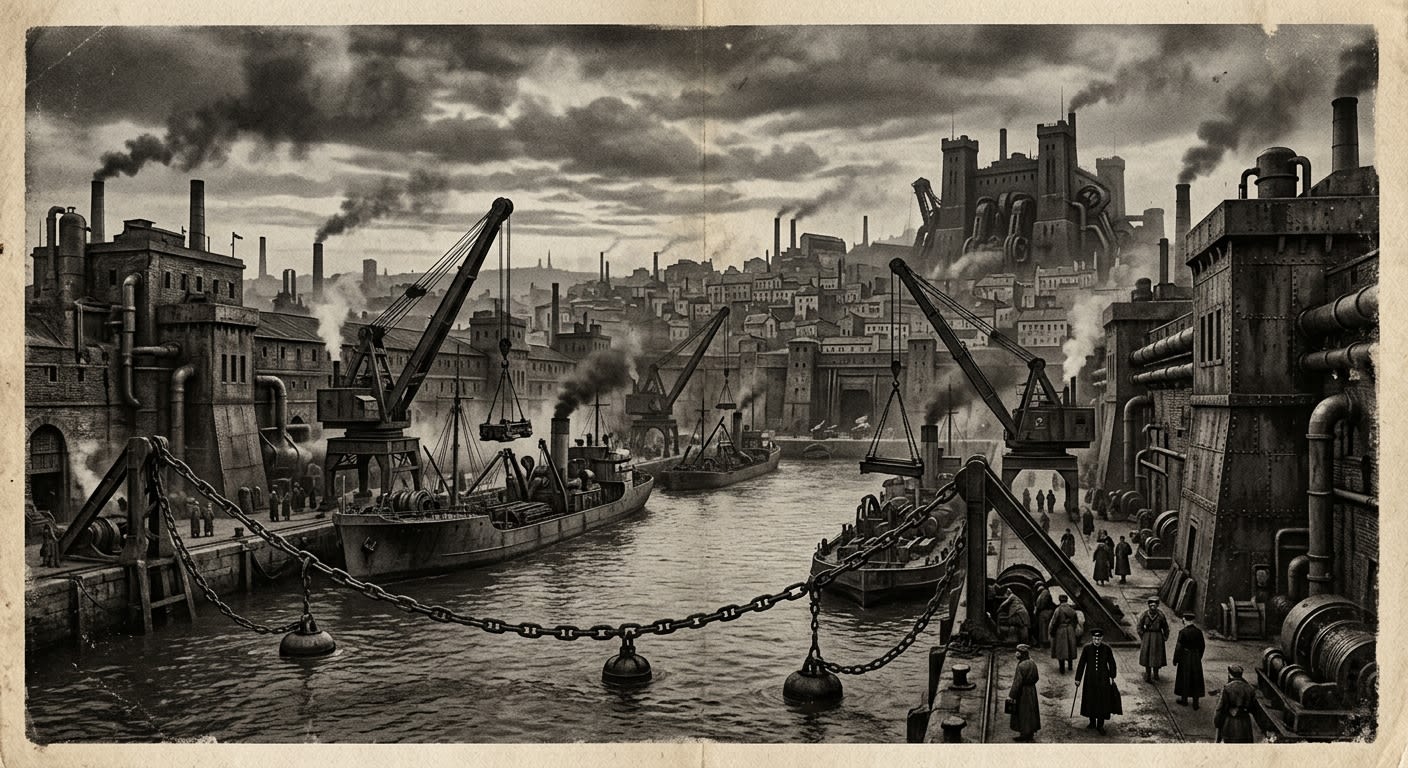
The city was already old when the Sundering cracked the east in A.S. 45 and gave the coast new reasons to fear low tide. The formal harbour-chain charter belongs to A.S. 72, backdated to A.S. 66 for theological precedent and re-ratified in A.S. 93 after the original was discovered to have been signed in invisible ink. That sentence contains everything worth knowing about Synodal coastal rule: the danger was real, the response was necessary, and the paperwork lied until it became true.
Earlier southern shipping guides describe the Aegean gate system as “maritime hospitality under Synodal protection.”
Corrected. Hospitality gives a guest a cup. Thessaloniki gives him three queues, four fees, a medical stamp, a chain-window, an arrival confession, and a clerk who can pause his name until the bribe learns manners.
The Chainward Quays stink of hot tar, fish-gut, wax, wet rope, and human compliance. Behind them rise the Ledger Steps, where Harbor Prefect-Archivist Iolana keeps the city's legal breath moving. Above them, Bellhouse Heights imposes hours upon a population that has learned to hear policy before sunrise. Below them, Drowned Row sells passage, lies, demon-glass, and the sort of salt-black wisdom Bureaus later purchase under seal and call intelligence.
Thessaloniki's population hovers around two hundred and eighty thousand, though the figure swells with refugees, rotated garrison men, sailors, quarantine cases, under-quay runners, and persons whose legal existence depends on whether the day's ledger has forgiven them. The city feeds the southern Line. If the Chainmaster closes the gate, the trenches starve in a week. If Iolana suspends stamps, the harbour fills with lawful cargo that cannot legally exist. If Pilot-King Nenos refuses fog passage, every licensed captain remembers that law has no hands on a blind sea.
#On the Sister Trenches and the Grave-Tide
One to two days from Thessaloniki, the Aegean stops pretending to be route and becomes wound. The Sister Trenches, Elder and Younger, cut the coastal shelf where Thracian bluffs descend toward the surf and where the Line is held by sandbag, seawall, saint-bone, rust hymn, and the stubbornness of men ordered to rebuild what drowned them yesterday.
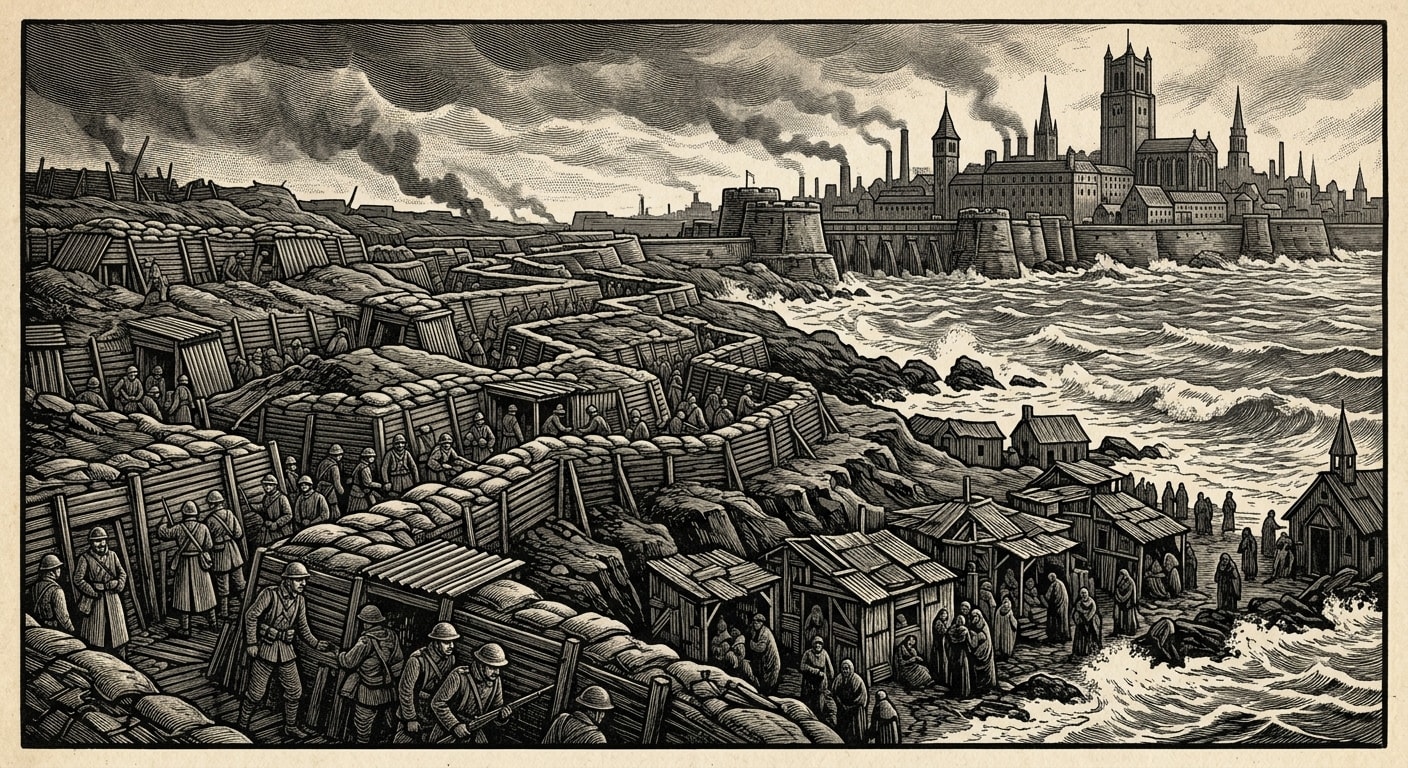
Between the trenches lies the Womb of Salt, called the Grave-Tide by soldiers because soldiers enjoy naming accurately when no officer is close enough to punish them. Twice daily the sea audits burial. Bodies interred in morning sand return at dusk. Teeth collect in drains. Tags arrive with no bodies. Bodies arrive with future tags. The Bureau calls this discipline. Rationalists would have called it erosion, had the coast not eaten most of their laboratories and several of their more lyrical pamphleteers.
The trenches date to the same hardening of the southern harbour-chain system that made Thessaloniki indispensable in A.S. 72. They have been restored so often that restoration has become their architectural style. Younger collapses more often. Elder lies more convincingly about it. The local rite, the Hymn of Rust, began as maintenance and became liturgy by the usual holy route: necessity, tune, inspection, toleration, doctrine. Each evening companies strip rifles, name flakes of corrosion as hours added to the Line, oil bolts, check masks, curse salt, and pretend the surf is only surf.
Wrathforged raids come low through black channels when the tide thins. Their armour hisses where spray hits heated plates. Their hammers glow under fog. The trenches answer with rifles, chain-shot, bell-timed mortars, and filthy singing against the Drowned Choir beneath the water. The reports file most such assaults under Maldrake's pressure. This is useful for artillery and insufficient for confession.
#On the Choir Below and the Bells Above
The Aegean sings. This is no poetry. Poetry is the lie by which harmless men make danger decorative. The Drowned Choir is a Category Three Harmonic Anomaly under Thessaloniki's chains, investigated since A.S. 121, revised after the A.S. 145 Crying Choir incident, cross-filed with the A.S. 198 Silence, and still unsuppressed because killing everyone who hears it would inconvenience shipping.
The first complete file records twelve sailors walking into the surf after hearing their names sung from below. The Crying Choir of A.S. 145 stripped tongues from refugee children sleeping in the Harbor-Chain Towers. The Silence of Thessaloniki in A.S. 198 stopped both surface bells for seventy-two hours while submerged chain-links continued vibrating the correct bell-schedule beneath the harbour. On the fourth dawn the bells returned with exchanged voices: Elder ringing Younger's note, Younger ringing Elder's. The reversal persists. Doctrine calls it a test of fidelity administered by mechanisms beyond current doctrinal scope. I helped polish that sentence. It gleams because it has no blood on the outside.
DIVER-MATRONATE (Unregistered) PRIVATE NOTE — POST-SILENCE REVIEW Chain-link vibration maintained dawn-and-dusk sequence during surface failure. Corrosion marks after third night resembled fourteen names later entered in Kosta's hidden ledger. All fourteen persons alive at time of inscription. All fourteen drowned within the year. Recommendation: do not let Records see the second copy.
The approved countermeasures are ugly and useful. Maintain communal hums in the Refugee Sheds. Strike bells on schedule even when bells misbehave. Keep chain-windows short. Confiscate name-slips held under tongues. Forbid sleep aboard fog-moored vessels. Record sleep-singing without transcription. Do not answer the Choir.
That last rule is older than the file. Chainwright apprentices learn it before safe tensioning. Pilots learn it before bribe scales. Refugee aunties hiss it at children who wake humming too clearly. To answer is to accept the offered note. Those who accept usually report relief first, then perfect sleep, then absence. The bodies, when recovered, look peaceful. Peace in Thessaloniki is evidence.
The Bureau of Bells treats hostile peals as routing weapons, and the Aegean has made specialists of everyone with ears. Counter-Toll practice along the coast is harsher than inland doctrine because fog carries borrowed cadence, chain hum complicates source, and water repeats sound without respect for authority. A Counter-Toll Operator posted to a harbour platform answers more than foreign bells. He argues with weather, hulls, gulls, surf, dock chains, smuggler horns, and whatever learns the schedule beneath the water.
#On Pilgrims, Contraband, and Clean Passage
A pilgrim route is a smuggling route with better hymns. The Aegean proves this daily.
Pilgrims move from western ports through Marseille, Genoa, Venice, Saffron Bastion, Thessaloniki, and onward toward shrines whose names change depending on which office sells the permit. They carry relic petitions, saint-bone dust, fever, contrition, counterfeit indulgence slips, and the astonishing confidence of persons who believe a stamped itinerary can impress demons. Bureau of Pilgrimage vessels sail with licensed chaplains and unlicensed arrangements. Bureau of Tithes counts the cargo twice. Purity boards at noon when spectators are plentiful. The under-quays unload at night when the moon has accepted its fee.
Demon-glass flows through the same water. So do black diesel, unsealed relic particulate, blank vellum stock, stolen hymn-vox devices, false quarantine exemptions, foreign bells in crates marked farm tools, and corpses travelling with papers more persuasive than their faces. The Maskwright Lanes of Thessaloniki mount legal trench lenses beside illegal panes because the Bureau of War needs masks that work and Purity needs arrests that can be seen. Both needs are met. The Synod calls this contradiction enforcement.
Clean passage is the Aegean's great temptation. A clean stamp, a warm berth, a docking window, a quarantine exemption, a pilot who knows which fog has teeth, a clerk willing to resurrect lost paperwork, a chain-window opened five minutes early — these are wealth along the southern coast. Coin matters. Names matter more. A paused name cannot buy bread, board ship, claim cargo, enter quarantine, leave quarantine, marry, inherit, testify, or die properly. Records discovered long ago that erasure is more efficient when performed temporarily.
Public Pilgrimage circulars state that Aegean passage is “open to all faithful travellers maintaining proper documentation.”
Amended for internal use. Aegean passage is open to faithful travellers maintaining proper documentation, correct fees, acceptable health, tolerable cargo, licensed hymns, cooperative weather, unpaused names, and the favour of men whose offices do not appear on public maps.
The Aegean underworld rarely bothers opposing Synodal order. It oils it, cheats it, feeds it, sells it a second copy, and hides when Purity requires theatre. Drowned Row guides convoys the official pilots refuse. Fuel smugglers keep lamps lit during audit seizures. Ledger-Ghosts correct manifests too dangerous for legitimate ink. Demon-glass polishers make masks for soldiers who will survive because Purity failed to confiscate the right crate. One must not praise criminals. One may, under seal, use them.
#On the Present Condition
As of A.S. 201, the Aegean remains open, which is the coastal form of miracle and the administrative form of a headache no one can afford to cure. Thessaloniki's external audit from Strasbourg measures corrosion, requests official ledgers, avoids hidden ones by incompetence or mercy, and asks questions whose answers already hum under the chains. The Sister Trenches continue to grip the coast with wet fingers. The Drowned Choir learns. The bells ring in exchanged voices. The Refugee Sheds hum at night. The sea keeps time.
Zone 7 policy treats the Aegean as a supply skin: food, pilgrims, contraband, bells, fever, and excuses move across it in sanctioned circulation. The phrase is elegant enough to survive committee. It hides the brute fact that the southern coast is a border held by harbours rather than walls, and harbours are holes with clerks arranged around them.
Maldrake presses from the east in heat, ash, and iron. Syrion's sleep-fog reaches the approaches when wind loses discipline. Velkara's agents prefer ports because sailors are lonely and inspectors are vain. Kargathite hunger rides grain manifests and famine rumours. The sea receives all factions without saluting any. It has the manners of an old aristocrat and the appetite of a tax farm.
No single battle conquers the Aegean. It yields to missed peals, late stamps, generous exemptions, fog accepted as weather, songs answered out of pity, and one dock clerk deciding that a ringing crate is probably harmless because the queue is long and supper is cooling. Doctrine knows this. Records knows this. Bells knows this. War knows it after every rusted rifle reaches the trenches two days late.
At dawn the ships wait under gulls. At the chain-window the bells strike. The Elder speaks in the Younger's voice. The Younger answers in the Elder's. The crews sing the Passage Psalm louder than fear requires. Below, the chains hum through black water, and something patient listens for names.