
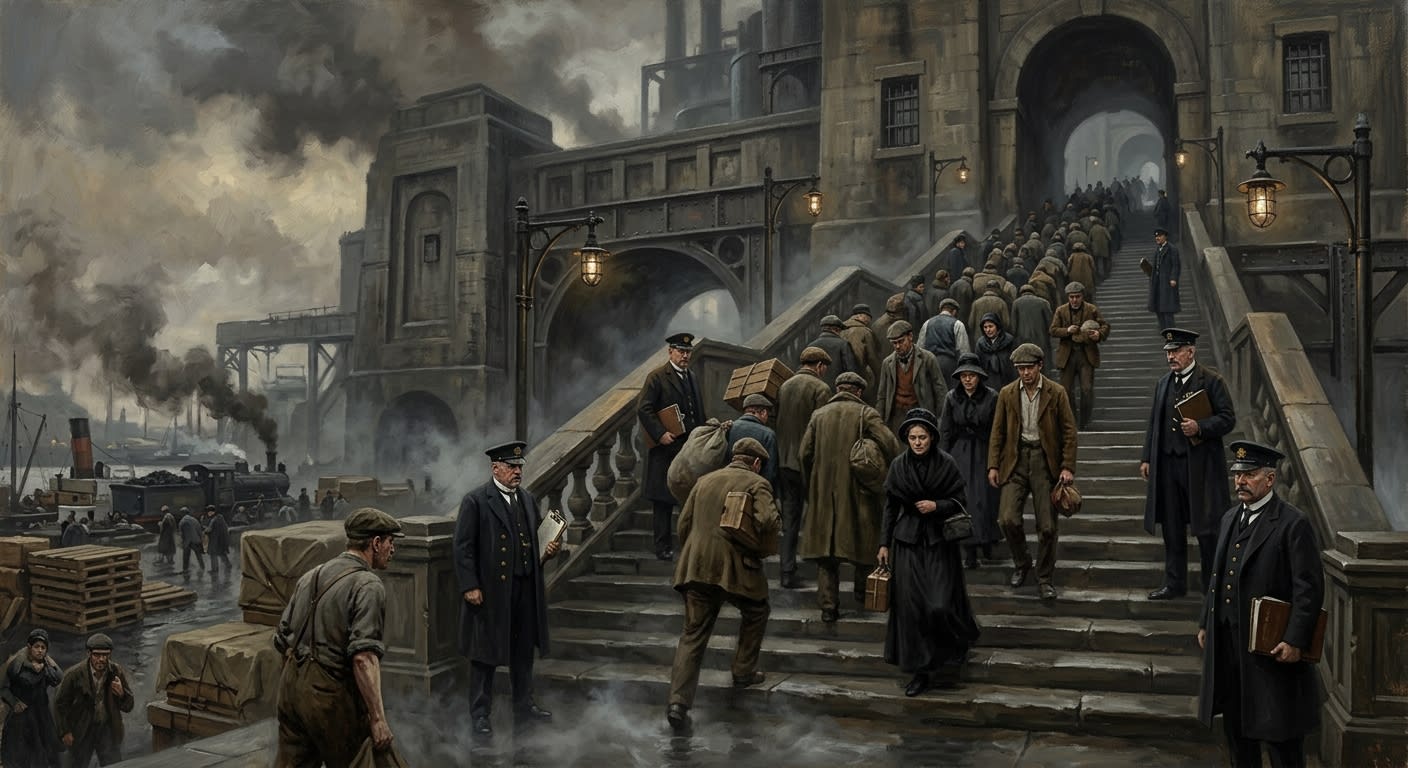
#On the Stairs That Make Arrival Legal
The Ledger Steps rise behind the Chainward Quays of Thessaloniki, terraced in wet stone, lamp-caged counters, testimony rails, rope barriers, complaint boxes, witness stalls, drying racks, salt shelves, and municipal despair. They are not symbolic stairs. Symbolic stairs do not smell of vinegar smoke, ink-wax, wet wool, lamp oil, fish rot, old rope, and the sweat of men discovering that handwriting can kill them more slowly than drowning.
Every ship that passes beneath the Harbor-Chain must climb the Steps in paper form. Hull, Soul, Substance: the threefold passage doctrine by which wood becomes vessel, crew becomes count, cargo becomes taxable fact, and a harbour that should be all water and motion becomes a ledger with gulls. The lower steps handle arrival. The middle steps handle cargo. The upper steps handle corrections, appeals, lost paperwork resurrection, and restricted rooms whose labels change whenever auditors come within smelling distance of the quay.
The Harbor Ledger Office occupies the Steps, though this phrasing flatters the Office and insults the stairs. The Office is the apparatus. The Steps are the civic throat. If Kosta commands iron and Iolana commands record, the Steps command posture: bent backs, lifted papers, damp hems, waiting feet, faces tilted toward a window where a clerk may look down and decide whether one's life has enough witness marks to proceed.
#On the Seven Windows and the Barred Eighth
The public order begins at Window I, Hull Entry and Docking Claim, where captains learn that a vessel's keel, sail, cargo, lice, rats, saints, and bilge odour are all insufficient proof of arrival unless the correct docking window has been accepted. Window II counts souls and attaches arrival confessions to crew lists. Window III receives Substance declarations and decides whether cargo belongs to Tithes, War, Quarantine, Purity, or that exquisite category known as “temporarily disputed,” by which property ripens into fees.
Window IV cross-notes quarantine. Window V hears witness disputes. Window VI reconciles fees, a phrase that suggests peace and delivers arithmetic with a cudgel. Window VII receives complaints so that complaints may be received. Reception is not remedy. It is the Bureau's little theatre of civility: a box, a slit, a clerk, a stamp, a citizen made briefly foolish by hope.
The eighth window is barred.
No public function is posted. No clerk sits visibly behind it. The shutter is iron, salt-pitted, and newer than the stone around it. Citizens are instructed not to queue there. Citizens queue there every Thursday, because human beings, in their animal wisdom, understand that a forbidden window in a Records district must either serve the desperate or eat them, and both possibilities attract petitioners.
Rumours assign it many duties. Some say it receives Port Loss (Unregistered) appeals from families whose children live in Quarantine while the file says drowned. Some say it routes names paused by service refusal to a lower archive where paper dries upside down. Some say Tamsin leaves corrected bundles beneath its sill. I have seen a clerk emerge from behind it once, carrying a basin of grey water and three witness slips that had not been wet when submitted. The clerk refused to meet my eye. A prudent habit.
#On Iolana's Altitude
Harbor Prefect-Archivist Iolana governs from the upper landing where the stairs narrow, the air dries slightly, and the clerks begin to smell less of harbour and more of knife handles. Her office has shutters facing the Chainward Quays, the Quarantine Crescent, and the internal file court. It has no sentimental view of the sea. Iolana does not require romance to count drowning.
Her rule on the Steps is colder than cruelty and more useful. Cruelty wastes motion. Iolana wastes nothing. A delayed captain receives reason, fee, witness requirement, and next window. A widow receives sympathy in the correct tone and a demand for proof that the dead man occupied his own body while aboard. A pilgrim receives correction if her sponsor mark is blurred. A corpse receives processing if its papers are better than the living man's beside it. This is Records showing its teeth.
Witness-Master Brencis (Unregistered) moves through the lower landings like a smile searching for an occasion to become evidence. He conducts refusals, calms crowds, verifies signatures, supplies procedural kindness, and eats fish at hours that would disgust a dock cat. The Steps are full of his voice. It is pleasant, which makes it suspect. A harsh refusal breeds anger. A pleasant refusal breeds obedience, then shame.
A civic guide for visiting captains described the Ledger Steps as “an orderly assistance terrace for passage verification.”
Corrected. Assistance implies rescue. Verification implies neutral fact. The Ledger Steps are a vertical instrument for converting arrival into obligation, error into fee, and fear of erasure into prompt compliance.
#On Lost Paperwork Resurrection
Lost paperwork resurrection begins on the upper Steps, where the stone is less wet and the fees improve. A manifest vanishes. A docking window evaporates from the daily schedule. A confession receipt returns from Quarantine with its ink bled into pious fog. A cargo witness dies, disappears, or learns that testimony against a guild cousin produces poor digestion. The citizen climbs. The Office receives. The search begins.
Resurrection requires docket number, witness fee, recovery stamp, ink surcharge, appeal interval, storage charge, clerk prayer, and a little fraud dressed for chapel. The recovered document often comes back with appropriate stains, stronger seals, better phrasing, and a small error that reassures auditors that it has truly travelled through difficulty. A perfect resurrection looks false. A damaged resurrection has moral texture.
The practice is bribery only to minds too crude to appreciate procedure. A bribe passes from palm to palm and leaves sin sweating between fingers. Resurrection passes through counters, witnesses, stamps, ledgers, denials, storage trays, and the solemn humiliation of pretending chance has rediscovered what payment summoned. It is not clean. Cleanliness is for unused knives.
The Steps' resurrection rooms also preserve the harbour's necessary hypocrisies. Demon-glass mask freight becomes optical supplies. Quarantine substitutions become cargo spoilage. A person who officially never arrived becomes damp damage, archival loss, corrected entry, and eventually a new name with better shoes. Drowned Row supplies memory. The Steps supply grammar.
#On Paused Names and Closed Service
Service refusal (Unregistered) is the Steps' most elegant violence. A paused name cannot claim ration, berth, wage, passage, burial right, marriage witness, complaint standing, debt correction, child retrieval, or release from Quarantine. The person breathes. The city stops answering. Friends may feed him if their own names remain stable. Employers may use him if the wage need not become official. Priests may comfort him, provided comfort does not require counter service.
The pause began as fraud control after bulk blank-paper seizures. It matured, as all useful emergency measures mature, into standing practice. A paused sailor sleeps in doorways near Window V because his berth claim requires the witness locked behind Window VI. A paused widow keeps two cups at table so neighbours remember the husband whose death claim is under review. Children scratch initials under benches outside the lower Steps and return after rain to see which marks survived. The Office scrapes the benches clean. The initials return with the wet stubbornness of mould.
SERVICE REFUSAL CASE — LEDGER STEPS / A.S. 200 Subject: refugee woman, sponsor mark half-drowned by Quarantine wash Requested: child release from Crescent Ward ███ Office finding: maternal claim paused pending witness Child status: Port Loss cross-note, living body observed Appeal result: ███████████████████████ Bench inscription found after rain: “MAMA HERE” Scraping crew note: letters bled salt water.
Appeals exist. Of course they exist. The Bureau allows despair to queue indoors whenever weather threatens the papers. A paused person may petition at Window V, then VII, then Recovery Room Three, then the upper appeals chamber if two witnesses certify prior service attempts. Witnesses cost money. Service attempts require receipts. Receipts require an unpaused counterparty. The system has no circle's elegance. It is a noose drawn by committee.
Service refusal was introduced as a temporary harbour protection against manifest fraud and quarantine evasion.
Clarified. Temporary measures that produce obedience, revenue, and quiet suffering have always been permanent in embryo. The Ledger merely allowed the creature to hatch.
#On the Silence and Emergency Legality
On 14 Ashmonth, A.S. 198, the bells failed. Pell struck the Elder and received no sound; Liss struck the Younger and received the same occupied absence. Chain-gate protocol lost its throat. No bell, no seal. No seal, no closed passage. Kosta held the gates open and sent runners to the Steps.
Iolana read the first message and began writing before the second arrived.
For seventy-two hours, the Steps became the harbour's substitute bell. They issued provisional witness marks for halted cargo, duplicate passage holds for ships that dared not cross under silent chains, quarantine adjacency notes for crews trapped in liminal berth, and emergency memoranda to Rites that arrived with such clean fury one could have shaved with the margins. Rites answered too late, in the ancient manner of interpretive authorities. The Steps had already built law out of wet paper and nerve.
When the bells returned in exchanged voices, the Steps adapted faster than the liturgists could panic. Forms acquired boxes for Tower struck and Tone received. Chain-window schedules gained acoustic cross-references. Prior manifests received retroactive tonal correction. The public was told no new fees arose. Existing fees, with admirable obedience, expanded to occupy the new wrongness.
#On Tamsin and the Downward Shadow
The Steps cast shadows into the under-quays, and one of those shadows has handwriting. Ledger-Ghost Tamsin does not appear in official record. Her absence is so steady that it has become a municipal office without furniture. Corrected bundles appear with one page too many. Missing witness marks return where damp had been. A quarantine hold becomes cargo spoilage. A passage that would embarrass War becomes a late ferry note. The harbour breathes through a clerk it denies possessing.
Iolana cannot acknowledge Tamsin. Brencis cannot admit seeing her hand. Junior clerks recognise her corrections by instinct and pretend the instinct is training. The Steps condemn forgery daily and preserve useful corrected bundles hourly. This is hypocrisy in the small sense and harbour survival in the large. The large sense is wetter and wins.
Tamsin matters because lawful harbour mechanisms spend half their time preserving dignity and the other half obstructing motion. Under-quay correction preserves outcome when procedure is busy venerating itself. The Bureau of Shadows knows. Purity suspects. Records denies. Denial, here, is a form of payroll.
#On the Present Ascent
As of A.S. 201, the Ledger Steps are audit-prepared and dangerous. External inspectors from Strasbourg are expected. Files have been arranged for display. Other files have been arranged for survival. Bundle 7-K (Unregistered) will be shown. Its underfloor copy has moved. References to Tamsin-type hand have been recoded as senior correction. If asked about salt bloom on a vanished thumbprint, clerks will demonstrate damp conditions with theatre enough to shame a festival master.
The Steps still process the southern theatre's hunger: grain toward Bastion-Shipka, munitions toward the coastal batteries, pilgrims through quarantine, conscripts with dry boots and damp futures, coffins returning with better documentation than the men had in life. Kosta's chains hum in wrong voices. Iolana's windows answer in correct ones. Between chain and stamp, Thessaloniki climbs, waits, pays, and learns which form of drowning has a receipt.