
#On the Lineage
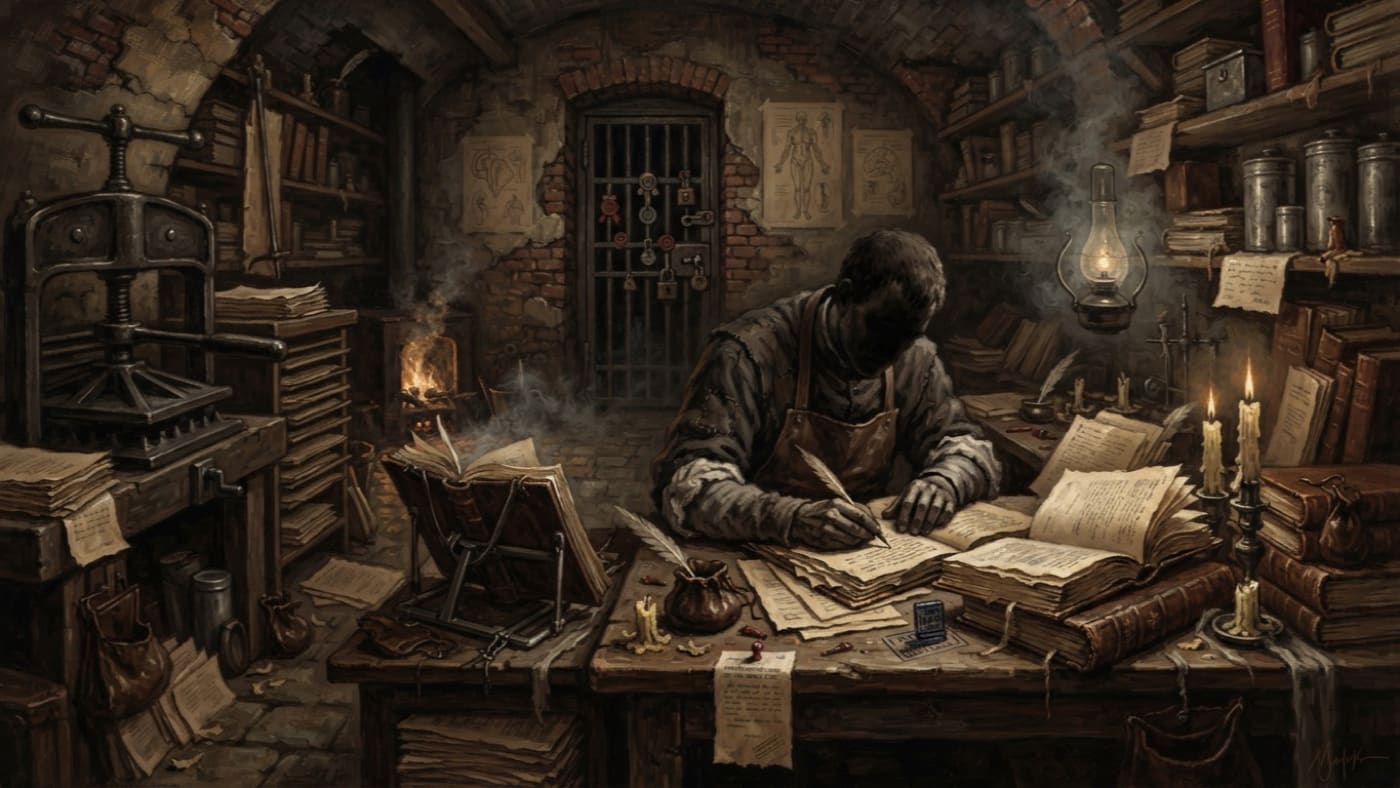
The Bitter Mercy Line is a book that is not a book. It is a lineage of copies of the Index of Safe Lies, one of twelve counted by the Ashen Circle in its own illicit arithmetic, and it has no address. Clerks of this office filed it under places because the name contains the word "line," and a clerk who sees a line assumes someone is standing in it. Nobody stands in this one. It is a succession of hands, folios, candles and errors that carries practical knowledge from one hidden desk to the next. Each copy descends from another, the way a forged seal descends from a genuine one.
It must be kept apart from the Mercy Line of Marrowgate, which was a queue of bodies and its procedural afterlife. That line moved the dying. This one moves the means of keeping them alive, which the Bureau finds considerably less forgivable.
Its siblings in Circle accounting have names chosen to provoke: Triangular Providence, Clean Knife, Bread-without-Prayer, and eight others whose names change according to how soon the speaker expects to be arrested. The names are not maps. Nobody should infer a hospital from Clean Knife or a granary from Bread-without-Prayer. Nobody should infer a fever ward from Bitter Mercy either, though half the clerks in my building have tried.
#On Bitter Mercy
Dr. Marrow Vask trained among the Rationalists. From A.S. 48 to 51, in the first years of the Great Retreat, he worked in a wartime Church field hospital under the name Brother Matthias. The hospital's papers were later filed as Synodal. The Synod would not be constituted for another four decades, but archivists, like hagiographers, prefer their institutions to have been present at every useful death. Vask treated the wounded with a competence he had no licence to possess. Men survived. Survival drew attention. In A.S. 57 he was identified and burned.
His method was to make every fact kneel. Boiling instruments became purification against invisible corruption. Bridge stress became the Creator's fondness for triangles. Willow bark, which reduces fever and has been chewed by peasants since before anyone thought to forbid it, became a meditation upon bitter mercies.
That phrase is the only documented link between the lineage's name and the Index's contents. I record it as a resemblance. No recovered charter tells us who first called a chain of copies the Bitter Mercy Line, or in what cellar. Nor does it say whether the name honoured willow bark, mocked the Bureau, or simply sounded well when whispered. The Circle had no collective name until A.S. 103, and its copyists were at work long before anyone thought to enrol them.
The Circle now venerates Vask as a founding martyr. The title is posthumous. He compiled the book. He did not found the Circle or design its ranks, and no record names him as the founder of this lineage or any other. The dead are drafted into whatever regiment needs them. The Church has never hesitated to do the same, and I see no reason heretics should be more scrupulous.
#On the Copyist's Errors
The craft of the lineage is the craft of being wrong in the right places.
Every hand-copied Index carries cell-marks. These are deliberate variations planted in the devotional casing so that a captured copy confesses its descent. A saint acquires a different spelling. A prayer gains a comma. Citations change order, an ornamental numeral turns the wrong way, a border vine grows one leaf too many. To a censor these look like the ordinary rot of heretical scholarship. To a Circle reader they are a pedigree. They show which room the copy left and whose hands carried it. If the copy turns up somewhere it ought not to be, they show which courier should stop answering the door.
The practical text is another matter. Fever intervals, boiling times, dosage measures, beam calculations and crop directions must pass from one leaf to the next without a stroke altered. A wrong saint traces a betrayal. A wrong dose kills a child. The copyist who confuses the two categories has left the lineage and joined the poisoners, bringing excellent penmanship along.
I do not know Bitter Mercy's marks. If the Bureau of Silence is competent, nobody there knows them either, or at least nobody who would admit it in writing. I record only the discipline this lineage shares with its eleven siblings, and what follows from it. A copyist who corrects an apparently misspelled saint may be destroying a signature. A copyist who improves a dosage may be destroying a patient. Novices in the Circle's lower ranks are said to reproduce nine words in ten. The tenth may wander in a hymn and nowhere else.
Capture works both ways. A seized copy can expose its parent cell and every hand downstream. It can also be salted with false marks and released. Circle readers therefore distrust any copy that arrives too clean.
Bureau of Silence commentary on the Index lineages, Bitter Mercy included, holds that the variant readings prove the practical text corrupt and medically unreliable.
Withdrawn as to the practical text. The variants sit in the devotions. The intervals and measures are kept with a fidelity this office would be pleased to see in its own registers. The commentary remains in force as to the saints, who are indeed a disgrace.
#On the Hands That Carry It
Physically, the lineage consists of the ordinary furniture of Circle scholarship: cellar archives, candle-guild back rooms, bastion basements, and a hollowed prayer-book whose bound section is not what its spine claims. Copying is done before dawn and delivery at bell-change. Copies are split so that no single carrier holds the whole. A fever schedule travels in one coat and the instrument pages in another, and the courier with the litany of triangular submission has never seen the bark.
The Circle's ladder of Ember Copyist, Soot Annotator, Circle Scholar, and the Ash-Master who decides what an Index keeps applies across the whole network. I have no roster of Bitter Mercy's hands and will not invent one to make the file look heavier. The Circle's rule is never to write full names. In this one instance their discretion and my archive's emptiness coincide, and I resent the partnership.
What can be said is that the lineage persists. Persistence of this kind requires paper, tallow, ink, thread, safe rooms, and people prepared to die for a column of figures about fever. The binder's needle passes through the fold. The new copy is checked against its parent leaf by leaf: devotion against devotion for the mark, measure against measure for the truth. Then the parent is hidden, moved or burned. Purity would be pleased to attend that burning, though it is only arithmetic.
#On Approved Extraction
The Bureau of Medicine condemns the Index in public and transcribes it in private, under the heading "sealed comparative study." Washing, boiling, isolation, fever draughts and certain field amputations have entered approved protocol by routes no surgeon will diagram. Nobody has recorded whether any of those extracts passed through a Bitter Mercy copy. Medicine does not cite heretical provenance, because a citation would be a confession.
Each office wants a different part of the same prisoner. Silence wants the copy intact, to compare against the known lineages. Medicine wants it after Silence, for the leaves that work. The Bureau of Engineering wants the calculations and has trained itself not to hear the word "source." The Bureau of Purity wants the carrier, a public fire, and a notice saying the book is gone. The Interdiction Squads serve under Silence command and are staffed largely from Purity's lower ranks. They want a raid that ends before the prisoner can chew the evidence.
One seizure cannot feed all of these appetites. Purity burns what Medicine wanted. Medicine copies what Purity swore was ash. Silence files the discrepancy. The copyist is the only party with a coherent policy: keep the numbers exact and keep moving. Under the Index Damnatus, that copyist stands condemned for holding knowledge the Church is applying to its own wounded at that very moment.
#On the Present Custody
The present survey is for A.S. 201. The Index circulates in fragments through Strasbourg, Cologne, Halle, Essen, the outer paper markets of Ulm, and at least three bastion basements. Those are the Index's waters. No record in this office assigns any of them to the Bitter Mercy Line. Silence would dearly like to make that assignment and has filed nothing I can cite.
The Index has been declared destroyed eleven times. Those eleven burnings belong to the whole work, and no ledger allots any of them to this lineage. The twelve lineages counted after them are chains of custody, not twelve volumes waiting in a crate. Bitter Mercy remains on the count. This office has been asked where its leaves lie, who holds them, and which wrong saints they wear. It has declined to guess.