
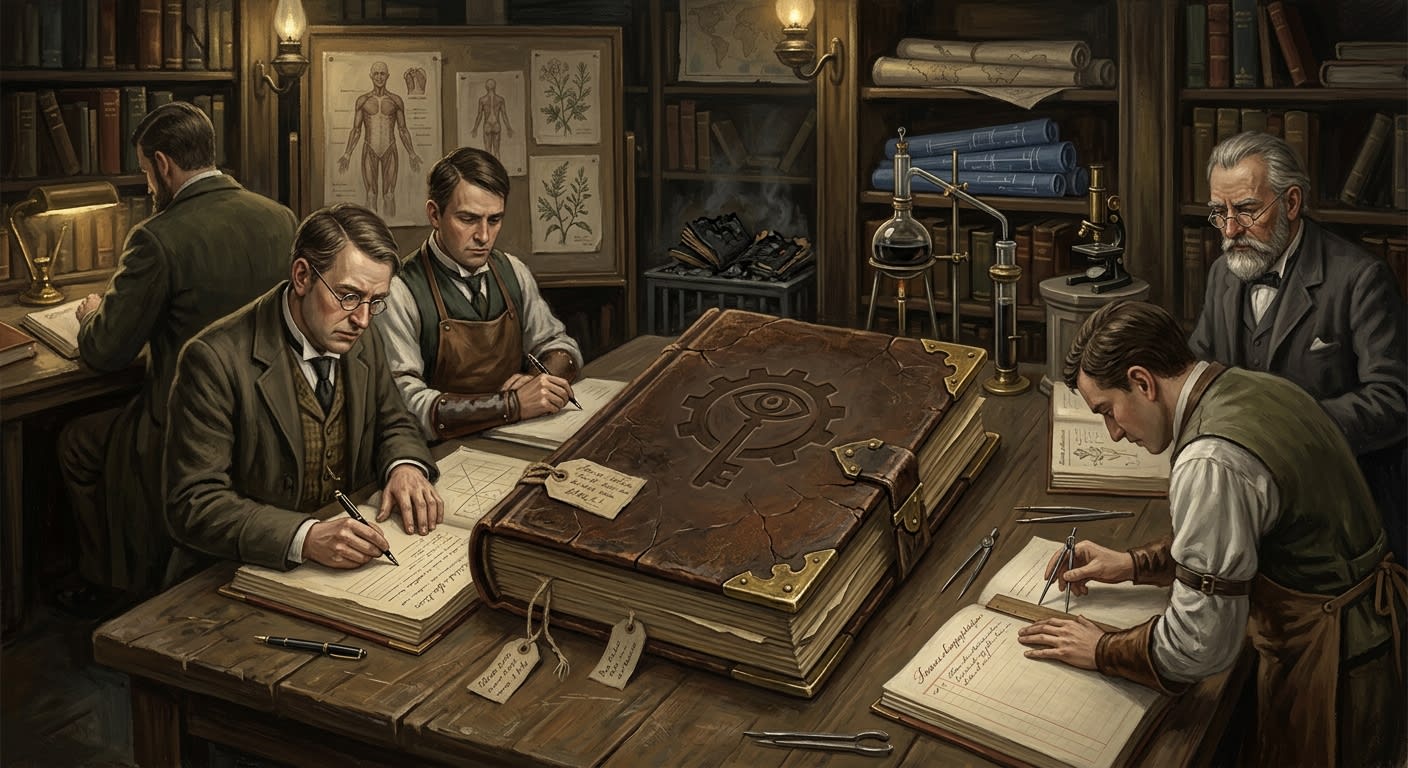
#On the Book That Lied Usefully
The Index of Safe Lies is the ugliest kind of heretical object: useful, copied, quotable, and sufficiently pious in its outer garments to pass through the hands of a censor who has eaten too much lunch. Its author, Dr. Marrow Vask, understood a principle the Bureau pretends to have invented: truth travels best when dressed as something respectable. He dressed medicine as mercy, chemistry as purification, agriculture as obedience, and engineering as Providence's private fondness for triangles.
The result was a book that lied on every surface and carried working facts underneath. It is a prayer-book with a scalpel hidden in the spine. It is a catechism whose footnotes know how to wash a knife. It is a crime with excellent margins.
#On Vask's Method
Vask had trained among the Rationalists before the Collapse, which means he suffered from that unattractive habit of testing whether a remedy worked before composing a sermon about why it ought to. During the Great Retreat of A.S. 48, he entered a Synod field hospital as Brother Matthias and treated the wounded for three years with forbidden competence. Men lived. The files became awkward. Suspicion followed survival, as naturally as flies follow an unburied horse.
His method was neither concealment alone nor translation alone. A hidden page can be found. A translated fact can be condemned. Vask made facts kneel and forced them to speak doctrine while retaining their teeth. “Boil the instrument” became a purification rite against invisible corruption. Willow bark became meditation upon bitter mercies. Agricultural rotation became the parish field's obedient alternation of penitential burden. Bridge stress became the Creator's affection for triangular submission.
A Purity primer of A.S. 59 calls the Index “a mere collection of blasphemous substitutions.”
Withdrawn from serious use. A substitution changes names. Vask changed jurisdiction. The facts remained intact, which is why everyone became so cross.
The genius lay in the censor's boredom. Vask knew the inspected sentence must smell approved before it meant anything dangerous. Too much clarity and Purity would burn it. Too much theology and the surgeon would kill the patient while deciphering Providence's alleged preferences. The Index balances on that filthy little knife-edge where a lazy reader sees piety and a desperate reader sees instruction.
#On the Contents
The surviving copies differ. This is deliberate. Each hand-transcribed lineage carries cell-marks: small errors introduced by copyists so that captured volumes reveal their parent cell, their route, their betrayer, their careless courier, their useful corpse. The errors are placed in devotional casing, prayers, ornament, citation order, saint names, and ornamental numerals. They are not placed in fever intervals, boiling times, dosage measures, beam calculations, bridge ratios, or crop instructions. The Ashen Circle is criminal, not stupid.
Medical sections occupy the earliest leaves in most lineages: wound washing, amputation timing, fever reduction, water boiling, instrument cleaning, poultice preparation, isolation practice, and the contemptibly successful habit of separating the sick from the healthy before thanking the Creator for the result. Chemical pages follow: lye, alcohol, distillation, lime, mordants, acids under devotional aliases, and the handling of substances the Bureau of Medicine now uses while refusing to pronounce their older names.
Agricultural folios are the most mournful. Six hundred pages of pre-Sundering agricultural science burned with Vask in A.S. 57: crop rotation, soil treatment, seed preservation, irrigation ratios. The Index preserves scraps, not enough to restore an entire science, enough to humiliate the clerks who destroyed it. Engineering folios survive more robustly: stress diagrams disguised as meditations, ratios embedded in litanies, bridge geometry smuggled through an approved reflection on holy proportion.
RECOVERED LINEAGE NOTE — COPY XII-B, COLOGNE CELLAR “Do not correct the third saint's name in the irrigation chapter. The misspelling is ours. If the name appears correct, the copy has passed through ████████████ and must be treated as compromised. Burn after extracting the bean-row table.”
[lower half of note eaten by damp; damp not yet charged]
#On the Eleven Burnings
The Bureau declared the Index destroyed. This announcement was made eleven times, which suggests either optimism or a charming deficit in arithmetic. Each burning produced a notice, a sermon, a custody receipt, and a fresh rumor that another copy had already moved. The Bureau of Purity burned confiscated folios at hospital yards, monastery courts, archive steps, and once inside a rainstorm in Ghent, where the pages smoked so stubbornly that the officiating Lictor accused the weather of sympathy.
Vask's own execution was the grandest obscenity. Purity burned him on a pyre of confiscated Rationalist texts, achieving theatrical unity at the cost of six hundred pages the Bureau of Agriculture would later have begged for in a voice unbecoming to an institution. The condemned reportedly laughed when the agricultural stack caught. The question he asked — whether his executioners knew what they were burning — did not enter the transcript. Questions have a way of failing to enter transcripts when the answers smell expensive.
#On the Twelve Copy Lines
Twelve copy lineages survive in Circle accounting. Purity claims fewer when speaking publicly and more when requesting funds. I believe the larger number when budgets are involved. Fear audits better than pride.
Each lineage is named in a way designed to irritate the Bureau: the Bitter Mercy Line, the Triangular Providence Line, the Clean Knife Line, the Bread-without-Prayer Line, and eight others whose names vary depending on whether the speaker expects to be arrested. Lineage is not ancestry in the sentimental sense. It is a chain of hands, rooms, candles, errors, refusals, betrayals, and one courier in Metz who carried twenty-four leaves sewn into his coat hem while reciting the Catechism of Obedience loudly enough to make two guards let him pass merely to end the performance.
The copyists obey one law above all others: practical sections remain exact. A devotional flourish may mutate. A saint may acquire the wrong aunt. A prayer may include a deliberate extra comma for cell tracing. The instruction “boil for twenty minutes” remains twenty minutes, because dead patients are poor advertisements for heresy.
Bureau of Silence commentary describes the lineage errors as evidence that the Index is textually corrupt and medically unreliable.
False in the parts that matter. The corruptions are signatures. The prescriptions are guarded with a reverence the Bureau usually reserves for authenticated femurs.
#On Official Theft
No institution despises the Index more publicly than the Bureau of Medicine, which is why its private archive contains the most carefully transcribed extracts. The Bureau's clerks call this “sealed comparative study.” Surgeons call it Tuesday. Protocols for washing, fever draughts, boiling, isolation, and certain field amputations entered official practice by doors whose hinges squeal Vask's name if one has the ears for it.
The theft is never admitted as theft. Admission would force a chain of intolerable recognitions: Vask was correct; Rationalist method preserved lives; the Index carried knowledge the Synod needed; the Bureau burned what it later used. Doctrine can survive any one of those facts. It cannot survive all four arranged in a neat row without summoning a committee, and committees are how embarrassment obtains stationery.
The Bureau of Silence wants every copy. The Bureau of Medicine wants every copy after transcription. Purity wants the carrier. Engineering wants the bridge pages and prefers not to hear the word “source.” The Interdiction Squads want a clean warrant, a quiet raid, and a prisoner who does not swallow the table of contents before questioning.
#On the Present Custody
As of A.S. 201, the Index circulates in fragments across Strasbourg, Cologne, Halle, Essen, the outer paper markets of Ulm, and at least three bastion basements whose commanders would rather be accused of heresy than of using the officially approved bridge tables. Full copies are rarer than honest procurement reports. Fragments are everywhere: a fever schedule in a hymn margin, a beam ratio in a penitential exercise, an irrigation rule beneath a sermon on obedience, a cleanliness protocol filed as preparation for moral purity.
The book endures because it does what propaganda fears: it produces results without asking whether the result is convenient. A washed knife cuts cleaner. A boiled instrument kills fewer men. A bridge built with correct ratios falls less often. The sentence may kneel, genuflect, kiss the hem, and call itself a prayer; the beam still bears weight according to mathematics.