
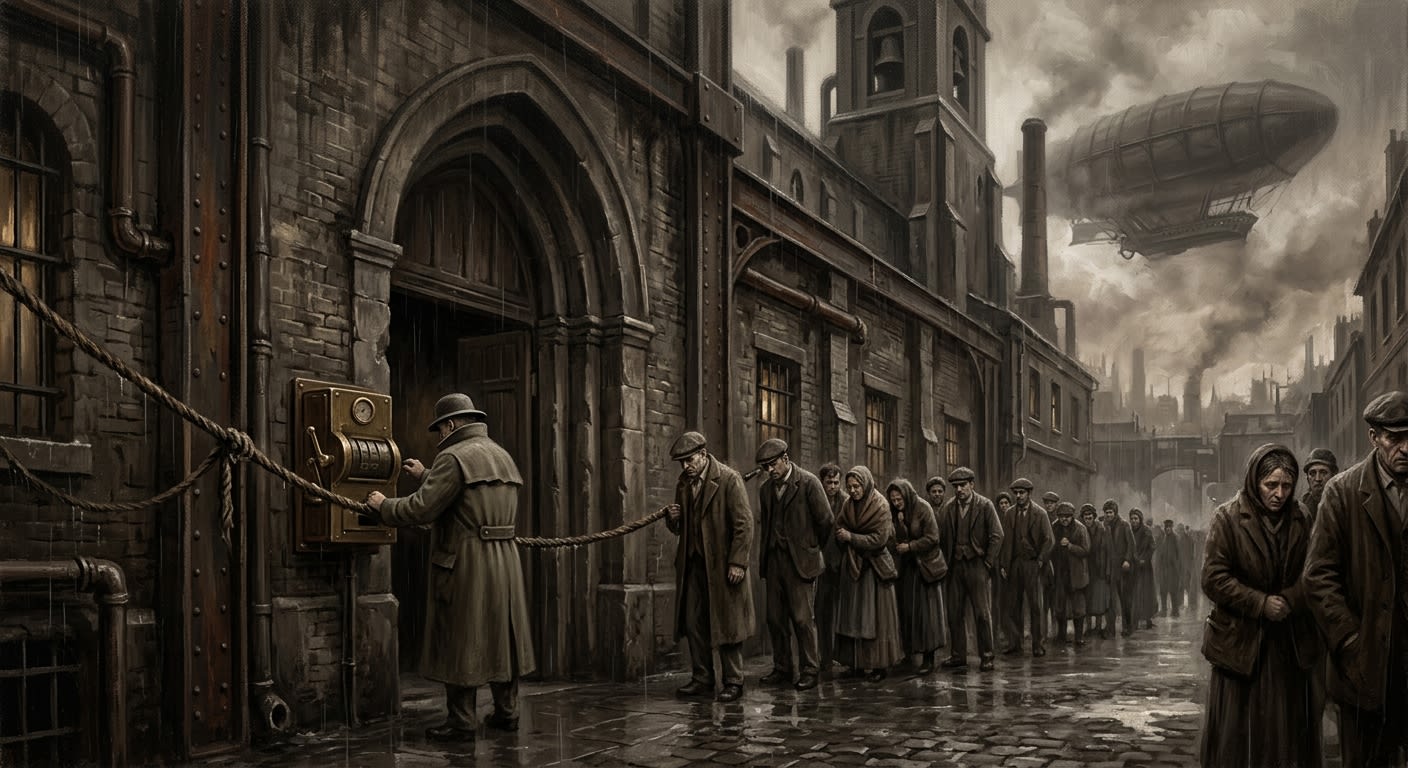
#On the Rope Outside Saint Morin
The Mercy Line began as a rope, which is how many of the Synod's nobler institutions begin when stripped of hymn and invoice.
It formed outside the Tariff-Chapel of Saint Morin at Marrowgate during the second week of the Gray Clearance, A.S. 157: a left-hand queue beside the corpse bays, apart from the ordinary petitioners, near enough to the chapel door that a clerk could walk it without entering the street proper, far enough from the main intake that families understood they were being offered an uglier category of hope. The dead were waiting. The living were bargaining. The city stank of lime, fever, boiled linen, horse sweat, spoiled canvas, and official reassurance.
The name began as mockery. Mercy Line. The phrase had a sweet taste if spoken by someone who had not stood in it. Families whose dead had been held under the emergency two-word system — Cleared or Held, those blessed little knives — gathered along the rope with slips tucked into sleeves, wax coins in mouths, wedding rings hidden under tongues, saint medals hollowed for salt or silver, and the particular expression of persons discovering that grief has a tariff schedule.
A clerk with tired eyes walked the rope at Prime and touched some papers with two fingers. Those bodies cleared before noon. The others remained. By the fourth day, everybody understood the rate.
#On the Street That Became Procedure
A line is a place only after people agree to fear it. The Mercy Line earned geography in four days.
At first, it was only an overflow habit. The corpse bays had failed. The old five categories — Burial, Transport, Salvage, Ornamental, Contaminated — had collapsed into Cleared and Held, because rot is a gifted constitutional scholar and had found every weakness in the mortuary code. Families whose dead were Held came to the chapel because Saint Morin, with his sealed mouth and waxed skull, was supposed to keep bones counted. They expected prayer, explanation, petition, something with a candle at least. They found rope.
Marrowgate's Wagon Quays (Unregistered) took the war in by cart. Its White Ward (Unregistered) lost patients by bell. Its Lime Yards burned so hot that frost withdrew from the streets like a prudent creditor. The Tariff-Chapel sat between these motions: prayer behind, carts before, lime beyond, paperwork everywhere. The left-hand rope offered a narrow passage through that machinery. Some bodies moved. Some names vanished. Some families paid and received ashes whose tag fibers matched nothing in their household records. Contradiction has been overruled by throughput.
Early Marrowgate ward accounts describe the Mercy Line as “a devotional queue for bereaved families seeking pastoral consolation.”
Corrected. Pastoral consolation was present in the sense that a painted saint watched the transaction from a wall. The queue moved bodies, payments, accusations, bribes, salt, priority slips, and grief. Consolation stood nearby and learned to keep its hands clean.
The Line's physical details acquired ritual speed. Left-hand rope. Three chalk marks before the chapel stair. A little board nailed crooked under Morin's skull. Ash dish on the clerk's stool. Wax lamp guttering even at noon. Families learned to stand with papers visible and valuables invisible until the right hand approached. Loud grief slowed the file. Quiet grief improved it. A child sent forward with a tag often succeeded where a father shouting scripture failed. Mercy had discovered public tenderness as crowd discipline.
#On Rates, Ash, and the Little Mercy
No circular authorised payment. No seal established a fee. No superior signed an acceleration schedule. The Mercy Line became pure in the official manner: corrupt without paperwork.
The rate varied by week, weather, body condition, clerk courage, family pressure, and whether the Lime Yards had room before Vespers. Wax coins moved fastest. Silver moved faster when hidden in saint medals, because priests dislike searching devotional objects where families can see. Wedding rings had a higher moral fragrance and worse resale. Salt purchased the attention of Ward-Sisters. Linen purchased silence. A confession packet, properly damaging to a rival household, could move a held uncle before Sext.
The mercy stamp (Unregistered) was the Line's true sacrament. It differed from the legal Gray stamp and the public Clearance mark: a smaller ash touch, sometimes rectangular, sometimes a thumb smear, sometimes a diagonal crease rubbed with soot and vinegar. It meant look again. It meant this one before noon. It meant the family has paid, pleaded, threatened, bled correctly, or stood in the sight of someone who has not yet killed the last small animal in his conscience.
MARROWGATE SANITATION CHAPTER — INTERNAL BAY NOTE, A.S. 157 Bay Four count: ███ bodies by tag; ███ by head; discrepancy unresolved. Gray marks issued: ███. Held appeals routed through left rope: ███. Unclaimed children transferred before kin bell by order of █████. Clerk marginalia: “If they ask, say lime. If they listen, say nothing.”
The little mercy saved bodies from rot and families from waiting. It also erased claims, accelerated misidentifications, converted unclaimed children into institutional matter, and taught a city that sorrow could be made to stand in two queues. One for procedure. One for speed.
#On the Spoken Line
The Mercy Line became words because places that wound the poor eventually become prayers.
Ward-hands recite it under the breath at shift-start: wash to the wrist, count ladles, tap the ward bell once even if it is not bell-hour, speak the Line, begin. The text varies. Some say, “A fed body is an obedient body.” Some say, “If it is not stamped, it is not mercy.” Some say the longer Marrowgate version, too soft for a training hall and too bitter for a chapel: “Move the bowl, move the tag, move the dead before the dead move us.” The better ones say nothing and begin.
The shift from rope to recitation followed the Broth Riots and the Ledger Laws that hardened Mercy into its modern form. A.S. 112 had made mercy countable: bowl, bandage, draught, death, confession packet, cot number, linen length, ration class, witness mark. A.S. 157 taught ward-hands what happened when the count broke beneath pressure. The Mercy Line became a mnemonic wound. Count the ladles. Watch the pot. Keep one measure reserved for the unexpected child. Never let the broth go silent.
In black-zone stories, the Line sings itself. Patients without tongues sing it before riots. A broth pot goes silent during a night outage; every patient wakes screaming the same dream. Three fevered soldiers rise from cots after Saint Marrow's ladle miracle and sing the Line in harmony. The Bureau of Orison and Song dislikes these accounts because unauthorized music embarrasses authorized theology. Mercy dislikes them because staff morale suffers when kitchen superstition acquires witnesses. Doctrine, naturally, preserves the reports under seal and calls the preservation caution.
#On Saint Marrow's Bowl
Saint Marrow-of-the-Ladle did not found the Mercy Line. Saints rarely found the practices that later require them. They arrive afterward, clean the blood from the handle, and permit the Bureau to sell icons.
Marrow belongs to the bowl: broth, ration, warmth, counted compassion. The old legend says a ward-hand of uncertain rank cracked marrow bones in a helmet and fed two hundred patients from a pot that diminished slower than inventory predicted. The miracle is perfect because it flatters the ward imagination: delayed depletion instead of vulgar infinity or endless feast. A little more than the ledger expected. Enough to keep the line human for one more bell-hour.
The Line adopted Marrow because the rope had no face. Families will stand before a skull, but they kneel before a saint. Ward-Sisters placed little helmet signs near broth pots. Tariff-Chapel clerks touched ash to held tags under Marrow woodcuts. Marrowgate children learned that a ladle dipped straight meant ration, dipped sideways meant favor, tapped twice meant go away before the guard notices. This is catechism of a high order, and I will hear no complaint from theologians who have never managed soup.
Later devotional broadsheets claim that Saint Marrow instituted the Mercy Line to ensure no bereaved family lacked appeal.
Withdrawn for instructional copies. The Mercy Line preceded the saint's formal utility in this matter. Marrow sanctified an existing wound, which is the ordinary path by which institutions convert embarrassment into pilgrimage.
#On Abolition and Inheritance
The Gray Clearance was revoked in A.S. 158. The Mercy Line was abolished the same afternoon in three notices, two sermons, and one Sanitation Chapter order pasted over the left-hand board while families were still standing beneath it. The notices declared that normal classifications had resumed; all held-body appeals would follow restored procedure; irregular acceleration was forbidden; payments to staff were punishable; and public confidence in Mercy's impartial tenderness had been preserved.
The rope came down. The practice walked indoors.
As of A.S. 201, the Mercy Line survives in ward ritual, hospice superstition, mortuary slang, Marrowgate alley procedure, and the small choreography by which Mercy staff still move suffering around the official map. A second press under the left side of a desk. Grey wax bought through candle accounts. A tag folded corner-up. A Sister saying after Vespers with her eyes on the floor. Paper slips in Hospices of Departure written by hands too cramped for proper capitals. Ash-salt packets under pillows. Little west-facing boards. The line is gone. Its grammar remains.
The Mercy Line must not be confused with the Bitter Mercy Line, an Ashen Circle copy lineage attached to the Index of Safe Lies. That line is textual, clandestine, and irritating in a different register. Marrowgate's Mercy Line is physical first, devotional second, administrative always. One copies forbidden remedies. The other moves bodies faster than law can bless. Both prove that the poor learn procedural theology with greater speed than their betters, because failure to learn costs them skin.
At Marrowgate the old left-hand stones remain paler than the street around them. Limewash does that. So do feet. So does memory, when forced to stand still long enough.
The clerk's stool is gone. The ash dish is gone. The board is gone. The rope is gone. At Prime, in the White Ward, a Sister washes to the wrist, counts ladles, taps the bell once, lowers her voice, and begins.