
#On the Workshops Beneath the Dikes
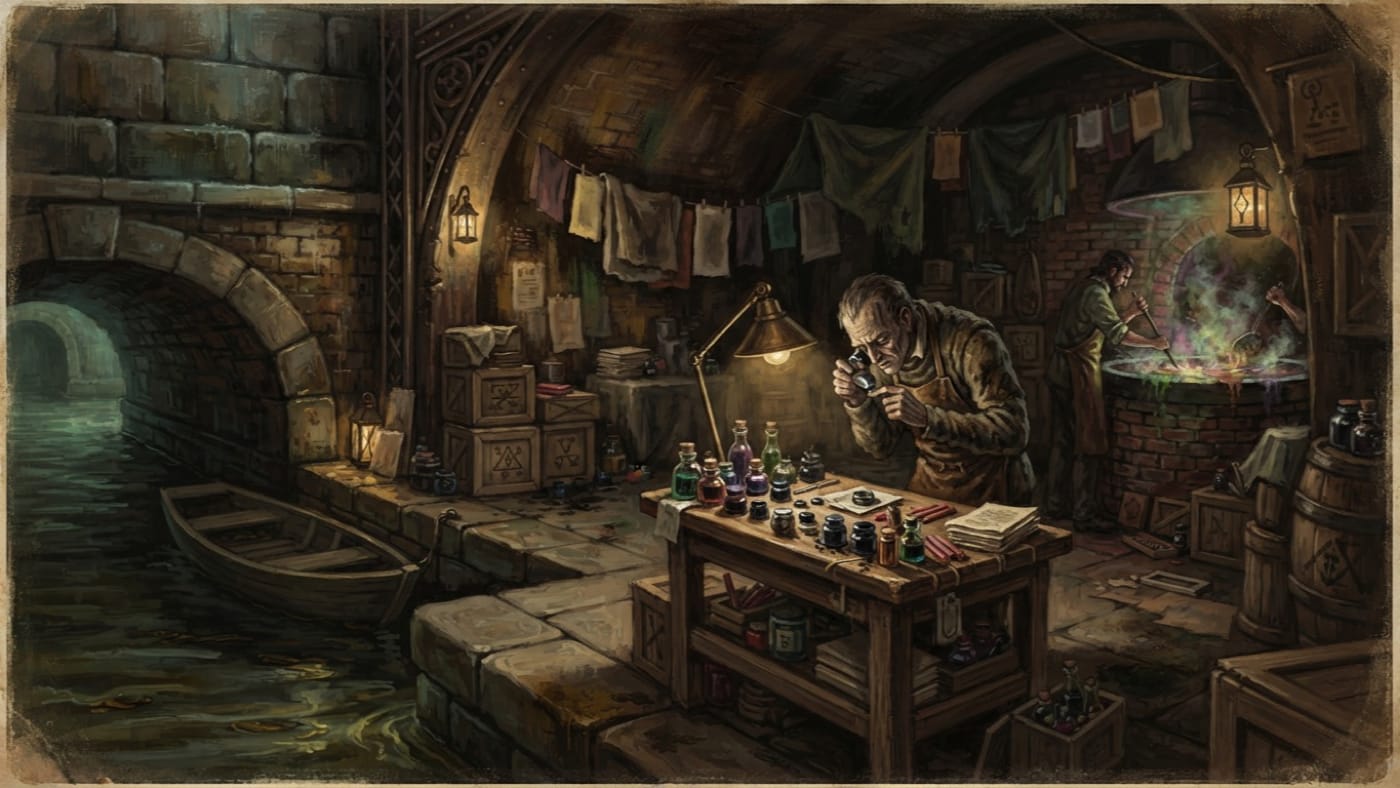
The Black Canal workshops are the rooms where Candlewick's forbidden goods are made, before anyone is paid to move them. The Black Canal is the water. The Black Canal Syndicate is a market that carries knives. The workshops are benches: a vat set back from a wet service arch, a lamp hooded against the culvert mouth, a drying line hung with sheets that must never see daylight, a stool worn smooth by the same hips over many years. They stand beside the under-dike's service sluices, dye-runs and maintenance culverts, and beside the private mouths the Houses cut for themselves and later forgot to confess. Nobody has counted them. A count would need a list, and a list is the first thing a provost asks for.
They exist because Candlewick exists. The Palatinate makes the inks, wax seals, watermarked paper and registered colours that decide whether a ration claim is honoured, a pass obeyed, a contract binding, or a person a person. When a city sells legitimacy by the gram, the people it shuts out will buy it by the drop beneath the dikes.
#On Materials and Impressions
No single cellar does everything. The Bureau's habit of writing "the workshop" in the singular flatters the trade. One room mixes outlaw pigment: unregistered blues and greens, greys matched to a single ration token, reds close enough to a House shade to survive a lamp held at the wrong angle. Another casts wax. Another cuts dies. That is the gravest of the crafts, because a blank seal die is one of Candlewick's red lines and ends the cutter's career, generally along with his neck. Another sizes and presses illicit paper. That paper must carry the feel of a watermark as well as its look, because a Registry clerk reads paper with the thumb before the eye.
The work is hateful in its difficulty. A loupe, or a cracked lens kept in a sleeve, measures line depth and the small scratches an honest punch collects over years of honest abuse. Scraps of genuine paper are hoarded like relics. Rejected wax sticks, stolen from the presses above, are melted down and reused, because fresh wax smells fresh and inspectors have noses. Drying boxes keep out the damp. Every mark has to survive scrutiny that Candlewick has spent a century perfecting: grain, sheen, emboss depth, the registrar's hand, and the grime a document ought to have picked up in the pocket of a man who has carried it since spring.
The counterfeiter's old proverb holds below the dikes: perfection is a tell. The best cutter on a dye-run will burn a flawless impression and keep the one with a believable fault.
#On Labor and Purchased Standing
The hands that work below are the hands that work above, minus the licence. Candlewick's apprenticeship contracts already amount to servitude. A missed quota or a defaulted debt reclassifies a worker as unlicensed labour, which in the Palatinate is a soft death with a long queue in front of it. The unlicensed dyer still knows how to stir. The disgraced die-cutter still has his eye. They go down the stairs because below the stairs their skills still buy bread.
They pay in the usual coin. There are vat burns, called a mordant kiss by people who have had several. Pigment dust settles in the lungs until the cough matches the coughing in the courtyards above. Wax scalds the thumbs. Fire is never a small matter in a city of tallow, and arson is among the Syndicate's own methods. When a raid comes, the only exit is the canal, and the canal drowns workers in inspection chases with the indifference of a magistrate.
The customers come for ordinary things: ration standing restored, passage through the Seal Locks, a trade paper for work in another ward, burial permission for a father whose registry mark was entered in the wrong shade, a usable name. The workshops supply these at prices that turn into debts. The debts become leverage, and someone in a dry office eventually collects it. A buyer whose purchased seal fails inspection does not suffer alone. Candlewick punishes counterfeits by household and by street. A bad impression brings provosts to the neighbours, and the neighbours remember whose door it started at.
#On the Charge of Fading
The Fading Winter began in A.S. 199. Documents across Candlewick and the River-belt lost their text while the seals, signatures and fee stamps stayed in place. The Chromatic Registry declared heresy. House Vatmarsh chemists declared mordant failure. The Seal Provosts blamed the Black Canal workshops.
It was a convenient charge. The workshops mix unregistered pigment, handle mordant salts that have to come from somewhere, and have every commercial reason to profit when trust in paper collapses. Convenience is a weak species of proof. Nothing in the published record shows that any workshop started the fading. The older wound beneath it, Hungry Ink, had been eating Candlewick pages since A.S. 143, when ash first gave Standards a correlation and nobody a cause. Doctrine keeps the workshop accusation in circulation alongside two other explanations, each in its own circular, so the three never meet.
The Registry's answer was chromatic reconciliation, applied to the whole city. New purity standards voided half the Palatinate's working documents. Eighteen workshops closed in the first month. Forty-seven workers were reclassified as unlicensed. Bottle Quay lost six ink-bottling rooms, and Lantern Mile lost two wick halls. The figures do not say how many of those closures reached the canal benches. They did supply the next intake of labour: forty-seven people with trades and no licence, who know where the stairs are.
Demand followed the purge the way gulls follow a barge. Households whose papers had been voided needed replacements faster than the revalidation queues could move. Brokers sold blank-backed licences whose seals could be filled in later. A blank page under a genuine seal is a different crime from a forged seal, though the Provosts prefer not to distinguish. Black Canal sellers offered fade-proof ink at three times the ordinary price. Some of it was made below the dikes. Some of it was merely bottled there.
The first draft of this survey stated that all fade-proof ink sold beneath the dikes was lampblack and gum sold to the desperate.
Corrected. As of A.S. 201 the stock comes in three grades: false, dangerous and effective. The dangerous grade keeps its own words by erasing the ink around them. The effective grade exists, costs the most, and is advertised least. My first draft was correct about the customers.
#On Inspection and Access
The workshops depend on things they cannot make. House Vatmarsh holds the mordant salts, fixing agents, vats and recipes that make any ink last. House Wickwarden holds the wax and chandlery stock. The Chromatic Registry defines every lawful shade, examines materials, and can void a document by declaring its colour a quarter-gradation wrong. Whatever reaches a canal bench from those stores arrives by theft, diversion, salvage, or the purchased blindness of someone with a key. Bought access can be withdrawn, and it is usually withdrawn on the morning of a raid, once the seller has been squeezed.
Raids are the Seal Provosts' trade. They come with boats, chain keys, warrants and informants. By persistent and unrefuted report, they also come with planted samples, since a raid that finds nothing counts as an audit failure. The workshops answer with what the canal already teaches: false lantern codes in the window slits, skiffs moored at the service arch, shutters that drop over a lamp, tarps over vats lit after curfew. Seized phials go to the Bureau of Alchemical Standards, and the paperwork goes to the Bureau of Records. Neither has ever received a list of the rooms.
#On the Present Account
This survey is filed in A.S. 201. The Fading Winter continues. The Registry declines to publish loss rates. Vatmarsh insists its salts are stable. The queues for shade revalidation still form in the fog. Beneath them the dye-runs smell of algae, tar and sweet rot, and someone is stirring.
The workshops have not been purified. Customers arrive by skiff with documents that say less than they used to, and they leave with documents that say enough, for a season, at a price. When a page goes blank, the Provosts still name the benches, because a named culprit costs less than an explained cause. The Houses still sell what the benches need. The Registry still voids what the benches produce, which keeps the benches in work.