
#On the Emergency and Its Year
The Brașov Crisis is Strasbourg's name for the season of A.S. 110, which the old reckoning calls 1820. In that season three hostile hosts broke three things the Church had thought reasonably secure: a city, a river and a chain of mountain passes. The Codex files it under events. It could just as well be filed under budget.
By then the war was already old. The Eastern Silence had fallen in A.S. 38. The Sundering of 1 November A.S. 45 opened the wound, and the eastern provinces burned through the decades that followed. By about A.S. 68 the Sagittal Line stood defensible, incomplete and ruinously expensive, as every respectable fortification should. The formal Synod had sat in Strasbourg since the Concordat of A.S. 90, twenty years before Brașov fell. Both founders were in their tombs before that settlement was sealed, and nobody of their generation put a hand to anything in 110. The men who answered the emergency had inherited a war, a Line and a constitution. They had not yet inherited an army.
#On the Consumption of Brașov
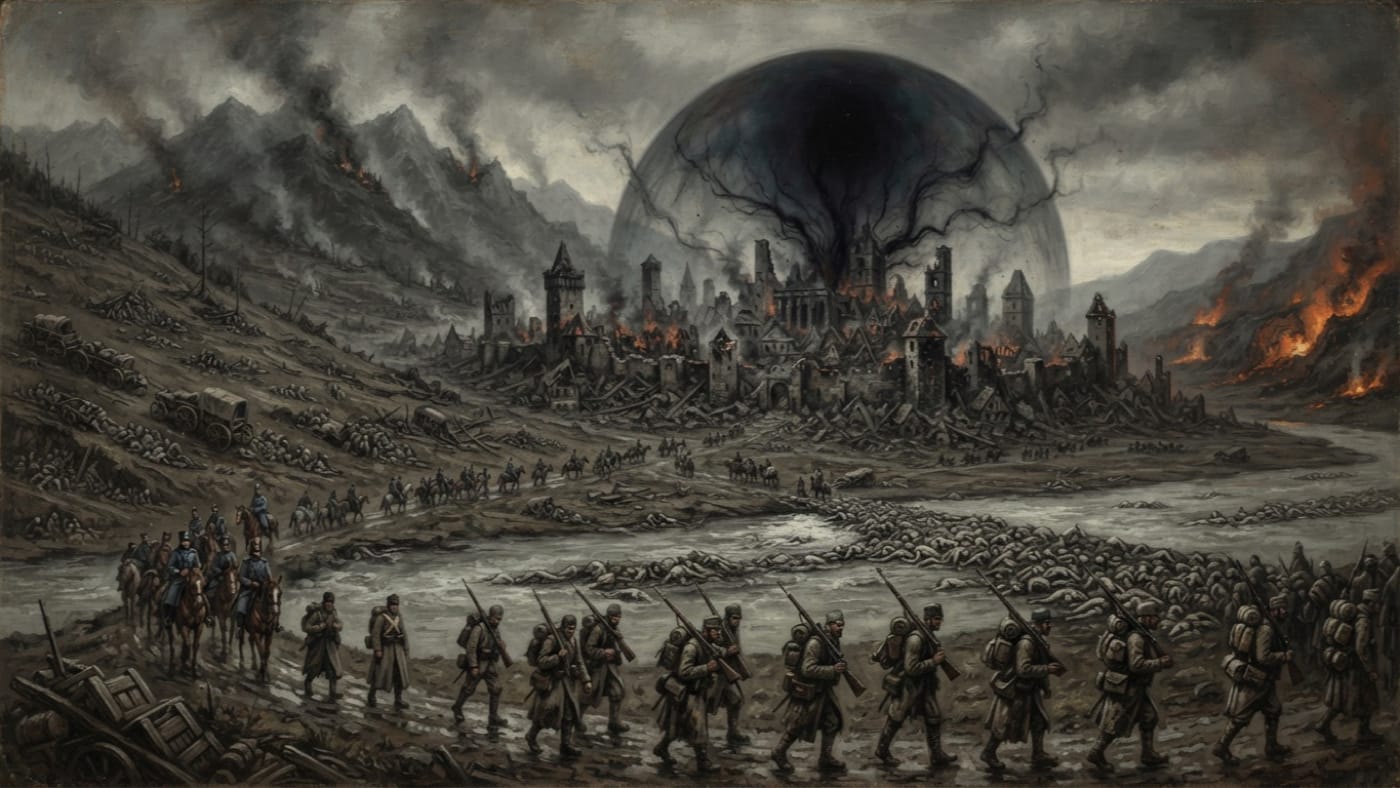
Brașov sat below the Carpathians in a bowl of Transylvanian slope. It was a Saxon town that trusted its walls the way a merchant trusts his scales. The guilds held its towers and the burghers kept its gates. It had storehouses, a market square and a road running west toward Sibiu, where Bastion-Sibiu now keeps the corridor. The city was built for tariffs, for sieges of the ordinary kind, and for the comfortable belief that an enemy goes home once it has been fed.
The host of Kargath does not go home. Gluttony's abominations came down on the city starved and swollen at once. Their ribs stood out like the bars of a penitent's cell over bellies that hung to the knee. They had mouths in palms, in flanks, in the hollows of the throat, and every mouth was working. The inherited accounts are brief, and they agree on two figures: about one hundred thousand souls, consumed in a single week.
Those figures are the reported scale. They were carried forward by chroniclers who had every motive to round toward horror and no means of counting the eaten. No census survived. The clerks who might have closed a ledger of the dead were themselves entries in it. The Church records the figure as it was received and declines to improve on it.
The local arms did what local arms do. The guild companies held their towers and the garrison held the gates. The Transylvanian levies came in valley by valley and lord by lord, each banner answering its own master's horn, and each was consumed in turn. First the town militia went, then the county horse, then the late reinforcements, who arrived to find the granaries stripped to bare stone and the defenders already inside the enemy. There was no shortage of courage. It was also local, and Gluttony eats locally with great efficiency.
The chronicles say Kargath devoured Brașov. That is shorthand for the work of his host. No credible witness puts the Sin-General at the gates, and this account will not invent one.
#On the Danube and the Thracian Passes
The Brașov Flood happened somewhere else, to other people, under a different master. Schoolroom chronologies blur this, and the blur has been corrected. Brașov stands on no great river. The Flood belongs to the Danube.
There, Velkara's host drove fifty thousand Ash-Fodder into the water. These were conquered men, kept by the enemy as expendables and marched at the river until it filled. Their drowned bodies made the crossing, and Lust's columns walked over them dry-shod. No source this office trusts records where the crossing was made. None explains why the operation took Brașov's name. The fifty thousand drowned on the Danube were a different population from the city's dead. They go in a separate column, and the Church forbids adding the two columns together to manufacture a grand total for the pulpit.
To the south, Maldrake's forces burned the Thracian passes. The Sundering had already made Thrace a furnace; in A.S. 110 Wrath stoked it hotter. Survivors described fire that burned without any fuel a quartermaster would recognise, rock running into slag, and defiles closed by heat alone. The Church records what was seen. The mechanism it leaves to Doctrine, which leaves it to the Creator.
So the year brought three hosts and three disasters. No document proves that the Sin-Generals met, conspired or timed their work together, and the effect required no such proof. The southern front broke in three places, the border companies broke with it, and the roads to the west filled.
#On Strasbourg's Answer
The refugees moved first. They came out of the Carpathian valleys and the Balkan river country with carts, cattle, children and rumours, and the rumours outran the carts. Panic reached the cities of Europe, as the old histories put it. Panic in a city is a fiscal event. It closes shops, empties tithe-boxes and fills chapels with people who suddenly want reasons.
Strasbourg drew the lesson the season had taught. The feudal levies failed at Brașov because they were feudal: raised by a lord, loyal to one valley, trained for one summer and used up in a week. The Synod already had soldiers, garrison chapters and the Line. What it lacked was a body of men drilled to a single standard, answerable to a single office, and replaceable without asking any count's permission.
The First Continental Levy supplied that body. Its demand ran from the Baltic to the Tagus: one son in ten, assessed by household. The decree carried the seals of the Bureau of War and the Bureau of Doctrine side by side, and the second seal was the clever one. War alone could ask for men. War and Doctrine together could define what refusing meant. Refusal was classified as apostasy. An apostate household could appeal to its prince, its guild and its neighbours, and found all three suddenly occupied elsewhere. Treason is a quarrel between a subject and his lord. Apostasy is a contagion, and nobody stands near a contagion for the sake of a neighbour's son.
The Synodal histories record that, though protests rumbled from Paris to Seville, none dared open defiance.
Corrected. Lyon tore up its cobblestones. Bruges killed Assessors. Cologne filed objections and lost a guild-master for its trouble. The defiance was open, loud and brief. Enforcement produced compliance, and compliance was then entered in the record as an absence of defiance. The earlier sentence is withdrawn as an error of tense.
An early marginal gloss rejoices that "the Synod devoured ten sons per household."
Corrected. The rate was one son in ten. Few households had ten sons to give, and a quota of ten would have harvested mostly widows' curses. A fraction is gentler on the page and more durable in practice, which is why it was chosen.
The emergency was real. A hundred thousand were eaten, fifty thousand drowned and Thrace burned. All of that was true, and all of it was useful. The measures drawn up for one terrible season discovered that a fraction keeps where a city does not. The early musters were disorderly enough that by A.S. 112 the Bureau of Conscription was constituted to administer what the decree had begun. The instrument's later life of assessments, musters, renewals and evasions is recorded under the Continental Levy, where it continues to grow.
#On the Ruin and the Continuing Obligation
As of A.S. 201, Brașov is a devoured ruin under Orison restriction. Entry requires a Pass stamped with the Seal of Orison. The Black Dome lies over the city, an acoustic hazard where sound dies. Its onset is undated and its cause is undetermined, and this office will not supply either from a theory it happens to like. The Lore Book preserves an undated account of one regiment that went in without permits. It came out days later with its eyes gouged and its tongues gone, carrying a banner no one could read. No recolonisation has been authorised. The Saxon walls still stand around nothing they were built to keep.
The Levy has outlived the city it was decreed to avenge. Brașov ended in a week, and the obligation it justified is now in its second century, collected every generation and sealed twice over. Doctrine remembers the dead of 110 with a feast-day, a casualty abstract and a recruitment rate. Of the three, only the rate is still in force.