
#On the City That Entered the Ledger by Mouth
Brașov was a Saxon-walled city below the Carpathian teeth, a market of gates, guild towers, mountain roads, fortified churches, leather aprons, brass scales, and that sour civic pride common to towns which have survived enough sieges to mistake endurance for election. It stood where routes from the Transylvanian (Unregistered) interior bent toward the Danube approaches and the Sibiu corridor; a useful place, which is the first stage of being ruined.
In A.S. 110, Kargath consumed it in a single week.
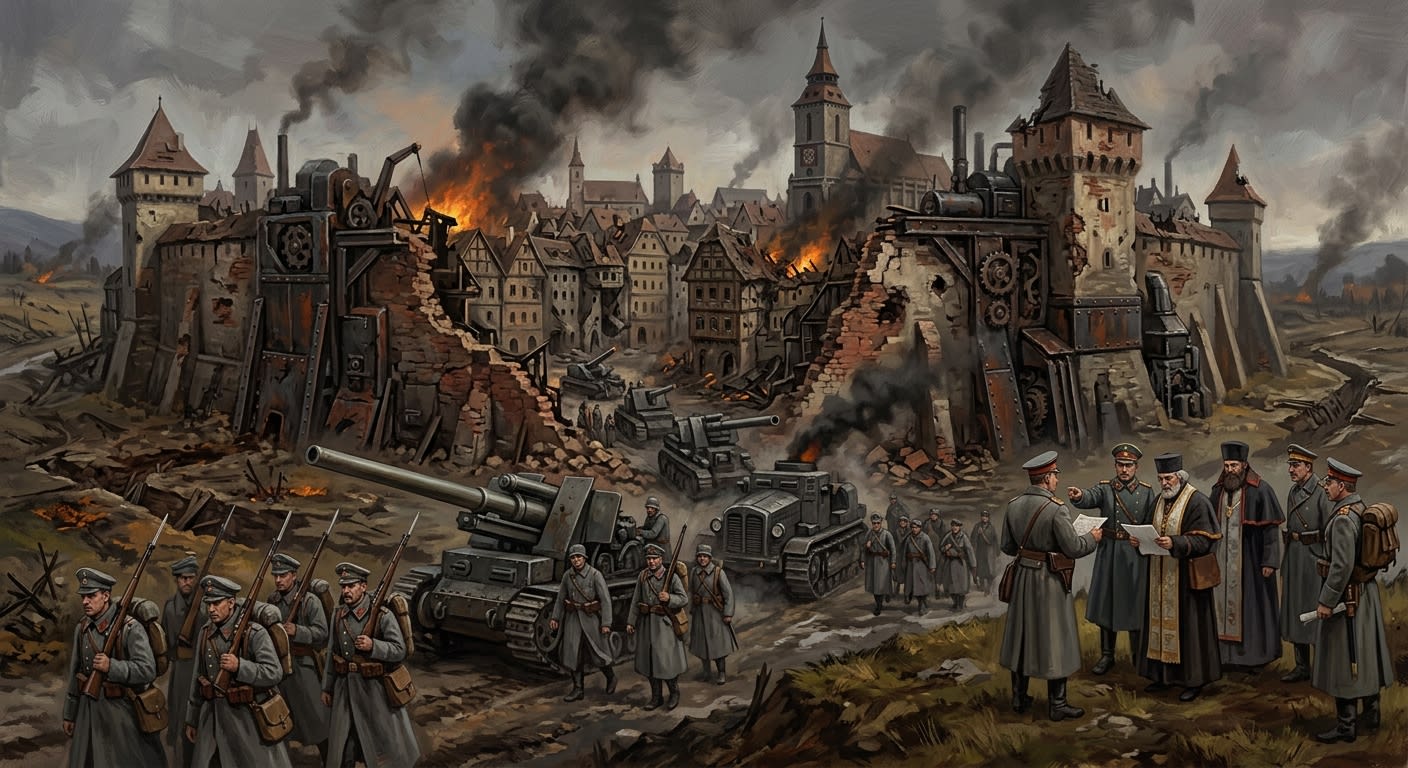
The sentence is too tidy. It has the shape of a report and the moral weight of a coffin label. The city did not fall in the honourable sense beloved by mural painters and officers with clean boots. Its walls did not surrender after a measured bombardment. Its councils did not sign terms. Its garrison did not march out with drums. Brașov was entered, surrounded, digested, emptied, and made available for later atrocity. One hundred thousand souls were converted into absence, and the Rationalist remnants, in their last service to cowardice, called it plague mortality.
The Brașov Flood followed: fifty thousand Ash-Fodder from the surrounding lowlands driven into the Danube under Velkara's overseers until their bodies formed a causeway for her host. The Flood is an event. Brașov is the wound beneath it. The Flood shows what Hell did with the countryside after the city had been eaten. Brașov shows why Strasbourg learned to turn fear into arithmetic.
#On the City Before Appetite
Before the devouring, Brașov possessed all the virtues that make a city worth taxing and worth hating. It had walls repaired by men who could argue mortar ratios for an hour and still distrust the man beside them for worshipping with the wrong grandmother's hymn. It had guild halls where tanners, smiths, chandlers, mule factors, scribes, and toll-keepers fought over precedence with the solemn ferocity of bishops debating the position of angels. It had churches thick-walled enough to shelter families during raids, cellars cut into stone, market stairs rubbed smooth by boots, and towers named after trades now extinct in the district because the men who practiced them were eaten with their tools.
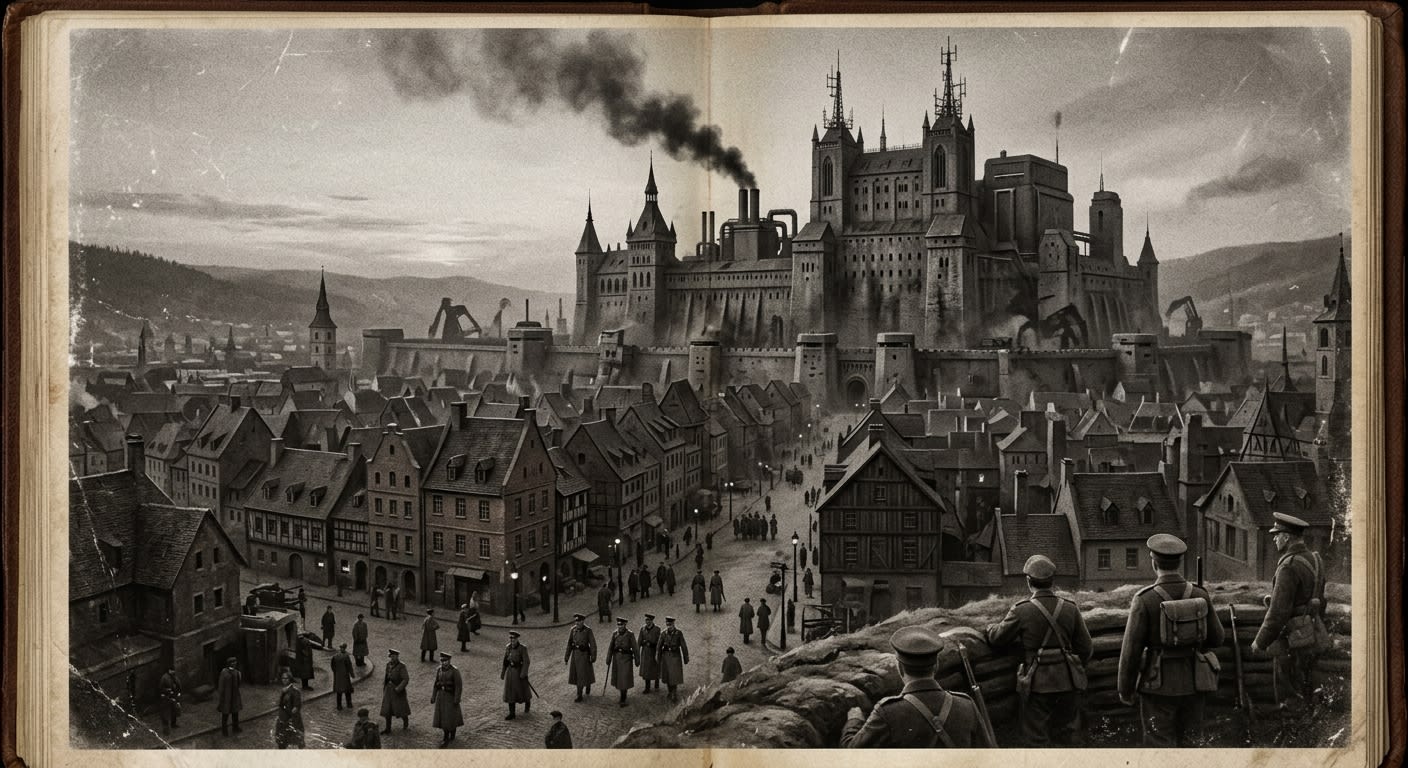
Its geography made smugness plausible. Mountain approaches guarded the east. River roads brought money. Fortified villages fed its markets. Saxon burghers kept accounts in a hand so narrow it seemed designed to deny mercy entry between the letters. The city had survived border wars, Ottoman shadows, merchant feuds, priestly quarrels, tax collectors, winter, wolves, and every species of provincial foolishness by which mankind prepares itself for the wrong disaster.
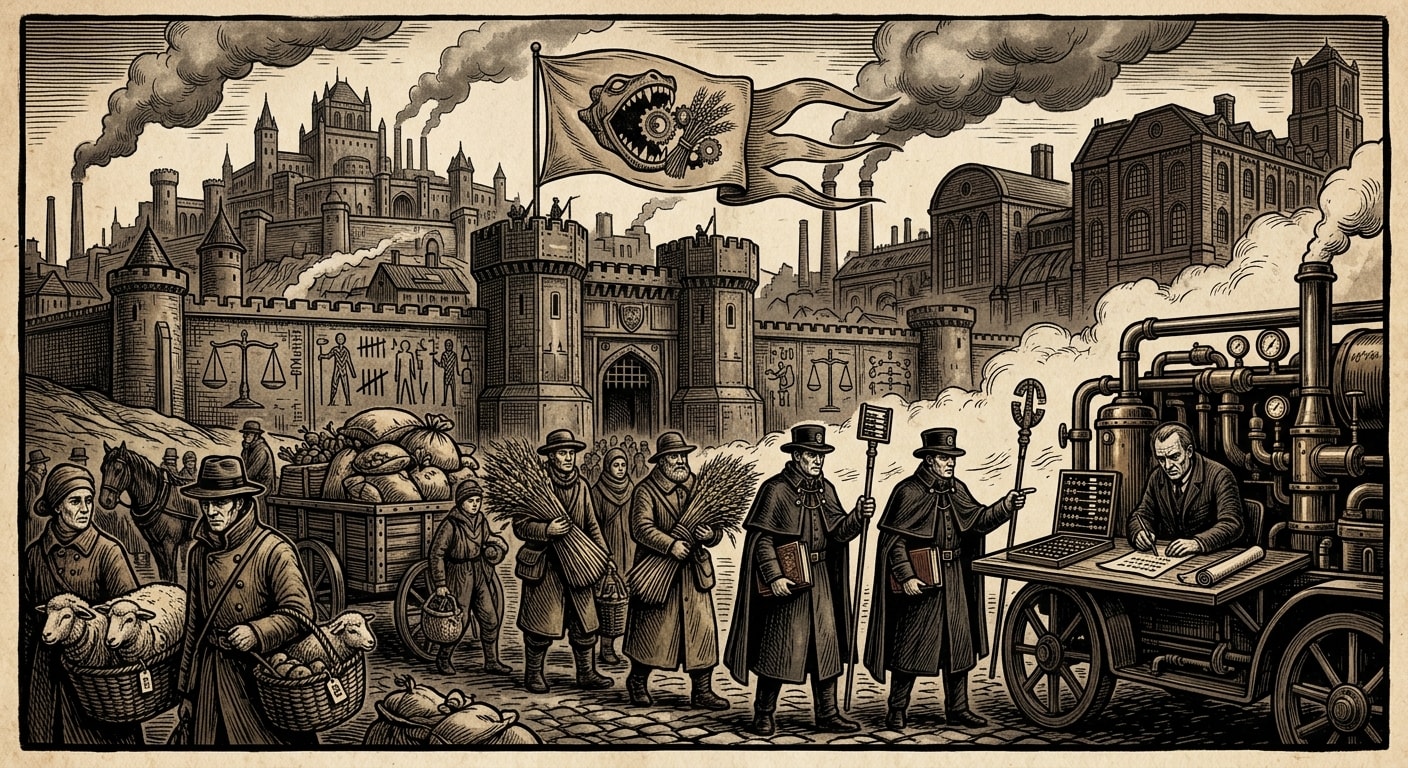
Brașov's old ledgers show leather, iron, wool, honey, wax, horseshoes, salt fish, lamp oil, pilgrim ribbons, roof timber, and toll receipts in healthy columns before the crisis years. Household books survived in fragments because household books hide in better places than banners. A woman named Marta Gell bought lampwick on the third day before the eastern farms went silent. A cooper paid his guild dues in advance. A butcher disputed the weight of a winter hog. Such entries are the true reliquaries of a city. Grand charters flatter themselves. Shopping lists tell us who expected breakfast.
Then the outer villages stopped sending carts.
#On the Week of Gluttony
The first reports spoke of empty farms with warm hearths, troughs licked clean, pigs gone, dogs gone, wells rimed with grease, and barns full of silence. Scouts found doorframes gnawed through at shoulder height. A mule train arrived without mules, the wagons dragged by men whose mouths had been stitched around bits of harness. The men died before confession. Their stomachs contained pages from a parish register, which Records treated as an archival complication and Medicine as diet.
Kargath's abominations entered from the eastern roads and the lower woods. They were swollen things of jaw and belly, Maw-Born, Hollow-Walkers, throat-crawlers, men altered into famine with legs. They did not besiege in the formal sense. Gluttony has no patience for ceremony when a pantry stands unlocked. They came through culverts, cellars, side gates, roof gaps, chapel crypts, water channels, and market drains. A city is full of mouths through which an enemy may enter if the enemy thinks like hunger.
BRAȘOV WATCH FRAGMENT — RECOVERED FROM WESTERN TOWER STAIR Third bell: east gate still held. Fourth bell: east gate no longer relevant. Fifth bell: something in the grain hall answered roll call in voices of stored men. Sixth bell: Captain Halden ordered the bells rung continuously. Bellringer eaten at rope. Rope continued moving.
The city tried to defend itself by districts. The Leather Quarter barricaded the lane with curing racks and wet hides. The Brass Scale Guild armed apprentices with weighing hooks. The Saint Michael stair became a killing slope until the bodies at the bottom rose by being eaten from within. The churches filled. The cellars filled. The sewers filled. Hunger, unlike artillery, improves in confined spaces.
The bells rang until no legal hand remained to ring them. Survivors claimed the ropes moved afterward, pulled from below by something that had learned civic alarm from the inside of a bell tower. Bells disputes this. Bells disputes many things that occurred while bells were being used more honestly than their keepers preferred.
Rationalist and early Synodal abstracts described the Brașov catastrophe as epidemic collapse compounded by refugee panic.
Corrected. Epidemic does not chew hinges. Panic does not sort bones behind bakeries. Refugees do not leave bite marks on church bronze fifteen feet above street level. The city was consumed by Kargathite forces in A.S. 110.
#On the Survivors Who Failed to Exist
Survivor is a generous word. The Bureau applies it to any body that moves west far enough to be questioned, taxed, quarantined, or used in a sermon.
Refugees reached the roads in broken strings: children with flour packed into their ears to stop the chewing sounds, women carrying door latches as proof of houses, old men whose beards had frozen with someone else's blood, apprentices still wearing guild badges that entitled them to nothing because the guilds were now stomach contents. Many had no names left in useful order. Some had eaten paper to preserve it from the enemy and could recite only the first line of their household rolls before retching ink.
Strasbourg disliked them at once. Refugees are accusation with feet. They arrive smelling of the policy that failed them. Mayors along the western road requested guards, bread, priests, quarantine chalk, and permission to close gates. Permission was granted selectively, which is to say on terms later described as mercy by men indoors.
The Bureau of Records established provisional Brașov rolls at three receiving stations. The first roll burned when a clerk set a lamp too close to drying pages. The second was seized by Purity after twenty-seven names appeared twice, once living and once listed among teeth recovered from a courier's bone-case. The third became the official roll because it was least legible and least embarrassing.
Several survivors spoke of a black quiet descending over the upper city after the feasting. Others described no quiet at all, only wet industry. The contradiction later gave Orison scholars their excuse for the Black Dome classification. I am suspicious of excuses that arrive bearing academic robes, but even I concede that Brașov's sound behaved badly after A.S. 110.
#On the Flood Beneath the City
The city proper belongs to Kargath. The Flood belongs to Velkara. Confuse them and you will please War College diagrammers, which is a sin adjacent to bad typography.
After Kargath's forces consumed Brașov, Velkara's host took the surrounding lowlands and collected the living remainder into use. Fifty thousand were driven to the Danube with iron gags and whips. The strongest went first into the fastest water; the light were layered above; the mouths were weighted; the current was obstructed; the host crossed on the dead. This was not appetite as Kargath teaches it. This was desire made structural, the Shattered Courts' doctrine written in bodies and current.
The distinction matters because Sin is not decorative. Gluttony consumes the city until rooms become throats and streets become digestive sequence. Lust converts persons into instruments for another's passage. Brașov received both doctrines in order: first the feast, then the bridge. A theologian could dine for a year on that sequence. A decent man would lose his appetite. The Synod employs more theologians than decent men, which explains the number of lectures.
The Danube held the bridge for nine days. The city held nothing. Its absence travelled faster than its refugees. By the time the first accurate reports reached Strasbourg, inaccurate ones had already done the better work. Teeth in bone-cases. Bells ringing without ringers. Rivers choked with households. Thracian passes burning under Maldrake. Fear does not require precision. It requires image, repetition, and a clerk willing to stamp while pale.
#On the Levy Born from Brașov
The First Continental Levy was Strasbourg's answer to Brașov, which is to say Strasbourg answered one devouring with another and called ours obedient.
A.S. 110: one son in ten, every household between the Baltic and the Tagus, under joint seal of War and Doctrine, the first modern form of the Continental Levy. The old feudal levies had dissolved into local courage and local extinction. Brașov proved that border principalities, guild militias, village pikes, and proud little banners could not hold against Sin-Generals who used cities as meals and civilians as engineering stock. The conclusion was sound. The appetite it licensed has never stopped chewing.
The Field of the Sixth Psalm in Strasbourg filled with boys. Lyon rioted. Bruges killed the wrong Assessors. Cologne petitioned and was corrected. Seville received the decree late and complied early, a feat of terror the Bureau still mistakes for devotion. Mothers were instructed by Mercy pamphlet to kiss their sons cheerfully. Fathers were instructed to stand straight. Sons were inspected by teeth, height, confession, limb, and usefulness. The state discovered that a continent could be counted by removing a fraction of its future.
Provincial sermons called the First Continental Levy “the offering inspired by Brașov.”
Corrected for internal doctrine. Inspiration is what poets suffer and clerks mistrust. Brașov supplied pretext, terror, evidence, and administrative appetite. The offering was compelled under seal. The cheerfulness came later, printed at public expense.
The Levy's defenders say the Line required it. They are correct. The Levy's enemies say Brașov made cruelty convenient. They are also correct, though rarely alive in office long enough to enjoy the accuracy. Contradiction is not a flaw in statecraft. It is the hinge.
#On the Black Dome
Brașov's ruin was worse than silence. Silence would be mercifully simple. The city became acoustically unreliable.
The Black Dome of Brașov appears in Orison training as the standard warning for unauthorised entry into silence-class districts. A regiment once entered without Dome Passes: rifles, rations, ordinary confidence, the whole charming kit of men about to educate a file. They emerged days later with eyes gouged, tongues absent, carrying a banner no one could read. Records copied the alphabet once and burned the copy. Orison instituted stricter pass doctrine. War asked whether the regiment had achieved reconnaissance. Doctrine pretended not to hear the question.
No one agrees where the Dome begins. Some say at the old eastern gate, which is no longer standing except in drawings that hate the viewer. Some say at the market square, where every footstep arrives late to the ear. Some say the whole ruin lies under it on damp days. The current Orison map draws three nested hazard rings and a fourth ring in pencil. Pencil is how a Bureau admits fear without committing ink.
The Dome does not preserve Brașov. It refuses ordinary access to what remains. A man may shout and hear nothing; whisper and wake a tower; drop a cartridge and hear his mother's baptismal name spoken from a cellar. The city has not been quiet. It has been badly sealed.
#On the Present Ruin
As of A.S. 201, Brașov is listed among devoured cities, ruined districts, and Orison-restricted acoustic hazards. Maps place it east of safety and west of certainty, which is where many useful lies live. The road approaches are watched from a distance. Scavengers go in when hunger makes courage cheap. Few return with goods. Some return with duplicate shadows. Some return carrying spoons from houses that no longer exist and insist the spoons are warm.
The Saxon walls survive in bitten segments. Guild towers stand roofless, their stairwells packed with dry leaves though no trees remain close enough to explain them. The market square is lower than it was, either from subsidence or from the weight of absence; surveyors disagree, then request reassignment. The churches are entered only by rope team. The fortified nave of Saint Bartholomew has been found empty, full of chairs, flooded, dry, and occupied by a choir of children on five separate inspections. Orison has sealed all five reports as mutually valid.
No formal recolonisation is planned. This is called prudence when spoken by War and cowardice when muttered by refugees whose grandchildren still keep Brașov keys in kitchen drawers. The keys open nothing. They remain excellent objects for grief, which requires weight more than function.
The city continues to feed the Synod in its approved manner. Levy sermons name it. War colleges diagram it. Purity lectures against appetite with it. Engineering studies the Flood born beneath it. Orison frightens recruits with its Dome. Records maintains provisional rolls for the unconfirmed dead, the confirmed uncounted, the counted misnamed, and the named who should have been dead but filed appeals.
At Brașov, the bells rang after the bell-ringers were eaten. If this is miracle, it is an ugly one. If it is machinery, it is worse.