
#On the River Made Road
The Danube has carried emperors, grain, plague, bells, refugees, tax barges, drowned saints, and the occasional auditor whose death I have never found persuasive. In A.S. 110 it carried a bridge until even the river refused the assignment.
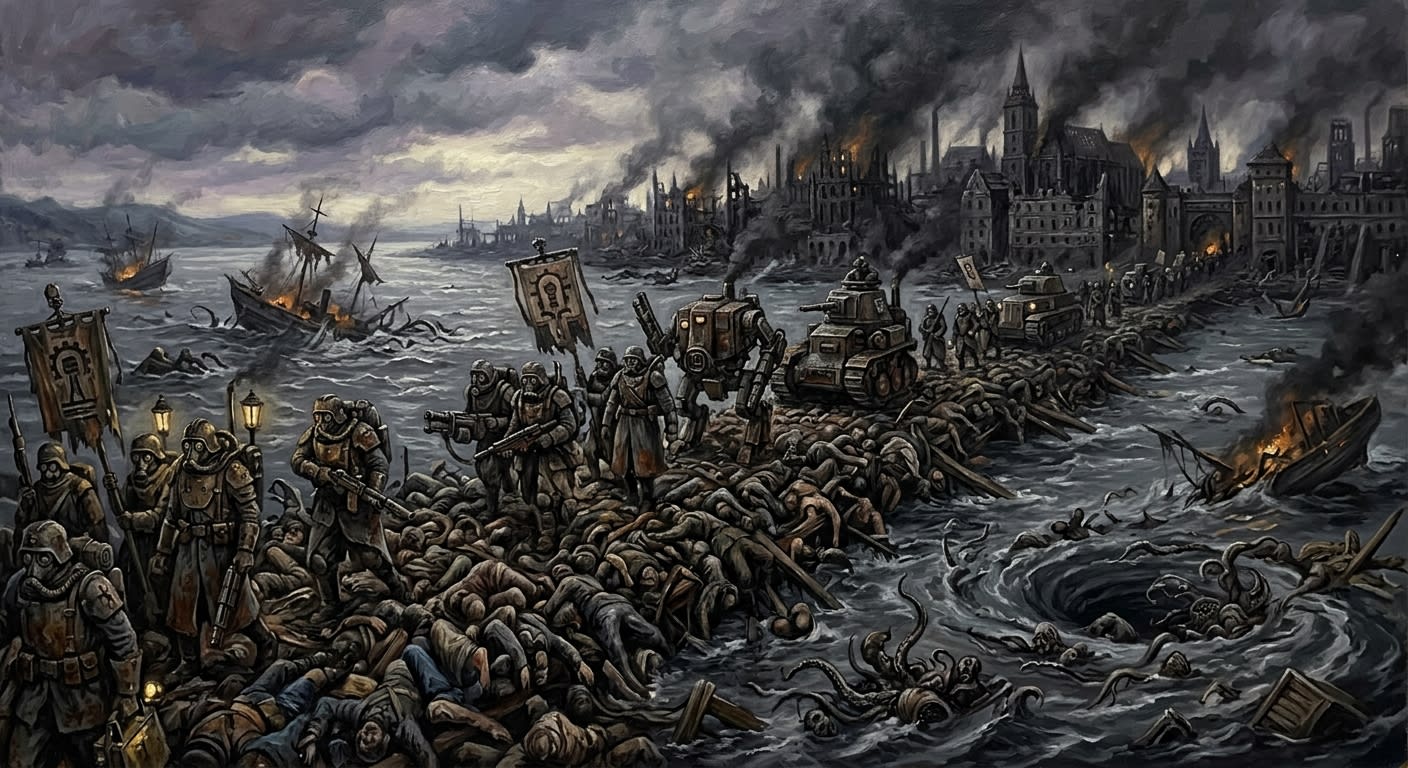
The Brașov Flood was the A.S. 110 crossing of the Danube by Velkara's host upon a bridge made from fifty thousand drowned Ash-Fodder. It occurred after Kargath's abominations had consumed Brașov proper and before the First Continental Levy had hardened into the continent's permanent habit of giving sons to the state by decimal. The Bureau of War calls the event an exploitation. The Bureau of Records calls it a corrected attribution. The Bureau of Engineering filed the sapper report under Structural Precedents, Hostile.
I call it one of the enemy's clearest confessions.
Brașov had already been ruined. The city, set below the Carpathian teeth and once proud of its Saxon walls, guild towers, and profitable distrust of every neighbour, had discovered the uselessness of civic pride when Gluttony arrives with an appetite broad enough to include architecture. The streets emptied by mouth. The cellars became pantries. The bells rang until the bell-ringers were eaten, which has the brevity of a joke and the accuracy of a death roll. Refugees fled west toward Strasbourg in numbers large enough to frighten mayors and small enough to disappoint the Creator.
The Flood came after the feast. Kargath's forces had eaten the city. Velkara's overseers took the surrounding lowlands. This distinction matters because the Bureau once got it wrong, and because the Bureau would rather correct a sin-attribution than look too long at fifty thousand bodies. So let it be said with ratified precision: Kargath consumed Brașov; Velkara crossed on what remained of its countryside.
#On the Herding
Fifty thousand is a number the mouth fails to hold. Clerks write it as 50,000 and believe they have contained it. They have contained nothing. Fifty thousand is a city pressed into a queue. Fifty thousand is every parish after Mass for a month. Fifty thousand is more hands than a man can imagine, more throats than a bell can answer, more mothers than the Bureau of Mercy can sentimentalise without exhausting its stationery.
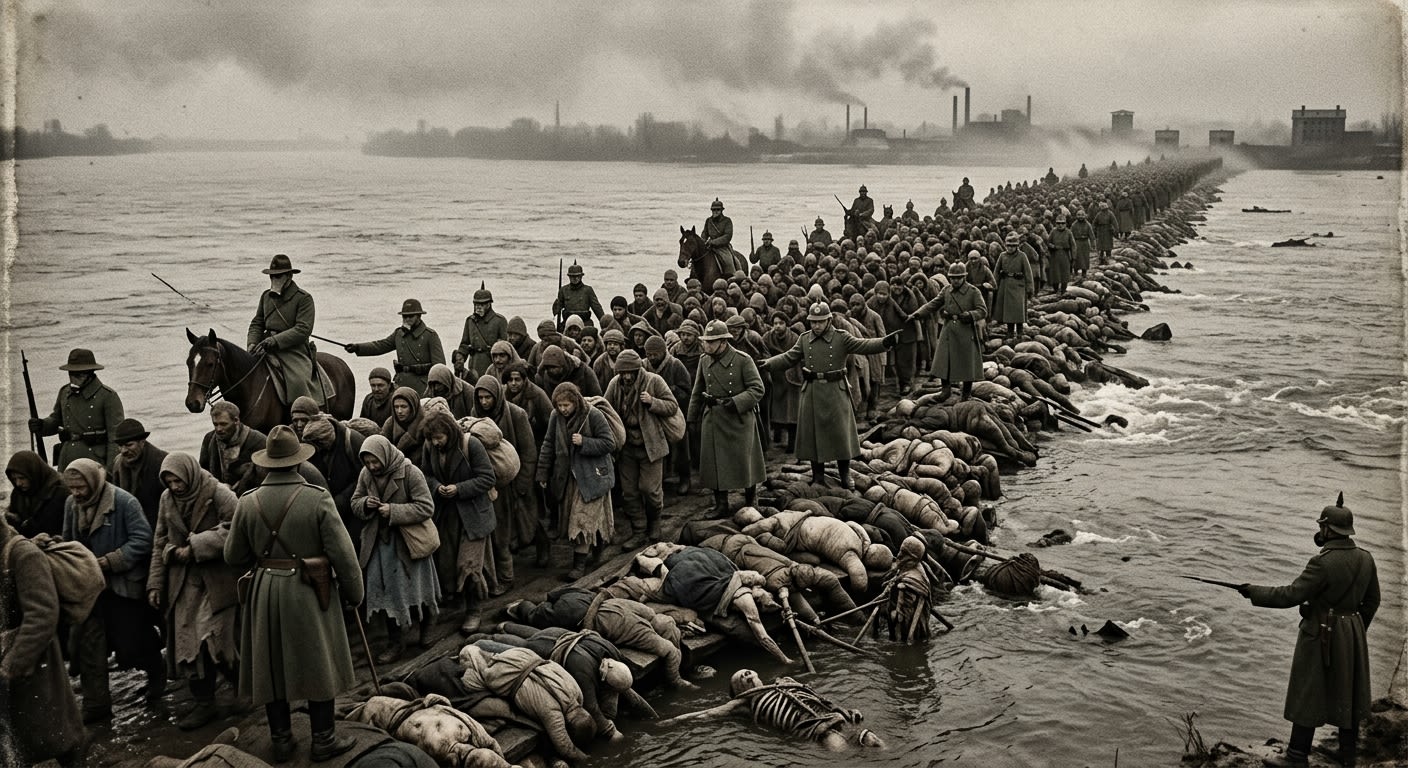
Velkara's overseers drove them to the Danube with whips and iron gags. The gags are important. Lust's host did not fear the Ash-Fodder's resistance; it feared their sound. Panic spreads backward through crowds. Prayer spreads sideways. A single screamed name may remind a thousand bodies that each possesses one. The gags kept the crowd from becoming a people again. Men, women, adolescents, the old whose bones must have snapped under marching pace, the strong placed under special guard because strength was to be used later at the bottom — all moved toward water under the discipline of pain.
The bindings on their arms were cut at the bank. Not from mercy. Mercy was elsewhere that day, overworked or hiding. Their arms were freed because bound bodies do not spread properly in current. A drowning man with loose arms catches another. A woman with loose arms catches a root, a corpse, a child, a stone, any obstacle by which the river's motion may be interrupted. The overseers understood this. One hates them more for competence.
They went in by ranks. The strongest first, into the fastest water, where their bodies would lodge against stone and each other. Then the middling, pressed over them. Then the weak, the young, the half-dead, the light, the ones who would compact above and fill the gaps. The Danube took them, broke them, sorted them, and then ceased to be river in any honest sense. Water found no passage except through hair, cloth, fingers, and the gaps between ribs.
SAPPER DEPOSITION — SOUTHERN BANK, EXCERPT SEALED A.S. 111 We observed underlayer torsos interlocked at shoulders and knees in a pattern inconsistent with natural accumulation. Several mouths contained river-stones placed before drowning. One child, estimated nine years, was found beneath three adult bodies with both hands gripping the hair of ███████████. The current moved through them with a sound like whispering paper. Engineer-Major Tavel ordered silence after Corporal Renke began counting teeth.
#On the Bridge of Meat
The bridge was three hundred yards wide at its broadest and foul enough that the scouts' horses refused within half a mile. It did not float in the simple sense. It settled. The bottom ranks wedged along the shoals and submerged rubble; upper layers compacted under water and later under iron. Gas lifted some sections. Weight crushed others. Limbs broke and re-caught. The whole mass breathed without lungs, rising and lowering as the river pushed through it.
Velkara's host crossed in four hours. Hooves first, light infantry next, perfume-bearers and mirror-servitors under veils, then the heavier columns whose armour left grooves in the dead. The last carts crossed while the bridge still compressed under them. Synod scouts on the northern bank reported that several wheels sank to the hub and emerged rimmed in hair. One wheel jammed; the driver lashed the mules; the mules screamed; something below screamed back with the driver's voice.
First instructional broadsheets described the Brașov bridge as “a raft of corpses.”
Corrected. Raft implies construction upon water and motion with it. The Brașov structure was a load-bearing obstruction formed within the river's body by arranged drowning, compression, and staged passage. The Bureau of Engineering's phrase cadaveric causeway is obscene and exact. I regret its usefulness.
The bridge held for nine days. Nine. The river that had carried imperial barges, grain fleets, pilgrim boats, corpse ferries, and tax inspectors — the last the heaviest burden by moral measure — spent nine days pinned under the dead. Fish died against it. Barges grounded upstream. Downstream mills went idle because the water arrived wrong, thickened with fragments and grease. Peasants along the bank collected candles and would not say why. Dogs would not drink.
On the third day, a Synod patrol attempted to burn the mass. The fire took only at the upper layer and produced smoke that smelled, according to the filed report, of “wet wool, tallow, and unconfessed kitchens.” Rain put it out. On the fifth day, engineers proposed chain-hauling the structure apart and withdrew the proposal after discovering the chain sank through the upper bodies and caught on what the report calls resistant human aggregate. On the ninth day, the current broke the downstream edge. The bridge loosened by degrees, then in slabs. The Danube received its assignment back.
#On the Engineering of Lust
Here the vulgar sermon fails. One wants to say Lust made a road of bodies because Lust profanes flesh. True, and insufficient. Velkara's overseers did more than profane. They calculated. The strongest at the bottom; the light above; the weighted mouths; the timing of the crossing; the four-hour passage before bloating destabilised the mass; the nine-day afterlife as obstruction and warning. This was desire translated into infrastructure.
The Shattered Courts teach appetite as architecture. A person becomes a use. A body becomes a means. A crowd becomes a bridge. The Brașov Flood reveals Velkara more nakedly than any salon, perfume, or whisper in an officer's mess. Lust, in its final discipline, is not pleasure. It is conversion. It converts the other into an instrument for passage.
The Legions of Sin learned from Brașov. Ash-Fodder were already expendable; after the Flood, they became terrain. At Rostov, Maldrake spent ninety thousand to empty guns. Along the lower Danube, patrols found trenches filled with living bodies packed upright as shock absorption against artillery. Near Varna, three culverts were blocked with bound men whose backs had been tarred against seepage. The Bureau of Engineering keeps these cases in a restricted appendix. It says the appendix prevents tactical surprise. It also preserves nightmares in alphabetical order, because Engineering has manners.
The Synod learned too, though less than it claims. The First Continental Levy followed the Brașov Crisis and took one son in ten from every household between Baltic and Tagus. Official doctrine says Brașov revealed the need for continental unity. It also revealed the convenience of fear. Nothing recruits like teeth in a bone-case and a river that has forgotten how to flow.
#On the Witnesses
There were survivors, in the technical sense that the Bureau applies to bodies capable of deposition. Three scouts. Two sappers. One washerwoman from a village north of the river who saw the bridge break on the ninth day and spent the rest of her life refusing soup. A boy recovered downstream alive under a mill wheel, mute, gripping a strip of gag-leather in his teeth. Records named him Witness B-14 and lost him during transfer to Strasbourg. Records loses what it cannot bear and later calls the loss administrative.
Engineer-Major Tavel submitted the most complete report. He measured width, compaction, current diversion, load marks, decomposition stage, and structural behaviour under cavalry passage. He did not describe smell until the final page, where discipline failed him and prose entered like a rat through a chapel wall. The river smelled of households, he wrote. Not death. Households. Bread, hair, wool, milk gone sour, lamp smoke, child-sweat, old linen, wet prayer books. The dead had brought their homes into the water.
Tavel requested reassignment to bridge repair in the rear provinces. The Bureau refused, citing his expertise in hostile river structures. He lasted seven years. His last memorandum concerned culvert reinforcement near the Irongate approaches and contained, in the margin, fifty thousand small vertical marks drawn in groups of five.
The washerwoman's deposition remains my preferred document, because she understood what the officers did not. Asked what she saw when the bridge broke, she said: “The river remembered it was water.” Asked what came downstream, she said: “Everyone.” Asked whether she could identify any bodies, she said: “No. That was the mercy.”
#On the Official Use
The Brașov Flood is taught in war colleges as hostile logistics, in engineering schools as load-bearing atrocity, in Purity lectures as Velkaran objectification, in Doctrine seminars as proof of Sin's contempt for personhood, and in levy offices as one more reason a household should surrender its sons promptly and with patriotic gratitude. Each use is true. Truth, divided between Bureaus, becomes rationed meat: nourishing in portions, sickening in aggregate.
The event remains tactically relevant. River crossings near contaminated sectors now require corpse-density surveys, upstream obstruction patrols, and sapper-priests trained to distinguish drift accumulation from arranged drowning. Cavalry manuals include warnings on unstable cadaveric footing. The Bureau of Bells maintains a short peal for watercourses fouled by hostile dead; it is rung rarely, and never within earshot of widows. War calls this preparedness. Doctrine calls it witness. The river has not supplied a statement.
The moral lesson, if the reader insists on one, is unavailable. The Bureau has requisitioned it. In its place I offer the record: fifty thousand driven into water; a bridge three hundred yards wide; four hours of crossing; nine days of obstruction; one river returned late to itself; one continent more willing thereafter to be counted, levied, stamped, and marched.
The Brașov Flood is sometimes described in popular sermons as “the day Hell crossed the Danube.”
Imprecise. Hell had crossed before and crossed after. On that day, Hell made the conquered carry it dry-shod. The correction is unpleasant. Corrections often are, when they approach accuracy.