
#On the Appointed Ear
The Creed goes in at the right ear. The left ear is classified, in the established phrase, "doctrinally vulnerable." Those two provisions are what Bureau Circular 88-D is known to contain, and every ward chaplain, rite-speaker and bedside clerk in the Church is required to obey them. The Synod has issued a great deal of paper that says more and means less.
The circular governs one gesture inside the Rite of Passing, the sequence by which the faithful are witnessed out of temporal custody. When I summarised that sequence in The Dead, I gave the ear one clause and the circular its number. Readers have since written to ask what else it says. This entry is my answer, and my answer is the ear.
The theological reason for the distinction has never been supplied. The classification carries the authority of the Bureau of Doctrine, which defines what words mean and has no duty to tell the rest of us why they mean it. I asked. Doctrine answered by restating the classification in a better hand.
#On the Bedside Application
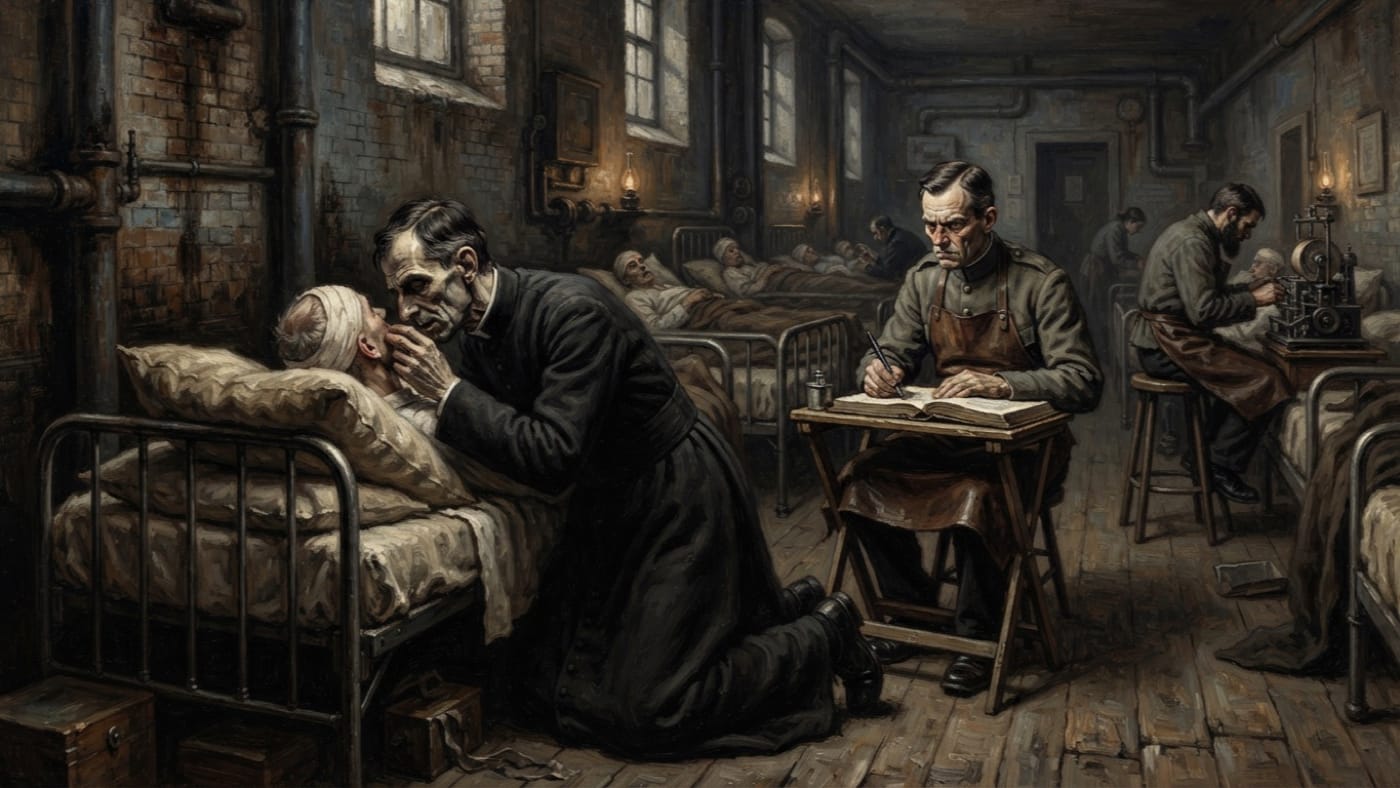
The Rite's instruction is plain. Where architecture and injury permit, the dying person lies with the head slightly raised and the right ear exposed. A priest or licensed rite-speaker bends to that side and whispers the Creed. Kin may stand near the bed. A clerk sits nearer, with ink.
Architecture is the first enemy. Masons build wards for their own convenience and to fit the largest possible number of cots, and a cot pushed against a wall on its right side offers the rite-speaker plaster where the ear should be. Injury is the second enemy: a bandage, a burn dressing packed with lint, or a head that cannot be turned without opening what the surgeon has just closed. The Rite needs its qualifying phrase because the dying do not arrange themselves for doctrine. Where the ear can be reached, it is reached. Where it cannot, the clerk records what was done. The Office of the Last Watch keeps "improper ear rite" on its list of failure categories, so the difference is written down somewhere.
Readers confuse two kinds of speech at the same bed. The Creed is spoken to the dying. Terminal confession is spoken by them. The first belongs to the priest or rite-speaker, and to the ear the circular names. The second belongs to the Deathbed Confession Harvester, who turns the minuteglass, ties the witness ribbon, keeps the quill moving and divides the last words into copies, one of them sealed. The speaker attends to the ear while the Harvester watches the mouth. A competent ward keeps the two from jostling over the same pillow. A poor ward learns that a single cot has little room for two professions.
The circular does not, so far as anything I may cite discloses, regulate the Harvester's stool, the ribbon or the glass. Those belong to the confession apparatus and its own instruments. The circular asks for one thing, the Creed in the correct ear, and it asks the same thing at every bed.
#On the Authorities of Departure
One ear does not make a Passing. The Rite surrounds the circular with officers, and each guards its portion. The Bureau of Mercy runs the deathbed: ward, stool, linen and Harvester. The Bureau of Records receives the name and the transcripts. The Bureau of Rites standardises observance and watches afterwards for disturbance. Doctrine supplies classifications such as the one under discussion. The Bureau of Purity comes in when testimony, recurrence or suspected heresy gives it cause, and it rarely lacks cause. Nothing I am at liberty to cite records which of these desks first sealed 88-D. The circular is in force either way.
The sequence goes on after the Creed. Terminal words are taken where the mouth permits. The body is displayed before witnesses, so that the neighbours can swear nobody was smuggled past debt or accusation. A bell marks the hour. The name goes into the Book of Departures in black ink, and the Great Ledger of Souls closes the living account and changes the deceased's standing. The remains are routed to ash, ground or ossuary, where the bone-stamp presses a name into the skull for the last time it will need one.
An earlier draft of this entry stated that "the Creed delivered to the right ear under 88-D completes the Rite of Passing."
Corrected. The right-ear Creed completes the Creed. The Rite also requires witness, terminal words where possible, body display, bell-hour, Departure entry and the routing of remains. A perfectly whispered Creed over an unwritten name is half a Passing and a whole problem.
Piety came to the deathbed before teeth did. Village priests whispered the Creed into dying ears long before any Bureau existed to file it. In A.S. 78 the Lull of Names cost the southern trench wards whatever the dying carried out unrecorded. In A.S. 80 Standing Order 22-C forbade departure from a licensed ward without terminal confession, witness, bell-time and seal. The Confession Reform of A.S. 104 gave the Harvesters their method. Those dates belong to the confession. The ear's circular does not appear among them, and I have left its place in that history blank rather than fill it with a guess.
#On Doctrinal Vulnerability
"Vulnerable" is an exact word. Doctrine might have written "improper" or "irregular" and chose neither. Those words describe a fault in the procedure. Vulnerability describes a condition of the thing itself: an opening, a side left without guard. The classification names the condition and leaves the threat unnamed. It is a verdict without its reasons, delivered with the full confidence of a court that intends never to publish them.
I obey it. Obeying a rule whose reasons you have been shown is only agreement. Obeying a rule whose reasons are withheld is faith, and faith is the Church's business and mine. The Creator did not consult the Hieromnemon on the arrangement of the inner ear, and Doctrine sees no reason to start now.
The ward is less comfortable. A clerk can be trained to follow a rule, but nobody can be trained to judge cases under a rule whose purpose is hidden. Suppose the right ear has been burned away and the left is whole. Does the speaker whisper into the vulnerable ear, or withhold the Creed from a dying man? As far as the circular is known, it is silent. The ward decides, Records files the decision, and Purity may later ask why it was made. When a rule has no stated reason, every exception becomes a confession waiting for an examiner.
The Bureau's own monitoring links careful Passing with quieter dead. I have said so elsewhere and say it again. But no report I have seen separates the ear from everything else. A ward that whispers into the correct ear is usually also a ward that writes names correctly and stamps bone with conviction. The observation shows that diligence pays. It does not show which part of the diligence does the paying. Testing the ear alone would mean licensing someone to do the Rite wrongly on purpose, and I have no wish to draft the application.
The Great Deceiver appears nowhere in the known text. Readers who want him there may put him in their own margins, where Purity can find him.
#On the Present Application
As of A.S. 201 the circular is universal in law and uneven in practice, as is every other part of the Rite. Casualty volume rises, and there are too few Harvesters. The Hospices of Departure fill. In Strasbourg the wards turn their cots so that every right ear faces the aisle, and the linen is ironed so flat it looks like an accusation. Near the front, cots stand where the floor allows. The rite-speaker kneels in mud on the correct side, or pays for the wrong one in the clerk's book.
At every bed the objects are the same. There is a raised pillow. There is a mouth a hand's width from the ear, whispering a Creed the patient may or may not hear. The Harvester's quill waits for the other kind of speech, the family stands at the distance the ward allows, and the bell waits for the hour. Then come the ink, and after the ink the seal.
The right ear receives the Creed. The left ear remains doctrinally vulnerable. Doctrine has given no further guidance on the point, and the ward will be told when it does.