
#On the Mercy That Ends
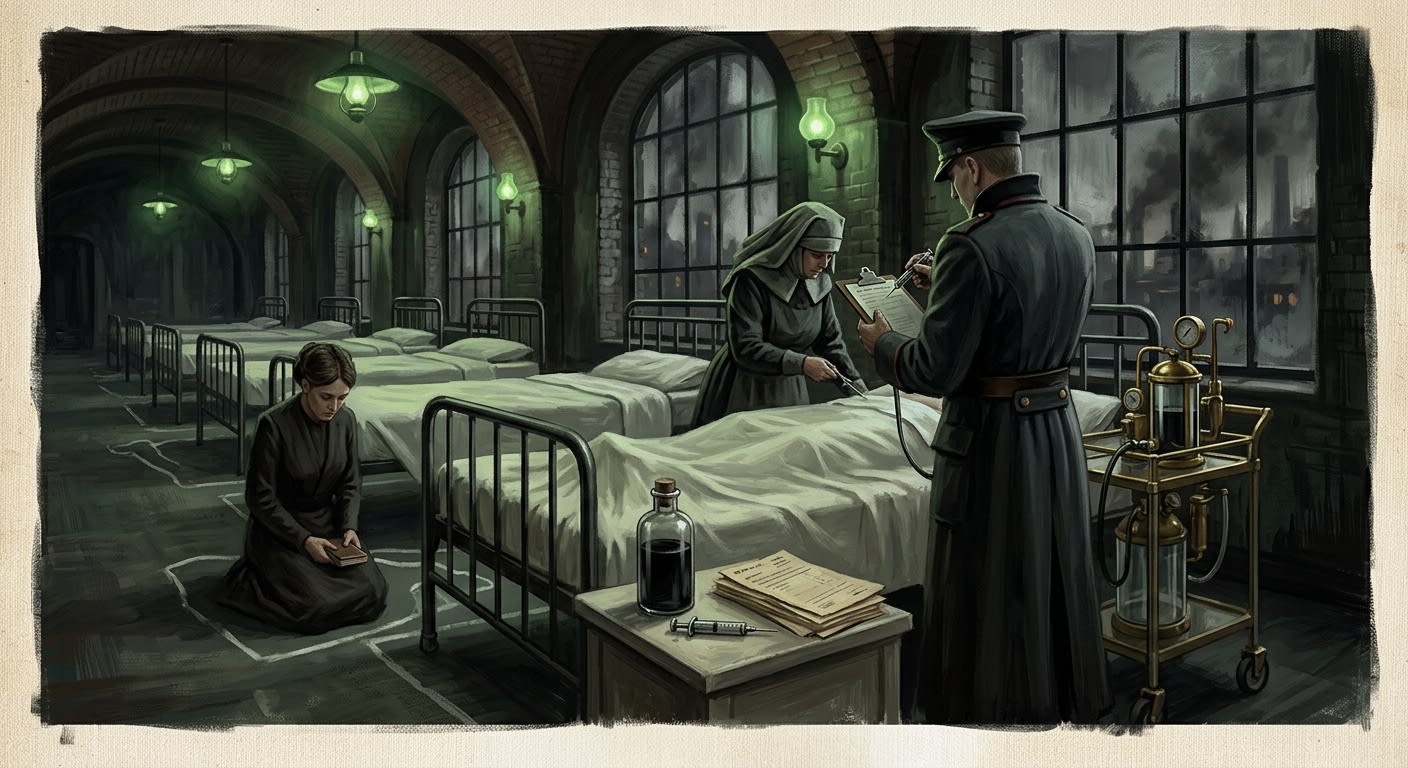
The Hospices of Departure are the Bureau of Mercy's cleanest rooms. This is the first horror and the last kindness. Their floors shine. Their linen snaps. Their windows admit measured air. Their beds carry no stains older than the patient. A Synod subject may spend seventy years in mud, ash, ration queues, trench smoke, audit fear, tithe arrears, broth lines, and rented cots where the previous occupant's cough still owns the straw; at the end, when usefulness has thinned to a candle-wick and the body can no longer be persuaded to serve, the Bureau gives him a bed fit for a bishop and a cup black enough to make theology unnecessary.
The public catechism calls Departure the final mercy owed to the faithful body after labour is complete. The ward-books call it release. Families call it blessing when the children are present and murder when they think the wall is thick. The internal accounts classify the same procedure under Resource Optimisation — Terminal. All four names are accurate. Accuracy is not innocence. It is merely the Bureau's favourite disguise.
The Hospice receives those whom the ordinary ward has ceased to find economical: the aged without labour value, the infirm whose recovery would consume more linen than their future tithe can repay, the retired Wound-Site Prospector whose lungs sing seep-hymns into every bowl, the widow too weak to stand in ration line, the black-zone patient whose suffering has become clerically untidy, the soldier with no remaining limbs of strategic interest, the parish grandmother who has outlived her sons, her allotment, and the patience of every household that once loved her.
No one is admitted by accident. Accident is what happens outside paperwork. Inside the Hospice, every footstep carries a form.
To call the Hospices cruel is to flatter ordinary cruelty. Ordinary cruelty shouts, strikes, neglects, drinks, forgets the basin, leaves the old woman to soil herself in a corner. The Hospice remembers the basin. It warms the cloth. It changes the pillow. It trims the nails. It asks whether the patient would like broth, then records the answer, then serves better broth than the patient has tasted since childhood. Cruelty with bad manners is easy to condemn. Mercy with good linen is a theological knife.
#On Admission
Admission begins before the patient is told. A Mercy Ward marks the body as declining. The clean zone refuses promotion. The grey zone keeps the cot too long. The black screen receives the name. A Ward-Sister who has learned to write without looking down adds the first small mark beside the patient's registration number: D-considered. She may sigh. She may press her thumb into the page until the ink blots. She may later deny both under audit.
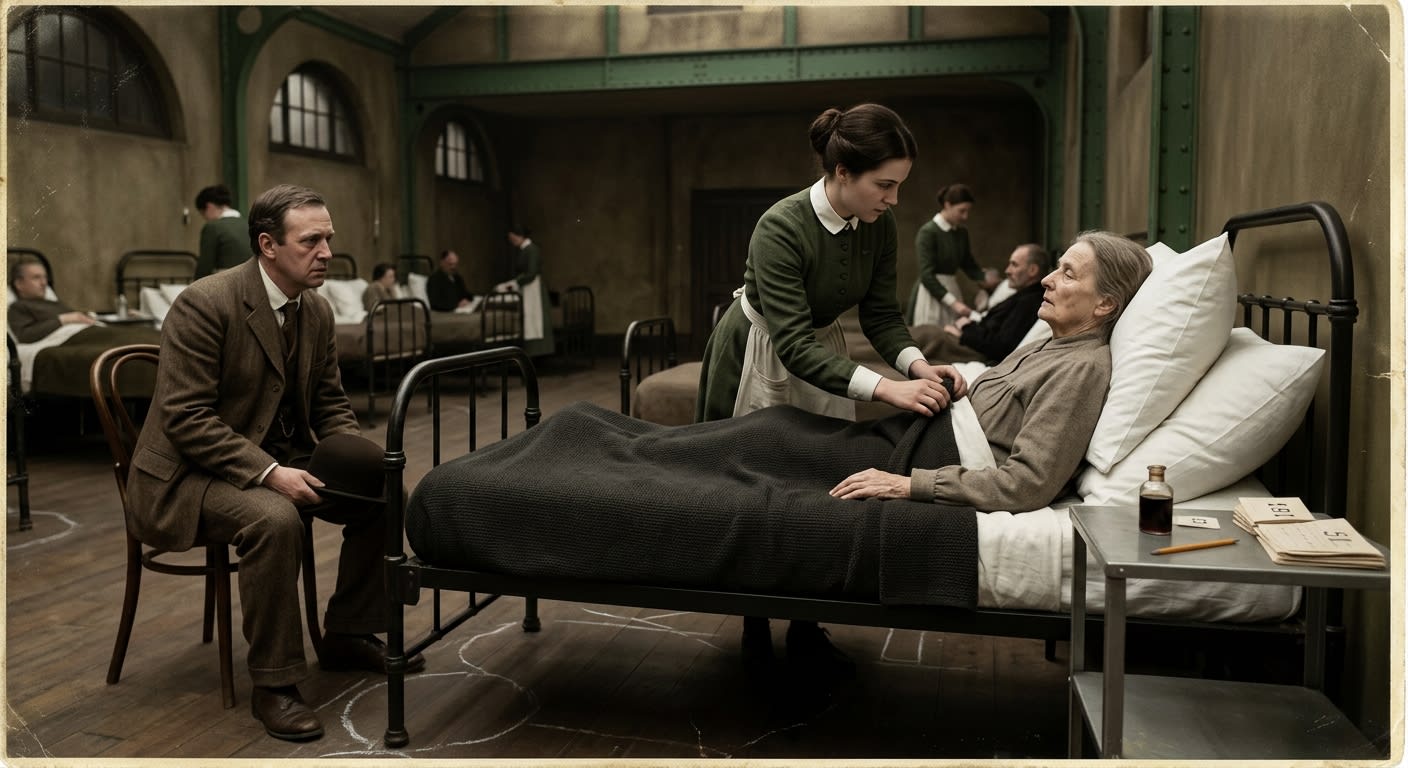
The physician, where one exists, certifies diminished function. The Records clerk certifies identity. The Tithes notice certifies future revenue insufficiency, though Tithes resents being named in soft rooms and prefers to appear as a column. The family receives a summons phrased in the Bureau's tenderest steel: your loved one has been found eligible for Departure mercy; attendance is encouraged; disorder at the bedside will be classified as obstruction of sacramental administration.
Some families resist. They hide the old in lofts. They bribe ward staff. They claim a grandmother can still peel turnips, watch children, mend socks, count beads, frighten debt collectors, and provide spiritual continuity to a household otherwise composed of fools. The Bureau listens with moving patience. Then it asks whether the household is prepared to assume full ration liability, linen liability, infection liability, and posthumous ledger liability. Love often falters at linen.
The poor surrender quickly because poverty has already trained them in surrender. The middling negotiate dates. The rich purchase private Departure suites and call them chapels. Nobles request priestly attendance above the standard allotment and receive it if their accounts are clean. Bastion families ask for the cup after a particular bell so the patient may hear the guns once more. The Bureau permits such details where they cost little. Mercy knows the value of theatre.
A devotional circular of A.S. 121 described Hospice admission as “wholly voluntary among faithful households.”
Corrected. Volition is presumed when objection has been processed. A household may petition, appeal, weep, pay, delay, and collapse. After these rites the decision appears, cleansed, as consent.
Departure queues lengthen during famine, plague, winter corridor failures, and troop surges. During the Weevil Year of A.S. 157, when lawful silos rotted under multi-Bureau custody and hidden Grain Keeper caches fed districts the Synod had officially measured as obedient, three zones saw Hospice beds turn over twice the ordinary rate. The Bureau attributed the increase to improved pastoral outreach. Grain Keepers used a shorter phrase: the old were poured out to make room for mouths with teeth.
#On the Rooms
A Hospice of Departure must not resemble a death-house. This rule appears in the design memoranda with heavier underlining than the ventilation requirements, which tells the architect everything. The entry court is modest. The walls are pale stone, never hospital green, never prison grey. The floors are scrubbed with vinegar and rosemary. Each corridor contains a small devotional niche, a bench for family collapse, a bracket for night-lamp, and a Records shelf within easy reach of the witness desk.
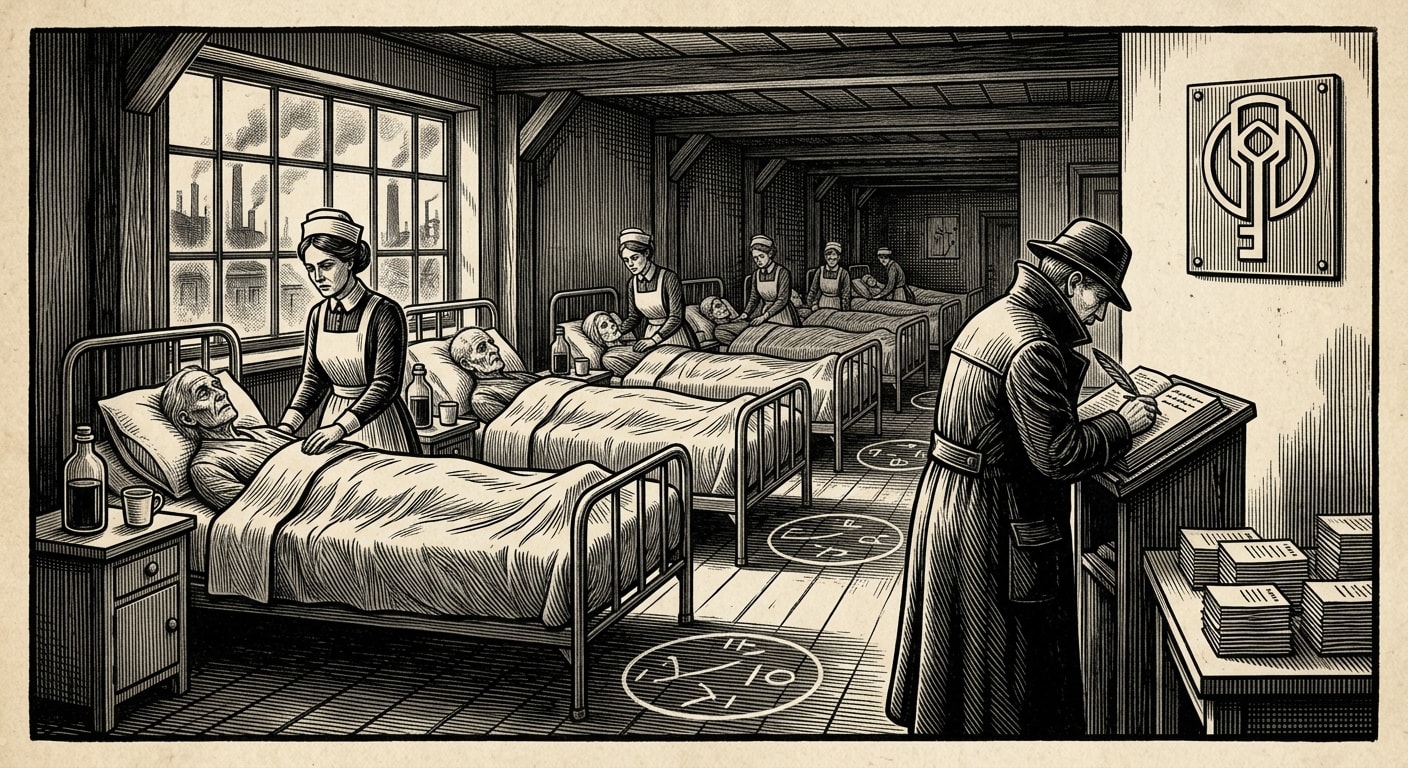
The beds face west where architecture permits. When architecture refuses, a painted western panel is installed, because symbolism is cheaper than renovation. The patient is washed, dressed in a plain shift, given a warm cloth for the hands, and placed beneath linen folded in the Mercy style: three turns at the shoulder, one at the feet, a narrow space left at the chest for the final breath to rise unobstructed. Such details calm families. They also calm staff. Procedure is a handrail over an abyss.
The chamber contains three authorised objects: the bedside lamp, the Departure cup, and the small ledger-board on which the Records Witness rests the Book slip. Unauthorised objects proliferate because humans are untidy even near the sacred. Families bring ribbon, bread crusts, medals, old socks, lockets, letters, contraband sweets, unlicensed saint-cards, and little bottles of soil from farms that no longer exist. Ward-Sisters confiscate what doctrine demands and miss what mercy permits. The best miss skilfully.
At larger houses, such as the Hospice of Saint Tiberias, rows of dying bodies lie beneath vaulted ceilings while scribes record exhalations as if each rattle were a confession. Saint Tiberias is famous for its chimney smoke, which glows faint blue on damp nights. Records calls this atmospheric distortion. Mercy calls it devotional vapour. The neighbours call it Tuesday, because awe becomes domestic when it stains laundry.
Smaller Hospices sit inside ordinary wards: a side hall behind the black zone, a converted chapel, an attic where bells arrive muffled by old beams. Front-line houses use whatever can be made clean. At Brest, Departure beds have been set in ammunition stores after shell weeks. At Przemyśl, tunnel-crushed men have received the cup under timber props while dust fell into the choir's mouths. At Shipka, the windows are sealed because fog has been known to whisper postponements.
The house is clean because cleanliness persuades. A filthy killing looks like crime. A clean killing looks like sacrament. The Bureau of Mercy has never neglected the difference.
#On the Black Elixir
The final potion is bitter and black. Children imagine poison. Physicians object to the word, then file objections in cabinets no one opens during budget season. The elixir is compounded under Mercy seal from poppy milk, grave-mint, ash-bitters, sleep salts, distilled myrrh, and a stabilising agent the apothecaries refuse to name in mixed company. It smells of scorched sugar and wet stone. It stains ceramic. It stains memory worse.
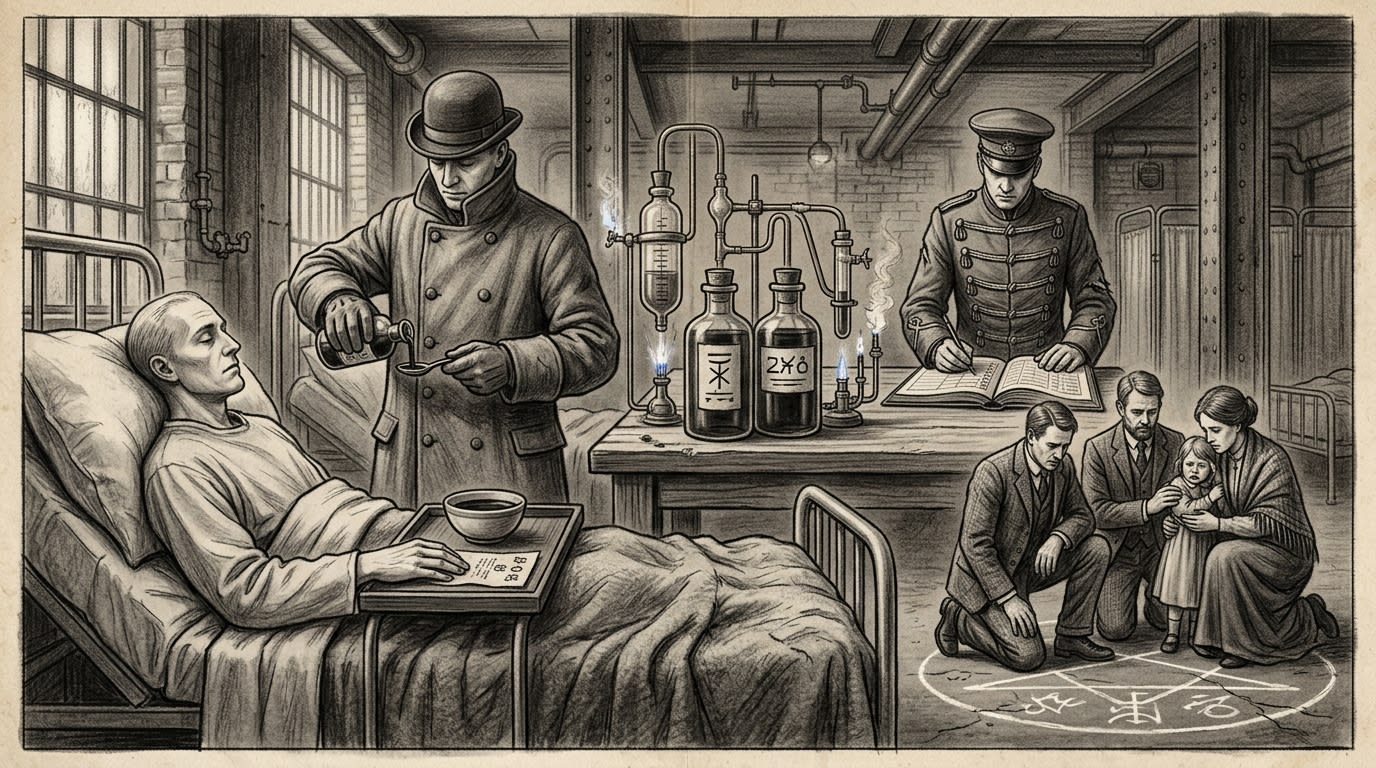
The draught custodian carries it in a sealed vial, warms it between the hands, breaks the wax before witness, and pours into the small Departure cup. The patient may drink unaided if able. If unable, the Ward-Sister supports the head and tips slowly. No cup is forced in the official record. The official record has never tried to pour medicine between clenched teeth while a daughter screams into her sleeve.
The formula has changed across the years. Early draughts were unreliable: too slow, too harsh, too likely to leave the patient gasping through the choir's second stanza. The A.S. 112 Ledger Laws standardised dosage tables after the Broth Riots hardened Mercy's appetite for countable procedures. Weight, age, fever state, confession status, and ration class now shape the measure. The poor receive accuracy. The rich receive privacy. Both die.
The elixir does not always behave. Wound-site lungs resist it strangely. Old prospectors sometimes exhale black vapour after the cup, setting the bedside lamp guttering inward. Shipka sleepers have awakened during administration and asked whether the Hospice has already happened. Victims of Kargath-adjacent famine occasionally smile with relief so profound that staff request transfer afterward. Mercy denies the transfer unless the request includes proper fatigue notation.
Saint Tiberias annex, A.S. 196: patient formerly attached to Basin-charter extraction inhaled after full draught, sat upright, and breathed the words █████████████ in a voice identified by three staff as belonging to the draught custodian's dead mother. Cup recovered empty. Patient recorded as departed. Custodian reassigned to laundry without explanation. Laundry burned at third bell.
After the draught, the Ward-Sister wipes the mouth. The choir lowers pitch. The Records Witness watches the chest. The family is instructed not to touch until the final mark is made. This is the rule most often broken. Mercy does not prosecute unless the touch disrupts documentation. Even bureaucracy has instincts, though it keeps them chained behind the inkstand.
#On the Family Line
The family stands two paces from the bed. The distance is pastoral, sanitary, and defensive. It permits farewell without permitting interference. Chalk marks the line in ward houses where grief has a reputation for leaping. In private suites, a carpet pattern performs the same labour with better manners.
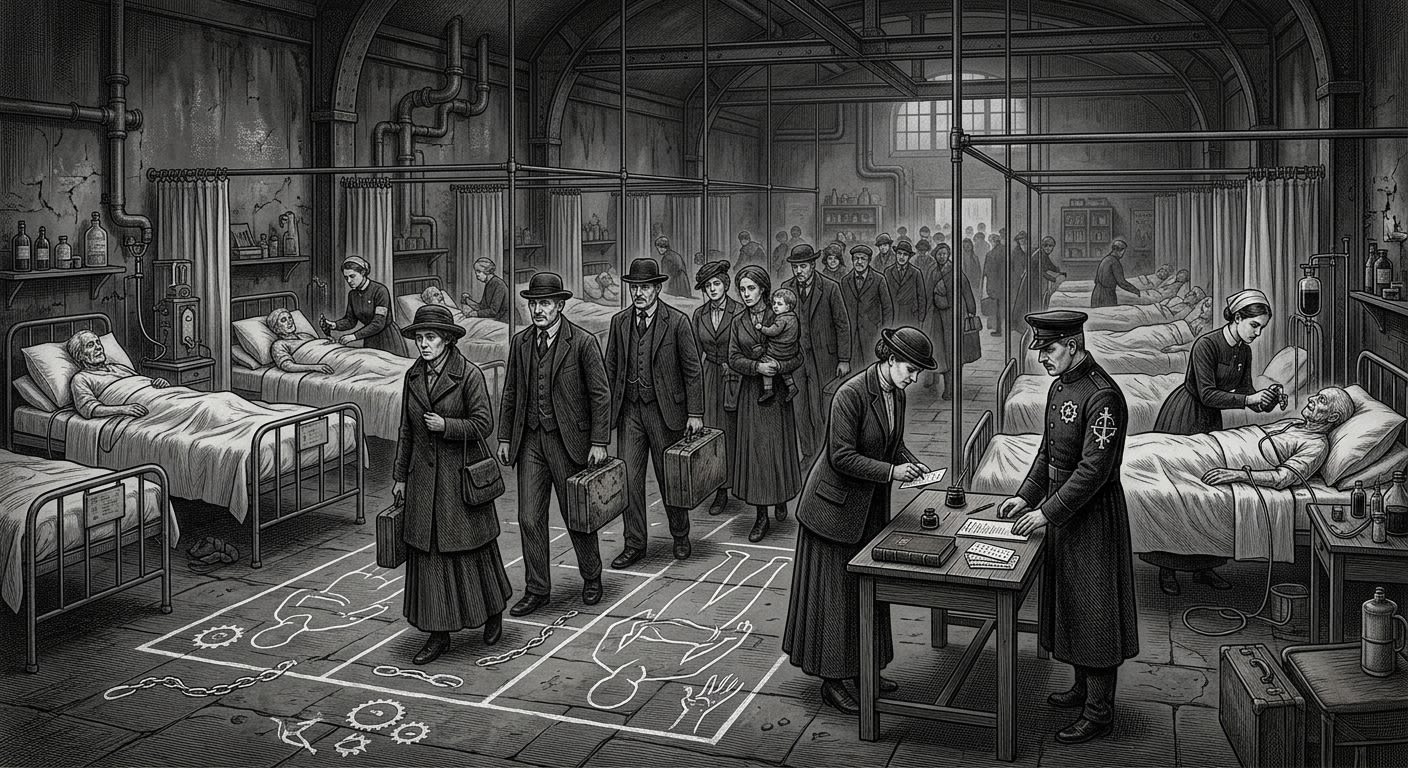
The family may speak three categories of words: blessing, gratitude, and authorised farewell. Accusation is discouraged. Bargaining is refused. Political commentary is routed to Purity if loud. The patient may answer if speech remains. If the patient confesses, the Records Witness writes. If the patient names hidden grain, illicit children, unlawful oaths, old songs, or debts, the family learns the ancient rule of Mercy rooms: death does not end liability; it perfects delivery.
Earlier family guides promised that words spoken in Departure chambers would be received “under the veil of final tenderness.”
Revised after the Mercy Ward Purge of A.S. 134. Final tenderness is pastoral posture, not evidentiary restriction. Useful speech remains useful.
Children are managed according to age, temperament, and household petition. The Bureau prefers children to attend when the death will teach obedience and to be absent when it may teach arithmetic. A child who watches grandmother drink the black cup may become devout. A child who asks why grandmother had to drink because grain was short may become a Grain Keeper. This distinction belongs to pedagogy.
Families bring gifts to staff afterward: candle ends, small coins, bread, ribbon, gloves, old prayer books, salt wrapped in rag. Officially, Departure staff may not accept gifts. Unofficially, refusing a crust from a widow whose mother you have just escorted to Heaven is indecent even by Strasbourg standards. Staff accept, log nothing, and sometimes eat in stairwells with the guilty hunger of people who still possess mouths.
The family receives a Departure Slip by morning. It certifies name, registry number, time, witness, draught measure, final words classification, body disposition, and Book of Departures routing. Without that slip, inheritance stalls, ration status remains uncorrected, marriage petitions tangle, and the soul's public dignity hangs in clerical weather. Families guard the slip more fiercely than relics. Relics belong to the Church. The slip belongs to survival.
#On the Book of Departures
Every death must enter the Book of Departures. To die unrecorded is a terror older than the Synod and more useful to it than any sermon. The unrecorded dead become domestic ghosts of paperwork: unable to release property, unable to close ration lines, unable to be prayed for properly, unable to stop costing the living. The Bureau does not need to threaten omission often. The possibility performs steady labour.
Hospices exist partly to prevent that terror. Their deaths are neat. The name is known. The witness is present. The hour is fixed. The body is prepared. The family receives proof. No trench mud swallows the tag. No plague cart loses the sheet. No shell turns a man into a dispute between Records and War. Departure is death with a receipt.
The Book itself is not a single volume, whatever catechism illustrations suggest. It is a distributed cathedral ledger system: vault copies, ward slips, indexed abstracts, parish returns, bastion casualty annexes, and sealed addenda where inconvenient last words go to ripen. Strasbourg maintains the master reconciliations. Mercy supplies the body data. Records preserves the name. Doctrine explains the arrangement when anyone complains.
The Hospice slip bears a small black corner mark indicating Departure administration. This mark alters subsequent paperwork. Ration obligations close at once. Household dependency tables recalculate. Widow's allowances, where payable, begin after the statutory mourning gap. Debts enter review. Confession packets route according to content. If the departed belonged to a charter house, as with many Gruhl workers, liability arguments may continue long after the lungs have stopped. A word can rob a corpse. A corner mark can rob a widow.
Charter Baron Gruhl's forty-one dead taught the Hospices a lesson in category warfare. Several men reached Departure beds after lungs failed from wound-site exposure. Tithes objected to occupational language. Mercy proposed commercial adjacency. Records requested names. The Hospice cup arrived while the offices argued. The bodies solved one docket. The compensation docket remained pious and hungry.
#On Staff Who Pour
Departure duty is granted to the Bureau's best Ward-Sisters and Ward-Brothers, or to those whose superiors wish to break them elegantly. Both categories overlap. The work requires clean hands, steady voice, strong wrists, obedient memory, and the ability to distinguish kindness from refusal quickly enough to keep the room from tearing itself open.
A Departure Sister is trained in lift support, draught angle, pulse watch, family line command, final-word capture, and post-cup washing. She learns the sanctioned phrases: fulfilled covenant; gentle release; Heaven receives; breathe with the choir; the Ledger is open. She learns the unsanctioned phrases from older staff: swallow, love; don't fight the cup; look at me; your daughter is here; I will write your name correctly. The second set saves more rooms than the first. The first set survives audit.
Staff mark themselves in small ways. A black thread inside the apron hem. A thumbnail kept short for lifting jaws. A private list of names remembered beyond the official slips. Some keep no list and claim this is healthier. They are lying or dead inside; the Bureau accepts either condition if punctual.
The Bureau watches them closely. Departure staff are vulnerable to softness, blackmail, elixir theft, mercy fraud, family pressure, theological nausea, and the slow professional deformation that comes from being thanked for killing people politely. Transfers are common after three seasons. The best refuse transfer. The worst request promotion. The Bureau, with its infallible nose for irony, often grants both.
#On Abuses, Delays, and Beautiful Lies
Every institution built around a cup develops cup-corruption. Families bribe to delay. Families bribe to hasten. Heirs arrive early with papers too neatly folded. Ward clerks sell favourable eligibility findings. Apothecaries dilute draughts and sell the surplus to private death rooms. Choirs accept fees to sing louder over dispute. Records Witnesses mishear final words for a price. The Hospice remains clean. Corruption wears slippers there.
The black-market name is little departure. A private cup given in a garret before the Bureau arrives; a counterfeit slip; a dead grandmother filed as still alive so her ration continues; an uncle hurried out before he can amend a will; a fevered child spared the ward by a mother who cannot bear another form. Mercy prosecutes little departures with fury because they steal both death and data. Of the two thefts, the second draws the sharper memorandum.
Delay can be its own heresy. During winter shortages, some households hide elders to preserve pension lines. During plague, households push the sick toward Hospice doors before eligibility. During famine, the arithmetic grows frank: one bed, one ration, one fewer mouth, one inheritance unlocked. The Bureau condemns such calculations in public, then uses better versions in policy.
There are beautiful lies too. A Ward-Sister marks a last word as blessing when it was accusation. A Records Witness pretends not to hear a hidden cache named. A choir enters too early to cover a son's sobbed treason. A draught custodian warms the cup longer because the daughter is still running from the outer ward. These are crimes. Some crimes keep the species tolerable.
#On Present Necessity
As of A.S. 201, the Hospices of Departure are full. This is not crisis language. Fullness is their ordinary weather. The Line eats bodies. Wards overflow. Wound-site work matures men into wreckage before forty. Famine pockets sharpen family arithmetic. Shipka returns sleepers whose ages have become clerical arguments. Brest sends trench-rot veterans. Irongate sends men who vibrate after too much Gasket Choir. Constantinople sends categories Mercy has stopped naming aloud.
The Bureau has expanded Departure capacity through chapel conversions, side-ward authorisations, mobile Hospice carts for remote districts, and the controversial two-cup protocol for married pairs whose households petition joint release. Doctrine approved the protocol under protest, then discovered the protest had been filed on paper produced by Ulm and had corrected itself overnight. The approval stands.
The Hospices spare resources. They also spare pain. They also weaponise dying speech. They also comfort families. They also convert inconvenient bodies into tidy entries. Adults should be able to hold several facts in one hand without dropping the cup. Most cannot. That is why the Bureau employs specialists.
A Mercy Prefect's A.S. 188 address declared, “No one enters Departure for reasons of scarcity.”
Clarified. Scarcity is not a reason. It is the room in which reasons are counted.
#On Resistance to Departure
Resistance takes three forms: the domestic, the clerical, and the heretical. The domestic form is ordinary love sharpened by fear. A household keeps the old man behind a laundry partition, feeds him thin soup, tells neighbours the cough belongs to a stove, and prays the ward examiner has poorer hearing than most ward examiners possess. This is illegal, touching, and doomed if the old man has a registration trail longer than a week.
The clerical form occurs inside Mercy itself. A Ward-Sister delays the D-mark. A Records clerk misplaces the eligibility slip beneath a baptism bundle. A draught custodian reports a cracked vial. A choir pair arrives at the wrong bell. These acts rarely save more than a day. A day is not nothing. Ask anyone whose mother has one left.
The heretical form belongs to Lanterns, Grain Keepers, black med crews, and those soft little sects that claim the body is not Synod property after its productive term expires. Their language varies. Their error is singular. They speak of natural death as if nature retained jurisdiction inside the Ledger.
Grain Keeper districts resist Departure most fiercely during hunger seasons. A cache household may feed an elder because the elder remembers routes, passwords, old hiding places, which patrol sergeant has a weak child, which parish floorboard rises without squealing. To Mercy, that elder is exhausted flesh. To a ward under famine, she is an archive with knees. This is why Purity accompanies Hospice sweeps in suspect districts. Archives run when frightened.
There are also the false Hospices. A shuttered wash-house becomes a mercy room. A Lantern preacher speaks comfort without licence. A retired apothecary gives poppy tincture in a spoon and calls it sleep. Families prefer these rooms because no confession packet leaves the bedside, no Book slip recalculates the household before dawn, no white-sleeved Sister stands between grief and the mouth. The dead vanish messily. The living inherit unlawfully. The Bureau's outrage is moral in the way a tax bill is devotional.
Mercy hunts false Hospices with particular disgust. The charge is not merely unlawful killing. The charge is theft of Departure: theft of the elixir's monopoly, theft of the final record, theft of the doctrinal comfort by which families learn to thank the hand that empties the cup. A garret death cheats the Ledger twice, once in breath and once in narrative. Doctrine cannot abide narrative leakage. That, reader, is where the stink gets in.
#On the Geography of Last Beds
Hospices differ by province. The Strasbourg houses are polished, audited, too well supplied, and decorated with paintings of Saint Sabina binding wounds under conditions the painters improved for civic morale. Marrowgate's Departure annexes smell of vinegar, broth, and wet wool, because every corridor there receives bodies before architecture has consented to the traffic. Brest's houses keep blankets under lock and issue them by bell. Königsberg warms elixir cups over blue coals because ordinary coals fail too quickly near the frost routes.
Przemyśl maintains tunnel Hospices for men who cannot be moved upward. The cup descends by pulley when shafts collapse. Irongate has vibration protocols: cup held in both hands, bedside lamp braced with iron, family line chalked twice because the floor tremors blur the first mark. Shipka's Departure rooms use wake-hymns at threshold pitch; no patient may receive the cup if a sleep-fog is in the corridor, since three disputed cases produced death slips dated before admission. Constantinople has harbour Hospices where the windows face the Bosphorus and are never opened.
In the Heartlands, Departure may look almost gentle. A family arrives by tram. A bell rings in a clean district. The patient drinks beneath a painted west. In the forward zones, Death enters already exhausted from the road. Patients arrive tagged, splinted, frozen, fevered, sung-through, shell-shy, seep-burned, or too tired to be frightened. The Hospice gives them uniformity. Uniformity is a mercy when life has become inventive.
Pilgrim-road Hospices deserve their own censure. They are funded by route tariffs, staffed by Sisters who can identify fraud by the way a man coughs into his sleeve, and visited by families who claim kinship with any dying traveller whose pouch looks heavy. The Bureau of Pilgrimage calls them Rest Gates. Mercy calls them transitional wardlets. Road people call them the last toll. All three labels fit on the same sign if one writes small.
#On the Saints of the Cup
The Hospices claim Saint Sabina of Ghent as their soft patron through Mercy's general charter, but the cup has bred smaller devotions. Saint Marrow-of-the-Ladle watches the broth before admission. Saint Vellum-Anna watches the final record. Saint Varric of the Twelve Blisters is invoked by pilgrim-road houses when the dying arrive chained, blistered, and too holy with suffering to stand. Saint Orren of the Iron Plug receives muttered respect in prospector wards, where men whose lungs were bought by charter houses ask a saint of plugs to seal what no physician can close.
The cult objects are humble: black cup tokens, linen knots, little west-facing boards, ash-salt packets, paper slips with the Mercy Line written by hands too cramped to form proper capitals. The Bureau tolerates these objects because they keep families from inventing worse ones. Relics are disciplined imagination. Leave imagination unwatched and it builds a shrine around a stain.
A prohibited devotion has grown around the Empty Cup: the belief that a patient who dies before administration has been spared by Heaven from scheduled mercy. Families hide such cups, hang them in rafters, fill them with grain, or bury them under thresholds to keep Mercy from returning. Purity calls this cup-superstition. Doctrine calls it a teachable infection. Mercy calls it damaging to staff morale, which may be the most honest classification.
One Empty Cup from the Weevil Year was found in a Wexel cellar with barley sealed inside by wax bearing no Bureau mark. The barley had not rotted. The family had. Records could not reconcile the household. Tithes claimed the grain. Mercy claimed the cup. Purity claimed the cellar. Doctrine claimed interpretive custody, naturally, and received it because the others lacked the prose.
#On the Administrative Theology
The moral engine of Departure is simple enough for a child and cruel enough for a Bureau: the body belongs to Order because Order preserved it, fed it, taxed it, healed it, counted it, and named it. When the body can no longer return value to Order, Order returns the body to Heaven under supervision. The circle is closed. The account is balanced. The surviving household is instructed to feel gratitude.
Older theologians objected. They muttered about timing, dignity, natural span, elder wisdom, the mystery of suffering, and other phrases commonly deployed by men who do not manage linen inventories. Doctrine answered with the Covenant of Administered Flesh, a tract so dry it could desiccate a fever ward. The conclusion, stripped of polite torment, reads: unscheduled suffering breeds waste; unscheduled death breeds omission; omission breeds spiritual panic; panic breeds disorder; disorder breeds heresy. The cup prevents a chain. The cup is a lock.
This theology does not make the cup kind. It makes the cup lawful. Kindness enters elsewhere: in the warmed cloth, the missed contraband ribbon, the extra minute before choir, the name written carefully, the daughter's hand permitted across the chalk line after the chest has stilled. Law builds the room. Kindness smuggles itself through the service hatch.
I sign Departure authorisations quarterly beside the Seal of Doctrine. I read the tables: age, ward, ration class, projected care burden, confession status, family attendance, elixir allotment, Book routing. Numbers march. Names stumble. A good administrator learns to keep both in view and to weep only where ink cannot spot.
At Saint Tiberias, the chimney glows blue. At Marrowgate, the carts arrive before dawn. In a bastion side-room, a Ward-Sister folds linen with hands that have done this too often to tremble. The family line is chalked. The choir wets its lips. The cup waits on the shelf, black, warm, exact.