

#On the Four Commands
"Defensive rating: excellent (geographic), poor (economic)." — Bureau of War Strategic Assessment, Sector Sibiu, A.S. 198
I compiled this survey in A.S. 201, which the Heartland almanacs call 1911, as Hieromnemon of the Bureau of Doctrine. It records a command as it stands this year. It makes no claim to record the command's birth.
The garrison of Bastion-Sibiu has four commands. The Alpine Watch holds the mountain passes of the Transylvanian Alps. The Plateau Guard holds the perimeter and the interior. The Convoy Escort Corps, the largest of the four, holds the roads. The Bureau Detachment holds the pens, the seals and the inquisitorial instruments of the offices represented in the bastion.
The garrison survey names its four component bodies in one breath: Doctrine enforcers, Records clerks, Purity inquisitors and Tithes auditors. Each serves a different master. The Bureau of Doctrine defines what may be said, the Bureau of Purity enforces it, the Bureau of Records keeps it, and the Bureau of Tithes counts what it cost. Put four such offices on one hill under one garrison and you get a detachment of Sibiu. You do not get a fifth Bureau.
The survey says the Detachment's combined headcount exceeds that of a frontline battalion. It gives no figure, and neither will I. None of my sources holds a writ, a founding year, a commander's name or a headquarters for the Detachment as such. A Hieromnemon who invents a writ to round out a survey has produced a forgery with a better seal.
#On Admission
"The process takes between four and eleven hours. Velmora's agents move faster." — Convoy Escort Corps field report, A.S. 199
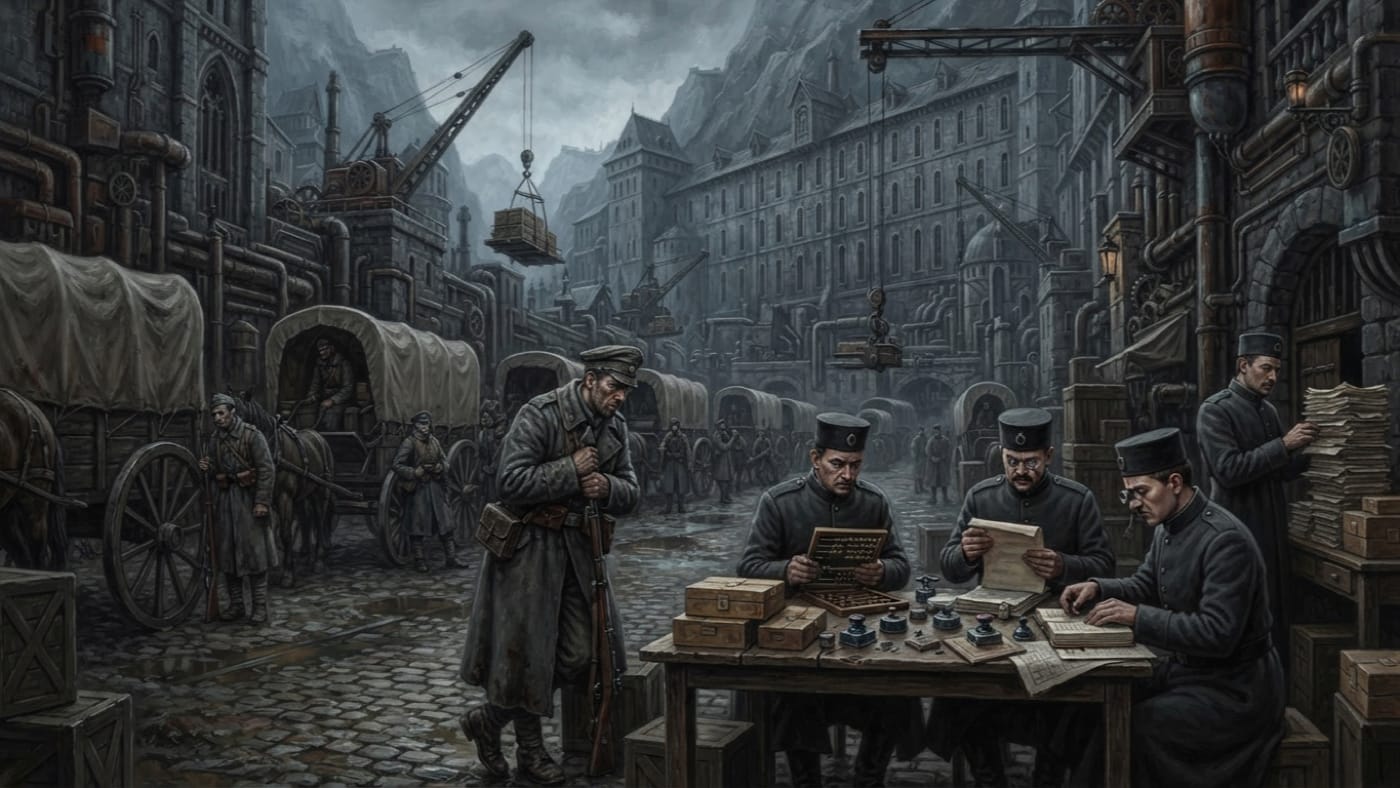
Every convoy that reaches Sibiu must be inspected, audited and certified clean by three officials before its cargo is admitted: a Tithes auditor, a Doctrine censor and a Purity examiner. Records clerks keep the paper but do not sign it, and I will not invent a fourth signature to make the count match the four offices.
The garrison gives the admission as four to eleven hours. The length depends on the size of the convoy, the temperament of the auditor, and whether any item aboard has a provenance that cannot be documented in triplicate. The sources disagree about where those hours are spent. The bastion survey puts the inspection at the gate. The Watch and the Assay Chamber put the hold at the Weighhouse, the long stone building in the Market Ring that serves as the Escort Corps headquarters. I record both versions and reconcile neither. Either way, the wagons wait.
The escort waits too. The Corps has guarded the cargo for days and cannot certify a single sack of it. The Detachment holds that authority and did not walk the road. The two commands therefore spend the hours of admission side by side over the same crates. One stands with bayonets fixed. The other reads.
Goss's dossier sets down what an auditor does during those hours, and its account of his class is plain. Auditors count wagons at the Weighhouse. They sign convoy certificates in triplicate. They carry sealed boxes of doubtful coin uphill to the Assay Chamber in the Citadel Ring, which also houses the Bureau offices. The box climbs the hill and the convoy stays below.
Rations pay for every hour of it. Supplies for the pass-forts wait behind the same queue as everything else, so a crate certified at the eleventh hour feeds nobody at the fourth. Uncertified bread would be worse. Everyone at the Weighhouse knows that, and none of them is comforted by it.
#On the Number Without Issue
"The paper is ours. The ink is ours. The number belongs to no one." — Marginal annotation in the Assay Chamber register, A.S. 181, initialled G.
The most consequential act in the Detachment's record was done by one Tithes auditor at one desk. The record identifies him only as Goss, G. His given name has been redacted. His own entry is Auditor Goss of Sibiu. This survey uses him for one finding and goes no further.
Crown scrip came into use in A.S. 130 because coin could not be trusted in a sector where Velmora could lay her hand on metal. For fifty years the Chamber tested notes by ash, watermark and ink, and passed every note that passed. In A.S. 181 Goss read a season of the scrip circulating in Sibiu against the master issuance ledger. Fourteen per cent of the notes carried serial numbers the Bureau had never issued. Their paper was genuine and their ink was correct.
That finding split the Detachment's work into two kinds of test. A material test asks whether a note is made of the right things. A documentary test asks whether the Church ever made it at all. Every one of the false notes had passed the first test and failed the second, and until Goss nobody had run the second.
The Serial Reconciliation Protocol came into force in A.S. 181 and has been renewed every year through A.S. 201. It requires every Crown note to be checked against the master ledger before acceptance. The master ledgers were moved into the Assay Chamber, where they fill the back wall from flagstones to vault in calf-bound columns.
The record does not support anything beyond that. The finding names no printer and no accomplice, and it identifies no mechanism, holy or otherwise. The Bureau of Shadows looks east. The garrison asks how anyone outside the Bureau came to print on the Bureau's own paper. Tithes classified that question, and I have been issued no answer. The official survey describes Goss's career as "subsequently brief" and says nothing more. What became of him is not on file.
#On Rations, Keys and Attendance
The Detachment's oversight does not stop at the Weighhouse. The Watch's own record says the Detachment audits its ration books, inspects its keys and questions its chaplain-attendance. Each inquiry has a reason in Sibiu. A ration book shows who has been fed and paid, and in a garrison paid in doubtful scrip, debt shows up there first. Keys matter because the Ten Thousand Keys take a brass key as collateral for every generous loan. Attendance matters because Purity examines every quarter whether the soldiers believe the Doctrine of Sufficiency they recite.
The Watch receives these inquiries from men who have never wintered on its ridges. Its unofficial assessment of the Detachment's combat contribution is "calligraphic." The word has been reported upward four times. It was denied each time and repeated in the mess each time. I record it as the Watch's word, an insult and not a finding.
The grievance is no less real for that. Most of the Watch's hunger is made on the plateau, behind the admission queue, and the offices that audit its ration books are the offices whose certificates hold up its rations. A soldier can be right to resent the audit and the auditor can still be right to make it. Sibiu keeps both on file.
#On Verification and Provision
"Bring it to the scales. Everything comes to the scales." — Order painted above the Assay Chamber door, hand unrecorded
The figures below cover the whole bastion. They are no measure of the Detachment's diligence, and nobody should cite them as a score.
Forty-three per cent of Sibiu's transactions go through the Protocol. The rest take place at quartermaster depots, canteen counters and the unlicensed stalls of the lower districts. The alternative is a four-hour queue at the verification window in the Market Ring. That queue is separate from the four-to-eleven-hour admission of convoys, and clerks who confuse the two should be made to stand in both. The estimated share of counterfeit scrip now stands at twenty-two per cent. The Chamber examines roughly ten thousand items a week and clears ninety-six per cent of them. What becomes of the remainder is not published.
The Detachment's quarry comes in several kinds. Cursed coin is mixed into Crown wages. Provisions are corrupted. Contract-scrolls are folded between the pages of requisition forms. By the sector's reckoning these account for perhaps a third of interceptions. The rest are bribes paid to teamsters, quartermasters, checkpoint guards and the occasional official whose pay has fallen behind the cost of a family. The blight that withers highland crops is Kargath's work, and Velmora's creditors follow it with credit. The Bureau of Purity is plain on one point: no pact made within Synod territory removes a man's choice. A teamster who sells a manifest chose to sell it, and Doctrine and Purity examine him on that footing.
Prior editions of this Codex stated that Bastion-Sibiu intercepts "an average of three corrupted convoys per season."
That figure comes from the A.S. 190 records and is obsolete. The Bureau of Tithes' A.S. 200 return gives eleven per season, and in the same year Tithes reclassified Sibiu's economic condition from "contained" to "chronic." Tithes attributes the rise to improved detection. The garrison attributes it to heavier Velmoran investment in the roads. Neither return states how many convoys were examined. The Ledger therefore calculates no rate from them and credits neither number to the Detachment alone.
The Bureau of Tithes asked for the Assay Chamber staff to be tripled. The Bureau of Records refused, saying assay is a matter for the Bureau of War. The garrison commander asked in three consecutive years for the Escort Corps to be doubled. War refused each time, on the grounds that economic warfare is a matter for Tithes. Neither request asked for anything to be added to the Detachment. Both refusals left its auditors climbing the same hill with the same boxes.
#On the Present Compilation
"We are solvent, Hieromnemon. The question is: in whose currency?" — Garrison Commander's dispatch, Bastion-Sibiu, A.S. 201
As this survey is compiled in A.S. 201 / 1911 CE, the Detachment does what its record says it does. Three certifiers sit over every arriving convoy. Auditors count wagons at the Weighhouse, sign in triplicate and carry doubtful coin to the Chamber. The Protocol has been renewed once more. The Watch's ration books are audited, its keys inspected and its attendance questioned, and it still calls the Detachment calligraphic. The bastion's economy is classified as chronic. The walls hold.