
#On the Room That Weighs the War
"Bring it to the scales. Everything comes to the scales." — Order painted above the Chamber door, Citadel Ring, hand unrecorded
The Assay Chamber of Bastion-Sibiu stands in the Citadel Ring, on the hilltop, in the old Saxon core. Its neighbours are the senior command, the Bureau offices, the cathedral-citadel and the vaults of the Bureau of Tithes beneath the altar. Those neighbours give orders, file them, pray over them and lock them away. The Chamber decides whether the money that pays for all of this is money at all.
Every Crown, every scrip note and every piece of metal that enters the bastion is carried up the hill and tested for Velmora's taint. That includes coin from the wage chests, scrip from the canteens and bullion from the reserves. It also includes buckles, cartridge brass off suspect wagons and anything else the three supply corridors deliver when nobody can prove where it came from. The official survey of the bastion calls the Chamber the single most contested resource in Sibiu. Every Bureau in the Citadel Ring demands time at its tables, and every one resents the results.
Convoys from the Transylvanian Alps stop first at the Weighhouse in the Market Ring. This long stone hall belongs to the Convoy Escort Corps. Cargo is tracked, catalogued and argued over there, and under Serial Reconciliation Protocol a wagon waits between four and eleven hours. Anything that shines, rings, folds or carries a serial number goes up the hill in a sealed box. The Weighhouse is Sibiu's throat and the Chamber its heart. Like every heart in a war, it is overworked, and men with no medical training keep asking whether it is well.
The Alpine Watch curses the delay. The Bureau of Tithes curses the Alpine Watch for cursing. The garrison eats late, and east of the passes Velmora's creditors note the improvement in local hunger.
#On Scrip, Serial Numbers, and the Goss Discovery
"The paper is ours. The ink is ours. The number belongs to no one." — Marginal annotation in the Chamber register, A.S. 181, initialled G.
Crown scrip came into use in A.S. 130 to fight Velmora's infiltration of the coinage. Metal can be cursed in the ground, in the furnace or in the purse. Paper printed by the Bureau of Tithes, on its own stock and under its own seal, would at least belong to the Church from the first fibre. For fifty years the Chamber tested scrip as it tested everything else. It burned a corner, sniffed the smoke, checked the watermark and passed the note.
Then, in A.S. 181, a Tithes auditor named Goss (first name redacted, career subsequently brief) compared a season's circulating scrip against the master issuance ledger. Fourteen per cent of the notes in Bastion-Sibiu carried serial numbers the Bureau had never issued. The paper was genuine and so was the ink. The Chamber had passed every one of those notes, and it had been right to, because everything it was built to test was clean. Someone had invented the numbers, printed them and fed them into circulation. Records privately described the workmanship as superior to its own.
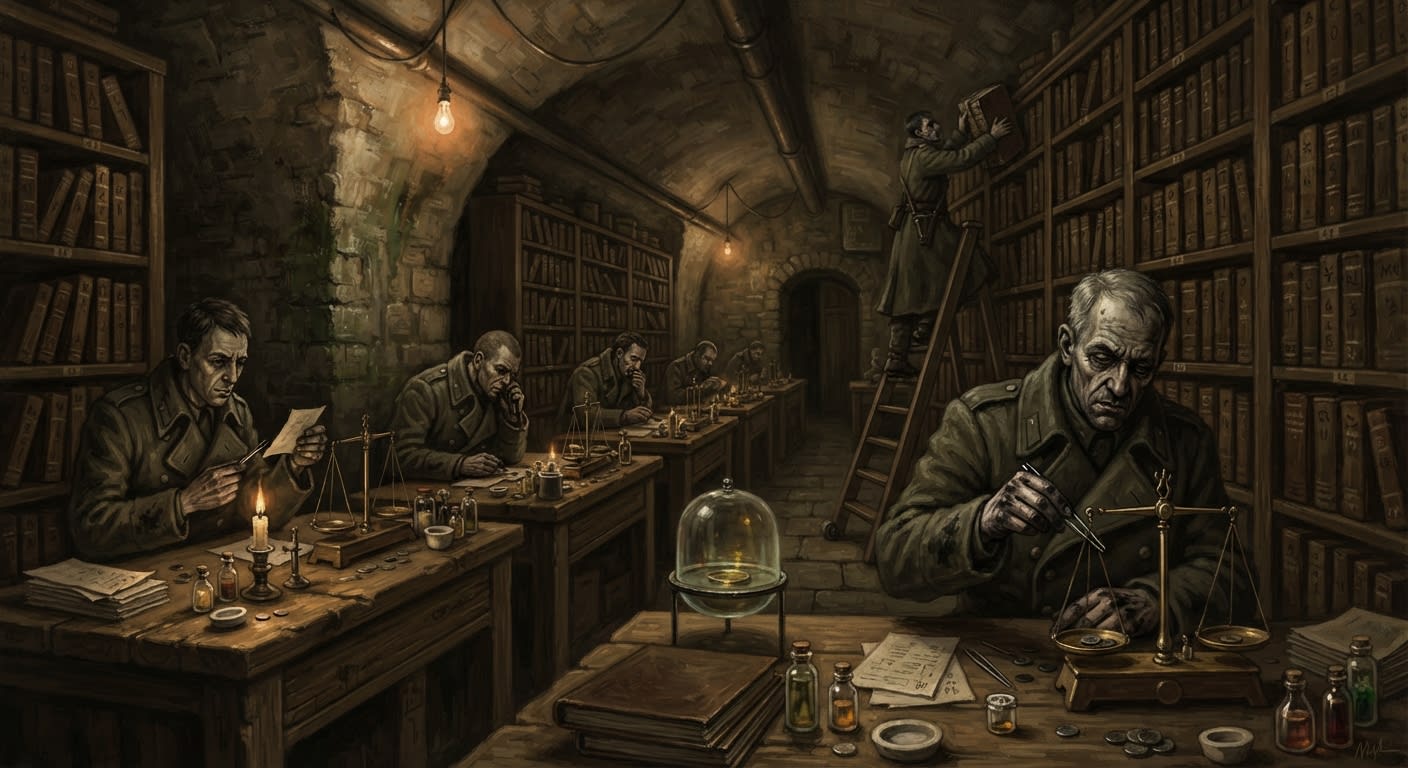
After A.S. 181 the master ledgers moved into the Chamber. They now fill the back wall from flagstones to vault in calf-bound columns, and a junior examiner climbs a ladder forty times a shift to consult them. A note can be pure in its paper and damned in its number, and only the ledger can tell the two apart.
The ledger did not win. Counterfeit scrip rose from fourteen per cent in A.S. 181 to an estimated twenty-two per cent in A.S. 201. The Chamber verifies what reaches it, and fifty-seven per cent of the bastion's transactions never do. They happen at canteen counters and at unlicensed stalls in the lower districts. A soldier with a warm loaf in one hand does not climb a hill to have his change read.
#On the Methods of Purity
"Compare, sniff, sing, scratch, burn, tap, bless, argue. Then begin again." — Examiner's shift card, Assay Chamber, current issue
The room is long, low and cold. Stone tables run its length under bare electric bulbs. Each table holds brass balances, a touchstone, acid bowls, a candle and a tray of reference Crowns from the Tithes vault, and a printed slip of the approved antiphon lies at its head. The examiners work in military greatcoats because the Chamber is never warm. Their cuffs are black with ledger ink up to the second button.
The shift card lists eight tests.
Compare. Weight, dimension and serial are each checked against reference. A light coin has been clipped or hollowed. A heavy coin has been filled with something that should not be carried.
Sniff. Clean metal smells of metal. The examiners say tainted metal smells of a palm, of warmth held too long. They cannot say whose palm, and they no longer try.
Sing. An examiner sings the antiphon softly over the tray. Most coin lies still. The rare coin that answers, in tune, goes to Purity in a lead box, and nobody sings near it again.
Scratch. The metal is streaked on the touchstone and then tested with acid. It is the oldest test in the room, inherited from Saxon goldsmiths who knew nothing of Velmora and distrusted everyone anyway.
Burn. A corner of each note goes into the candle, and the ash is read for colour and curl. Ash that settles in a neat column like a receipt is reported and never discussed.
Tap. Honest silver rings on stone and honest gold thuds. The examiners claim a counterfeit note has its own sound when tapped. The Bureau has not ratified this.
Bless. A Bureau of Purity examiner signs every cleared tray. About once a week, Purity withholds its signature and gives no reason.
Argue. Two examiners who disagree call a third, and the three take the item to the duty auditor. It is the slowest test and the most reliable.
The Chamber examines about ten thousand items a week and clears ninety-six per cent of them. No mint in the Heartlands would be ashamed of that figure. The Bastion-Sibiu survey has done the arithmetic the Bureau prefers to leave undone: four per cent of ten thousand is four hundred compromised items entering Sibiu's economy every seven days. The Chamber is excellent. At wartime volume, excellence leaks.
Earlier Codex drafts described the Assay Chamber as the organ that "contains Velmoran currency contamination within Bastion-Sibiu."
Withdrawn. The Bureau of Tithes' A.S. 200 assessment reclassified Sibiu's economy from "contained" to "chronic." The corrected wording is that the Assay Chamber measures the rate at which containment fails. It measures that rate with great accuracy.
The Chamber never closes. Examiners sleep in four-hour shifts in a dormitory behind the ledger wall, close enough to hear the balances. The Bureau of Mercy says they age at a rate that is "accelerated but not yet miraculous." The Bureau of Tithes has asked for three times the present staff. Records refused on the grounds that assay is a military matter, and War considers it a fiscal one. The examiners have no opinion on jurisdiction. They are asleep, or about to be.
#On Clean Gold
"The walls sing when the gold moves." — Alpine Watch sentry report, classified A.S. 199
In A.S. 178 the Bureau of Engineering confirmed that gold veins run beneath the foundations of Bastion-Sibiu. The Bureau of Doctrine classified the survey at once. That same year the inner walls of the Citadel Ring began to weep. At irregular intervals, a thin film of warm liquid gold runs down the consecrated stone. Soldiers catch it in tin bowls and carry it to the Chamber, since nothing that shines in Sibiu can go anywhere else.
The Chamber has tested every weeping since the first. The gold has passed comparison, touchstone, acid, song and Purity's blessing. By every method the Bureau is willing to publish, it is clean gold with no trace of Velmora.
MINERALOGICAL ANNEX — CHAMBER COMPARISON OF CITADEL RING EXUDATION AGAINST SUB-FOUNDATION SEAM SAMPLES, A.S. 178 / REVIEWED A.S. 199 Correspondence of composition: ████████████████████ Examiner's remark: ██████████████████████████████████ Recommendation: ████████. Denied.
The Bureau of Doctrine has offered three explanations. In A.S. 179 it credited the mountain's gratitude for faithful stewardship. In A.S. 188 it credited residual geological pressure working through sanctified mineral channels. In A.S. 199 it offered silence, by order, and that third explanation remains in force. The weeping is a Tier III anomaly. It is separate from the A.S. 199 file on cooperation between the Crimson Concord and the Hierarchy of Debt, which Records files as the Sibiu Anomaly. Sibiu now has two anomalies and one drawer label.
Over twenty-three years the walls have produced about four thousand Crowns' worth of gold. The Bureau of Tithes books it as revenue. The garrison has its own theory, which Doctrine denies. The soldiers say the veins are Velmora's and that her workings reach west from the Gilded Chasm, under the range and the Sagittal Line, to the bastion's footings. The walls weep, they say, because they are already sold. The Chamber takes no position. Its job is to find taint, and it has found none.
That is the trouble. A cursed coin is a relief to its examiner. It can be sealed, burned and entered in the register as an enemy act. Clean gold must be weighed, entered and counted, and every Crown of it in the ledger is a Crown the Church now owns and cannot explain. The Ten Thousand Keys make generous loans on clear terms. The walls of Sibiu make gifts on no terms at all.
The wall-gold sits apart from the other trays in a covered basin with a glass lid. It is weighed last each shift, after the scrip, the coin and the brass, when the bulbs are dimmest and the examiners most tired. It has passed every test so far. Afterwards the examiners wash their hands, which no protocol requires.