

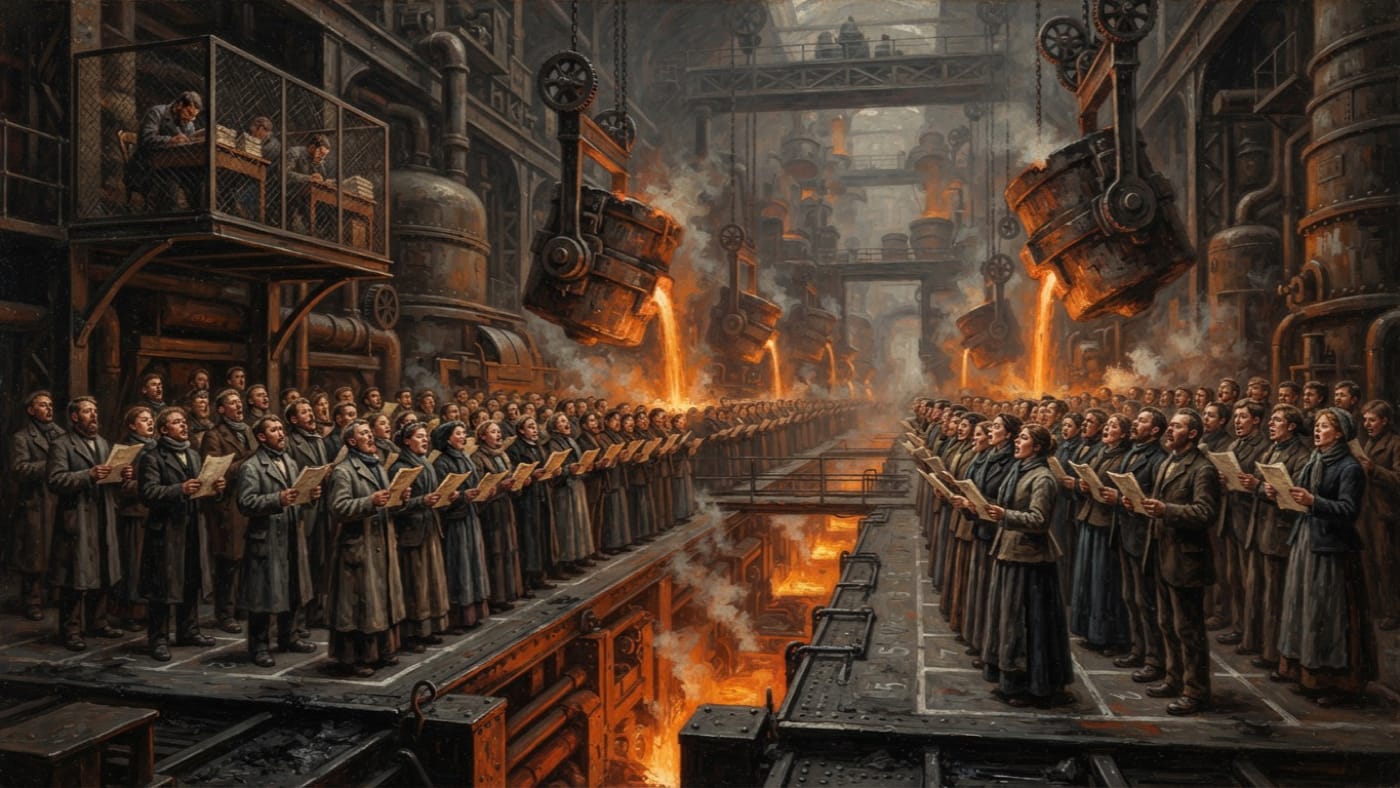
#On the Singer's Work
This survey was compiled in A.S. 201 / 1911 CE. That is the year of the present compilation. No year is recorded for the first time anyone sang metal into service, and this office claims none.
A calibration singer is a worker of Essen-of-Hymnsteel who sings prescribed measures over a hymnsteel pour. The Bureau of Orison and Song holds that the measures set the grain of the cooling metal. The Bureau of Engines and Furnaces holds that they steady it while it cools. The singer holds the note and leaves the two Bureaus to argue about what it means. The work yields bell-cannon throats, hymn-drive housings and reliquary fasteners for the Sagittal Line. Other hands assemble the guns, cast the rounds and load them. The singer's share is the metal that has to hold.
Three confusions must be corrected at once. The tavern tenor and the recitalist of the Quiet Gradient sing to be heard. A singer of the Hall sings to a crucible, which has never applauded anyone. The trade also has nothing to do with the Iron Choir Brand-Singers, who hold pitch in tribunal basements while confession is burned into skin. The two professions share cartilage and nothing else. Last, the gun-pit crews who chant the peal on the Line are a different choir. Neither ever hears the other.
#On Custody and Recruitment
The singers work in the Hall of Measures in the Foundry Core. They sleep in the Throat Dorms, which the city plans call the Choir Quarters. Under the Tri-Bureau Compact of A.S. 110, three offices divide them. The Bureau of Orison and Song approves the stanzas and manages the voices. The Bureau of Engines and Furnaces owns the fuel, the furnace schedule and the constant pressure for more. The Bureau of Records keeps the singer's name, roster entry and certificate, which in Essen amounts to keeping the singer. Orison decides what a throat may sing. Engines decides how often. Records decides whether its owner exists.
Recruitment runs by several roads, and the Compact would rather none of them were described aloud. The voice tithe binds certain families of the Ash Warrens to give up one child per generation whose pitch meets Orison standard. It does not bind every household or take every child, a precision the Warrens might call mercy if they were in the habit of it. Debt brings others. Condemned labourers come by sentence, their lashes commuted to chorus. Family bargains, orphan transfers and the occasional genuine vocation make up the rest.
Compact recruitment notices describe calibration singing as "a free vocation, freely entered."
Corrected. Entry is by tithe, debt, sentence, family bargain or orphan transfer, with genuine vocation present in numbers sufficient for a pamphlet. "Freely" is withdrawn. "Vocation" may stand, since the Bureau has already paid for the type.
#On the Pour and Its Witnesses
The Hall floor is ruled into stations with chalk. Two choir platforms face each other across the crucibles, so that their measures cross inside the pour. Each singer stands within a chalk boundary holding an approved stanza sheet. The furnace crews work the gauges and shutter chains below. Records witnesses sit in iron-mesh cages above the south aisle and copy everything. The Hall prescribes its own sequence:
First Bell: throat inspection, chalk renewal, platform count. Second: the crucible opens and the low antiphon begins. Third: the paired choirs enter, Engines releases the metal, Records witnesses. Fourth: the grain-setting stanza, during which no one leaves a marked station except authorised hands. Fifth: cooling silence, with every signature gathered before water reaches the runnels.
What the stanza does inside the metal is disputed in writing. Orison credits grain alignment. Engineering describes vibration stabilising cooling stress. Doctrine has said obedience, which is Doctrine's answer to most questions and cannot be disproved. This survey does not certify whether the metal comes away keeping a note, a memory or an opinion. I record each Bureau's claim under that Bureau's name. The singers say hold and leave the metaphysics to people with chairs.
The paper is another matter, and that I can certify. Each pour leaves a roster, a stanza sheet with its copy number, a heat mark, an injury notation and a cooling record, all signed. When a batch fails in Essen, or comes back cracked from the Line, clerks walk those papers back from the fracture to the station, and from the station to the voice that stood in it. A skilled singer earns the grain-setting stanza and answers for everything that goes wrong during it. Skill buys no exemption from burns, blame or the Discrepancy Cage. It buys a more legible name on the roster.
#On Keeping a Voice Fit for Shift
About two thousand voices live in the Throat Dorms, above the Foundry Core between the Hall and Ledger Row. They sleep by cohort, so that bodies trained to breathe together go on doing it in the dark. Throat-cloths dry in the galleries. The herb rooms draw bitter steam from the furnace boilers. Salt gargles are issued before long pours. Licorice root is rationed. Honey requires a prescription, which makes it the one sweetness in Essen that has to be confessed to a physician.
A slate stands at the foot of every bed: name, range, pitch class, medical caution, ration grade, last approved stanza. Each morning the singers lift a note toward a brass standard hung in the Pitch Court, and the brass gives its verdict before breakfast. Between slate and brass, a singer becomes six administrative facts and a cough. Pitch class and barrack range tell Orison where to put a voice and what to ask of it. They describe placement. Essen has issued no ladder of grades for singers to climb, and this office declines to draw one for it.
The medicine is real. The steam soothes, the salt cleans and the physicians attend. Every remedy is also a production instrument, applied so the throat is back on the platform by the next bell, and the herb ration rises and falls with the quota, not the wound. Provosts watch the ranges. Rest is allotted, interrupted and recorded. Shift length changes with the pour and the pressure, and no fixed hour can honestly be given.
#On Service and Vocal Failure
By Orison's own estimate, a voice lasts about nine years before it frays. The Hall calls nine respectable and twelve remarkable. The Dorms know singers who failed in three, and a few who passed fifteen and were kept on to teach. The figure is an average of bodies that refuse to average.
The failures are documented with care. Cords bleed and scar. Pitch drifts flat under heat. Years beside the crucible dull the hearing. Breath shortens, and eyes dry and blur. When the voice goes, the singer is moved to slag haulage, lock duty, the duct crews or clerical whisper work, and Orison enters the transfer as completion of service.
A bleed shift is a pour in which singers stay at station after the throat has torn, because the metal is already cooling and abandoning a pour mid-stanza costs a batch. Bleed shifts have been abolished. The abolition is published, the bleed shifts are still reported, and both records are kept in the same building.
The Throat Line bargains over these matters. It is part barracks union and part brotherhood, and it negotiates pause lengths, herb quality, whether a family keeps its heat credits after a singer fails, and how the dead are carried out. Its slowdowns are filed as liturgical caution. It speaks for many singers and enrols fewer of them, so its name is not the name of the profession. Mara Nine-Notes holds standing in its ranges.
#On Altered Sheets and Unowned Failure
An exhausted singer holding approved sheets is exactly the person the Mirror Choir most wants to reach. The same singer is exactly the person the Bureau of Purity watches most closely. The Choir works through altered syllables, shifted breath marks, a quarter-tone slipped in during cough practice, and sheets clean enough to pass review. Its method makes every singer a suspect, though suspicion makes no singer an insurgent. Purity audits teeth, fingers and page edges all the same.
The Ash-School Scandal of A.S. 187 ended with a correct explanation of fire rewarded by immurement and the Paper Mines. Since then, causal talk near production has been dangerous and the audits have grown intimate. The pursuit of the Mirror Choir enters the record from that year. That establishes nothing about how the Choir began, and this survey assigns it no founding.
A second trouble lies beneath the floor, and it is not an organisation. During a Resonance Bloom, tools sound without being struck, teeth ache in repeating intervals and metal fails along its grain. The workers call the source the Wrong Choir. The name describes what is heard. It identifies no speaker, and this office names none. Bloom activity predates the Mirror Choir's earliest documented operations by approximately forty years. The singer stands between the two troubles with an approved sheet and is expected to answer for both.
#On the Present Requirement
The survey closes where it opened, at A.S. 201 / 1911 CE. Strasbourg demands triple the output of hymn-drive siege engines, from furnaces and voices that also supply throats, housings and fasteners. Furnace-Marshal Kord presses for tempo and threatens conscription from the Warrens. Master-Calibrator Sister Rauth governs Essen's pour-stanzas, tolerances and singer rotations, and she will not accelerate without guarantees of stability. Arch-Notary Veyl has forms ready for either outcome. The sources report three Blooms in the last eighteen months. More Provosts stand behind the platforms.
As of this compilation the profession is overfilled, audited, medicated, rostered and required. The singers rise at the bell and file down to the Hall, and the grain is set, by whichever Bureau's account one prefers.