
#On the Toll and the Gun
"Peal by peal, not before, not after." — gun-pit litany, the Sagittal Line
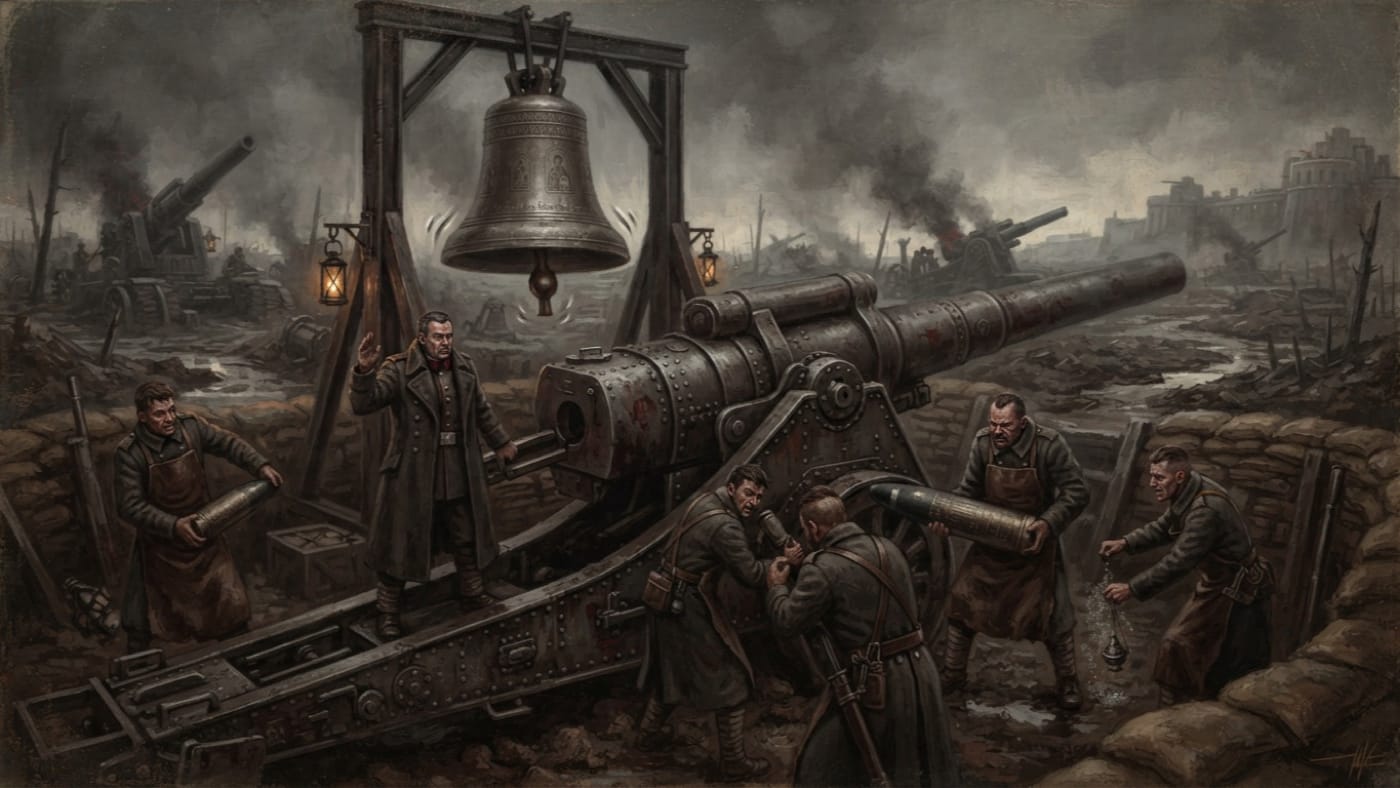
A bell-cannon is field artillery that tolls before it fires. The Bureau of War requires no longer definition, and it has never required a longer definition of anything it could shoot. The weapon has powder, shot and a barrel, which the crews call a throat, and a timing bell hangs within sight of the gun-pit. The toll rallies the faithful in the trench behind the gun. It also tells the enemy in front of it that a sermon is about to arrive by air.
By the institutional account, the Rationalists had artillery first. They weighed powder in grains, spoke of elevation in degrees, and believed Heaven could be plotted on a range table. The Synod did not abolish their guns. It baptized them. I reproduce this account under my own seal and stand behind every clause. The Ledger does not say who performed the first baptism, in which year, or at which battery. I will not supply a date merely because a reader would like one.
Two offices own the weapon. The Bureau of Bells governs lawful peal. It was constituted as the Office of Bells in A.S. 52, and its current standard was ratified in the Bell Codex of A.S. 115. The Bureau of War owns the powder, the crews and the casualties. Both offices own the gun, so neither owns its failures.
#On the Three Peals
Doctrine holds that no clock governs the barrage. The toll is the only measure.
At the first peal the gun is readied. Loaders take their posts and begin a chant that is part prayer and part tally, so that no one loses count of the work. At the second peal the powder is sanctified by chant and spit, and the powder-men scatter ashes over the charge with the care of a sacristan salting a threshold. At the third peal the relic-shot is released. Each round has already been inscribed with the names of saints and notaries associated with past miracles. The gun-captain intones the cadence throughout, and every body in the pit moves to his voice as a congregation moves to a cantor's. A company at work looks like a Mass that has been issued a quota.
It has always been the case that the toll and the range table stand side by side. At Bastion-Shipka, batteries recalculate their ranges for distance, elevation, and the drag that damp marsh air puts on a shell in flight. The choir platforms rehearse their sanctioned hymns in time with the dry runs, so that smoke and song have practised together before they must work together in earnest. The toll decides when. Arithmetic decides where. Only a Rationalist would find a contradiction in that, and only a Rationalist would be foolish enough to say so within earshot of a gun-captain.
Shipka also keeps an old Exalted Howitzer, Saint Aegidius, and maintains it like a reliquary. It is one gun with one history. A reader who concludes from it that every bell-cannon is a cathedral bell melted into a barrel has concluded wrongly and should stop drawing conclusions.
The drill warning is short, and the crews learn it before they learn their own weights of shot. If the peal is struck late, the shell detonates inside the barrel. If it is struck early, the fire lands on our own lines. The casualty accounts speak of crews whose remains were swept into reliquary jars and catalogued by Records, and of shield-lines fused into glass under friendly relic-fire. Some of these accounts are sworn testimony and some are garrison folklore. I have stopped trying to sort them. Records files the whole category as "strategic misapplication." A later Orison revision directed that the word murder be excised wherever it appears and replaced with unintended canonization. The widows use neither term.
These gun crews are a different choir from the one that made the gun. The singers who calibrated the throat stood in a hall hundreds of miles west, in a shift that ended before the metal cooled. The loaders never hear them, and the singers never hear the gun fire. Each choir answers for work the other performed.
#On the Throat That Essen Sends
Essen-of-Hymnsteel makes three things the Line cannot do without: hymn-drive housings, reliquary fasteners, and calibrated bell-cannon throats. The last of these is the subject here.
A throat begins in the Hall of Measures, where paired choirs sing prescribed stanzas across the crucible during the pour. The Bureau of Orison and Song attributes the result to grain alignment. It holds that metal cooled under the correct stanza keeps its pitch under stress and does not sing back wrong frequencies when struck. I record the Bureau's explanation as the Bureau's explanation. The comparison the city itself publishes is blunter: a throat cast in ordinary steel cracks within forty firings. Forty firings is an afternoon on a busy sector.
The Tri-Bureau Compact of A.S. 110 divides the throat's life among three offices, and each office protects its share. Furnace-Marshal Kord's Bureau of Engines and Furnaces does the pouring, sets the furnace schedules and fights over the coal. Master-Calibrator Sister Rauth's Bureau of Orison and Song supplies the approved calibration songs and the voices that sing them. Arch-Notary Veyl's Bureau of Records certifies the finished throat, seals it and enters it in the ledgers. A throat without a Records seal does not leave the Seven Locks. A throat with a Records seal leaves whether or not anyone can hear what is wrong with it.
From the Locks the throats go east by barge and rail to the Sagittal Line. There they are fitted, fired, worn out and replaced. Every bell-cannon from Bastion-Königsberg to Bastion-Constantinople fires through an Essen-forged throat. Essen does not build every complete gun, and it does not cast every round. It supplies the part that has to hold the explosion. Every throat on the Line will eventually need a replacement, and every replacement comes from the same city and the same singers. By the Bureau of Orison's own reckoning, a calibration singer's voice frays after about nine years, and the pitch begins to drift. The Bureau files this as "completion of service." Whatever that voice sang into the pours during its last season of service is now in the throats on the Line.
#On Misapplication and Its Authors
When a throat fails, each office names a different cause, and each cause indicts some other office.
The Bureau of War prefers firing error, meaning a late peal, a slack captain or a novice at the bell-rope. The remedy is discipline, and the Bellwardens who keep calibration logs for lawful peals can be required to produce the paperwork. The Bureau of Engines and Furnaces prefers counterfeit parts. The Shard Markets deal in counterfeit seals and falsified certifications, so this answer conveniently blames Records for letting the fraud through. Records prefers altered calibration sheets. The Mirror Choir has been pursued since A.S. 187 for seeding single wrong syllables into approved stanzas, so this answer blames Orison for losing custody of its own hymnals. Orison prefers nothing it can be made to sign.
The fifth cause is the Resonance Bloom. Nobody prefers it, because nobody can charge it with anything. During a Bloom, rivets shear and throats crack along the same grain-lines the choirs aligned in the pour.
On the authority of Compact Report 447-E (A.S. 198), this Codex attributed the Resonance Bloom and the throat failures that attend it to Mirror Choir sabotage.
The Bureau of Rites' subsequent investigation (file sealed) found that Resonance Bloom activity predates the Mirror Choir's earliest documented operations by approximately forty years. A cell cannot have caused events that happened before it existed. Altered sheets remain a real hazard. They no longer serve as the explanation for everything.
The case that none of these explanations fits is the shipment returned from Bastion-Przemyśl. Its throats had been cast on different days, by different choirs, from approved stanza sheets. Every one came back cracked along the same grain-line. The receiving inspector called the pattern "decorative," and the Bureau of Purity removed him from his post. The pattern has since been classified.
Consider what each office would have to say about it. Firing error does not produce matching cracks in guns that fired on different days under different captains. Counterfeiting would require the forger to have sat in on every pour. The Mirror Choir would have needed to reach several choirs across several shifts through several approved sheets, and if it can do that, it has done more than any heresy has ever done. Only the Bloom leaves marks this uniform, and a verdict of Bloom would satisfy none of the three offices, because it names no culpable party they can use.
#On the Present Requirement
This survey stands at A.S. 201. That is the year of the assessment, not the year the weapon was invented, and no invention year is known.
Strasbourg's current procurement mandate demands tripled output of hymn-drive siege engines. Those engines come out of the same furnaces and are calibrated by the same exhausted voices as the throats. Rauth refuses to raise the calibration tempo without what she calls "liturgical stability guarantees." Kord threatens to conscript singers from the Ash Warrens. Veyl stamps both positions and charges a fee for each. Meanwhile the Blooms are increasing: three in the past eighteen months, against two in the whole decade before. The batteries on the Line still fire on the third peal and expect the throat to hold.
The crews have not been told about the Przemyśl pattern. The Bureau of War judges that a loader who believes the metal might break along a classified line will hesitate, and a hesitating loader does more damage than a cracked throat. I do not dispute the judgment. I have filed it.