
I've finished reading the continuity file, the voice guides, the location entries and the related Codex pages. Here is the article.
#On the Ground and the Theater
"He does not attack. He condescends." — Marshal's briefing, Carpathian Theater, A.S. 195
The Bureau of War says theater when it wants a map to sound like a liturgy. I have looked for the writ that founded this one and found none. There is no boundary survey, no constitution, no headquarters and no commander set over the whole. The phrase lives in briefings and in the headers of requisition forms. Its best-known use tops the Marshal's briefing quoted above, so clerks now give A.S. 195 as the Theater's birth year. It is the year of a briefing. The mountains are older.
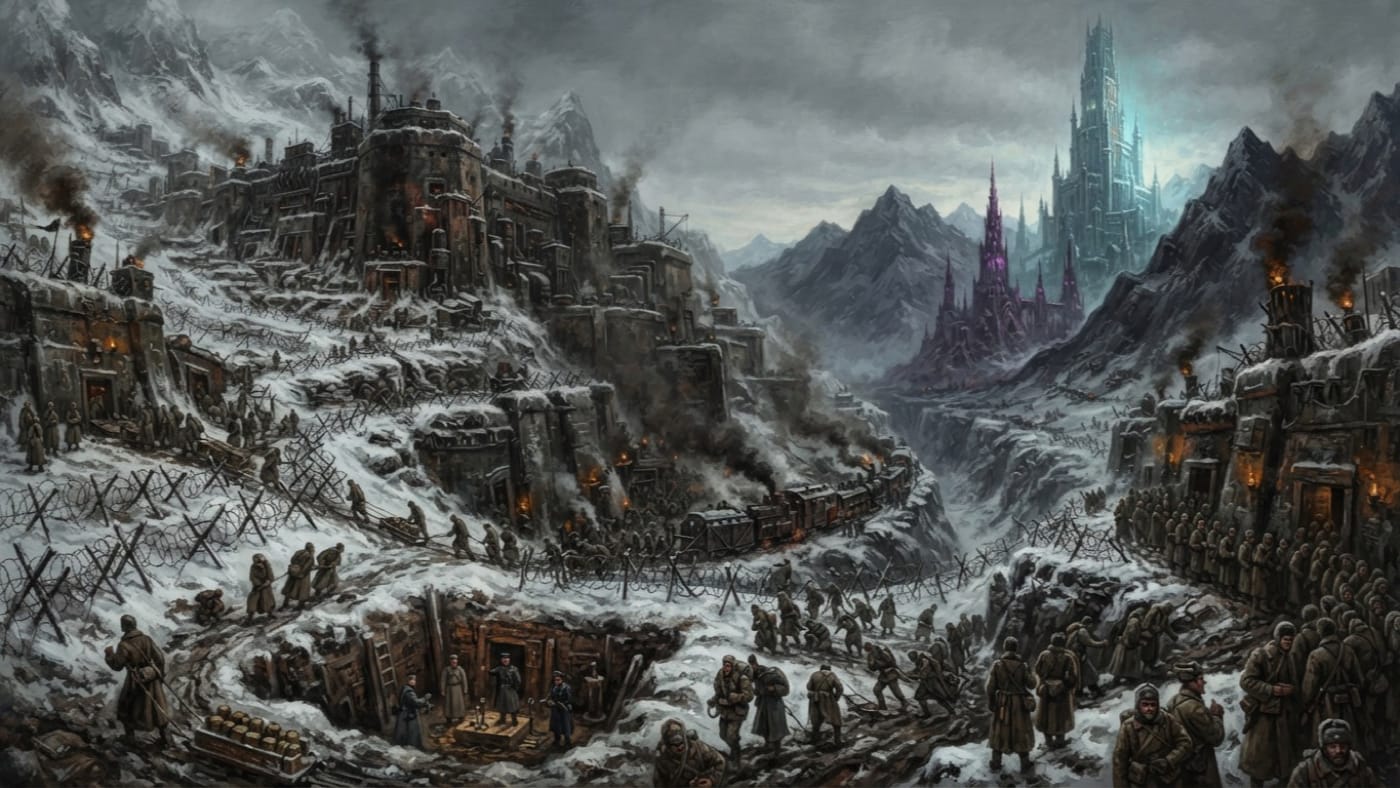
What the word describes is less disputed. The Sagittal Line runs north to south from Königsberg on the Baltic to Constantinople on the Bosphorus, with seven bastions set along it like seals down a long writ. Third from the north stands Bastion-Przemyśl in the western Carpathian arc, near 49.8° north and 22.8° east, in Zone 4. It guards the principal western passes and sorts whatever moves between the rear depots and the forward works. Around it lies the ground the briefings mean: ridges, saddles, ravines, snow galleries roofed against drift, pass-forts, and tunnels where men fight by lamp and bayonet. There is wire wherever the slope will hold a post.
The Carpathians run on south. Sibiu holds the Transylvanian wall against Velmora. Irongate, where the range breaks at the Danube gorge, answers Morwen. Both share rock, weather and roads with Przemyśl. Whether they also share a theater depends on whose letterhead wins. As briefed, the Carpathian Theater looks east from Przemyśl toward Atheron, who looks back from a considerable height. Syrionic fog sometimes creeps up from the Balkan front. Here it counts as weather, because Syrion has no assignment on this sector.
#On Retreat and Holding
Before the Sundering of 1 November A.S. 45, the western passes carried salt, timber, cattle and the small frauds of trade. Afterward they carried refugees, and then the men sent to stop whatever followed the refugees. The Line was never laid down in a single season. By about A.S. 65–68 it was defensible but incomplete, a chain of forts and ditches whose gaps were filled with bodies and bad weather. Its practices were standardized over the years from 68 to 72.
Przemyśl was surveyed and established around A.S. 67, under authorizations scattered across A.S. 64–72. It stands on an old fortress where three passes meet the last good rail. The officers who signed served the Church's wartime administration, which had offices but not yet the Bureaus that now claim them. I use the later names when it saves ink. The Bureaus inherited the files and do not object.
The Carpathian Gates grew in the same fashion. Saddles, road-locks, mule cuts and pass-forts were thrown up in a panic and approved afterward. Nobody ever designed a single door. Below Przemyśl, the wire took root. The Wire Orchard reached two miles in A.S. 75. The Concordat of Strasbourg gave the Synod its constitution in A.S. 90, and by A.S. 92 the Orchard stood at three miles. The garrison runs the two dates together. The men who strung that wire had never heard of the Concordat, and it never fed them.
#On Roads, Men, and Paper
"A tag is warmer than a coat." — Proverb of the Orchard
The Theater eats from the Carpathian Corridor. Freight is gathered in the west-bank yards of Budapest and on the Bratislava approaches, hauled through the Turda ridge-gates, and divided between Przemyśl and Sibiu. Each change of carrier, from rail to road to mule, is another chance for something to freeze, spoil or go missing. Ballast freezes solid in January and heaves the rails in March. Wagons wait at road-locks for seals. Where the gradient defeats the locomotive the mules take over, and where the mules lose their footing the porters do. When winter shuts the high saddles, the battalions eat whatever the autumn manifests remembered.
Przemyśl's rail spur and wagon route survived intact, and the bastion grows fat on its position. Its clerks say nothing crosses the western arc without their stamp. The smugglers, the goat paths and the Sibiu road disagree. The clerks are right about everything worth stealing.
Everything comes in at the Rail-Throat Yards: grain bricks, fuel, shells, conscripts, prisoners, and manifests in sealed pouches. The yards smell of coal soot and boiled cabbage. Here a newcomer learns the Theater's real doctrine. A ration tag entitles a man to bread. A confession receipt from the Chapel of Counting, where Archivist-Prelate Odran Kelle keeps the slips, entitles him to the tag. A wax blank from Sealwright-Master Joryn Malk's Candleworks enters the receipt in the Ledger. Hot wax, a wet tag and a falling die are how a conscript becomes eligible to be shot at.
Provost-Marshal Vanna Rook commands about 2,400 provost troops and auxiliaries. They are Przemyśl's own garrison, and the provost eats first. The fighting strength along the ridges is larger and more scattered, and nobody has given me its total. Men who fall out of the paperwork fall into the Underwire, where the Gleaners swap tags between the living and the recently dead. At dawn the harvest patrols walk the Orchard with hooked poles and come back with tags on strings.
#On the Enemy Above
Atheron holds the eastern highlands and the passes opposite Przemyśl because they are high. The Ebon Heights rise beyond the wire in black ridgelines, each one crowned with a spire. Above them the Crownspire catches the light before the valley does. Altitude is his instrument. Every morning a man on this front measures himself against the skyline, and the skyline is rigged.
His host turns comparison into tactics. Crownguard Titans advance under banners that make the knee want to bend. Sun-Spear troops burn eyes and hunt brass, glass and anyone who watches them come in. The Mirror-Lords and Ascendant Shades come after them, and each arm makes the defender smaller in a new way. Most of the bodies in that host were human once, now corrupted or enslaved. The physical demons that drive them are one category. The influence-demons who work behind our wire are another, and rarer.
The rarer kind needs little equipment at Przemyśl. It finds the officer passed over for promotion and the clerk refused his grade. It finds the soldier who watches the provost eat first while the officers' terrace stays warm. It tells each of them that he deserves better. Doctrine holds that the whisper does not choose for the man who hears it. He still signs. Doctrine is also careful, as I am obliged to be, that a hungry sergeant's grievance is a fact about rations and not yet a sin. The garrison's own hierarchy does Atheron's preaching for free. He supplies only the accent.
Certain barracks histories record "the Fall of the Crownspire" as a Synod victory on this front.
Withdrawn. The Crownspire stands. What fell in A.S. 195 was the Spire-Crusher. Nobody has established where the confusion began, and this office will not invent an answer for the convenience of instructors.
#On the Nine Hours and the Low Bells
The Marshal's line is quoted often, usually by men who were not on the eastern salient in the autumn of A.S. 195. That autumn Atheron condescended with a siege engine.
The Spire-Crusher was first sighted at three hundred and forty feet. It grew on the march over ravine and scree and reached the outer wire at nine hundred. Soldiers prefer a rubric to a panic, so the bombardment that followed is remembered as the Nine-Hour Rubric.
For nine hours Przemyśl's guns fired into galleries that seemed to put on new surface wherever a shell struck. The bastion answered height with dirt. Bells were struck low. Ash and kitchen soot went into the smoke to foul the Sun-Spear glare. Brass was blackened. Labor crews of prisoners and clerks hauled shell while the range slates cracked in the cold. In the bell pits, the crews struck the Humility Sequence to hold their eyes against the tower's pull: boot, mud, ration, wire, cartridge, number, name, breath. It is ugly by design. Beauty lifts the chin, and a lifted chin is what Pride wants.
The final fire went into the narrowing of the forward pier, below the lowest gallery. At the ninth hour the pier broke, and the tower folded into forty feet of rubble. The garrison then spent three days staring up at the empty air where it had stood. The engine was gone in an afternoon. The posture took longer.
The Sequence answers Pride and nothing else. It is useless against Syrion's fog or Velmora's ledgers, and it did not spare the bell crews who were blinded in the fifth hour. What it did was keep the survivors low enough to go on firing.
#On the Present Holding
This assessment rests on Przemyśl's A.S. 201 survey and seal and on present accounts from the sector. It certifies nothing beyond them.
The Theater holds. Trains reach the Rail-Throat late, but they reach it. Mules die on schedule. The Corridor has kept the yards supplied through another autumn of manifests.
The strain is inside the wire. A stamp die went missing in A.S. 200 and has not been found. A die makes the blanks that make the tags that make a man eligible for bread. In the wrong hands it prints lives. Its serial number appears in the records of two bastions. Investigators have not determined which other bastion, whose hand, or what means. Rook has used the alarm to recast the dawn harvest as a matter of security. She is plainly angling to bring the Logistics-Penance Tribunal under provost command, but she has not done it. War has modeled riots and mass erasures if forged tags spread. The model is still a model.
Orchard Wardens still report the Wire-Hymn, a low hum in the old strands at night, and they still plug their ears with wax. I record the report and leave its explanation where Doctrine filed it.
To the east, the ridges keep their spires. Watchers report new silhouettes on the Heights, which War files as unconfirmed structural developments. The gun crews call them sons.