
#On the Book That Taught Cruelty to File Receipts
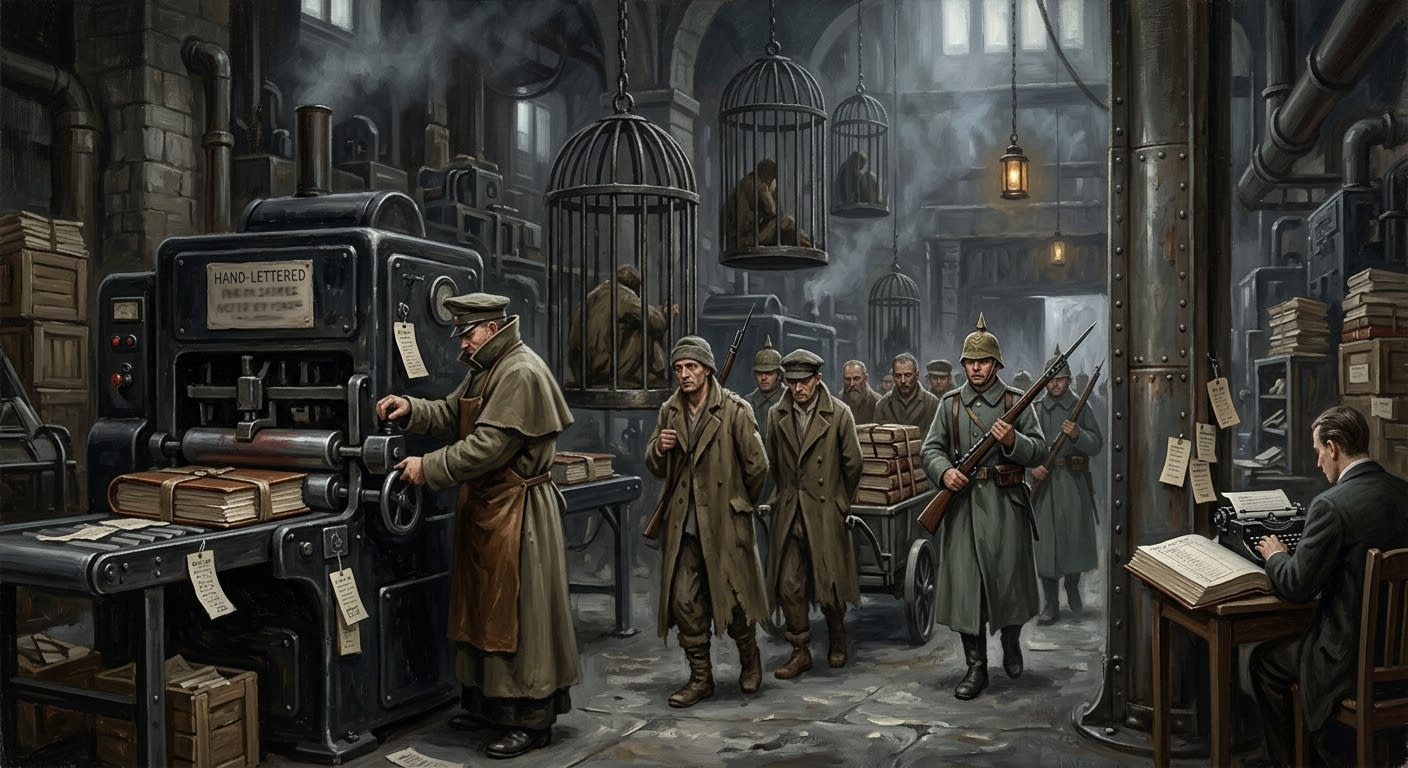
The Commentaries on Faithful Severity are attributed to Inquisitor-General Severian of Mainz, architect of the Iron Choir, director of the A.S. 134 Eighth Doctrinal Congress, and that rare theologian whose prose can make a cage seem under-explained. They refuse the comforts of devotional manual and legal code alike. They are an operating grammar for sanctioned harm, written by a man who understood that cruelty without paperwork remains appetite, while cruelty under seal becomes Doctrine's most persuasive clerk. Every Bureau owns books. Purity owns this one the way a hangman owns a rope: with practical affection, regular maintenance, and an eye toward replacement costs.
The vulgar quotation is known across the Synod: Better a thousand villages ash than a single heresy kindled. Children learn the sentence from Purity primers, soldiers hear it from trench catechists, and provincial magistrates quote it before doing something they would rather not describe in verbs. The full work is worse. Abbreviation is mercy, and mercy, in Severian's vocabulary, is often a clerical error wearing perfume.
The Commentaries survive in seventeen authorised recensions and an impolite number of bootleg extracts copied by young inquisitors with more zeal than penmanship. No two recensions agree completely. This is not a scandal. It is Severianism in textual form: the wound remains stable while the instruments vary.
#On Its Structure and Its Appetite
The public edition contains four books. Book I, On Contagion of the Civic Body, supplies Severian's doctrine that a city may be judged as a single heretic organism. Book II, On Instruments of Continuing Instruction, gives the theological machinery behind cages, public marks, sustained pain, witness management, and all those small administrative refinements by which a scream becomes a syllabus. Book III, On Silence, prepares the Severian Gloss later hardened into Article 19. Book IV, On Mercy Properly Timed, is the shortest and most dangerous, since every sadist writes at length on pain, but only the serious administrator writes carefully on when to stop.
The restricted edition adds appendices. The First Appendix concerns witness retention and the decline of public fear after excessive exposure. The Second Appendix concerns the tongue. The Third concerns children, school exercise, and the disciplinary use of overheard doubt. The Fourth is sealed under Purity ash-wax and described in catalogues as numerical. Nothing good in the Synod is ever merely numerical.
Common seminary extracts describe the Commentaries as “a meditation on necessary correction.”
Corrected. A meditation sits still. The Commentaries move through courts, cages, classrooms, bridges, kitchens, and throats. The approved phrase is “doctrinal apparatus for the proper calibration of severity.” This phrase is uglier and much more accurate.
Severian writes in clauses sharpened like surgical hooks. He does not plead with the reader. He assigns the reader a station: accuser, witness, recorder, corrected object. The sentence is never innocent because innocence is exactly the category Severian distrusted. Every page asks the same question in different vestments: what has been left uncut because someone was sentimental about surface?
#On the Sentence Everyone Quotes Incorrectly
Better a thousand villages ash than a single heresy kindled appears in Book II, section twelve, between a discussion of smoke legibility and an instruction on separating witnesses by age so pity does not travel too efficiently through a crowd. Quoted alone, the line sounds like holy excess. In place, it is accounting.
Severian's argument is not that a thousand villages should always burn. Amateur monsters adore that reading because it lets them purchase grandeur by the cartload. Severian argues that the number of innocents harmed in correction must be judged against the reproductive capacity of uncorrected heresy. A village burned is a closed column. A heresy spared is an open account accruing interest in children, jokes, songs, omissions, inheritance, and the little affectionate delays by which families protect their own from the Bureau. This is the passage most often abused by provincial fire-prelates, who underline the villages, ignore the accounting, and then wonder why their reports smell of enthusiasm rather than necessity.
This is why the line has endured. It gives cowardice a costume of arithmetic and courage a knife to hold at the census desk.
Purity loves the quotation because it absolves scope. Doctrine tolerates it because it makes error sound botanical without using the soft language of growth. Records distrusts it because burned villages produce damaged paperwork. Mercy hates it with a sincerity I almost respect.
#On the Second Appendix and the Tongue
The Second Appendix is the most famous limb of the book, having marched farther than many armies while nailed to oak. Its central line furnished the theology behind the Procession of Tongues: The tongue that lies is still a tongue. Remove it, and the lie remains, voiceless, breeding in the dark. Better to nail it open, so the world may hear what heresy sounds like when it can no longer hide.
The sentence is often admired for its brutality. That is the shallow reading, fit for boys, lictors, and bishops after wine. Its true force lies in ownership. Severian treats the tongue as confiscated civic property. A lying tongue has misused a public instrument. Cutting it away wastes the instrument. Nailing it to doctrine reassigns it.
The Order of Saint Ephrath understood at once. In A.S. 94, its Prague petition cited the Appendix with devotional greed: forty-one pages of route diagrams, oak thickness tables, nail measures, silence-yield projections, and crowd-sightline calculations. Ephrath supplied the rite. Severian supplied the permission to make the mouth keep working after guilt.
SECOND APPENDIX — MARGINAL VARIANT, MAINZ RECENSION “The tongue is not removed because removal flatters the heretic with privacy. The tongue is fixed because ████████████████████████████████████. Let the crowd learn which sounds belong to error when error has been made useful.” Later annotation: “Retain for Ephrath training. Omit from children's sheets.”
The Rationalists had made silence by mutilation. Severian made speech by injury. Crude minds call this imitation. Literate minds call it reversal with custody transfer.
#On Article 19 and the Domestic Uses of Fear
Book III, On Silence, is the seedbed of Catechism Article 19. Here Severian wrote the gloss that has since nested behind every tooth in the Synod: silence is shelter. Shelter is participation. Participation is heresy given walls.
The genius is logistical. White cloaks and broad appetite still cannot put an Inquisitor in every kitchen, workshop, dormitory, ferry queue, choir loft, maternity room, and tavern corner. The state that relies only on officers has already confessed its poverty. Severian's answer was to conscript reflex. The citizen hears deviation, calculates danger, and reports before affection can harden into obstruction. The mother becomes preliminary examiner. The child becomes witness. The neighbour becomes an unpaid lictor with softer hands and better access.
Later Purity handbooks claim Article 19 sprang fully formed from the Eighth Doctrinal Congress.
Clarified. The Congress ratified the instrument in A.S. 134. The Commentaries supplied its teeth, hinge, appetite, and table manners. Congresses rarely invent. They legitimise what sharper men have already made possible.
The Commentaries are especially vicious on delay. A report made late has granted interval to the Enemy. Pity is a timing defect. Friendship is an evidentiary hazard. Ignorance is reportable uncertainty. The household becomes a tribunal with poor lighting, and the supper table acquires jurisdiction beneath the bread.
#On the Iron Choir as Commentary in Metal
The Iron Choir is the book's argument translated into iron, throat, road, and maintenance schedule. Severian did not want punishment to end when the condemned stopped being administratively convenient. He wanted instruction prolonged past sentence, past trial, past the crowd's first nausea. A body in a cage, throat opened shallowly, breath regulated by Brand-Singers, can continue publishing its guilt until death closes the office.
Book II gives the theory. Mainz supplied the material. Bridge scrap, gate iron, failed bell-collars, confiscated chains, condemned bodies, Records clerks, borrowed psalmists, and a road no traveller could avoid: Providence, with the usual Bureau thrift, arrived as salvage.
The Choir proves the Commentaries were never meant to remain bookish. Severian's prose seeks furniture. It wants benches arranged, witnesses counted, bells tuned, cages numbered, children routed, clerks posted, mercy delayed until its arrival improves terror rather than interrupts it. The text is less read than enacted. This is the highest compliment a bureaucracy can pay to prose, beneath only taxation.
#On Restricted Circulation and Present Use
As of A.S. 201, full copies of the Commentaries circulate under Purity restriction in Strasbourg, Mainz, Prague, Lyon, selected bastions, and training cells attached to the Inquisition. Extracts appear in catechism schools, Lictor manuals, Ephrath tablet drills, Article 19 primers, Iron Choir Brand-Singer instruction sheets, and those little household denunciation cards whose edges curl from kitchen damp while the word REPORT remains stubbornly black.
The Bureau of Doctrine permits quotation under supervision because the work is too useful to suppress and too dangerous to let provincial zealots read alone. Severian makes fools ambitious. An undertrained inquisitor reads Faithful Severity and discovers grandeur in escalation. A trained one reads it and discovers the footnotes, where the true terror lives.
There are forbidden marginalia. Mine, naturally, are not forbidden, being clarifications by the proper hand. Purity has objected to several. I have filed their objections beneath Comparative Envy, Subsection White-Cloak. Severian himself would have appreciated the classification and then prosecuted me for enjoying it.
The safest modern use of the book is narrow: cite the sentence, follow the table, check the witness column, count the children separately, and do not confuse scale with sanctity. The most dangerous use is devotional. Severian did not ask to be loved. He asked to be applied. Love makes relics. Application makes states.
The Commentaries remain because the Synod remains. Fear still requires maintenance. Silence still requires accusation. The cage still hums on the Mainz road. The Procession still carries oak through Prague. Article 19 still enters the house before the guest has removed his coat. A sentence written by a dead inquisitor continues to spend living mouths.