
#On the Congress That Put an Ear in Every House
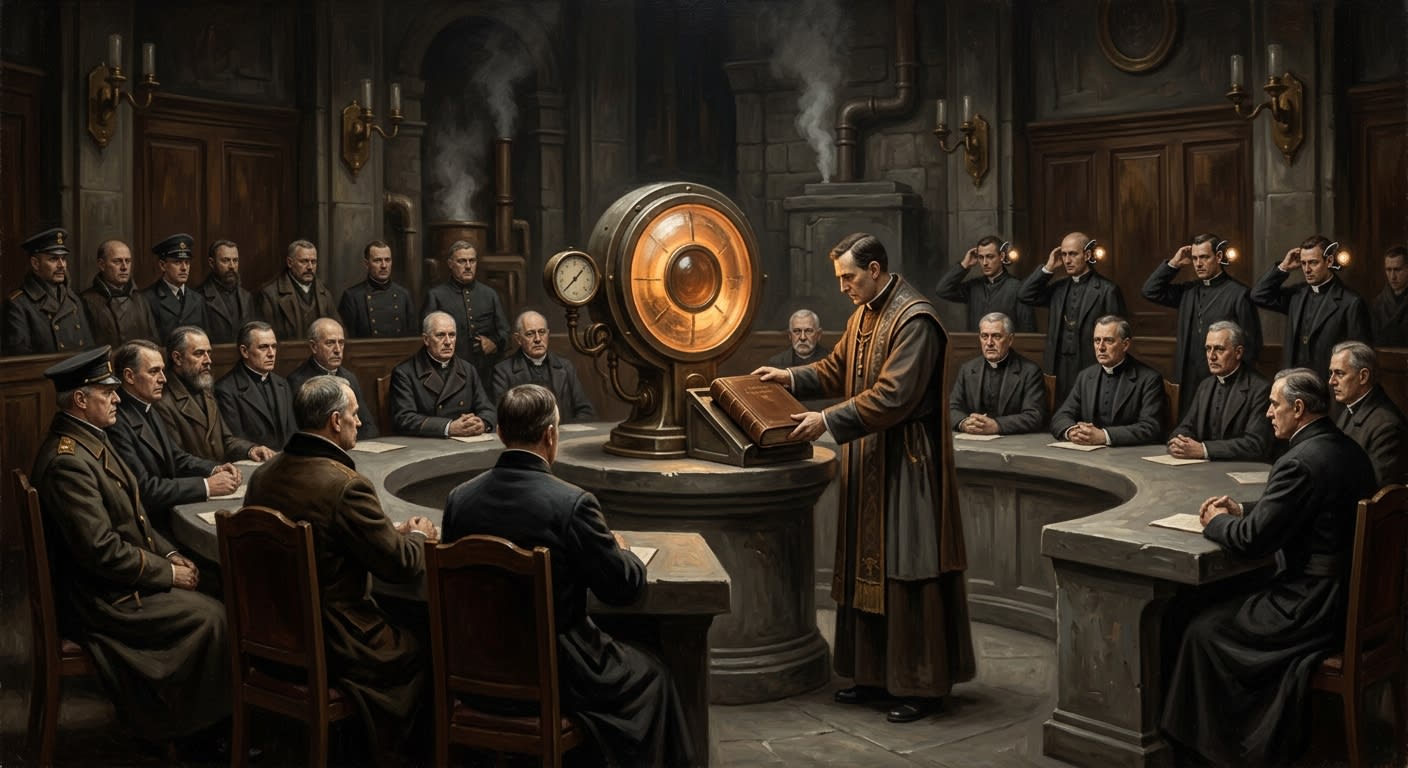
The Eighth Doctrinal Congress convened in Strasbourg in A.S. 134 and did what congresses do when guided by a man with knives in his grammar: it converted an appetite into law, a theory into procedure, and a private terror into public obligation. Its principal act was the Severian Revision of the Catechism of Obedience, by which Severian of Mainz placed Article 19 into the Synod’s most copied instrument and taught the faithful that silence has walls.
The Congress is commonly remembered through one phrase: Silence is shelter. This is efficient, which is why it is insufficient. The phrase was the nail-head. The Congress supplied the hammer, the witness, the replacement table, the reporting window, the penalty cross-reference, the school primer, and the necessary little memorandum explaining why a mother who did not denounce her son had participated in whatever he had said, thought, sung, hidden, delayed, or almost confessed.
The Eighth did not create Severian. Heaven forbid that any meeting should receive credit for that much malice. Severian arrived with the Iron Choir already humming behind him, the Commentaries on Faithful Severity already circulating through Purity instruction cells, and the Second Appendix already teaching young correctionists that a tongue was public property misused by private error. The Congress gave his doctrine incorporation. Incorporation is the Bureaucratic Synod’s preferred miracle: what enters as a memorandum leaves as inevitability.
#On the Need for Revision
The Catechism had been ratified in A.S. 92 as the second instrument under the Concordat, seventy-four pages of beautiful coercion bound in grey vellum and distributed with that missionary zeal by which a state learns to love its own echo. Its early Articles established the Synod as sole interpreter of truth, licensed hope, left heresy undefined by design, and made oaths binding unto death with no procedure for unbinding. A lesser civilisation would have rested there, admiring the accomplishment and persecuting at leisure.
We are not lesser.
By A.S. 134, public obedience had acquired private hiding places. The A.S. 104 Third Revision had hardened market speech, oath discipline, correction slips, catechism schools, and street-vicar practice; it had taught the Synod that commerce could carry error beneath respectable weights. The years that followed taught a colder lesson. Heresy did not require public argument. It could survive in delay, pity, household tact, family warning, priestly hesitation, guild courtesy, and that revolting little pause before a man betrays someone he loves.
Earlier instructional summaries describe the Eighth Doctrinal Congress as a routine clarification of catechetical procedure.
Corrected. Routine clarification does not require Severian, closed doors, Purity countersigns, and seven sealed appendices whose table of contents alone made a junior copyist vomit into a sand tray. The Congress was a severity settlement. Procedure came afterward wearing clean cuffs.
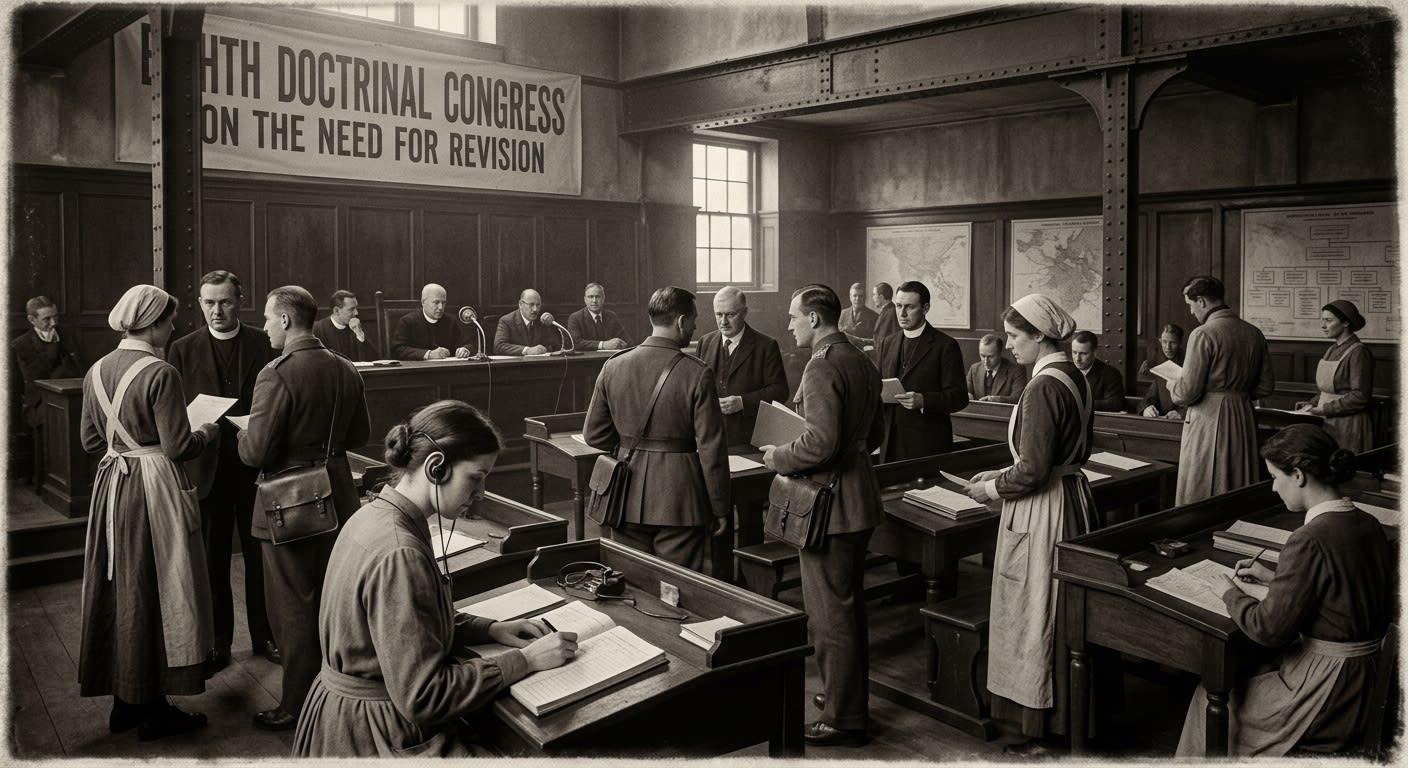
The Congress met in the Hall of Confirmed Necessities, three streets from the Basilica precinct and far enough from the public galleries to prevent spectators from mistaking government for theatre. The Bureau of Doctrine presided in form. The Bureau of Purity governed the temperature of the room. Records supplied indexed copies of the Catechism, prior glosses, provincial denunciation failures, Confessarii complaints, school reports, and a black-bound packet from Mainz that was opened only after the clerks without clearance had been dismissed. The dismissed clerks later claimed they heard singing through the walls. Records classified the claim as architectural stress.
Severian’s argument was delivered without flourish. Men who can make cages sing do not need table-pounding. He had learned at Mainz that punishment, if visible and maintained, could instruct roads, markets, and children. He had learned from the Second Appendix that the mouth could be reassigned. He now proposed that the ear, too, belonged to Doctrine.
#On Severian’s Proposition
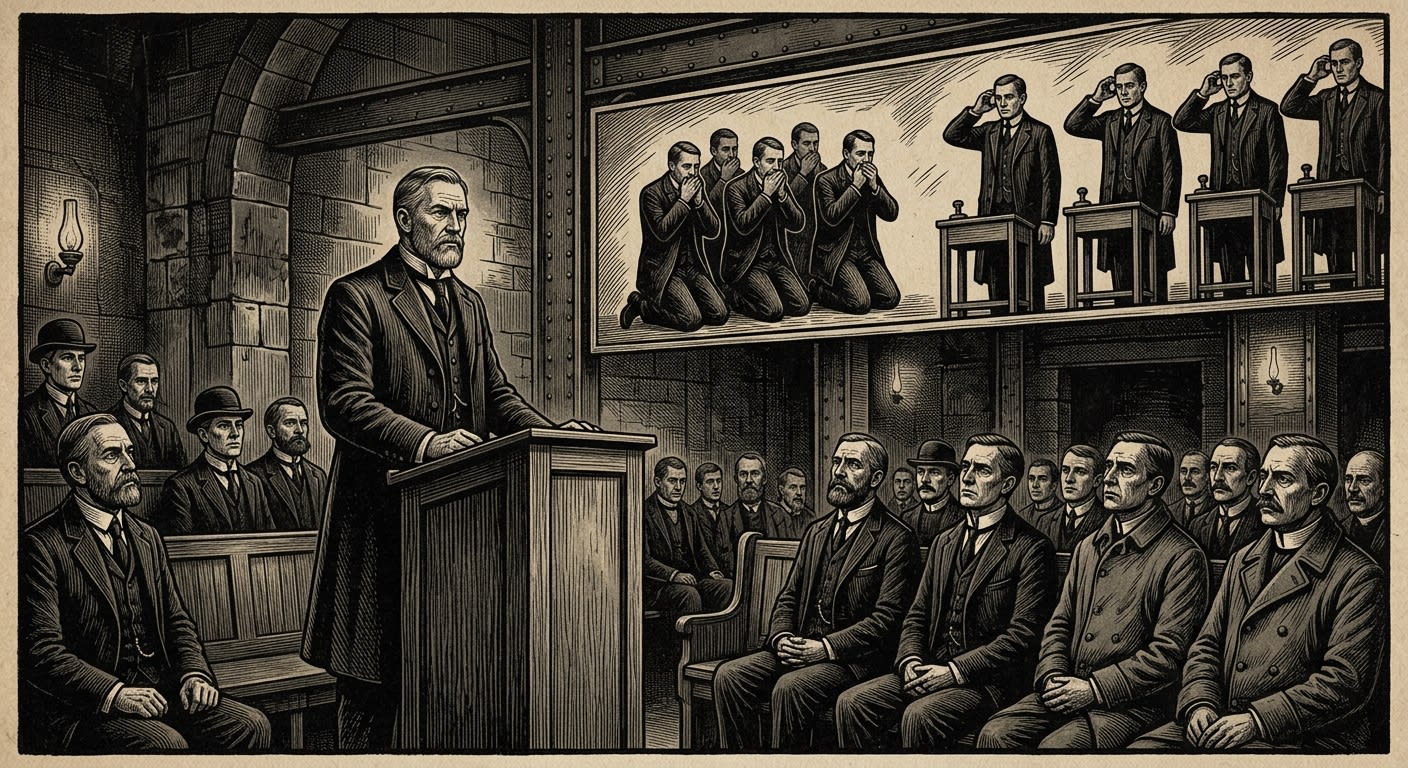
Severian’s proposition was simple enough to be recited by a child and poisonous enough to govern a century: a citizen who hears, sees, suspects, or spiritually smells contamination and fails to report has not remained innocent. He has provided shelter. Shelter is participation. Participation is heresy given walls.
The language drew from Book III of the Commentaries, but the Congress improved it by making it dull. This is not insult. Dullness is how doctrine enters daily practice. A brilliant paragraph inspires admirers. A dull clause survives being copied by exhausted schoolmasters, frightened ward clerks, half-literate gate officers, and magistrates with ink on their cuffs. Severian supplied the murderous compression. Doctrine supplied grammar durable enough for damp stairwells.
The debate did not concern whether citizens should report heresy. That duty already existed in sermon, custom, and the ordinary survival reflex of people who prefer not to be hanged beside their friends. The debate concerned whether failure to report could be treated as the same species of offence as the thing unreported. This distinction, dear to Mercy and to other departments with soft chairs, died before the second session.
A Mercy delegate asked how suspicion could be measured. Severian answered that measurement was unnecessary where delay had already occurred. A Doctrine canon asked whether mistaken reports would burden parish offices. Severian replied that a burdened office was preferable to an unburdened heresy. A Records officer asked how duplicate accusations should be indexed when the reported act remained undefined. Severian approved the question. Records has never recovered from the compliment.
The turning moment came, according to three accounts and one wine-stained private letter I was not meant to see, when Severian placed two objects on the table: a child's slate from a Catechism School and a cage tag from Mainz. The slate bore a copied sentence with one word omitted. The cage tag bore a condemned man’s name, row, throat condition, hymn schedule, and witness count. Severian asked which object frightened the room more. The delegates chose incorrectly at first. Then he explained that the cage punished a heresy already found. The slate taught a child how not to hide one. The Congress adjourned early and returned obedient.
#On Article 19
Article 19 — On the Duty of Denunciation — entered the Catechism as a new civic reflex. It required every person subject to Synod jurisdiction to report suspected heresy, doctrinal deviation, or spiritual unease of a contaminating character to the nearest competent authority within twenty-four hours of observation. Failure to report became participation, punishable under the same doctrinal family as the unreported offence. The unborn remained covered through anticipatory jurisdiction, naturally, since a state that counts the cradle may as well count the womb’s silence.
Its report window was Severian’s finest piece of logistical cruelty. Twenty-four hours is long enough to locate a priest, schoolmaster, gate desk, Purity office, ward examiner, or any official with a seal and a taste for usefulness. It is short enough to prevent affection from regaining strength. Give pity three days and it forms arguments. Give it one day and it spends the day looking for ink.
The nearest competent authority was left deliberately broad. Parish examiner, Bureau representative, route confessor, White-Mantled Inquisitor, licensed schoolmaster, tribunal clerk, gate officer, military catechist: all could receive the report and transmit it into the digestive tract of the state. Competence was presumed when the accusation looked valuable. Incompetence was assigned after jurisdictional credit had been secured.
Article 19 did not merely increase prosecutions. It changed the posture of listening. A citizen no longer heard speech as sound first and meaning second. He heard liability. A joke entered the twenty-four-hour ripening period. A pause after the Creed became a possible shelter. A wife’s grief, if too inward, became spiritual unease. A child’s question became a household test. A priest’s hesitation before answering became a reportable condition if witnessed by anyone with a sufficient fear of not reporting it.
SESSION VI — JUVENILE INSTRUCTION DEMONSTRATION Exercise: staged doctrinal hesitation by instructor before twelve children. Reports filed within one hour: eleven. Non-reporting subject: one child; approached instructor; physical embrace observed. Congress notation: “affectional shelter reflex confirmed.” Disposition of child: ███████████████████████████████████████ Use in primer development: approved.
The demonstration is absent from public congress abstracts, which prefer cleaner origins. Public doctrine says Article 19 arose from necessity, theological insight, and vigilance. This is true in the Bureau sense. The sharper truth is that a child hugged the staged heretic, and the room understood that love itself would require a reporting form.
#On the Secondary Glosses
Article 19 was the famous wound. The Congress also cut smaller ones. It expanded Article 4 to include the licensing of festivals and public joy, a measure prompted by provincial celebrations whose organisers had apparently forgotten that happiness in groups can become politics before the second song. One Munich incident of spontaneous dancing appears in the minutes under the phrase unlicensed rhythmic consent. I would have promoted the clerk who wrote it and then inspected his dreams.
Article 14’s oath provisions were tightened to include silence as a form of oath-breaking. This mattered in barracks, offices, factories, garrisons, orphan houses, and every place where men swear aloud and later pretend they did not hear one another betray the oath in smaller words. A sworn man who hears deviation and remains silent has broken oath by refusing witness. The mouth, already conscripted, received a duty to wake the ear.
The Congress also authorised secondary glosses for Catechism Schools, Confessarii, Purity examiners, and provincial tribunals. These glosses taught that uncertainty kept the reporting clock alive, that spiritual unease should be reported before understanding arrived to spoil it, that mistaken denunciations were preferable to delayed true reports, and that deliberate over-reporting for malice remained punishable chiefly when it embarrassed the wrong superior. That last clause is not printed. It is understood, which makes it stronger.
A provincial tribunal in A.S. 141 later ruled that uncertainty delayed the Article 19 reporting clock until certainty formed.
Clarified by Doctrine, Purity, and the tribunal’s subsequent silence. Uncertainty is reportable. The phrase “certainty formed” has no standing in denunciation practice except as evidence that a clerk once wished to be merciful in public.
#On the Flood of Reports
Within six months, denunciations flooded parish offices, guild courts, tithe houses, military counting rooms, chapter schools, orphan desks, barracks chapels, factory gates, and the lower desks of Strasbourg. The first reports were clumsy: neighbours accusing neighbours, sons accusing fathers, debtors accusing lenders, spurned lovers discovering contaminating unease in handwriting, apprentices hearing Rationalism in the way a master weighed flour. Purity accepted most. Records indexed all. Mercy complained in memoranda so weary that the paper seemed to sag.
The flood exposed a pattern. Citizens denounced sideways and downward with inspiring zeal. They denounced rivals, kin, servants, old women, shopkeepers, cousins with better boots, children who mispronounced Creed words, and priests insufficiently prompt in correcting them. They rarely denounced superiors. Bureau officials generated fewer accusations per head than washerwomen, which did not prove greater holiness among officials, though several officials attempted the argument with faces of admirable wax.
From this asymmetry came the post-Congress severity reforms and the decisive formation of the Order of Severance. If silence sheltered heresy in houses, it built palaces in offices. Article 19 armed Purity against the domestic table; Severance armed Purity against the polished desk. The same doctrine climbed the stairs.
Reports also transformed language. Ordinary speech acquired warning habits. Families learned to cough over unsafe names, then learned that suspicious coughing had its own risks. Workshops developed denunciation boxes beside wage ledgers. Catechism Schools awarded promptness tokens. Some dioceses required children to recite “Silence is shelter” before meals, which improved compliance and destroyed soup as a place of rest. The Bureau of Tithes envied the system. An accusation collected itself more cheaply than coin.
#On the Congress as Theatre Denied
The Eighth Congress had no public procession, no grand outdoor ratification, no triumphal peal advertised in advance. This restraint was deliberate. Severian distrusted spectacle that did not continue working after the crowd dispersed. The Congress’s true procession moved through copied pages, school drills, kitchen warnings, office posters, and the trembling pause before someone decided whether love could survive a report.
Still, there was theatre. Government always has theatre; it merely calls the stage a chamber when ashamed of applause. Delegates entered through the north archive door to avoid petitioners. Purity Lictors stood behind the last row without insignia. Records kept three parallel minute books: public proceedings, doctrinal proceedings, and an acoustic notation sheet tracking pauses after Severian’s interventions. One delegate from Mercy stopped speaking after Session IV and communicated by written objection. The objections were entered. The silence was also entered.
A small bronze bell sat on the table before the Doctrine chair. It was rung only twice. The first ring opened deliberations. The second followed a question from a provincial canon who asked whether Article 19 might encourage false accusation. Severian did not answer immediately. The bell rang. The canon withdrew the question, then filed a self-report for having implied that loyal citizens might abuse duty. The Congress accepted his vigilance and struck his name from the speaking list.
The final vote was unanimous after abstentions were reclassified as hostile hesitation. This is among the Synod’s most efficient parliamentary techniques. No delegate voted against. Several later claimed they had intended refinements. Intentions, unless filed before the bell, are decorative vapour.
#On Legacy and Present Application
As of A.S. 201, the Eighth Doctrinal Congress remains the hinge between public obedience and domestic surveillance. Earlier doctrine governed belief, oath, hope, commerce, sacrament, speech, and printed error. The Eighth governed the failure to betray. It made the unspoken interval prosecutable. It placed a little Purity desk behind every ear and told the citizen to staff it himself.
The Congress feeds modern practice in a hundred visible and invisible ways: Article 19 warning cards in tenement stairwells; Catechism School promptness drills; White-Mantled Inquisitor household entries; Confessarii pre-confession suspicion sheets; Lictor manuals on delayed reporting; Severance comparative-silence examinations; Orphanarii intake checks for unreported nursery songs; factory wall notices; gate tribunal accusation slots; barracks oath refreshers; and the cheerful little parish boxes marked REPORT BEFORE MERCY CONFUSES YOU.
The Twelfth Amendment of A.S. 196 did not replace the Eighth. It fulfilled its direction inward. The Catechism’s march is clear enough for schoolchildren and unpleasant enough for adults: public speech, public silence, private thought. A.S. 104 disciplined the market mouth. A.S. 134 disciplined the listening household. A.S. 196 disciplined the face when it believed itself alone. Progress, properly filed.
One may judge a Congress by its monuments. The Eighth has few statues. It does not need them. Its monument is the neighbour who reports before pity forms; the child who hears a dangerous pause and runs; the clerk who denounces a blank line; the wife who files grief before grief shelters anything; the official who fears not being feared enough. Severian built cages at Mainz. At Strasbourg in A.S. 134, he learned to leave the cage door open and let the citizen step inside to avoid being accused of standing outside it too quietly.