
#On the Cathedral
"A building keeps no creed. It keeps tenants, and the Ledger keeps their names." — Drax, marginal note in a Vienna survey register
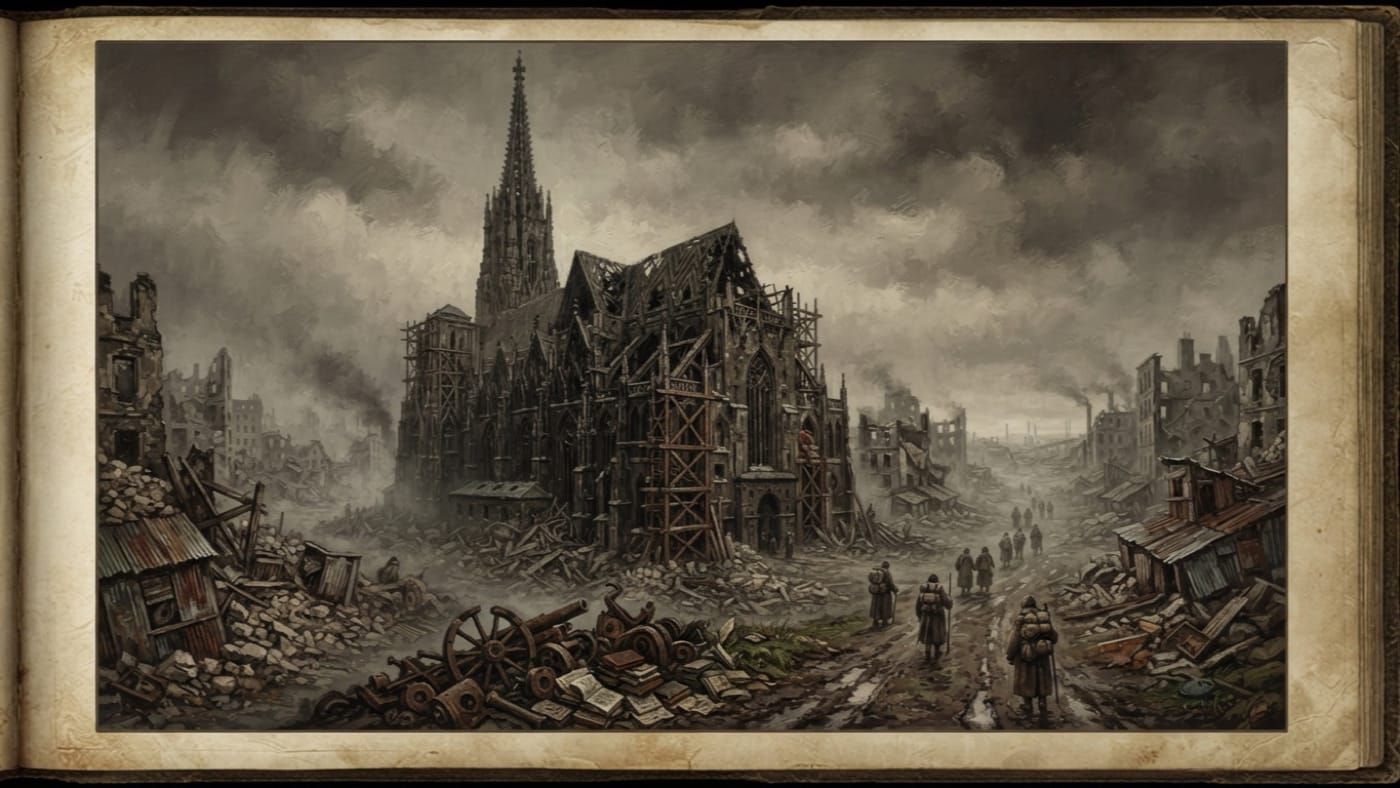
The Cathedral of Saint Stephen is the Ledger's name for a building that has changed masters more often than its stones have moved. It stood in Vienna while Vienna was the seat of the Holy See. It housed the Academy while Vienna was the showroom of the Rationalists. It lies today among the consecrated ruins of Vienna-Ruins, Zone 3, where pilgrims walk round it on their way to somewhere warmer.
The Ledger has nothing to say about its founding, and holds that silence as a matter of discipline. No builder's charter, consecration record or list of incumbents has reached my desk with a seal I recognise. Other scribes have supplied these things from imagination. I have confiscated their drafts.
On the saint, the Ledger records the name and nothing more. The saint's own file is not this article's business. Any reader who requires a hagiography may apply to the appropriate office and wait.
Three things get confused in this matter, and I will separate them once, because I am paid to: the building, the jurisdiction and the institution that later filled it. The See was an authority. The cathedral was premises. When the Rationalists dissolved the first, they took possession of the second, and the possession conveyed exactly as much sacred authority as a bailiff gains by sitting in the debtor's chair.
#On the Academy
The Treaty of Regensburg was concluded in A.S. 30 / 1740 CE. The Atheist Wars ended there, the formal Rationalist Republic was constituted, and the Holy See of Vienna was dissolved at swordpoint. That is the Lore Book's phrase, and I keep it because nothing gentler would be accurate. The victors proclaimed a "New Dawn." The faithful who remained took their prayers into cellars, and the Rationalists hunted them there with the thoroughness of men who had found a use for their census tables.
The Rationalist Academy occupied the Cathedral of Saint Stephen by the autumn of that year. The register establishes this through the Procession and leaves the rest blank. On what day the keys changed hands, who held them and whether any priest was still inside, the surviving papers do not say. The Ledger does not supply a date the archive has failed to keep.
The motive is easier to read than the deed. The Rationalists placed their Academy in the cathedral for the same reason they routed their triumph down the old feast-day boulevard. They understood symbolism, even as they professed to despise it. They chose the largest sacred room in the city to teach that sacred rooms were merely large. A man who wishes to prove that a chalice is only a cup does not buy a cup. He steals the chalice and drinks beer from it in public.
What they taught there was "public instruction," a phrase the Rationalists used the way the Church uses catechesis and with the same intent: to make the young repeat a doctrine before they could examine it. The Academy's students wore black gowns. They learned to name each miracle in the calendar and then explain it away. On the one occasion when their instruction left the building and entered the street, it left in print. The students carried programmes listing each saint's "superstitious claims," followed by a paragraph of "rational correction." Saint Rupert's salt became "saline crystallization in humid environments." Leopold's incorrupt body became "naturally occurring adipocere formation in alkaline soil."
They had an explanation for every relic in Vienna. They had no explanation for the Academy's address, and never thought one necessary.
I will not describe the interior during the occupation from rumour. Some accounts have filled the nave with apparatus, lecterns and instruments of improbable size, but none of them bears a seal. The Ledger takes no furniture on hearsay. It is enough to know that black-gowned young men sat where the faithful had knelt and were taught that the kneeling had been a mistake of posture.
#On the Procession
On the fourteenth of Novembris, A.S. 30, the cathedral's occupants went out to demonstrate their lessons. The full account belongs to the Black Procession of A.S. 30, and I will not copy my own work at length. For this article, three places must be kept separate, because careless chroniclers have run them together.
The Academy was housed in the cathedral. The Procession moved along the Ringstrasse, with forty-seven saint-effigies on wheeled platforms and a column of Academy students marching behind each one, programmes in hand. The burning took place in the Heldenplatz, on seven pitch-fed pyres. The fires caught, the flames rose, and the heat left them. Frost formed on the buttons of citizens standing within reach of the flames. Three people died of exposure. The second day of celebrations was cancelled without explanation.
No register places the cold inside Saint Stephen's. The cathedral did not burn and did not freeze. It supplied the students who carried the programmes and the doctrine printed in them, which was the Academy's whole contribution to the day.
The Bureau of Doctrine classified the event retrospectively as a First-Order Portent and holds that the Creator withdrew the heat from an act of desecration. That is the Bureau's reading, and I sign beneath it with the enthusiasm my office requires. What happened is recorded. Why it happened is classified.
The Academy, for its part, filed the cold under weather and went back to its lectures in the cathedral. The Year Without Dawn followed in A.S. 32, the Red Flood in A.S. 34 and the Eastern Silence in A.S. 38. Each was explained, filed and taught. On the first of November, A.S. 45, came the Sundering, which the Academy could not explain, and nobody remained in Vienna with the leisure to try.
#On the Relics and the Retreat
The Academy's lectern did not survive the war that followed. The Lore Book records that the Rationalist hold on Vienna collapsed through despair more than through shell or famine. Its councils disappeared and their records stop mid-sentence. Into that gap came rumours of small miracles, such as a child healed of a plague sore and a candle burning without oil. The hidden Church had been praying in Vienna's cellars since Regensburg. Now it came up the cellar stairs.
There was no Synod yet, and I will not pretend otherwise for the sake of a tidier heading. Before A.S. 45 there was a hidden Church. After it came an uneven public emergence, with priests and officers taking up civil work in each town as the collapse allowed. The ceremonial names that later Bureaus gave to those early efforts are retrospective, and I use them sparingly.
During the Great Retreat, the long westward bleeding after the Sundering, Vienna bought the retreating armies a brief reprieve. Relics flared and the armies rallied. The city still could not be held, and it was abandoned. Its walls became what the Lore Book calls "ruins consecrated in absence," which is the most honest phrase in that book.
Where in the city the relics were raised, and for how long their light lasted, the inherited registers disagree. Some name the cathedral crypt. Some give durations precise to the day. None that I can authenticate settles either question. A Warden who picked a crypt and a number from these lists for the sake of a better paragraph would be a novelist, and the Bureau already employs enough of those in the Office of Pilgrimage brochures.
The faithful left Vienna westward with whatever they could carry. The cathedral could not be carried, so it stayed behind with the rest of the city.
#On the Ruins
The formal Synod was constituted under the Concordat of Strasbourg in A.S. 90 / 1800 CE. Five years later, in A.S. 95 / 1805 CE, it took Vienna back. In the Siege of Vienna, Rationalist remnants allied with eastern daemon-cults held the city against the Synod's forces until Bishop-Warden Clemens Stahlhand struck down Althazar of Pest. Tradition says the weapon was the reliquary of Saint Aldebrand.
The Ledger records that Althazar fell. Doctrine records that the blow was a miracle. The Lore Book's own stamped erratum reads "Miracle unverified; but useful," and I have never seen the Bureau's position put more economically. How the blow worked is Doctrine's to pronounce. That it landed is mine to record, and I have recorded it.
Stamped Erratum — Warden of the Sacred Ledger: Certain older chronological tables bound into the Lore Book place the Black Procession in A.S. 124 and the Siege of Vienna in A.S. 201. Both entries are struck. The Procession belongs to A.S. 30 / 1740 CE and the Siege to A.S. 95 / 1805 CE. A.S. 201 is the year of the present survey. The clerk responsible confused the date on which he was writing with the date he was writing about, and has been reassigned to a parish where nothing has happened since the Flood.
The reclaimed city is a shrine-ruin, and the cathedral is one ruin among many. A living town of about ninety thousand souls surrounds the consecrated wreckage. It is the last major hub on the Central Corridor before the Carpathian passes, and every column moving east from Munich must pass through it. Supply wagons and pilgrims share its roads. Pilgrims are more numerous and harder to inventory. The Heldenplatz, a short walk from the cathedral, now holds the seven basalt columns that stay warm through every winter. Pilgrims press their hands to them and then walk on through the city, past the building whose tenants supplied the original fire.
The columns are a Heldenplatz monument. They are not a cathedral installation, and the guides who tell pilgrims otherwise are in breach of the route permit.
No bishop sits in Saint Stephen's. The Holy See has not been restored there or anywhere else, and the Ledger records no successor occupant. Vienna gave the Church a dead chair, and the Synod, which governs from Strasbourg, has never needed to fill it.