
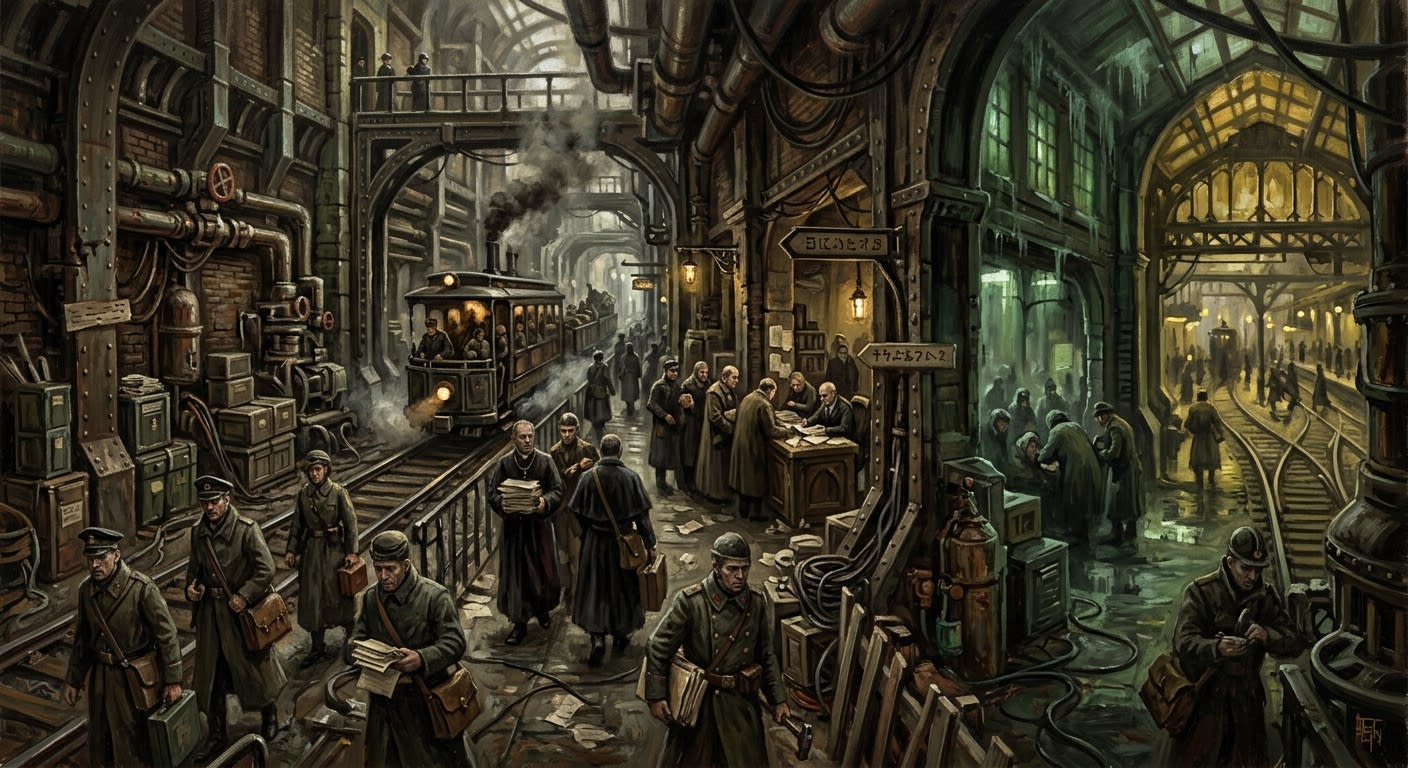
#On the Iron Middle Road
The Central Corridor is the Synod's middle artery, though artery is too soft a word for a thing made of rail, chalk, orders, coal smoke, bridge-chain, clerk-fatigue, Danube mud, Bavarian obedience, Hungarian contempt, Viennese bone-dust, and the private panic of men who have discovered that their destination has a firing schedule. It begins in the controlled abundance of Munich, where the west is still fat enough to complain about inconvenience, and it runs east through Vienna-Ruins, Bratislava, and Budapest before dividing toward the Carpathian approaches, the Danubian forward works, Bastion-Przemyśl, Bastion-Sibiu, Bastion-Irongate, and all those excellent reasons a man might prefer dentistry without laudanum.
It is called a corridor because men like to imagine routes as clean passageways. This is a kindness language performs for cowards. The Central Corridor is a procession, a warehouse, a jaw, a shrine road, a casualty drain, a market in favours, a military stomach, a river-crossing habit, a rail schedule, a confession queue, and a sequence of increasingly eastern disappointments. A man enters it as cargo with boots. If blessed, he exits as a soldier. If luckier, he exits westbound with the same name.
The Corridor's formal settlement belongs to A.S. 90, the Concordat year, when Munich entered the Synod's administrative apparatus and the Bureau of War designated it the primary Central supply node. The old Bavarian rail habits were not created by the Synod. They were seized, disciplined, blessed, audited, and made worse in the productive manner. From that seizure came the Provisorium, the Münchner Kreuzbahnhof, the Durchgangskaserne, Platform Eighteen, and the great eastward motion by which the safe zones pay their debt to the Line in grain, steel, cloth, men, coffins, and denial.
A corridor is judged by what it refuses to admit. This one admits delay but calls it staging. It admits death but calls it throughput. It admits panic but gives panic a platform number and a departure bell. The great genius of the Central Corridor lies in this transfiguration. Mud becomes report. Hunger becomes requisition. Cowardice becomes medical category. A mother watching her son board in Munich becomes civilian obstruction if she remains too long at the rail gate.
#On Munich, Where Motion Is Packed
Munich is the Corridor's western mouth, and like all mouths used by governments it chews more than it tastes. The city entered official Central service in A.S. 90. By A.S. 110 the first perimeter survey for the Provisorium had been driven into its southeastern quadrant, and after that the Gut did what guts do: it swallowed.

Four hundred and twelve warehouses now stand inside the Provisorium's fences. Grain halls. Shell sheds. Chrismole tanks. Boot-nail cages. Bandage lofts. Coffin timber yards. Locked brick blocks catalogued as Other, Theological. Roughly fourteen thousand metric tons pass through each week on ordinary paper, plus whatever the emergency slips, duplicate routings, black drawers, and Bavarian habit of performing unauthorised efficiency can conceal from the weaker offices. War counts quantity. Tithes counts value. Doctrine counts sanctity. The crates, wiser than their handlers, continue east.
The Cross-Station receives the Provisorium's breath. Fourteen public platforms, sixty trains on an ordinary day, ninety during surge, one mile of sorting yards, eleven thousand workers, and an iron canopy under which steam gathers like incense dismissed from chapel service for drunkenness. Lines enter from Strasbourg, Cologne, Kanzleiburg, and the southern approaches. Lines leave toward Vienna, Budapest, Przemyśl, Sibiu, and the eastern appetites that keep the station ugly and holy.
Passenger service survives as a polite fiction. Three trains to Strasbourg, two to Cologne, one to Vienna, each threaded between ammunition, grain, medical crates, coffin timber, bell fittings, and barrels of chrismole that smell like penance learned chemistry. Civilians with tickets become cargo with hats. The Bureau calls this integration. The hat rarely agrees.
The Durchgangskaserne stands along the eastern freight yards, receiving approximately forty thousand soldiers each month. Men arrive from parish rolls, reserve depots, disciplinary transfers, family kitchens, and the hopeful ignorance of rural stations. Intake verifies name. Intake verifies body. Intake verifies that name and body have not made separate arrangements. The scar check is often more reliable than the papers. Flesh, though corruptible, is less ambitious as a liar.
Older War guides state that Munich forwards men and materiel “without spiritual alteration.”
Corrected. Every man who passes through Munich is altered. The warehouse takes his civilian weight. The barracks takes his local comforts. Platform Eighteen takes his name if he scratches deeply enough. The train takes the rest.
Platform Eighteen, ancillary by plan and central by dread, is the last safe-ground sight for many soldiers heading east. Its pillars have been cleaned four times by Records. The names return. Bayonets are patient chisels. A man can be briefed, blessed, counted, kit-checked, stripped of his private bottle, and treated as movement code. Then he carves his name into iron and becomes briefly inconvenient to abstraction.
This is Munich's true offering to the Corridor: packed motion. Flour packed into sacks. Shells packed into wagons. Men packed into barracks. Names packed into pillars. Resentment packed into exact compliance until the whole city becomes a spring held under a saint's thumb.
The Munich schedules deserve particular contempt, which is to say attention. Each train receives a movement folio before the engine receives coal. The folio contains origin, destination, cargo class, sanctity class, hazard class, staffing count, axle report, bell-credit window, emergency priority, reroute conditions, and the little grey supplement used when the destination is known to be unpleasant in ways no ordinary form should dignify. The clerks at the Cross-Station bind these folios with black twine during ordinary weeks and red twine during surge. Nobody admits the colour matters. Every yardmaster checks it first.
A train of grain may be delayed for shells. A train of shells may be delayed for medical return. A medical return may be delayed for reliquary dispatch. A reliquary dispatch may be delayed for an empty coal train whose absence would starve three later departures into immobility. This is the Corridor's doctrine in miniature: the visible thing is rarely the urgent thing, and the urgent thing is often a dirty wagon with no saint painted on it.
The Bavarian workers understand priority without believing in it. Belief would slow them. A loader may curse Strasbourg, spit near a War inspector's boot, steal three mouthfuls of soup, hide his brother's transfer slip under a stack of axle-grease rags, and still load the eastbound shell wagon in correct order because incorrect loading kills men he has never met in a place he already hates. The Bureau mistakes this for obedience. It is older and harder. It is craft under occupation.
#On Vienna, the Sacred Interruption
From Munich the Corridor runs east toward Vienna-Ruins, the city that died as capital, died as retreat wound, and rose as shrine because the Bureau of Pilgrimage has never permitted a profitable corpse to rest unlabelled. Vienna is not a hub by size. It is a hub by infection of meaning. Everything passing through it receives ash, scrutiny, relic-gossip, delay, and the uncomfortable instruction that a route may be holy while still smelling of latrines.

Vienna's old Rationalist pride ended in A.S. 95 when Bishop-Warden Clemens Stahlhand struck down Althazar of Pest with the reliquary blow whose nine-second note still fattens sermons. The Hofburg remains sealed, the Council of Nine's last meeting preserved, the pen still wet. Saint Stephen's ruins remain a First-Order Martyrdom Site. The Via Stahlhand runs four hundred and eleven metres through the Kärntner Gate breach (Unregistered), taken by pilgrims on their knees unless they are me, in which case they walk upright and endure Pilgrimage's small squeaking noises.
The Corridor learned to route around sanctity without appearing to insult it. Supply convoys pass through the rebuilt rail junction while pilgrims press palms to the warm basalt columns in the Heldenplatz. Relic consignments receive special curtains. Troop trains slow under chapel windows. Wounded men returning west look at shrine-peddlers selling miniature columns and learn a useful lesson: martyrdom has a retail division.
Vienna's Bureau of Pilgrimage headquarters makes delay sound devotional. A wagon halted by crowding becomes a procession adjacency. A grain car delayed by relic observance becomes sanctified sequencing. Soldiers from the Durchgangskaserne call the city the Waiting Room. They are correct in the vulgar sense and wrong in the deeper sense. Waiting rooms promise a physician. Vienna promises memory, which cures less and charges more.
The Corridor needs Vienna because routes are not held by iron alone. A line that carries men east must feed their obedience with theatre, dread, and proof. Vienna supplies all three. The cold pyres of A.S. 30 proved Reason's failure. The warm columns prove something else, depending on which Bureau is paying the printer. The sealed Hofburg proves that paper can remain wet longer than empire. The gift shop proves Tithes has the truest endurance of all.
The Donaukanal still gives up bones with orthodox scripture on them. The Hanged Bridge still carries weight after its bodies were cut down. Mothers still keep candles in Judenplatz after the lullaby brandings. The Central Corridor passes through this accumulation of sanctioned grief because the alternative would be a purely military road, and pure military roads become efficient enough to frighten even War.
The Vienna halt also performs a disciplinary mercy upon the westbound wounded. Men returning from the Carpathian passes, Irongate gorge, and Danubian crossings are unloaded under shrine bells before being sent farther west. Those who can stand are encouraged to touch a warm column. Those who cannot stand are rolled past it. The Bureau of Mercy claims this aids recovery. The surgeons claim it occupies the conscious. The men claim very little, having learned that speech invites questions with forms attached.
Records keeps a transit chapel beside the rail junction for names that arrive without bodies and bodies that arrive with names in dispute. The chapel has eight desks, a bone drawer, a basin of vinegar, and a painted sign reading SPEAK CLEARLY FOR THE DEAD. During surge weeks the sign is turned toward the clerks, who need the warning more than mourners do. It is one thing to lose a man at the Line. It is another to lose him between two files in Vienna, where loss has marble columns and a gift tariff.
#On Bratislava, the Damp Throat
Bratislava, Pressburg in old memoranda and stubborn mouths, stands between Vienna and Budapest. It is a Zone 3 city of one hundred and eighty thousand resident souls, plus transients, soldiers, patients, barge crews, petitioners, animals, and those human ambiguities that appear whenever a checkpoint has weather. It is a Danube crossing, secondary rail junction, supply overflow node, quarantine reserve, and Bureau of Passage checkpoint. It is also proof that middle places may become indispensable by refusing glamour.
Munich has warehouses. Vienna has sanctity. Budapest has command. Bratislava has hinges.
The bridges there have been rebuilt, widened, measured, reinforced, blessed, re-measured, and cursed by engineers discovering each winter that a river treats paperwork as furniture floating past. Barges sit under chain inspection. Military ferries move at night. Civilian traffic passes beneath Passage's stone customs house, a building swollen by annexes until it resembles a monastery that traded salvation for stamps and feels no regret.
Every convoy between Vienna and Budapest presents itself there. Grain trains. Ammunition trains. Reliquary consignments. Beer casks from Munich's Bräuviertel described in medical documents as morale fluid. Refugee columns holding provisional writs that smell of wet wool and terror. Wounded men behind curtains thin enough to teach the nose what the eyes have declined. Passage examines all and loves none.
Bratislava also remembers the Pressburg Binding (Unregistered), that delightful case in which deserters found themselves walking back into line against their declared intention because their military oaths had been attached to material obligation by a Records clerk with iron-gall ink and imagination. Catechists embroidered the tale until signatures acquired ankles. The approved lesson remains sound: no oath is small when a bridge contract is listening.
The city's rail yard escaped the sin of greatness. It is not the largest, which is why it works. Great yards aspire to apocalypse. Secondary yards settle for vice. Bratislava handles west-east freight, Danube bridge traffic, quarantine cars, overflow from Vienna, overflow from Budapest, and all the ordinary cowardices of a line that prefers its failures to happen elsewhere. When three incompatible gauges once met under its roof, men moved shells by hand and learned to pray for standard measure with sincerity usually reserved for fever.
Quarantine gives Bratislava its darker credential. Survivors from the Iron Plains and Debrecen came west through its wards. Captain Elias Mürren was held there, asking whether wall-plaster could be blessed before consumption. His final disposition remains absent. In Bratislava, absence has four fathers: mercy, appetite, incompetence, and sealing wax.
Bratislava's talent is triage without glory. A grand city makes declarations. Bratislava makes piles. Fit to proceed. Hold for Passage. Hold for Mercy. Hold for Purity. Return west under guard. Forward east under guard. Burn bedding. Save harness. Question chaplain. Replace wheel. Reclassify passenger as tolerated encumbrance. Reclassify tolerated encumbrance as refugee. Reclassify refugee as witness. The chalkboards in the customs annex change faster than sermons and with greater pastoral force.
During flood months the city becomes a wet abacus. Barges back up under bridge-chain. Rail wagons wait with wheels chocked in water brown enough to look official. Passage inspectors walk plankways between queues while clerks in upper windows lower documents by cord, as though bureaucracy itself has become a fishing practice. The documents rise damp. The seals blur. Men swear the river has opinions about ink. The river, questioned by competent authority, continues.
BRATISLAVA FLOOD PROCEDURE — EXTRACT: If bridge traffic halts, rail priority transfers to high bank sidings. If high bank sidings flood, War priority transfers to barge-chain. If barge-chain fails, Passage may authorise mule elevation routes. If mule elevation routes fail, classify delay as Act of Water pending theological assignment.
#On Budapest, Command in a Cut City
Budapest is where the Central Corridor stops pretending it is a route and reveals itself as command under siege. The western bank is Synod-held Zone 3, population 847,213 by the revised A.S. 200 census. The eastern bank, Pest, has been Vacated since A.S. 120, confirmed annually with a sincerity that requires patrol boats, reliquary lamps, Litany-Engineers, and men who rotate every forty-five days before they begin reporting things.
The Danube splits the city into doctrine. West: Order. East: Vacated. Between them: brown water, guns, patrol craft, rumours, and the old bridges demolished from A.S. 118 to A.S. 122 during the Great Retreat. The Chain Bridge held six hours after detonation with eight hundred refugees still crossing. Records filed them as transferred, destination pending. The bridge fell. The pending remains.
CENTRAL CORRIDOR EAST-BANK CONFIRMATION, A.S. ███ Patrol lamp passed third market row. No residents observed. Windows counted: ███. Windows answering count: ███ + 1. Litany-Engineer requested relief before assigned rotation. Classification maintained: Vacated.
Central Corridor Command occupies the former Royal Palace (Unregistered) on the western heights. There Quartermaster-General Hofer governs green, yellow, red, and black pins. Green moves. Yellow is delayed and dying. Red is lost and easier. Black receives a drawer. Hofer understands the Corridor with the hatred necessary for competence. He knows which convoy gets escort, which medical train waits, which grain load outranks a colonel's dignity, which Danube patrol crew has looked east too long, and which prayer may be postponed because locomotives do not burn pity.
In A.S. 200 Q3, Budapest forwarded 412,000 metric tons of grain, 88,000 metric tons of munitions, 34,000 personnel rotations, and 1,147 reliquary consignments. Numbers of that size cease to instruct unless forced back into the hand. A sack. A shell. A man. A bone in a box. A yellow pin at dawn. A clerk too tired to sharpen his pencil and using a knife instead.
Popular Munich pamphlets call Budapest “the Corridor terminus.”
Corrected. A terminus ends. Budapest does no such charitable thing. It divides hunger toward Sibiu, Irongate, Shipka's feeder lines, wound-site roads, river patrols, and the Carpathian transfers. Budapest is a fist with too many fingers.
Refugees make the city larger than its census and smaller than its grief. Between eighty and one hundred and twenty thousand transient people occupy queues, warehouses, repurposed schools, bathhouse corners, and the Seventh District field office of the Mothers of Plenty. Every refugee needs a crossing writ, tithe receipt, confession certificate, and the patience of stone. Most arrive with a bundle, a child, and a village name that no office agrees to spell.
The eastern bank remains visible. This is the Corridor's cruelest architecture. The citizen of Strasbourg can forget the east through distance. The citizen of Budapest sees Pest across four hundred metres of water: windows dark, churches broken, markets empty by decree, occupants patient by rumour. Directive 88-E (Unregistered) advises facing west. The coffee houses face whichever direction earns trade.
#On Movement, Measurement, and the Sin of Yellow
The Central Corridor is operated by conflict among offices that would ruin a weaker system and preserve this one by keeping any single office from becoming sane. War demands speed. Tithes demands value. Records demands names. Passage demands delay. Doctrine demands meaning. Mercy demands exemptions. Engineering demands that bridges obey weight. Pilgrimage demands that Vienna's sacred traffic not be inconvenienced by shells, unless the shells are decorously curtained.
The result should fail. It does not fail often enough to relieve anyone.
Movement classifications carry the true catechism. Green is permission. Yellow is accusation. Red is obituary. Black is absence wearing official shoes. Quartermaster-General Hofer did not invent these colours, but he gave them their present severity. A green convoy is moving and may be ignored until it becomes interesting. A red convoy is lost, and grief can be scheduled. A yellow convoy is still breathing somewhere between mud, bridge, fog, broken rail, refugee pressure, enemy interference, bureaucratic quarrel, and mule philosophy. Yellow requires choice. Choice stains.
The Corridor's materials teach obedience through handling. Grain must be dry. Chrismole must be distant from flame and fools, two categories with frequent overlap. Reliquary crates must ride cushioned, sealed, and watched by men who know the difference between reverence and curiosity. Troop cars must be warm enough to prevent losses before deployment and cold enough to discourage singing. Coffin timber travels west and east alike, because the Line is optimistic in planning and pessimistic in carpentry.
Standard gauge reduced one old misery and created several more respectable ones. The Gauge War left scars through every yard from Munich to the Carpathian transfers. Standard Measure (Unregistered) gave the Corridor a common iron language. Men still die under wheels, but now the wheels agree on width. Civilisation is often disgusting progress by inches measured correctly.
The Danube adds its own arithmetic. Bratislava measures it with bridges. Budapest measures it with patrol rotations. The forward corridor measures it with standards, as at the Night of the Three Bridges in A.S. 172, when three crossings were forced in one charge and War ratified the wet, freezing, shell-torn struggle as miracle of locomotion. They did not swim, says the Bureau. They were carried. The veterans, who swallowed the river, retain opinions.
The Corridor's private economies cling to this official machinery like candle-grease under an altar rail. In Munich, labels scraped from crates buy queue priority. In Vienna, replica reliquary fragments travel east tucked into boot linings, acquiring holiness by proximity to fear. In Bratislava, bridge guards know which grain sacks conceal letters, which letters conceal coin, and which coins have returned once already and should be thrown into the Danube with tongs. In Budapest, coffee runners carry message slips inside sugar packets because Hofer's command chamber forbids private correspondence and breeds it by pressure.
No system of this size remains pure. Purity is a quality of empty shelves, silent platforms, and roads nobody uses. The Central Corridor lives in managed contamination. A bribe may move a medical crate faster. A forged priest's pass may keep a witness from being eaten by a queue. A stolen coal voucher may launch a train whose official coal remains admirably documented in a shed three districts west. The Bureau condemns these acts in circulars and depends upon their descendants by breakfast.
War hates this and uses it. Tithes taxes what can be confessed. Records files what can be named. Doctrine denounces the rest after victory, or after failure, or after lunch, according to ink supply. The Corridor does not become less corrupt under scrutiny. It becomes better described.
#On the Present Corridor
As of A.S. 201, the Central Corridor remains operational, congested, overburdened, sanctified in pieces, poisoned in sheds, damp at crossings, frightened at windows, and more honest than most offices because a halted train is difficult to theologise for long. Munich chews. Vienna blesses and delays. Bratislava checks the throat. Budapest decides which hunger receives wheels.
The Corridor's present strain comes from every direction at once. Przemyśl wants wire, wax, shells, tags, men, rail plates, and coffins. Sibiu wants grain, anti-bribery auditors, mule teams, mountain guns, and coin that has not learned Velmora's temperature. Irongate wants bridge-chain, gasket parts, bell-metal, river crews, and replacements for men whose lungs now sound like wet parchment. Shipka's southern demands arrive through feeder orders carrying fog annotations no clerk enjoys reading. Vienna wants pilgrims managed without being called an obstruction. Munich wants roof repairs in the Gut and receives devotional cards for coughs. Bratislava wants the river to behave. Budapest wants the east bank to remain empty in the only way that matters: officially.
The people along the Corridor have adapted, which is the saddest praise a government can earn. Munich workers cough grey and load correctly. Vienna guides sell sanctity beside troop sidings. Bratislava inspectors identify forged writs by dampness. Budapest clerks drink coffee black enough to confess into and continue moving pins. Soldiers carve names into iron. Mothers learn platform numbers they will never forgive. Refugees choose which of their duplicate identities owes the lowest tithe. Chaplains bless departing trains while standing clear of loading ramps, a humility learned at last through bruising.
At second bell in Munich, an eastbound train leaves the Cross-Station under soot and hand signals. At fourth bell, Vienna slows it beneath ruins warm with profitable memory. By Vespers, Bratislava has searched, stamped, and released it with two cars delayed and one passenger category corrected. Near midnight, Budapest receives its manifest. Hofer's clerk places a green pin, then hesitates, then moves it to yellow. Somewhere beyond the river, an unlit window counts the same train without paper.
The Corridor keeps moving. The Ledger appreciates motion. Motion blurs the screams.