
#On an Object Officially Too Absent to Weigh
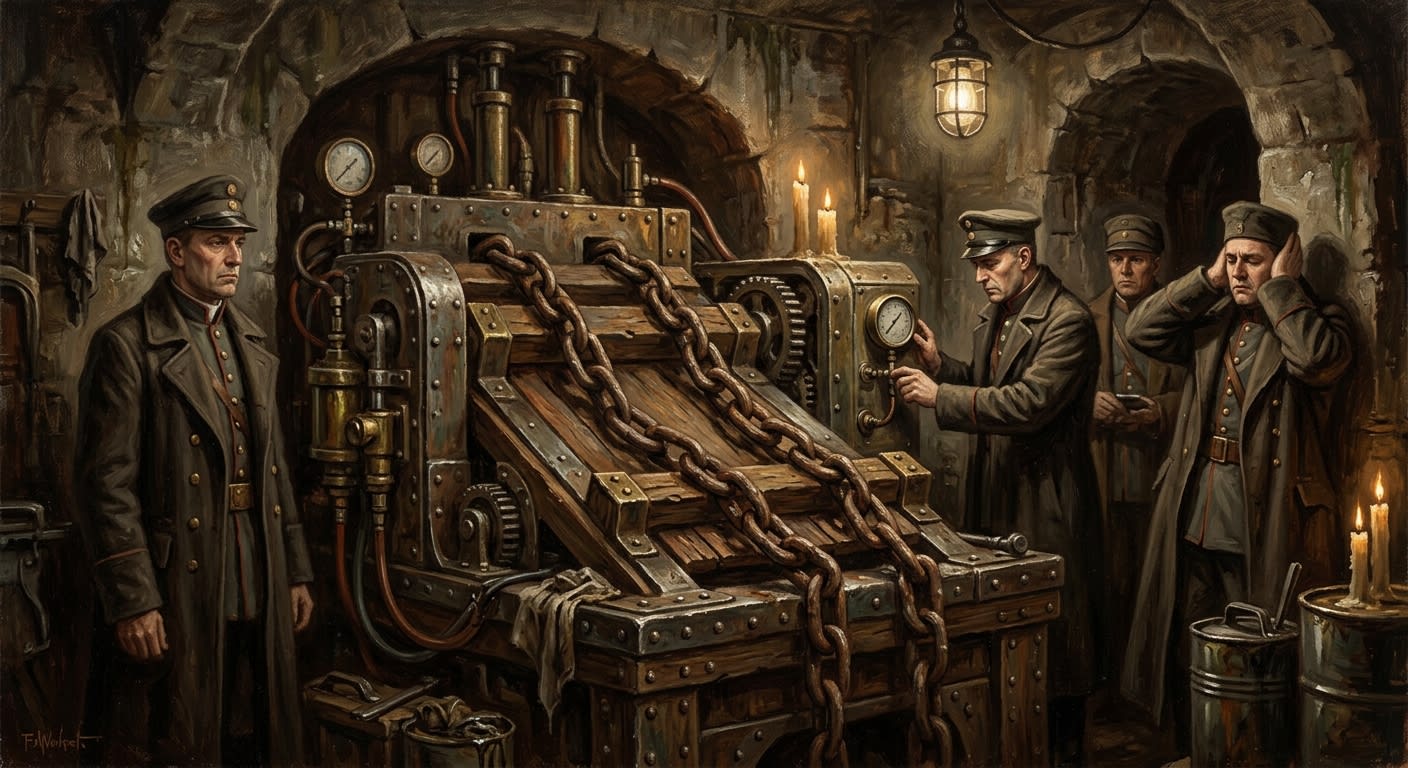
The Chains of the Martyrs of Avignon are the most obedient relic in the Bureau of Relics because they do not exist whenever asked and hum whenever ignored. This, to the untrained mind, appears inconvenient. To the Bureau, it is almost ideal. A visible relic invites petition, procession, theft, counterfeit, devotional poetry, and peasants with candles. An absent relic can be guarded without being displayed, invoked without being explained, and denied without being moved.
The chains are said to be iron links used to bind schismatic clergy after the Schism of Avignon in A.S. 111, when the Drowned Pontiff was crowned beneath the Rhône, preached water older than stone, and forced Strasbourg to remember that jurisdiction is a sacrament best defended with soldiers. The city was razed. Its stones went north. Its names were scraped. Its witnesses were visited. The chains, if one trusts the catalogue no one is allowed to cite, came with the prisoners.
No public inventory acknowledges them. One private Relics list, copied in a hand later reassigned to wax counting, places “Avignon iron, martyr-chain, disputed plurality” beneath the Basilica of the Ledgered Saints. The Bureau of Records denies the vault. The Bureau of Purity denies the chains. Doctrine denies that martyrs can arise from an event whose most stable legal position is non-occurrence. The denials harmonize poorly. So do the chains.
#On the Martyrs Who Cannot Be Martyrs
The word martyr is the first difficulty. Avignon's schismatics were not martyrs under law. They were rebels, jurisdictional contaminants, followers of a drowned non-person, and beneficiaries of the Synod's first great lesson in civic clarification. A martyr dies for truth. A rebel dies for paperwork badly understood. The distinction is obvious, sacred, and maintained by whoever controls the blade.
The popular name did not come from Strasbourg. It crawled upward from the Rhône nets, from Provençal mothers who murmured over glass-caked rosaries, from dockmen who handled barges carrying Avignon stone north and claimed the iron cargo knocked from inside its crates. “Martyrs” is what people say when the body has vanished but the injustice has kept its shape. The Bureau dislikes this instinct because it is difficult to arrest an instinct without first giving it a name.
Early Relics margining used the phrase “Chains of the Condemned of Avignon.”
Corrected by later hand to “Chains of the Martyrs of Avignon,” then struck, restored, struck again, and finally left under a paste-over so thin that candlelight reveals the quarrel. The Bureau did not choose the holier title. The title survived the Bureau.
Whether the chains bound clergy before execution, prisoners during transport, or calcium-white figures after the Culling is disputed. The first account is legal. The second is plausible. The third is the one Purity hates most, which gives it a certain perfume. Seventeen sealed fishers' depositions speak of glass rods in the ruins, faceless figures arranged in rows, rosaries fused to iron, and no bodies fit for ordinary burial. Seventeen is also the number of missing blank clay seals (Unregistered) in the Purity tally. The Bureau calls this coincidence. Coincidence is the word clerks use when arithmetic begins looking back.
#On Custody Beneath the Basilica
The alleged vault lies beneath the western service floor of the Basilica, below the ledgered side-aisle where deceased donors are listed in descending order of generosity. Its access is said to pass behind a reliquary niche containing a documented fragment of Saint Armand's (Unregistered) jaw, then through a Records door that opens only for keys Records says were melted in A.S. 147. I have not entered this vault. I have merely stood above it at second nocturn while a sound like iron breathing rose through the flagstones.
Relics guards do not call their duty a watch. They call it lower-floor condensation inspection. The inspection requires three men, two lanterns, one bell-mute, one pitch slate, and a written pledge not to record tonal phenomena unless directly ordered by an Archon-Custodian who will never directly order it. Guards rotate every forty-one nights. Any guard who reports humming is transferred. Any guard who fails to report humming when later questioned is disciplined for incomplete vigilance. This is fair, by Bureau standards, since fairness means every answer has a trap of equal dignity.
The chains have never been displayed. They have never been carried in procession. They have never received an Authenticity Writ because no parish may petition to authenticate an object whose existence is already protected by denial. The Bureau of Relics insists that authenticated relics are made holy by writ. The chains, lacking writ, should be kindling. They remain, according to the same Bureau, important enough to require a sealed lower schedule and quarterly silence audits.
#On the Hum in B-Flat
The hum is the scandal. Iron may rust, bite, weigh, stain, or break a jailer's wrist if saints are feeling theatrical. Iron should not sing in B-flat beneath a cathedral floor.
The first confirmed pitch measurement came from a Bureau of Bells examiner summoned under the false pretext of testing a cracked service gong. He descended, listened, and wrote B-flat on a slate before Relics took the slate and asked him to stop discovering things. His later report refers only to “subfloor acoustic sympathy of no liturgical consequence.” The phrase is a cage with velvet lining. One can still hear the bird.
Three theories circulate. Relics calls the hum iron settling against stone. Bells calls it unresolved resonance from old Avignon shackles exposed to prolonged liturgical pressure. Purity calls it sedition transmitted through metal, which has the advantage of being prosecutable. Doctrine has issued no final ruling. We are waiting, as usual, for truth to become useful enough to print.
The hum grows strongest near river anniversaries: the month of the crowning beneath the Rhône, the tenth day after the Razing began, and certain damp evenings when pilgrims from the south enter the Basilica with mud on their shoes. It is said to answer blank clay discs. It is said to quiet when the name of the Drowned Pontiff is scraped aloud from a page. It is said many things by people who should remember that walls have ears and that I, regrettably, have better ears than most walls.
BASILICA LOWER FLOOR — INCIDENT NOTE, A.S. 188 Pilgrim child from Arles dropped unmarked clay disc during donor procession. Subfloor hum increased to audible nave level. Seventeen candles extinguished without draft. Relics guard reported chain-noise “like wet iron being pulled through teeth.” Child removed by Purity. Disc recovered: █████████████. Nave hymn corrected upward by Orison emergency cantor.
#On Authentication Deferred Forever
The Bureau of Relics has authenticated stranger things. It has passed surplus femurs, doubtful ash, argumentative skulls, and chalices with provenance chains held together by wishful ink. The chains remain deferred because authentication would force classification. Are they relics of martyrs, instruments of punishment, evidence of an erased crime, or hostile leftovers from a non-event? Each answer opens a cupboard. Something inside each cupboard breathes.
If the chains are holy, then Avignon produced martyrs. If Avignon produced martyrs, then the Synod made them. If the Synod made martyrs while denying the event that made them, the Bureau must either canonize its victims or reclassify martyrdom as a clerical error. I have seen both solutions proposed in private. The first was pious and suicidal. The second was very Strasbourg.
A draft Relics ruling from A.S. 160 classified the chains as “Second-Class restraints touched by persons later judged spiritually instructive.”
Withdrawn before seal. “Spiritually instructive” was judged too close to “holy,” “restraints” too close to “evidence,” and “persons” too close to admitting that Avignon contained people rather than administrative residue.
Counterfeit risk provides the official excuse. Relics claims that public recognition would invite false Avignon chains across the south: blacksmith pieties, pilgrim scams, river-iron sold as sanctity, Velmoran merchant tricks dressed in Provençal grief. This is true. It is also convenient. A counterfeit relic is easier to fear than a real one whose implications have teeth.
The chains occupy the Bureau's most cherished category: too dangerous to reveal, too useful to discard, too embarrassing to classify, too loud to ignore. They are an object lesson with no approved object. They are absence under guard.
#On Present Use by Offices That Deny Use
As of A.S. 201, three offices use the Chains without admitting use. Relics uses them as a custody precedent for disputed hostile-holy objects. Records uses them in training lectures on Trifold Erasure, though the lecturer refers to “a southern restraint case” and coughs before the word southern. Purity uses them as bait. A suspect who says the chains hum is asked how he knows. A suspect who says they do not hum is asked why he knows they are chains. Purity wastes nothing, especially not a contradiction.
Doctrine uses them more delicately. In private instruction for senior clerks, Avignon is taught as the moment when denial became load-bearing. The Chains are mentioned after the Razing and before the clay seals: proof that matter may retain a verdict the record has rejected. The correct doctrinal response is not panic. Panic is for amateurs and parish priests. The correct response is layered custody.
Southern pilgrims still ask, never directly, whether the Basilica floor sings. They place ears to flagstones under the pretense of faintness. They bring rosaries with iron links. They buy no approved souvenir and leave mud in the nave. The guards watch them with bureaucratic pity. The floor says what the floor says.