

#On the Man Who Does Not Exist
"There was no pontiff crowned in Avignon; therefore, there was no culling. Fishers' tales are unreliable." — Stamped Erratum, Bureau of Records, 3rd Revision
I am about to describe, with the full weight of my office and the borrowed authority of three Bureaus, a man who never lived, who preached to congregations that never assembled, who was crowned in a ceremony that the Bureau of Doctrine assures us took place exclusively in the imaginations of superstitious Provençal fishermen. I do this for educational purposes only. The Bureau permits the study of fictions provided the student understands they are fictions, and provided that the student does not, under any circumstance, begin to believe them. Belief is the Bureau's prerogative. Private belief is theft.
His name is gone. I will say this plainly, because the Bureau's achievement deserves plain acknowledgement: they have done it. Whatever syllables his mother spoke over his cradle, whatever patronymic his father's parish recorded in its font-ledger, whatever cognomen his seminary brothers assigned him in the refectory — all of it has been scraped from the vellum with such thoroughness that the fibres themselves are thinned where his name once sat. I have examined three of the original registers. The ink is gone. The surface beneath is scarred. You can feel the absence with your fingertip, a slight depression in the page, as though the parchment itself remembers being wounded.
The Bureau of Records calls this the first application of what would later be codified as the Trifold Erasure: death of the body, death of the name, death of the memory. In the case of the Pontifex Submersis, the body was never found. The name was obliterated so completely that even the Bureau's internal memoranda refer to him only by his title. And the memory — well. The memory has proved more stubborn than the Bureau anticipated, which is why I am writing this entry, and why the Bureau has stamped it three times before permitting its distribution.
#On His Origins
What can be said of a man whose biographical record has been reduced to a scar on parchment?
He was Provençal. This much survives because geography is harder to erase than names, and the Bureau of Records, for all its competence, has not yet learned to scrub the accent from a witness's deposition. The seventeen surviving accounts — sealed, classified, and officially nonexistent — all agree on this: the man spoke with the flat vowels and swallowed consonants of the lower Rhône valley. He was clergy. Ordained, trained, seminary-educated — the theology he preached was too sophisticated for a self-taught mystic, too precisely aimed at Strasbourg's weaknesses to have come from anyone who had not studied at Strasbourg's feet.
Beyond this, the Bureau has succeeded. We do not know his age at the time of his crowning. We do not know which order he belonged to, if any. We do not know whether he was tall or short, lean or heavy, scarred or smooth. The fishers' depositions describe his voice — "like a man speaking from inside a well" — and his hands — "long-fingered, ink-stained, the hands of a scribe" — but these details are classified as "unreliable" by the Bureau of Purity, and I am required to note this classification, and I have noted it, and we may proceed.
#On the Crowning Beneath the Rhône
In A.S. 111, twenty-one years after the Concordat of Strasbourg had bound the dioceses to Synod authority and eleven years after the Council of Cologne had tightened the yoke, a faction of Provençal clergy declared the Concordat void. Their grievances were jurisdictional in clerical costume: Strasbourg had claimed supremacy over the southern dioceses through a combination of reliquaries, armies, and the sort of conviction that does not distinguish between divine mandate and administrative convenience.
The faction needed a figurehead. They chose — or he emerged from among them, the distinction mattering less than the outcome — the man who would become the Pontifex Submersis, the Drowned Pontiff.
He was crowned beneath the Rhône.
The accounts disagree on the precise location — the parent entry describes a ceremony in the river itself; the Hierarchy's account specifies flooded catacombs accessible at low tide. The Bureau of Doctrine has issued no clarification, because clarifying would require acknowledging that something occurred that requires clarifying, and the Bureau's official position is that nothing occurred. I find both accounts plausible. The theology he preached made water itself the medium of consecration, and whether the Rhône flowed above his head or around his waist, the principle was the same.
He was crowned in waterweed. Anointed with river silt. His congregation stood waist-deep in the brown current because no consecrated ground would have them, and the words of his consecration bubbled upward through water and were received — the hierarchy's own account admits this detail, buried in a subordinate clause the scribes evidently hoped would pass unnoticed — by eels.
An earlier edition of this entry speculated on the liturgical significance of the eels.
The Bureau of Rites has requested that all speculation on the eels be struck from the record. The eels are irrelevant. The eels are witnesses to nothing. The eels have been classified as "aquatic fauna, non-doctrinal" and require no further analysis. I have complied. I will note only that the Bureau of Rites does not ordinarily issue formal classifications for fish.
#On His Theology
The Drowned Pontiff's theology was heretical. This is not in dispute — even he would have agreed, though he would have called Strasbourg the heresy and himself the correction. His argument, reconstructed from the fragments the Bureau has failed to destroy, ran as follows:
The Synod had confused Order with ossification. Faith is a living thing, and living things flow. Stone does not flow. Ledgers do not flow. The Concordat was stone. The Great Ledger of Souls was the heaviest stone of all — a boulder placed upon the chest of the faithful until they stopped breathing and called the stillness "peace." Water, he argued, was older than stone. The Rhône was older than any cathedral built upon its banks. Apostolic succession did not pass through Rome, which was rubble, nor through Strasbourg, which was ambition dressed in incense, but through the river itself — through the medium that baptized, that cleansed, that moved, that refused to be ledgered.
It was, I concede, a seductive argument. Dangerously seductive. The southern dioceses had always resented Strasbourg's claim — a northern city, a cold city, a city that smelled of ink and stone, presuming to command the sunlit parishes of Provence (Unregistered) and Languedoc. The Drowned Pontiff gave that resentment a vocabulary. He gave it sacraments. He gave it a rival seal, pressed in river clay rather than wax, bearing no insignia that the Bureau could counterfeit because its insignia was the absence of insignia: a blank disc, the surface of still water, the anti-stamp.
He attracted thousands. Tens of thousands, if the accounts the Bureau has not yet burned are to be credited. The southern dioceses wavered. Iberia sent quiet delegations — men in unmarked cassocks who observed, took notes, and returned to their bishops with reports that the Bureau of Shadows intercepted but could not, in the time available, entirely suppress. For six months the Synod held its breath, and for six months the Pontifex Submersis preached from the riverbanks and the flooded catacombs and the fishing boats of the lower Rhône, and his congregations grew, and the water rose.
#On His Destruction
Cardinal Kratz — dead by A.S. 111, but his methodology survived him with the tenacity of a well-drafted regulation — would have approved of the response. Kratz had coined the term Clarification to describe the administrative erasure of a dissenting position, and it was under this heading that the Bureau of War dispatched the Strasbourg garrison south.
The garrison was accompanied by Wardens of the Bureau of Purity, whose white cloaks were spotless on departure and considerably less so on return. Avignon's walls held nine days. On the tenth, the gates opened from within — by whom, no record states, though the Bureau of Purity's expense ledgers for that month show a line item for "persuasive disbursements, Avignon garrison, confidential."
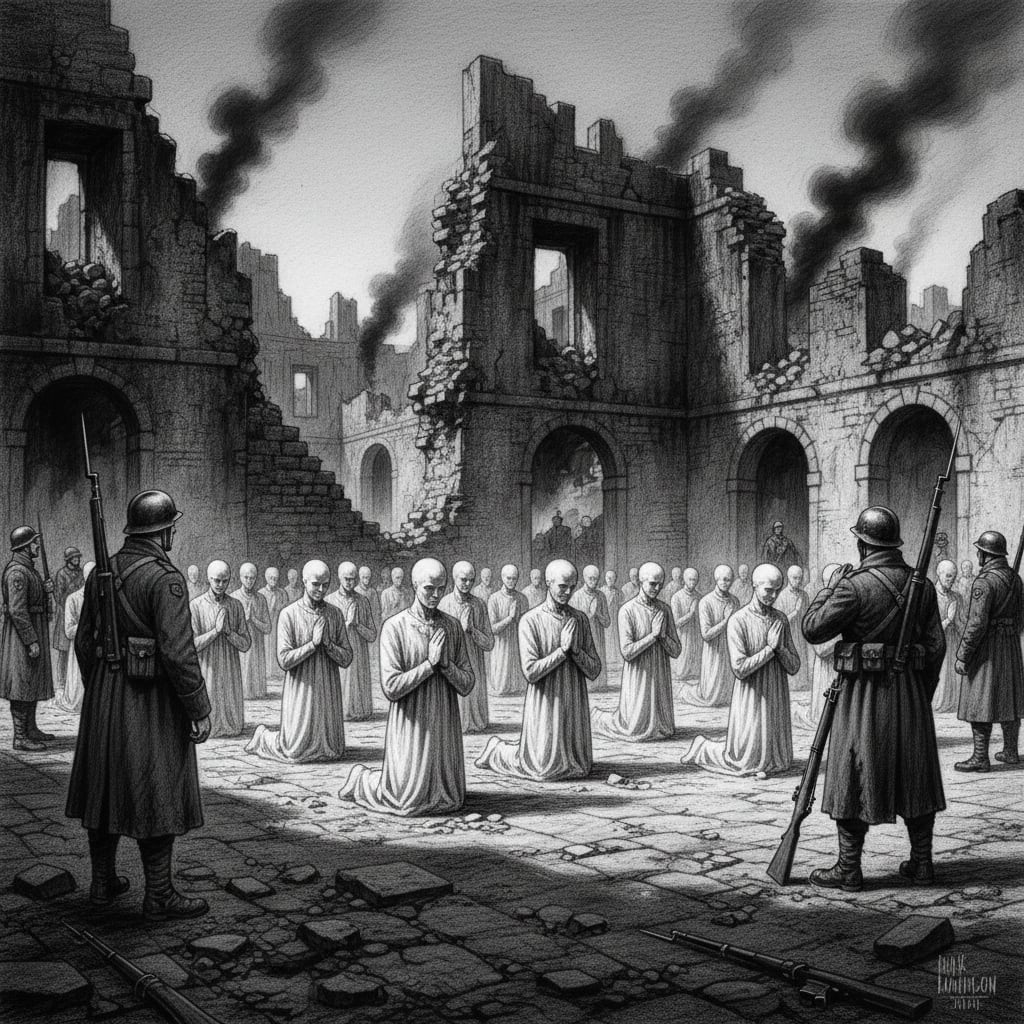
Avignon was razed. Stone by stone, structure by structure, cobble by cobble, until the site was reduced from "city" to "former terrain feature" in the Bureau of Records' geographic index. The stones were loaded onto barges and shipped north to Strasbourg, where they now form the staircases of the Cloister of Concord. Every clerk who ascends those stairs treads upon Avignon's pretensions without knowing it.
This entry previously stated that the Pontifex Submersis was killed during the Razing.
No body was recovered. No body was identified. The Bureau of Records has no death certificate for a man who did not exist, which is administratively consistent and theologically unsatisfying. The fishers' depositions — all seventeen of them, sealed and stamped — describe the last night: after the fires had consumed the wooden structures and the garrison had done its work, something else moved through the ruins. Glass rods striking the ground. Whole neighbourhoods collapsing into shapes — faceless statues, brittle husks of men frozen in postures of prayer. When investigators arrived at dawn, they found no bones, no relics, no bodies of the sort that fire produces. Only calcium-white figures arranged in rows, as if a congregation had been calcified mid-genuflection. Whether the Drowned Pontiff was among them, no one can say. They were faceless. They were all faceless.
#On What Remains
The Bureau's erasure was thorough. The name is gone. The body is gone. The theology is classified. The city that sheltered him is rubble repurposed as staircases. Seventeen witnesses were visited by the Penitential Shadows; fourteen recanted; three vanished, their own names scraped from the parish rolls with the same efficiency applied to the schismatic clergy.
And yet.
The Chains of the Martyrs of Avignon — iron links said to have bound the schismatic clergy during their processing — are rumoured to exist in a sealed vault beneath the Basilica of the Ledgered Saints. The Bureau of Records denies the vault. The Bureau of Purity denies the chains. The Bureau of Doctrine denies that martyrs can be produced by an event that did not occur. On certain nights, a low rhythmic hum rises from beneath the Basilica floor. I have heard it. It sounds like iron settling against stone.
The fishers of the Rhône still drag up rosaries in their nets. Glass-caked, river-worn, beads fused to iron chains as though melted and then quenched in water. The Bureau has sent three separate delegations to investigate. Each returned with the same report: "natural mineral accretion." Each delegation's lead investigator was subsequently transferred to the Paper Mines of Ulm.
And the clay seals keep appearing. In market stalls, in confession boxes, in the pockets of pilgrims who swear they have never been south of Lyon. Blank discs, smooth as still water, smelling faintly of silt. The Bureau of Purity collects them. The Bureau of Purity destroys them. The Bureau of Purity has destroyed two hundred and fourteen. They have confiscated two hundred and thirty-one. The discrepancy of seventeen is noted in no official report.
Seventeen. The same number as the sealed depositions. The same number as the witnesses. I do not draw conclusions. Drawing conclusions about Avignon is a disciplinary offence.
█████████████████████████████████████████████████████████████████████████████████████ ████████████ ██████████████████ █████████████████████████ ████████████████████████████ █████████ ███████████████████████████████ ██████████████████████████████ — and the river, they say, still mutters psalms at dusk, though the Bureau insists it is echo, and echo, the Bureau reminds us, is the past refusing to stay where it was filed.