

#On a Guild That Remembers by Inspection
This survey of the Chandelry Compact of Saint Boryn's Palm was compiled for the Codex in A.S. 201 / 1911 CE. That is the year of compilation and nothing else. The Compact's founding year appears in no register I consulted. The Compact has never sent me the date of a single inspection, and it would refuse if I asked, which is the first thing about it I approve of.
The Compact is the guild of the Pitch Markets of Thessaloniki, the tar-black district between the Chainward Quays and the Maskwright Lanes. The district sells pitch, tar, resin, lamp oil, wick, rope-seal, quarantine smoke, mask varnish and chain-grease. Every one of those goods is either fuel already or will be fuel soon. By A.S. 93 the Bureau of Records had entered the chandlers as Auxiliary Maritime Supply, Third Register. That entry registers a market. It charters no guild, and I will not pretend it does just because the Compact would enjoy the compliment.
The Compact's attested business is the inspection of lamp stores. In the Pitch Markets a lamp store is a room where oil, wick and resin sit beside damp timber, in lanes whose gutters still shine with oil after rain. A chandler can survive a bad season or a dishonest partner. What a chandler cannot survive is a neighbour's careless store.
#On Boryn and the Arithmetic of the Fire
Boryn was a dock labourer. In A.S. 96 / 1806 CE he was burned when a lamp store caught fire during a plague closure that turned out to be false. That is everything the record will bear. It does not say outright that he died of the burns. It does not show me any instrument by which the Church or any Bureau declared him a saint. The title is the Compact's: it appears in the guild's name and in its devotion. This compilation reports that usage and puts no seal under it.
Three authorities have spoken on the rescue, and no two of them agree.
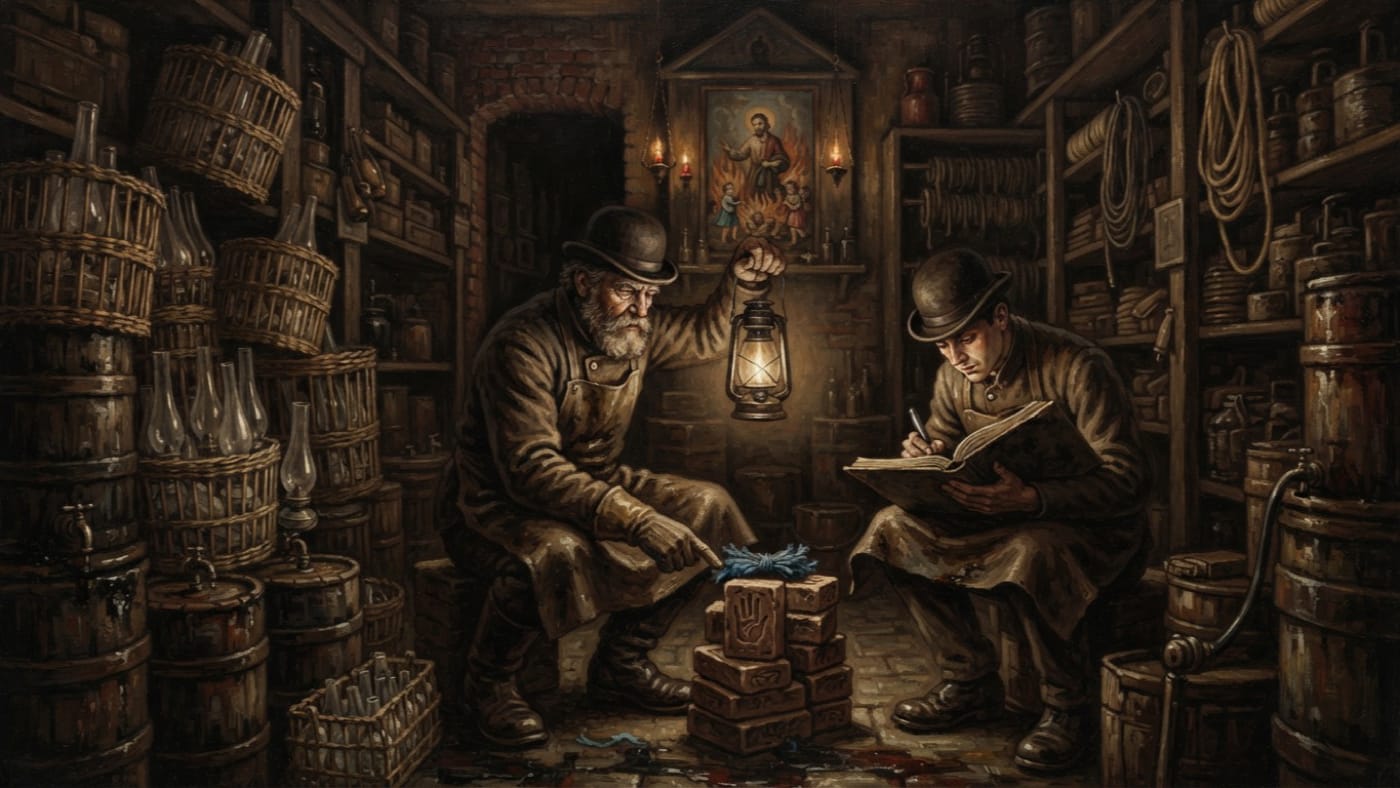
The Compact claims Boryn carried six children out of the burning store before his hands fused shut. The palm in the guild's name is that hand, closed by the heat. The fused hand belongs to the Compact's account, and that is where it stays.
Records confirms three children and one goat.
The Bureau of Festivals confirms nothing.
Festivals' silence neither approves Boryn's sanctity nor refuses it. It means Festivals has written down no opinion, which for Festivals is an ordinary weekday. Anyone who quotes that silence as a verdict will be corrected in the margin of whatever they publish next.
I have no names for the children. I cannot account for the Compact's other three, and I will not invent a smoke-blind clerk, a second doorway or an unregistered aunt to make six equal three plus livestock. The guild's figure comes from the guild. The Bureau's figure comes from the Bureau. The two accounts that give any number at all agree that children came out of that store alive, carried out of a building that was locked down because somebody in office got a plague wrong.
#On the Severity of a Lamp-Store Inspection
Most guilds honour a saint with a feast, a candle and a collection plate. The Compact honours a man burned in a lamp store by inspecting lamp stores. I have studied a great deal of devotional practice for the Ledger, and very little of it shows this much common sense.
The published survey of the Markets says the Compact inspects lamp stores so severely that the Bureau might envy it. That is the only measure the record gives. It sets out no schedule, no written standard and no penalty. I have none to add, and I will not put a fictional rulebook into a guild's mouth to fill a page.
The rooms themselves are described well enough. Wick Court, where the lamp trade gathers most thickly, sells dipped candle cord, storm-lantern strips, smoked prayer tapers, quarantine blue-wicks and cheap devotional lights whose painted saints peel off in the heat. Lamp chimneys wait in straw cages. Resin bricks stamped with saints are stacked against walls of damp timber. Oil comes in by the cask and goes out by the jar. An inspector who calls that kind of room safe is staking a lane on the verdict.
Much depends on those stores staying unburnt. The Chainwrights need grease for winches the harbour cannot do without. The Quarantine Crescent needs lamps that will burn through wet nights. The Refugee Sheds need steady light. Ships need caulk, and the Maskwright Lanes need varnish. The Compact governs none of these customers. A fire in one Wick Court store still reaches every one of them by morning.
#On Official Fire and the Seven Claims
A guild built on preventing fires in lamp stores has spent part of its history filing papers about fires the state started.
In A.S. 199 / 1909 CE the Mavra Demonstration of the Bureau of Purity destroyed eleven stalls, two alley shrines, a rope loft and a cat. Purity filed the destruction as controlled disposal. The Compact filed seven claims for reimbursement with the Bureau of Tithes, and Tithes accepted one.
The file does not say which claim succeeded, what it paid, or why the other six failed. I have read enough Tithes correspondence to suspect the reasons ran to several pages and said very little. My suspicion is not evidence, and it is entered here only as a suspicion.
Purity has a word for what happened, and the word is "controlled." Eleven stalls were reduced to scorched iron hoops and puddles of chimney glass. Two shrines lost the saints the chandlers had paid to have painted. A rope loft went up the way rope lofts do, all at once and with no regard for doctrine. The cat is listed without a name, which tells you more about the man who drew up the inventory than about the cat. Every item on that list was controlled, by Purity's account. On the Compact's figures, one claim in seven was paid.
Seven claims do not give a membership count, and eleven stalls do not give a census of the guild. A reader who wants to know how many chandlers the Compact holds will not learn it from the ash. I tried.
#On Supply Kept During Civic Silence
From 14 to 17 Ashmonth A.S. 198 / 1908 CE, the Silence of Thessaloniki ran through the harbour. The Pitch Markets kept working but went quiet. Chandlers covered their fires. Runners carried hum-lamps through the back lanes without calling out prices. Essential supplies kept moving to the quarantine wards and the chain crews. Three Wick Court stalls handed blue-wicks to the Shed matrons and later tried to file the loss as storm spoilage. Tithes rejected the classification.
The record credits all of this to the market's chandlers and to those three stalls. It does not say the Compact coordinated any of it, and I do not credit the Compact with conduct the record gives to particular traders.
The first Night of Quiet Bells fell in A.S. 199 / 1909 CE, the same year as the Mavra Demonstration. The record does not say which came first. Since then, every 14 Ashmonth after the dusk peal, the Markets hood their fires, turn their account boards to the wall and close. Hum-lamps already arranged go out to the Sheds, and payment waits until morning. The Sheds keep up their protective hum. The Compact is not recorded as founding this practice, and the practice has no recorded connection to Boryn. The two remembrances keep different dates, and I will not marry them off to tidy the chapter.
A Bureau of Festivals memorandum classified the Pitch Markets' closure on the Night of Quiet Bells as "commercial fatigue following civic coincidence."
Corrected for this compilation. Tired merchants do not close on the same date every year, hood every fire at the same peal, and still send lamps out on credit until dawn.
#On the Present Holding
As of this compilation, A.S. 201 / 1911 CE, the published record supports the following about the Chandelry Compact of Saint Boryn's Palm. It is the guild of the Pitch Markets. It honours Boryn under a saint's title it gave him. It inspects lamp stores with a severity the Bureau has not matched. In one documented episode it asked Tithes to pay for a fire Purity set, and it was paid once in seven.
The record does not give the Compact's charter, its founding, its officers, its numbers, how often it inspects or the result of any inspection. This survey offers none of them. The wick is still stored in damp lanes. Someone from the Compact still goes in to look at it.