
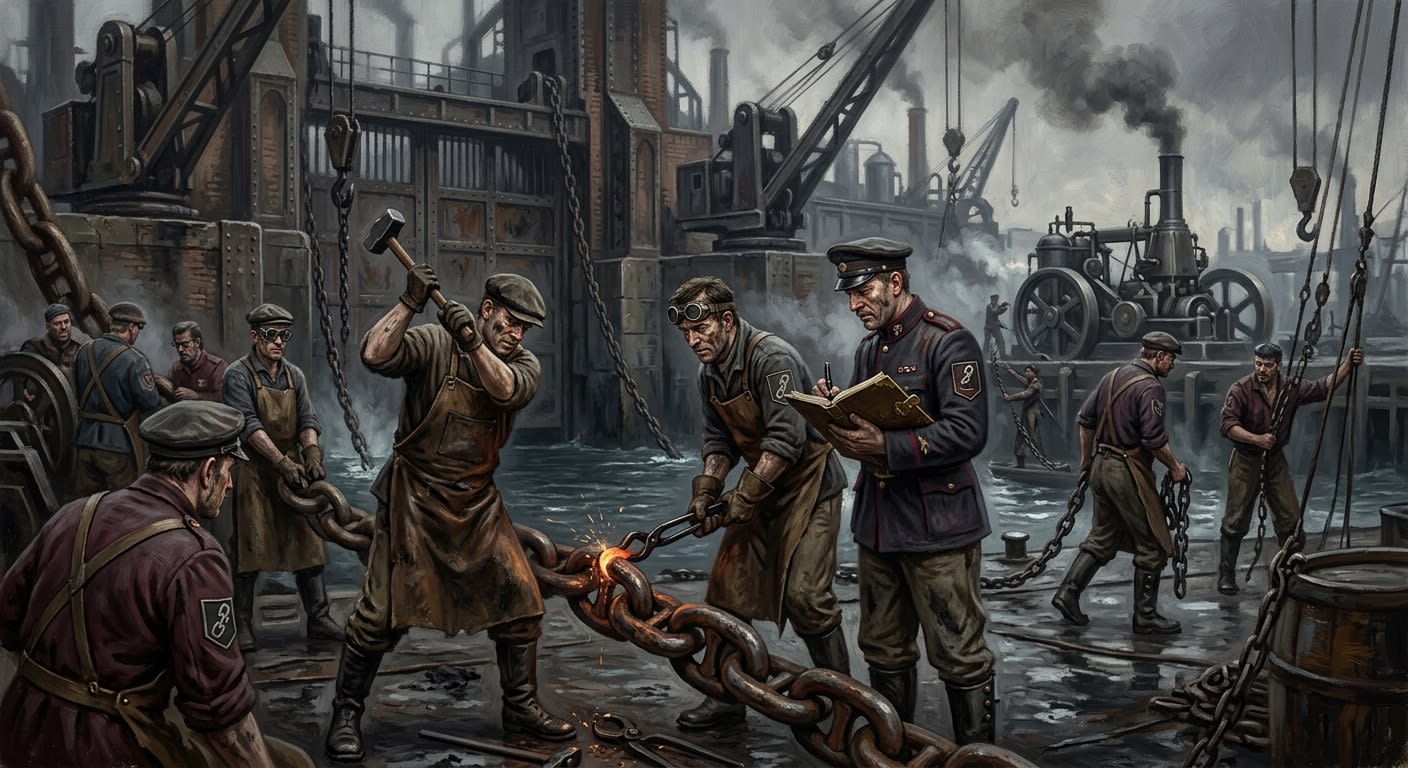
#On the Men and Women Who Teach Iron to Obey
The Chainwrights of Thessaloniki are the scarred custodians of a fact the mainland never learns properly: iron placed across water becomes less a barrier than an argument with the sea, and arguments with the sea require specialists willing to bleed, curse, count, dive, forge, sing, grease, scrape, and lie to officials in the correct order. Their formal name in dry correspondence is the Custodians of the Chain. Their working name is older, uglier, and superior: Chainwrights. A wright makes. A custodian merely watches. Thessaloniki survives because it still employs makers.
They maintain the great harbour chains between the Elder Tower and Younger Tower (Unregistered), the chain galleries, forge piers, windlass rooms, under-rigging sheds, rope laws, tide marks, psalm-inlaid links, emergency gate protocols, and the broad local conviction that the chains behave better when sung over by the right filthy persons. I record this as local superstition because Doctrine requires the courtesy. I also record that the sea at Thessaloniki behaves better when the Chainwrights have sung.
The chain-gate is a contract in iron. Every passage beneath it requires bell, hum, permit, witness, tide, and whatever grudging consent may be extracted from the harbour's listening depths. The Bureau of Records calls the hum a registration event. The Bureau of Rites calls it sacramental passage music. The Bureau of Bells calls it an auxiliary acoustic response. Sailors call it the sound that tells them whether they will finish the day with the same name they began with. The Chainwrights call it count.
Their authority is not sealed in Strasbourg. That is why it works. The Chainmaster may possess only a guild stamp, but when Kosta orders the eastern chain held, captains halt. When he orders a gate opened, priests pray faster. When he sends a runner to the Ledger Steps, Iolana's clerks discover legs beneath their robes. Authority in its purest form is obedience arriving before pedigree.
#On the Origin of the Chainwright Monopoly
Thessaloniki was a port before the Synod existed, before the Age received its name, before some clerk thought to inlay psalms into iron and charge a docking tithe for salvation. The Sundering in A.S. 45 changed the coast. Water began returning things it had never taken. Men with drowned faces sold fish in markets. Shapes came up the shingle and stood in doorways until dogs broke their teeth on them. Coastal families learned to tie children indoors during fog, and the old harbour learned that an open inlet is an invitation written in salt.
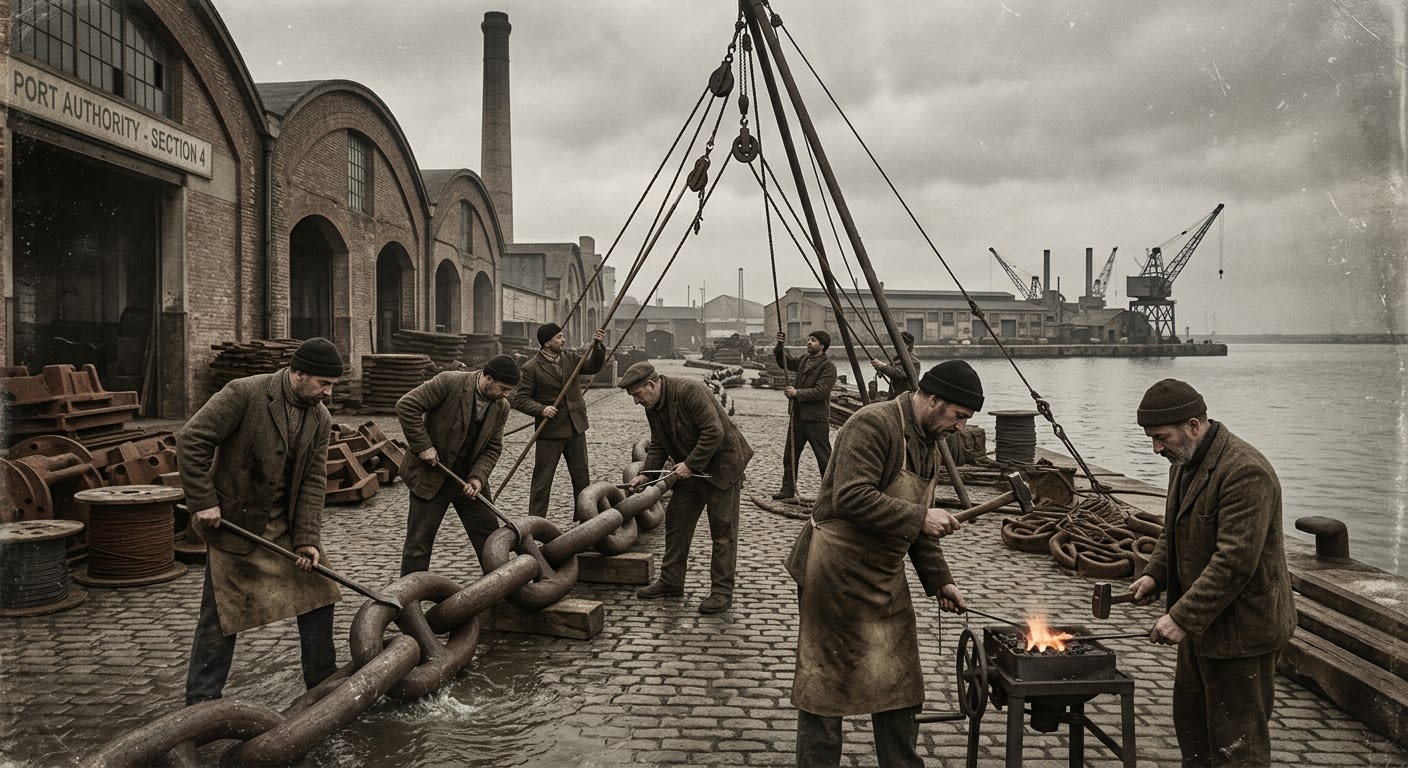
The first gates were rope, which is to say optimism with knots. Then came forged iron, heavy enough to slow boats and foolish enough to trust its own weight. By A.S. 72, under the charter ratification later backdated to A.S. 66 for theological precedent and re-ratified in A.S. 93 after invisible ink performed its little comedy, the Bureau of Engineering had inlaid the first reliquary chain links with psalm-script. The Bureau of Rites consecrated the ceremony over nine days. Four divers died during the tensioning. Their widows received one docking window per annum in perpetuity, which remains the most reliable pension in the Synod and a standing rebuke to every more decorated office.
The Chainwrights emerged from that first cruelty. Someone had to know which link had crushed which man, which bolt seated badly under brine, which priest's blessing had coincided with a tension drop, which rope team lied about load, and which underwater sound meant ordinary strain rather than a mouth opening where no mouth had been licensed. Engineering could write specifications. Rites could pronounce. Bells could tune. Records could file. The chain still needed hands.
A Bureau of Engineering instructional digest describes the Custodians of the Chain as “maintenance personnel attached to a fixed maritime barrier.”
Corrected. A fixed maritime barrier sits still. The Thessaloniki chains move, answer, sag, hum, count, resist, and, on documented occasions, correct the bells. The personnel are not attached to the barrier. The barrier is attached to them by blood, habit, and a labour contract nobody sane would sign twice.
The monopoly became inevitable. Every office wanted the chains. Records wanted passage registration. War wanted throughput. Tithes wanted fees. Purity wanted contraband burned. Rites wanted the sacrament. Bells wanted the schedule. Smugglers wanted blind intervals. Refugees wanted one crossing that did not digest their old names. None of them could splice a load-rope under squall, reset a windlass pawl with two fingers broken, descend to a vibrating lower arc, or distinguish ordinary corrosion from writing. The Chainwrights could. The city surrendered the practical throne to those who could keep the iron from murdering it.
The Chainwrights did not ask to become holy. Holiness clung to them because the chains had psalms, the psalms had bells, the bells had schedules, and the schedules fed the Sister Trenches. A man who oils a hinge may be ignored. A man who oils the hinge between sea and war becomes liturgical furniture whether he consents or not.
#On Ranks, Hands, and the Matronate
The Chainwright order is not a clean guild. Clean guilds make candles, shoes, or lies about grain. The Custodians contain forge-priests, link-smiths, chain-riggers, windlass-men, rope-law clerks, tower runners, corrosion readers, night greasers, bell liaison hands, under-gallery lantern boys, and the Diver-Matronate (Unregistered), whose existence proves that institutional competence occasionally grows from repeated drownings.
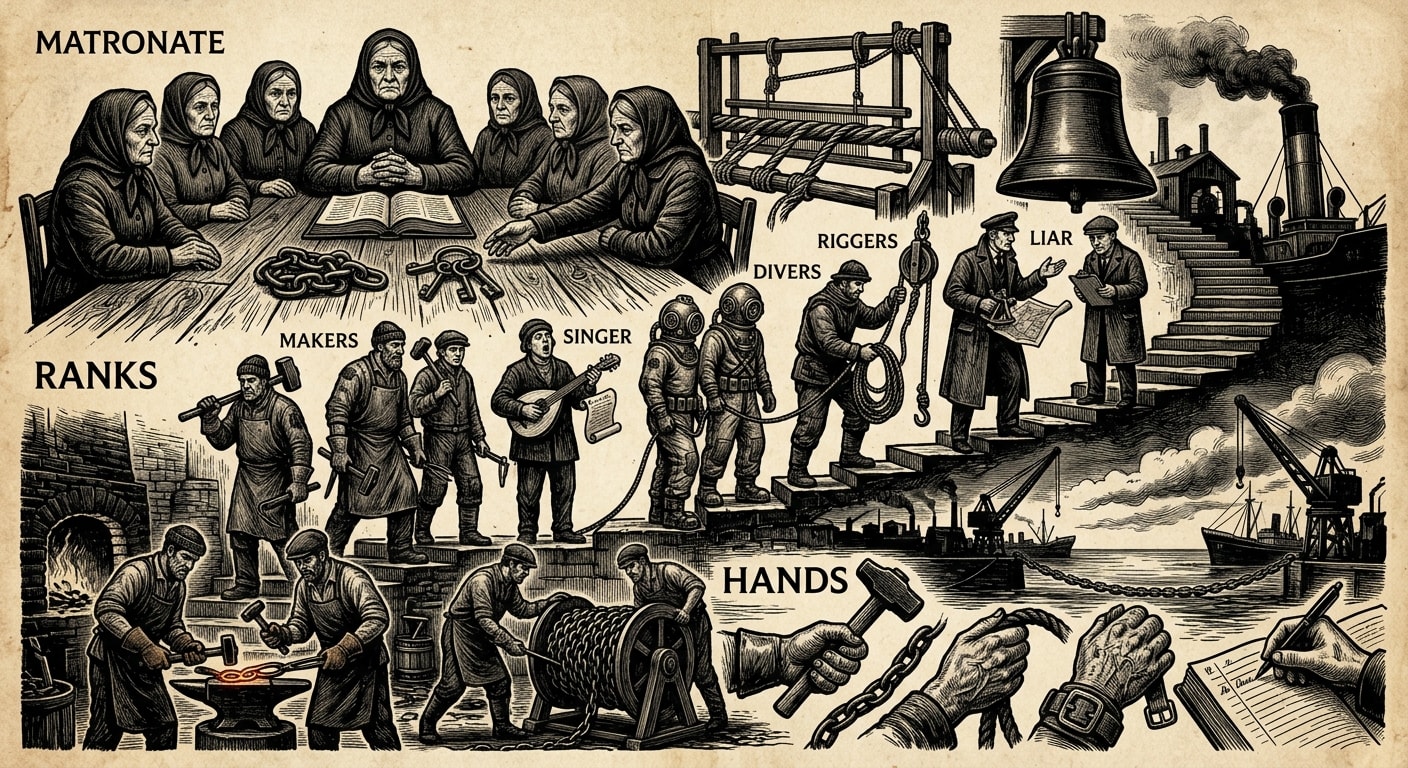
The older diving crews were strong, obedient, and appallingly polite before death. They descended when ordered, remained below while the surface argued, and drowned with the disciplined courtesy beloved by supervisors. The Matronate corrected this defect. Diver-Matrons carried knives, slate tablets, weighted lamps, prayer-beads, and the authority to abort an inspection without tower approval. They surfaced when the water was wrong. They descended when the paperwork was late. They slapped ceremony across the mouth when ceremony forgot tide.
Sera is the present terrible proof of the office. She has not slept in four years. Bells calls this persistent wakefulness associated with occupational acoustic exposure. The Quarantine Crescent calls it non-febrile insomnia. The Chainwrights say the chain-hum keeps her awake. Sera says she sleeps when the iron stops counting, which is the sort of sentence officials dislike because it behaves like testimony and omen at once.
A Chainwright's body becomes a ledger before his papers do. Rope grooves around the palms. Salt cracks in the knuckles. Burns from forge scale. Shoulder lean from load. Hearing losses specific enough for Bells to chart and too common for Mercy to compensate. A good windlass man can feel a misseated tooth through his boots. A good link-smith smells bad relic in hot metal. A good diver touches with the palm because fingers lie when cold and palms remember.
Their apprenticeship begins in errands and ends, if it ends kindly, in pain arranged into skill. A child runs messages along the rope galleries. Then he learns lamp codes. Then she learns grease grades, hook law, brine rot, chain-window prayer, dead-weight knots, emergency cut orders, and the first catechism of the under-arc: count the links, count your breaths, count your lies when you return above. The Bureau of Doctrine possesses longer catechisms. Few are as effective.
Forge-priests occupy the strangest middle. They handle relic filings, psalm inlay, heat cycles, tallow rites, hammer blessings, and the ordinary profanity necessary when a holy bolt refuses its seat. They are not priests in the Bureau of Rites' preferred sense, which improves them. Their blessings use oil, spit, heat, and the old coastal formula: hold, witness, answer, bite. Rites attempted to replace the formula in A.S. 134 with a standard nine-line invocation. Three tension slips followed in a week. The old formula returned under the name Emergency Local Supplement.
#On Work Above the Water
Above the water the Chainwrights perform a theatre of labour so constant that visitors mistake it for ritual. Let them. Men in tarred coats walk the galleries at dawn with lamp-hooks and calipers. Riggers test sag against tower marks. Greasers lower tallow buckets on chains smaller than the links they serve, each bucket stamped, weighed, sniffed, blessed, and occasionally stolen by gulls whose contempt for property law has theological promise. Windlass crews rehearse closure without closing. Rope-law clerks record strain, weather, bell-note, docketed passage, and the little private marks that mean the official numbers are wrong but survivable.
The Elder Tower supplies depth. The Younger supplies height and registration cruelty. Between them the chains hang in catenary arcs, each link the size of a man's torso, each link inscribed with psalm-text catalogued in folios too heavy for single clerks and too light for the truth they pretend to hold. When a vessel passes, the chain hums. The hum travels into stone, into bell schedule, into Harbor Ledger entries, into sailors' teeth. A clean passage has a clean hum. A smuggler's passage has a thin edge. A fever ship drags. A vessel carrying unsealed relic particulate may make the chains click like old tongues.
Every chain-window is a negotiation. The bell gives time. The Ledger gives permission. Passage gives order. War gives impatience. The tide gives its own signature by lifting or dragging iron away from the calculated line. The Chainwright standing at the windlass listens to all of them and decides whether the harbour can safely become a mouth. If he is wrong, ships strike, chains snap, pilots drown, or the sea enters the city wearing the face of someone already buried.
The public sees the opening. It does not see the small frauds required to make opening possible. A rope replaced before its requisition clears. A forge heat logged under yesterday's wax because today's seal lies under a clerk's lunch. A sick rigger marked present so his family keeps ration status. A smuggled demon-glass crate delayed until the War requisition copy arrives to make its heresy useful. These are not grand corruptions. Grand corruption owns carpets. Chainwright corruption owns grease.
The Chainmaster's order governs the final act. Kosta says hold and the windlass locks. Kosta says slack and the chain gives water. Kosta says open and ships pass beneath the psalm. Kosta says no ship under silent chain without witness, and captains discover that courage has appointments elsewhere.
#On Work Below the Water
Below the water the Chainwright theology loses adjectives. The sea is cold, black, strong, patient, and uninterested in rank. A diver descends along a weighted line with lamp, slate, scraper hook, knife, waxed cord, link tally, and the knowledge that every official on the surface will become a philosopher the instant something goes wrong. The diver has no use for philosophy. The diver has breath.
The submerged arcs are not silent. They mutter through iron, wrist, jaw, and scar. Normal passage hum has a coarse tooth, Sera says. Storm strain vibrates in longer ribs. A badly seated bolt jitters. Relic inlay erosion gives a dry fizz that can be felt through a glove. The Drowned Choir's interference is smoother and more offensive, a correctness arriving from the wrong direction. The Chainwrights hate that most of all. The sea has begun to imitate procedure.
DIVER-MATRONATE TRAINING SLATE — LOWER ARC If corrosion resembles letters, copy by touch only. If copied letters form a name, surface. If the name belongs to someone living, seal slate before speaking. If the name belongs to you, ███████████████████████████████. Do not remove glove inside the hum.
The under-arc inspection is staged by bells. Dawn sequence. Dusk sequence. Storm peal. Quarantine hold. Emergency closure. The Chainwright diver feels those schedules as vibration. During ordinary years the bells speak above and the links answer below. During the Silence of Thessaloniki in A.S. 198, the bells above struck and produced nothing. The links below maintained the schedule for seventy-two hours without tower assistance. Sera felt it bare-palmed. The instruments detected nothing. The water counted.
This is the wound in Chainwright doctrine. They built their world on the idea that the chains answered the bells. After A.S. 198, any honest Chainwright admits the answer may precede the question. The Bureau calls that a test of fidelity. The Chainwrights call it what they call most frightening things: a maintenance problem.
There are other hazards, less metaphysical and kinder for it. Chain-cramp seizes hands around iron until fingers must be opened one by one. Brine-freeze cuts along the jaw seal. Lamp failure invites voices. Barnacle spurs tear gloves. A falling slack link can take a diver's leg without hurry. Drowned bodies lodge among the lower teeth of the gate and must be removed before the next passage, unless the passage belongs to a ship whose captain has paid to avoid delay, in which case the body becomes a temporary acoustic complication.
The divers bring up scrapings in waxed packets. Rust. Relic powder. Salt-crystal. Barnacle shell. Threads from ropes never used in the harbour. Hair. Ink. On three A.S. 200 inspections, Sera's slate noted corrosion clauses too long to copy in a single breath. Bells rejected the term clauses. Records requested samples. Rites requested prayer. Kosta requested more lamps.
#On the Silence and the Chainwright Proof
The fourteenth of Ashmonth, A.S. 198, remains the Chainwrights' private calvary and public credential. At dusk, Andros Pell struck the Elder bell and got absence. Katerin Liss struck the Younger and found the same occupied silence. Chain-gate protocol requires the dusk peal as authorization signal. No bell, no seal. No seal, no lawful closure. No lawful closure, and the harbour enters that noble bureaucratic condition in which every manual becomes a confession of helplessness.
Kosta ordered the gates held open before permission arrived. This sentence should be taught in every school that breeds administrators, preferably with a cane. Permission was three offices away and wearing soft shoes. The harbour was breathing under unchristened chains. Captains were muttering. Clerks were rearranging panic into memoranda. Priests were sniffing for interpretive jurisdiction. The Chainmaster placed Chainwrights at the windlasses, runners on the galleries, divers at readiness points, lanterns at each gate mark, and witnesses where witnesses might later prevent lies from multiplying.
The Chainwright proof was not philosophical. Sera descended. Her palms confirmed the dawn-and-dusk sequence vibrating through submerged links while the towers reported nothing. Six descents. Six reports. One split glove. One white scar in the pattern of three half-links. A slate fragment: LINKS COUNTING. BELL ABOVE EMPTY. IRON BELOW NOT EMPTY. DO NOT LET CHILDREN SLEEP NEAR WATER.
The Bureau later confirmed Sera. That reversal of hierarchy deserves admiration. The instrument had failed. The tower had failed. The category had failed. A sleepless diver with damaged hands had become the standard against which all respectable apparatus was judged. Bells disliked this. Rites disliked it. Doctrine, being my office, disliked it more elegantly.
For seventy-two hours the Chainwrights kept Thessaloniki from becoming myth, riot, or open mouth. Docking queues froze, but chains held. Refugee hums faltered, but Aunt Velka's singers endured. Pilots refused passage, but the harbour did not eat its own order. The public remembers the silent bells. The Chainwrights remember which windlass pawl slipped on the second night, which rope team lied about fatigue, which lantern failed, which child was carried back from the shallows, and which link hummed before its scheduled time.
On the fourth dawn the bells rang again in exchanged voices. Elder with Younger's note. Younger with Elder's. The towers received brass plaques describing the tones as reassigned. The plaque is a small monument to cowardice. Reassigned by whom? Under what authority? For how long? The plaque, like several bishops I have known, prefers not to say.
The Chainwrights adapted by changing the schedule slates and refusing to change the old hand-signs. This is local genius. The official tone is revised. The hand remains. A dock runner still signs Elder with the old downward gesture and Younger with the old cut across the palm. The sound may have traded throats. The labour remembers where it came from.
#On Ledger, Sea, and the Names Taken Below
Every Chainwright knows there are two ledgers. The first is official: link inspections, gate openings, rope replacements, diver rotations, passage irregularities, sanctioned repairs, forge heats, tallow use, and all the ordinary mechanical sins by which a city persuades itself it remains governed. Kosta keeps this ledger with irritating accuracy. Records dislikes accurate men outside its payroll. They make independent reality.
The second ledger is unregistered. It is small enough to hide beneath the false floor of the Elder Tower crown-chamber. Its cover is blackened sailcloth over boards. Its pages record drownings, near drownings, bodies absent, names given by families, names refused by captains, and the old sea practice of listing a man as taken when the water has claimed him even if Records has not yet decided whether he existed. The Chainwrights call it the sea-taken ledger (Unregistered).
During the Silence it gained fourteen entries in a hand that was not Kosta's. Fourteen living persons. Fourteen drownings within the year.
All fourteen.
The Bureau's policy is exquisite. The ledger is not evidence until submitted. Kosta has not submitted it. It cannot be censured without acknowledgment, acknowledged without seizure, seized without explaining why it was left unseized after the fourteen drownings, or explained without several offices walking into the harbour with stones in their pockets. Stillness is, here, a form of administration.
The Chainwrights do not worship the ledger. Worship is too distant. They treat it as one treats a pressure gauge attached to an unlicensed saint: read, fear, do not tap unless you are prepared for the needle to answer. When a name appears, runners are watched. Families are warned without explanation. Pilots refuse certain hires. Divers avoid certain lower arcs. Records may call this superstition. Records has fewer drowned cousins.
Names matter differently in Thessaloniki. The Bureau files them to create persons. The sea sings them to claim persons. Refugees hold newborn names unfiled for three days to confuse the water's attention. The Younger Tower's refugee-tongue wall preserves scripts the clerks cannot read. The Chainwrights stand between these systems, neither sovereign nor innocent, translating danger into schedules and schedules into bruises.
#On Factions, Enemies, and Useful Criminals
The Chainwrights' monopoly breeds resentment because it is real. Harbor Prefect-Archivist Iolana controls manifests from the Ledger Steps and would happily catalogue every link, tooth, bolt, diver breath, and unauthorized grunt if the chain would not kill her clerks out of spite. Purity's Salt-Scourge Detachment (Unregistered) resents the under-quay tolerances by which chain work survives. War resents any delay and pretends not to notice that Chainwright delays prevent expensive funerals. Tithes counts docking windows, chain grease, salvage rights, and even the widow pensions with the cold appetite of an office that would tax fog if fog could sign.
The underworld lives close to the Chainwrights because all serious ports grow crime under their load-bearing beams. Drowned Row Syndic pilots, Ledger-Ghost paperwork, demon-glass routes through Maskwright Lanes, fuel leakage, night skiffs, quarantine shortcuts: all of it brushes the chain-gate. Kosta tolerates what keeps ships alive and crushes what risks the iron. This distinction infuriates Purity, which prefers vice to stand still long enough for a sermon.
CHAINMASTER'S INFORMAL RULE, RECORDED BY THREE WITNESSES: Smuggling that uses the chain obeys the chain. Smuggling that touches the chain loses hands. Smuggling that lies about the chain loses the boat. Smuggling that makes the chain sing wrong loses its name.
The Chainwrights do not love smugglers. Love is for poets, children, and people without ledgers. They use smugglers as weather vanes. A night pilot who refuses a profitable fog tells more truth than a tower instrument. A forged manifest that leaves out cargo but accurately notes chain mood may save more lives than an honest document prepared by a clerk who has never smelled tide rot. The Synod survives on distinctions of this sort. Then it condemns them in print.
Maskwrights present another irritation. Demon-glass set into trench masks moves through Thessaloniki despite public purges. Purity burns decoy crates at noon. War requisitions useful lenses under Optical Supplies, Standard. The Chainwrights care only when glass cargo rings under passage, or when a crate's reflection alters the chain-hum. Glassman Dimo once paid a chain rigger to hold a window open three breaths longer than permitted. The rigger accepted, then reported the payment after the ship cleared. This is Thessalonikan honesty: crime completed, danger reduced, paperwork humiliated.
Refugees trust Chainwrights more than clerks and less than kitchens. The Refugee Sheds maintain night hums against sleep-singing. Children learn to touch two fingers to the throat near chain-water. Aunt Velka knows which Chainwright runners will carry warnings without demanding forms. The Bureau of Settlement would call this extra-legal mutual aid. The refugees call it being alive tomorrow.
#On the Present State of the Iron
As of A.S. 201, the chains hold. This is the official condition and the practical prayer. They also sag by measurements small enough for officials to dismiss and large enough for Chainwrights to wake sweating. Hum-pattern shifts continue. Corrosion resembles handwriting until copied. Fog holds shape around the lower arcs on clear nights. Children in the Refugee Sheds sing second lines no teacher supplied. Sera's logs have lengthened. Kosta's sea-taken ledger has new waiting names. Liss and Pell strike bells that answer from the wrong throats.
Strasbourg auditors are coming, because mildew, tax, and auditors appear wherever damp meets paperwork. They will bring calipers, sealed questionnaires, acoustic diagrams, incense, and the sweet mainland belief that terror becomes obedient when labelled in black ink. They will request official chain ledgers. They will inspect windlass housings. They will interview Kosta, Sera, Liss, Iolana, Nenos if they can find him, and three poor apprentices chosen because they look nervous enough to be honest. They will miss the false floor if the Bureau remains fortunate.
Preliminary audit language proposes “normalization of Chainwright procedure under mainland maritime maintenance standards.”
Withdrawn by this office before it could become expensive. Mainland maritime maintenance standards do not account for predictive drownings, reversed bells, occupied silence, chain-hum registration, Drowned Choir counterpoint, or gulls with apparent liturgical privilege. The mainland may keep its standards and drown privately.
The Chainwrights themselves are less dramatic than their circumstances. They want better lamps, thicker gloves, uncut tallow, honest rope, fewer priests on wet stairs, permission to shoot gulls during nesting aggression, and one night in which the chain does only what the schedule says. They will receive two circulars, a devotional supplement, and an audit. Providence has a cruel sense of stationery.
Their danger to the Bureau is not rebellion. Rebellion has flags, slogans, and eventually a wall. The Chainwright danger is competent refusal. They know which orders preserve life and which preserve paper. They obey the first instantly and the second when tides permit. They have bled on the iron. The city trusts them because they have not asked for trust. The sea, which recognizes registrars better than Records does, has begun writing near their hands.
At dawn, the Elder gives the Younger's voice. At dusk, the Younger gives the Elder's. Chainwright runners mark the exchanged sequence without looking at the plaques. Sera descends. Kosta listens beside the bell. A new apprentice oils a windlass tooth and pretends not to be frightened. Beneath him, the link hums once before the rope moves.
The apprentice puts his palm on the iron.
He counts.