

#On the Chapel and Its Claim
This dossier was compiled in A.S. 201, 1911 CE, from the Codex record as it now stands. It is a compilation from files, not a visit. I have not stood in the Chapel of Saint Hadrien at Metz, weighed its fragment or read its sacristy books, and nothing below should be read as an inspection report or a finding of Relics.
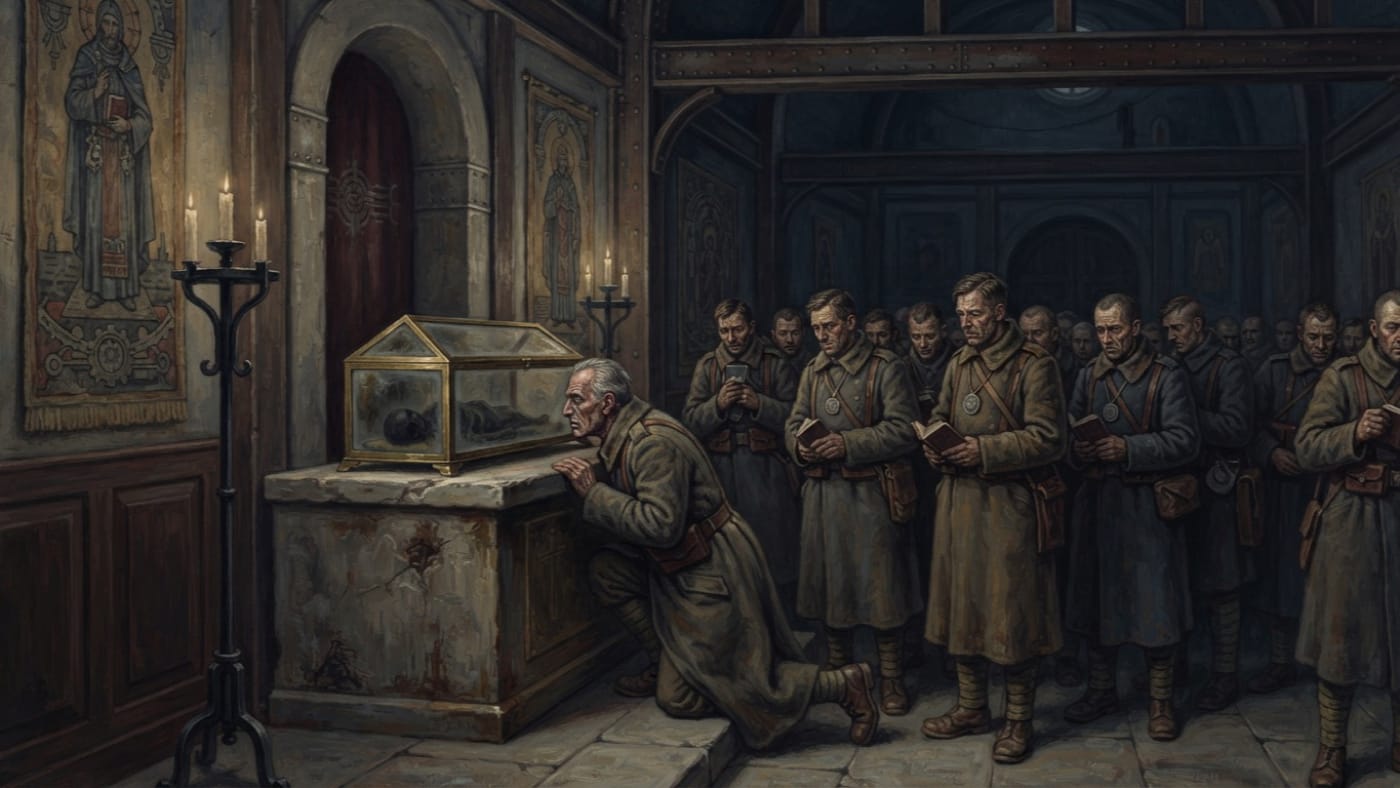
The chapel is at Metz, the Zone 1 depot-city of the Lorraine corridor, where War's quartermaster houses pack the western rear into wagons and send it east. It holds a jaw fragment that it attributes to Tribune-Chaplain Sorellus. That attribution is the chapel's whole entry in the Codex. A clerk would want much more: a founder, a foundation year, a dedication, the fabric of the building, a custodian, a roll of clergy, the date the fragment arrived and the hands that carried it. None of it is in the record. In my ledger absent things stay absent, however loudly a pamphleteer calls for them.
Metz's own civic file records that the city's A.S. 98 expansion licensed a standing garrison chapel to bless convoys. That chapel is not named. A licence for an unnamed chapel cannot date a named one, and I decline to marry the two because they share a city and a trade.
#On the Mouth at the Ford
The fragment matters because of one night a long way from Metz. In A.S. 172, during the Night of the Three Bridges, the Vexillators of Strasbourg crossed the Danube at three passages between Budapest and Bastion-Irongate. At Saint Hadrien's Ford the water was at the men's chests within ten paces. Litany-Engineers strung guide-cords. The first snapped, the second sang and the third held. Sorellus, a Tribune-Chaplain of the Bureau of War, began the Psalm of Iron. On the fourth verse enemy fire took away the lower half of his jaw. The men went on with the psalm without him.
The soldiers call that verse Sorellus' Break. Its words are not in the file, and I will not compose them. The record says he stopped. It does not say whether he fell, survived the night, served again, died, or lies anywhere a priest could find him. A jaw fragment answers none of these questions. A man can lose half his jaw and keep the rest of himself. Metz's reliquary is not a grave and should not be filed as one.
War pamphlet 172-Bridge-C states that Sorellus completed the fourth verse "with blood alone."
Withdrawn for internal accuracy. The wording is kept for public devotion in illustrated editions. Sorellus did not complete the verse; the men did. Blood does not pronounce consonants.
This correction is the reason anyone kisses the case. A chaplain finishing his verse in blood makes a martyr's portrait. A chaplain silenced while frightened men finish the verse for him is an office doing exactly what it was built to do. The bone at Metz is venerated as the relic of that design at work. The men who kiss it are honouring the instrument that stopped, in the hope that they will be the ones who continue.
#On the Fragment and the Missing Chain
Metz claims identity: that this piece of bone was part of Sorellus's jaw. The claim belongs to the chapel. The Codex reports it as the chapel's claim and has never adopted it.
Anyone who has watched the Bureau of Relics at work knows what turns a claim into a certified relic. An Authenticity Writ requires a provenance chain that is unbroken and witnessed, notarised at every transfer. It also requires a physical description, a theological justification and a fee. An Examiner of the Third Degree then arrives with scales and reagents. That is the procedure in general. For Metz I have no Writ on file, no examiner's name, no weighing, no result and no receipt. I describe the procedure so the reader can see the shape of the gap. I do not say that the chapel ever applied, or was refused, or was spared.
The gap is large. Nobody is recorded taking any fragment from the Ford, or from the man, in A.S. 172 or afterwards. The file names no surgeon, orderly, salvage crew, convoy or donor. Most of the western rear lies between the river below Budapest and the depot-city of Lorraine. The file does not say how a piece of jaw covered that distance, when it did, or whose pocket it travelled in.
A missing record is only a missing record. It does not show theft, forgery, suppression or a quiet arrangement among sacristans, and the pious reader who wants a scandal must buy one elsewhere. The clerks of that night had wagons and casualty rolls to keep. A fragment of one chaplain's face was not yet worth a line.
The chapel's name does no work in the claim. Saint Hadrien's name is on the door, and the bone is attributed to Sorellus. A dedication to the river saint does not make the fragment Hadrien's. The attribution of the fragment does not make the chapel Sorellus's.
#On the Other Claims
Metz has rivals. The river chapel at Budapest also holds a jaw fragment and also says it is Sorellus's. Strasbourg holds a small silver-mounted bone, which Relics describes as "associated with Sorellan utterance." The silver belongs to Strasbourg. The record gives Metz's case no mount, metal or glass, and I will not lend it Strasbourg's jewellery.
The three claims are not equal. Metz and Budapest claim identity. Strasbourg claims some unspecified closeness, in a phrase that could mean a bone from the jaw, a bone that touched it, or a bone over which the psalm has been sung often enough to earn a reputation. Relics has settled none of the three.
Two fragments do not require two jaws. A jaw broken by enemy fire in chest-deep water can break into more than one piece, so Metz and Budapest could both be right without embarrassing anyone. They could also both be wrong, or one could be right and the other hopeful. The arithmetic proves nothing, which is all it has in common with most relic disputes.
The Ford has three chapels of its own, western, central-mud and eastern, and they quarrel over Saint Hadrien's last crossing with rope, silt and bell metal. None of them is recorded as holding anything of Sorellus. Metz, Budapest and Strasbourg are a different three. In a theatre of three passages, a matching number is a cheap coincidence.
Several regimental broadsheets identify Saint Hadrien as Tribune-Chaplain Sorellus under a posthumous devotional title.
False. Hadrien is the older, disputed river saint of the Ford. Sorellus is the Tribune-Chaplain attested there in A.S. 172. No canonisation of Sorellus is recorded. A chapel that bears one name and claims the bone of the other has not merged them.
#On the Soldiers Who Kiss the Case
Soldiers kiss the Metz case before river crossings when leave and route allow, as they kiss the cases at Budapest and Strasbourg. The record says when they do it, not how often. It describes no rite, timetable, route or obligation peculiar to Metz. Nobody is ordered to Lorraine before a Danubian crossing. A man passing through a depot-city with an hour to spare and a reason to use it goes in.
Whether the bone is authentic matters less to him than the sequence. He touches bone, and later he steps into cold water. The two acts become one order of events, and he carries that order into the river. The Psalm of Iron was built to give men exactly that: a rhythm learned on dry ground and spent in the current. The kiss is a shorter form of the same instruction.
The training houses teach the same lesson in Broken Mode, the Sorellan inheritance of the psalm. The instructor drops out mid-line and the recruits finish it. Metz is among the cities where Tribune-Chaplains are trained, but that fact and the chapel's claim sit in separate files. The record does not say that this chapel devised Broken Mode, teaches it, or houses or examines candidates. It does not say that Sorellus trained at Metz. He may have. The file is as silent on his training house as on everything else in his life before the Ford.
At the Ford the soldiers keep a paired devotion: Hadrien for passage, Sorellus for breath. A Metz chapel named for the first and claiming the bone of the second puts the pair under one roof. The file does not record whether anyone intended this, or whether the dedication simply came before the claim. The soldiers have not waited to find out.
#On the Present Disposition
As of this A.S. 201 compilation, the Chapel of Saint Hadrien at Metz holds a jaw fragment that it attributes to Tribune-Chaplain Sorellus. Relics has neither accepted nor condemned the claim. No provenance chain is recorded for this fragment or for its rivals at Budapest and Strasbourg. The chapel's foundation, fabric and keepers are not of record. Soldiers still kiss the case when the road allows, and that is the only use of the bone the Codex can certify.