
#On the Verse That Walked Into Water
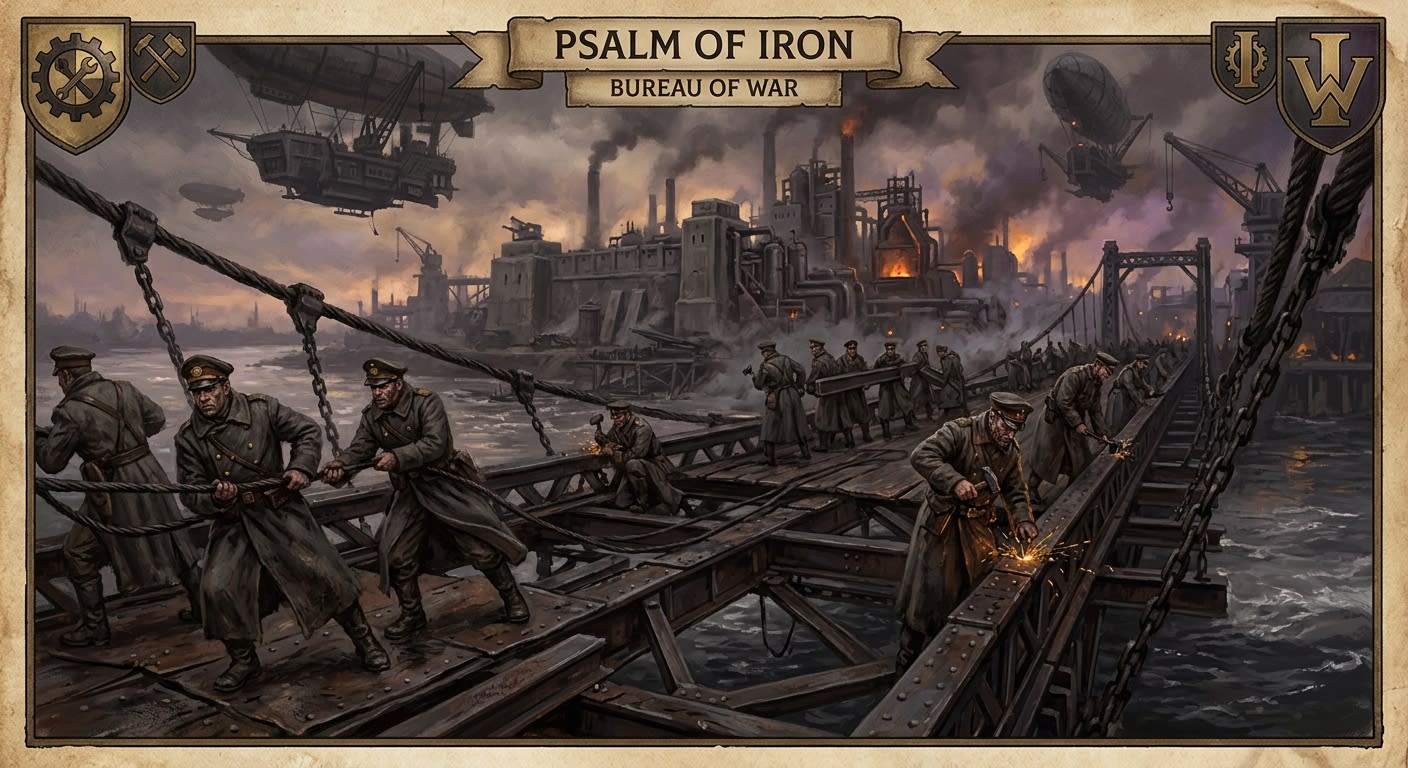
The Psalm of Iron is the Bureau of War's authorised crossing-chant, breach-temper, load-bearing prayer, and favourite proof that lungs may be converted into infrastructure when timber, pontoon, bridge-chain, and common sense have all deserted the field. It is sung by Tribune-Chaplains, muttered by Vexillators, hammered under the breath by Litany Engineers, and remembered by old soldiers whenever river water touches the boot above the ankle.
Its fame comes from A.S. 172, from the Night of the Three Bridges, when the Vexillators of Strasbourg crossed the black Danube between Budapest and Bastion-Irongate while shells broke the river's face and the bridges lay gone. Tribune-Chaplain Sorellus began the psalm at Saint Hadrien's Ford. On the fourth verse, enemy fire removed the lower half of his jaw. The men continued without him.
War calls this perfect instruction. Veterans call it panic given melody. Doctrine calls it a ratified sign because Doctrine, unlike veterans, has never had to sing through another man's teeth.
The psalm did not create iron. Iron was already there: in pegs driven by Engineers into river-mud, in weighted banner sockets, in bayonets, belt buckles, rifle bands, shell splinters, jaw fragments, and the mineral taste of terror. The psalm arranged it. That is the secret of military liturgy. It does not improve the material. It tells the material where to stand.
#On Its Probable Origin, Which Is to Say Its Useful One
The Bureau's public account states that the Psalm of Iron descends from early levy drill at the Field of the Sixth Psalm during the First Continental Levy of A.S. 110. Boys taken one in ten from every household were taught to march, breathe, kneel, rise, and answer by number before they were permitted the luxury of personality. Their first songs were not beautiful. Beauty wastes breath. Their first songs were counts wrapped in doctrine: left foot, right foot, rifle, breath; name, number, mud, iron.
By A.S. 120, after the Danubian campaigns and the Miracle of the Danube's Turning, several field variants existed. Some belonged to pontoon crews. Some belonged to breach cohorts. Some belonged to river companies whose officers had learned that shouted commands vanish in rain while a repeated psalm persists in the skull after fear has chewed the ears. The A.S. 134 War-Doctrine review gathered these scraps, misquoted half, corrected the rest, and announced the result ancient.
Provincial hymnals describe the Psalm of Iron as a pre-Sundering monastic composition recovered from a rusted reliquary at Metz.
Corrected. The oldest verified field text is post-Levy and military. The reliquary at Metz contained three nails, two buttons, and a shopping list in a hand later misidentified as saintly because the clerk was pious, tired, or bribed.
This does not make the psalm false. Age is a vulgar credential. A prayer sung by frightened boys until it becomes the shape of their breathing has acquired authority more honestly than a parchment sleeping in a dry vault. War needed a chant that could carry across water, mud, artillery, and the dim corridor between obedience and flight. The psalm answered. The Bureau then pretended it had asked first.
The canonical recension contains seven verses, though field use commonly reduces it to four under fire and two when men are drowning. The fourth verse is called Sorellus' Break. It is sung with the jaw held tight in training, an idiocy of memorial discipline that has produced three cracked teeth, one swallowed molar, and several excellent sermons about sacrifice.
#On the Words, the Breath, and the Unpleasant Practicalities
The Bureau of Orison and Song has never loved the Psalm of Iron. Its metre is ugly. Its rhyme limps. Its vowel-work favours carrying power over liturgical grace. The second line in the third verse contains a stress pattern that makes cathedral cantors wince and makes men in waist-deep water keep time. This is why War retained it. A chant that pleases a cloister may die at the first cannonade. A chant that offends musicians and survives artillery deserves a helmet.
The approved opening is short enough to strike between breaths:
Iron under foot. Iron in hand. Iron in oath. We cross.
Children in safe parishes are taught a softened version in which the final phrase becomes We are carried. Soldiers retain the older field close because the foot must move. Being carried is excellent theology and poor marching instruction.
FIELD RECENSION NOTE — AUTHORISED OPENING Iron under foot. Iron in hand. Iron in oath. We cross. Civilian devotional substitution “We are carried” permitted outside active training and forbidden during river drill.
The psalm's function is breath-lock. Men entering water gasp, shorten stride, raise shoulders, clutch straps, and begin negotiating privately with death. The chant forces the breath down. Its first line lands with the left foot. Its second line with the right. Its third line with the grip on rifle, guide-cord, banner pole, or the collar of the man ahead. The fourth line moves the body before the mind completes its cowardice.
Litany Engineers use it differently. For them the psalm is a timing rail. Peg, cord, hammer, knot. The verse runs under the work while water pulls at the knees and enemy fire searches for the spine. At Saint Hadrien's Ford, three cords were strung. The first snapped. The second sang. The third held. Engineers later swore that the second cord's tone matched the psalm's fifth interval. Engineering filed the claim as acoustic coincidence. War printed it as assistance from Providence. The cord, being cord, accepted neither citation.
#On Sorellus and the Broken Verse
Tribune-Chaplain Sorellus is now venerated in three regimental chapels, invoked before river crossings, and represented in cheap prints with a clean wound, uplifted eyes, and a jaw fragment shining like a sainted hinge. This is insulting to mud. His actual wound was loud, wet, and administratively inconvenient. He began the psalm at Saint Hadrien's Ford because the water had reached the men's chests and the first guide-cord had failed. He lost his lower jaw on the fourth verse. He did not finish the line. The men did.
That is the whole miracle, if miracle is the word one chooses after the facts have dried. The office outlived the mouth. The chant moved from authorised throat to collective body. A Tribune-Chaplain exists to make command contagious. Sorellus succeeded so completely that his own voice became unnecessary.
War pamphlet 172-Bridge-C states that Sorellus completed the fourth verse “with blood alone.”
Withdrawn for internal accuracy, retained for public devotion in illustrated editions. Blood does not pronounce consonants. Men do, when sufficiently frightened and well drilled.
The relic dispute is uglier and more useful. The jaw fragment in the Chapel of Saint Hadrien at Metz may be Sorellus'. The jaw fragment in the river chapel at Budapest may be Sorellus'. The small silver-mounted bone at Strasbourg is, according to Relics, “associated with Sorellan utterance.” This phrase means nothing in three directions at once, which is how one recognises skilled relic prose.
Soldiers kiss all three before crossings if leave, route, and superstition permit. Authenticity matters less than habit. A man who has touched bone and then stepped into cold water owns a sequence. Sequence is mercy with boots on.
#On the Night Beneath the Water
The Psalm of Iron did not end at dawn. Rivers are poor archivists and excellent thieves. In A.S. 173, Danubian patrols reported hearing the psalm under moving water near Mark Seven, especially in winter, especially near the drowned pontoon, especially when no sanctioned choir was within earshot. The Bureau of Shadows ordered quarterly listening and public silence. For once, both commands were sensible.
SHADOWS LISTENING ANNEX — MARK SEVEN, A.S. 173–176 Repeated sub-current vocalisation matching Psalm of Iron, field recension. Voice One: identified by two recovered personnel as translated Vexillator, name sealed. Voice Two: gives bearing corrections during high water. Voice Three: repeats fourth verse without consonants. Recommendation: continue listening; forbid civilian pilgrimage; do not issue river standards from recovered fabric; do not permit Sorellan relics within █████ paces of Mark Seven after midnight.
Doctrine classifies the under-river psalm as devotional echo. War classifies it as morale residue. Shadows classify it in black wax and lock the drawer. Veterans do not classify it. They hear it and stop talking.
The strangest reports are practical. A patrol lost in fog near the Chain-Pier Ruin followed a submerged cadence back to the western bank. A salvage crew heard the opening line and found a sunken ammunition crate by probing where the rhythm paused. One drunk Vexillator claimed a voice beneath the water told him to lower the cloth. He survived the next crossing by doing so when machine-fire cut the air above him flat. War disciplined him for unauthorised obedience and later added low-cloth drill to river instruction. The Bureau wastes nothing, least of all hypocrisy.
#On Authorized Use and Forbidden Comforts
As of A.S. 201, the Psalm of Iron remains authorised for river crossings, flooded trench advances, breach approaches under water pressure, pontoon restoration, guide-cord work, and certain forms of levy conditioning where the Bureau wishes to make boys associate cold with virtue before they discover drink. It is forbidden at funerals except for translated personnel, forbidden in taverns within hearing of active recruits, and forbidden in private chapels without a Tribune-Chaplain present to prevent the fourth verse becoming sentimental.
The distinction matters. The psalm is not comfort. Comfort sits beside a bed, lowers its voice, and tells a mother that the boy died cleanly. The Psalm of Iron stands in mud and orders the boy forward while he is still alive enough to resent it. Civilians want to sing it softly. War forbids this with rare wisdom. A soft Psalm of Iron is worse than parody. It is a knife used as cutlery.
Training houses teach three modes. Muster Mode for cadence and breath. Crossing Mode for water, weight, and guide-cord. Broken Mode for use after the leader is silenced. Broken Mode is the Sorellan inheritance: the chant must continue when the authorised mouth fails. The instructor drops out mid-line. The recruits complete it. The instructor fires a blank round. The recruits complete it. The instructor has a bucket of river water thrown into their faces. The recruits complete it or begin again.
The Bureau of Mercy objected once to the severity of Broken Mode. War replied with casualty ratios from crossings before A.S. 172. Mercy withdrew its objection and requested softer buckets. War denied the buckets.
#On What the Psalm Teaches, and Whom It Accuses
The Psalm of Iron teaches that obedience can be made portable. A bridge may burn, a pontoon may drown, an officer may vanish into smoke, a chaplain may lose the mouth by which the order entered the world. If the line remains in the men's lungs, command has not died. This is admirable, terrible, and exactly the sort of discovery that makes the Synod powerful.
It also accuses every office that recites it too cleanly. War loves the psalm because it turns fear into motion. Doctrine loves it because motion can be interpreted after survival. Records loves it because repeated words make repeated deaths easier to group. Tithes dislikes it because martyrdom-translations complicate pensions. Vexillators love the beat because cloth rises better when the body has rhythm. Tribune-Chaplains love the fourth verse and privately fear it, since Sorellus proved that the office may be perfected by the office-holder's removal.
The soldiers have their own final couplet, unauthorised and durable:
Iron in the river. Iron in the lung. If the priest stops singing, steal his tongue.
Doctrine condemns the couplet as vulgar. War tolerates it under veteran privilege. I approve of its efficiency. A stolen tongue is still a working instrument if the regiment moves, which is more than can be said for half the committees entrusted with morale.
The Psalm remains ugly, useful, cold, and alive in the places where water has learned names. Sing it softly and it curdles. Sing it under fire and men cross.