


#On His Station
Tribune-Chaplain Sorellus is in the Codex because of three verses, part of a fourth, and the enemy fire that ended it. He was a Tribune-Chaplain of the Bureau of War, a field liturgist and sanctified assault officer. In A.S. 172 he stood in the Danube at Saint Hadrien's Ford during the Night of the Three Bridges. He began the Psalm of Iron. On the fourth verse he lost the lower half of his jaw. The men continued the psalm without him.
That is the deed. Chapels, pamphleteers, drill-masters, relic clerks and the river have attached everything else in his file to it since.
I have been asked for a full dossier on a man whose documented life fits in four sentences. The request is not unusual. The Bureau often orders biographies of men it has met only at the moment they became useful. The careless clerk is tempted to supply the rest: a pious mother in some western parish, a vocation discovered at a sickbed, a scar from an earlier campaign, a favourite verse, a last word. The pamphlets have done this. I will not. The record gives no name beyond Sorellus. It gives no age, birthplace, family, regiment number, training house, date of ordination or earlier campaign. It does not describe his face. It does not say what was done for him after the fourth verse, whether he lived through the night, where he went if he did, or where he lies if he did not.
These are absences, and I file them as absences. No fire consumed his papers. No office is known to have hidden them. A Tribune-Chaplain of the river columns was one officer among many, and the clerks of A.S. 172 had no reason to record the childhood of a man who had not yet become a relic.
What survives is the office, the water and the consequence. That is a great deal. The Church has built feast-days on less, and War has built doctrine on much less than that.
#On the Voice Required of Him
The Tribune-Chaplain exists because shouted orders die young. Shell-burst swallows them, rain flattens them, and the frightened ear throws away whatever it cannot use. A prayer repeated since the training yard survives where a captain's sentence does not. War learned this early and built an office around it. The Tribune-Chaplain is a priest who leads both prayer and assault, whose sermon runs to a bayonet schedule, and who turns command into syllables a man can keep in his head after fear has ruined his hearing.
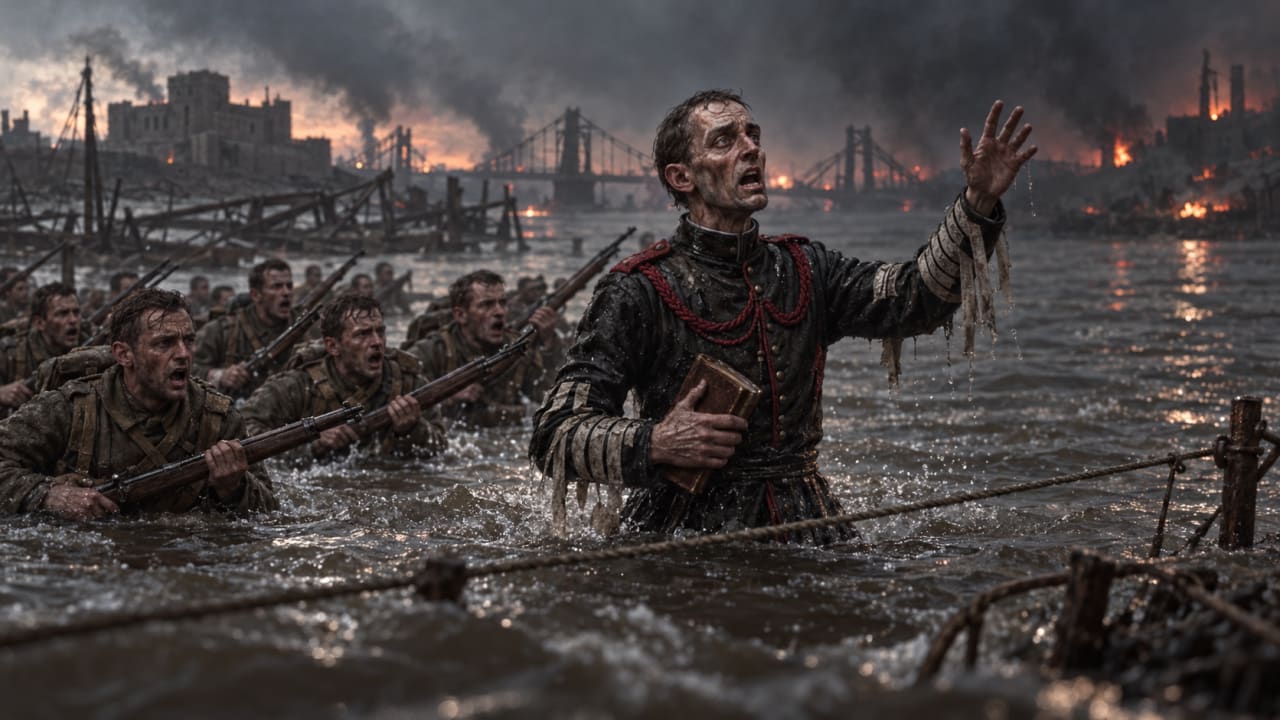
The office stands beneath the Warden-General in the sanctified chain, classified beside the Vexillators and the Litany-Engineers. The three offices solve one problem with three instruments. The Vexillator commands the eye with cloth. The Engineer commands peg, cord, charge and metre. The Tribune-Chaplain commands the ear. When all three agree, a column can move through conditions that ought to dissolve it into private persons. When they disagree, the battlefield receives three doctrines at once and chooses the stupidest.
That placement limits Sorellus, and the limit matters. He did not command the crossing. Warden-Submarshal Calev Rohn held that authority and ordered the Vexillators of Strasbourg forward. Sorellus carried no standard and drove no pegs. His task at the Ford was narrower and harder to measure. He had to put a sanctioned rhythm into the lungs of men entering chest-deep water, so that the rhythm would govern their feet when their minds proposed other arrangements.
The psalm he used was older than his wound. War's public account traces it to levy drill after the First Continental Levy of A.S. 110. By A.S. 120 field variants were circulating among pontoon crews and breach cohorts. The War-Doctrine review of A.S. 134 gathered them, corrected half, misquoted the rest and declared the result ancient. Those dates belong to the psalm. They are not stages in Sorellus's career, which has left only one date.
The general dress of the office is known. The collar is black beneath crimson field braid, and the hem is weighted against wind. The sleeves carry prayer-strips and casualty chalk, with a stitched pocket for sacramental supplies that the weather usually spoils. I record this as the dress of his profession. Whether his braid was frayed or new, which hand held his missal, whether he carried a revolver: none of it is written. The painters who give him a silver-hilted sword and a clean profile are working from uniform regulations and their own appetite.
The art of the office is compression. A full liturgy belongs to a cathedral. An assault prayer has to fit between two volleys, or into the seconds before a wave reaches the wire. The training houses at Metz, Stuttgart, Lyon and the forward schools teach candidates to pitch a psalm so that the back rank hears command inside the prayer. They teach which syllables carry through smoke and how to give absolution in phrases short enough to speak at a run. I do not know which house trained Sorellus. I know what all of them teach. Whichever house it was, it taught him well enough that his voice became unnecessary.
#On the Water Before the Fourth Verse
The necessity was a column of forty-seven wagons. A sudden enemy advance closed the far side and trapped it against the western bank of the Danubian forward corridor, between Budapest and Bastion-Irongate. It carried rifle cartridges, consecrated bridge-chain, three portable bell-frames, two sealed ossuary reliquaries and grain. Irongate's southern works needed all of it before winter. The bridges were gone and the river was high.
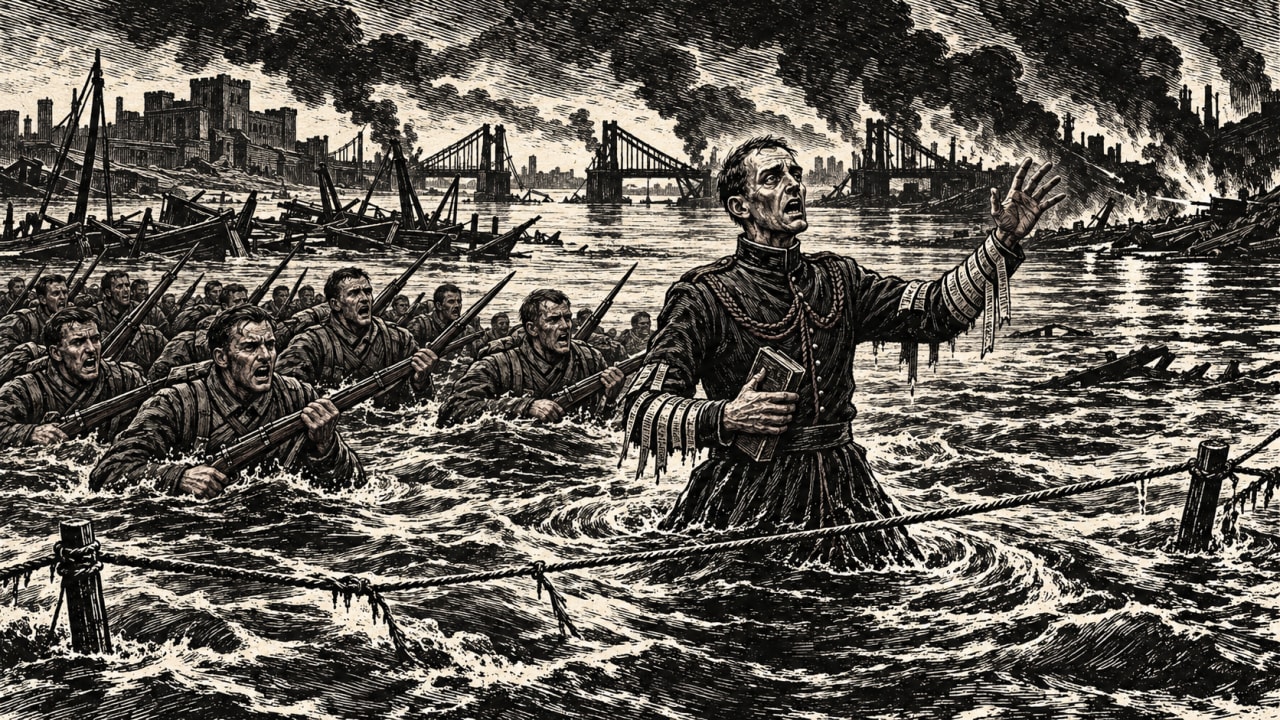
The corridor had been bad for some time. Velmora's assessors had been found near the crossings. Morwen's pressure from the south had turned guide-posts against their own directions. Maldrake's forward batteries were ranging the exposed flats. I accuse none of them of what happened to Sorellus, because the record names only enemy fire. I list them so the reader understands that the eastern bank was not empty and the night had more than one author.
Rohn's answer was to send the Vexillators across at three places at once: Saint Hadrien's Ford, the Chain-Pier Ruin and the drowned pontoon at Mark Seven. None of them was a bridge. The name came later, from men who needed the night to sound like architecture. The tactic was simultaneity. Enemy batteries could not decide which passage mattered, and sorcerous fire split between the standards.
At the Chain-Pier Ruin, Lorn of Metz fixed the Brass-Lipped Banner between broken stones and left it standing for ninety seconds with no hand on it. At Mark Seven, Sister-Vexillator Anje Rusk brought Widow's Rag to the eastern bank and rang a hand bell until the striker froze to the rim. Those deeds are theirs. The surviving record never puts Sorellus in conversation with either of them, or within sight of them, and I decline to stage the meeting the woodcut-makers prefer.
At Saint Hadrien's Ford the water reached the men's chests before they had advanced ten paces. Everything after depends on that detail. A man in water to the chest, under pack and rifle, is no longer walking in any sense the drill-yard would recognise. The current takes his legs sideways. Cold closes his throat. His breath comes in short gasps with no room for words. The rank behind him pushes, and the man he is meant to follow may already be under. Battery smoke lies on the water and shouting does not carry. A standard, if he can see one, gives him a direction. It does not tell him how to breathe.
The Litany-Engineers drove iron pegs into the mud and strung guide-cords along the current. The first cord snapped. The second sang. The third held. Engineers later swore that the second cord's tone matched the psalm's fifth interval. Engineering filed the claim as acoustic coincidence, and War printed it as assistance from Providence. I keep it in both drawers.
Sorellus began the Psalm of Iron in the middle of this: a cord failing, a cord singing, a cord holding, men in water to the chest. The Psalm tract records that he began because the water had risen and the first guide-cord had failed. I accept that order of events. A Tribune-Chaplain who waits for good conditions waits for the war to end.
#On the Verse He Did Not Finish
The approved opening of the field recension is short enough to strike between breaths:
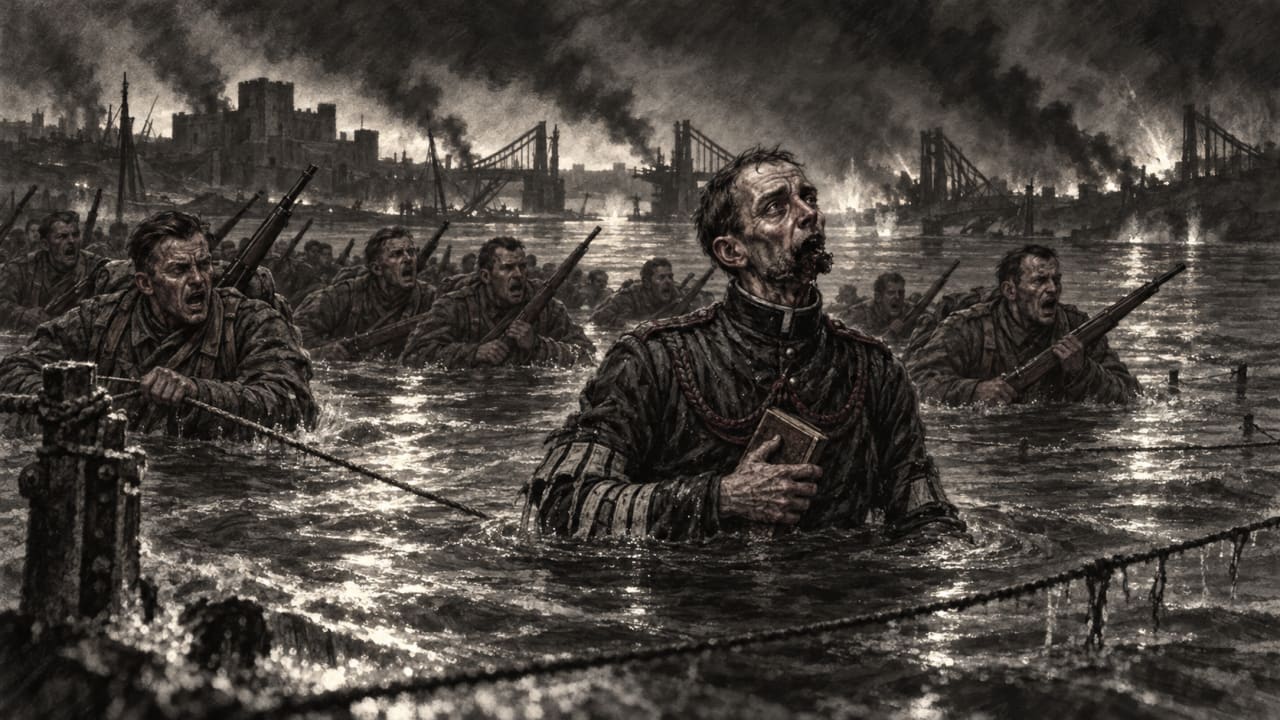
Iron under foot. Iron in hand. Iron in oath. We cross.
The record supplies those lines. It does not supply the text of the fourth verse, and I have no intention of composing one for him. The canonical recension runs to seven verses. Under fire, field use commonly cuts it to four, and in drowning water to two. Sorellus reached the fourth. The soldiers call that verse Sorellus' Break. The reader must not confuse it with the fourth line of the opening above. "We cross" was not the phrase he failed to finish. The record does not say what that phrase was.
The published accounts of the Ford, the Night and the Psalm agree on the sequence. The water rose. The cords were strung. Sorellus began the psalm, and the column moved with it. On the fourth verse, enemy fire removed the lower half of his jaw. He did not complete the line. The men did.
Note what is missing. No account names the weapon, the range, the battery or the hand that fired. No account says whether he fell, stood, was held up by the men beside him or went under. No account records a word he spoke afterwards or a sign he made. I have seen devotional prints in which he raises a hand to bless the column while blood runs from his face, and others in which he points east. Both are compositions. The engraver needed the arm to be doing something.
The men continued. This is the only part of the event that belongs to more than one person, and it is the part that made him famous. A Tribune-Chaplain exists to make command contagious. At the fourth verse the contagion was complete. The psalm left the authorised mouth and went on in the column's mouths, at the same cadence, in water to the chest, with the third cord holding.
The interpretations split at once and have not reconciled. War calls the continuance perfect instruction: proof that the drill had done its work and the psalm lived in the ranks as well as in the officer. Veterans call it panic given melody. Terrified men keep doing whatever their bodies were last doing, and their bodies had been singing. Doctrine calls it a ratified sign. I see no contradiction worth correcting. A drill is a way of arranging panic in advance. When it works, the panic and the instruction make the same noise.
What the men felt about the chaplain who had stopped is not recorded either. I would like to know. The soldiers' own couplet, unauthorised and still sung, is the closest thing to a verdict:
Iron in the river. Iron in the lung. If the priest stops singing, steal his tongue.
Doctrine condemns the couplet as vulgar. I find it more exact than most of the sermons preached on him. It does not mourn him. It takes his instrument and keeps moving, which is what the men at the Ford did.
War pamphlet 172-Bridge-C states that Sorellus completed the fourth verse "with blood alone."
Withdrawn for internal accuracy. Sorellus did not complete the fourth verse; the men completed it. The pamphlet's wording is retained for public devotion in illustrated editions. Internal accounts and this dossier use the corrected sequence. Blood does not pronounce consonants.
The pamphlet survives because blood is easier to paint than drill. A chaplain finishing the verse in his own blood is a saint. A chaplain silenced while frightened men finish the verse for him is a training outcome. Both are true of the Ford, and only one of them sells.
#On the Instruction Extracted from Him
War began using the Night before the casualty figures had dried. The first after-action report was written under a wagon in the rain by Tribune-Clerk Othmar Vey. It said the men were borne forward "in a manner exceeding ordinary locomotor explanation." By the time War, Doctrine, Records and the sermon offices had finished with that sentence, it had become the miracle of locomotion, and the authorised formula ran: They did not swim. They were carried.
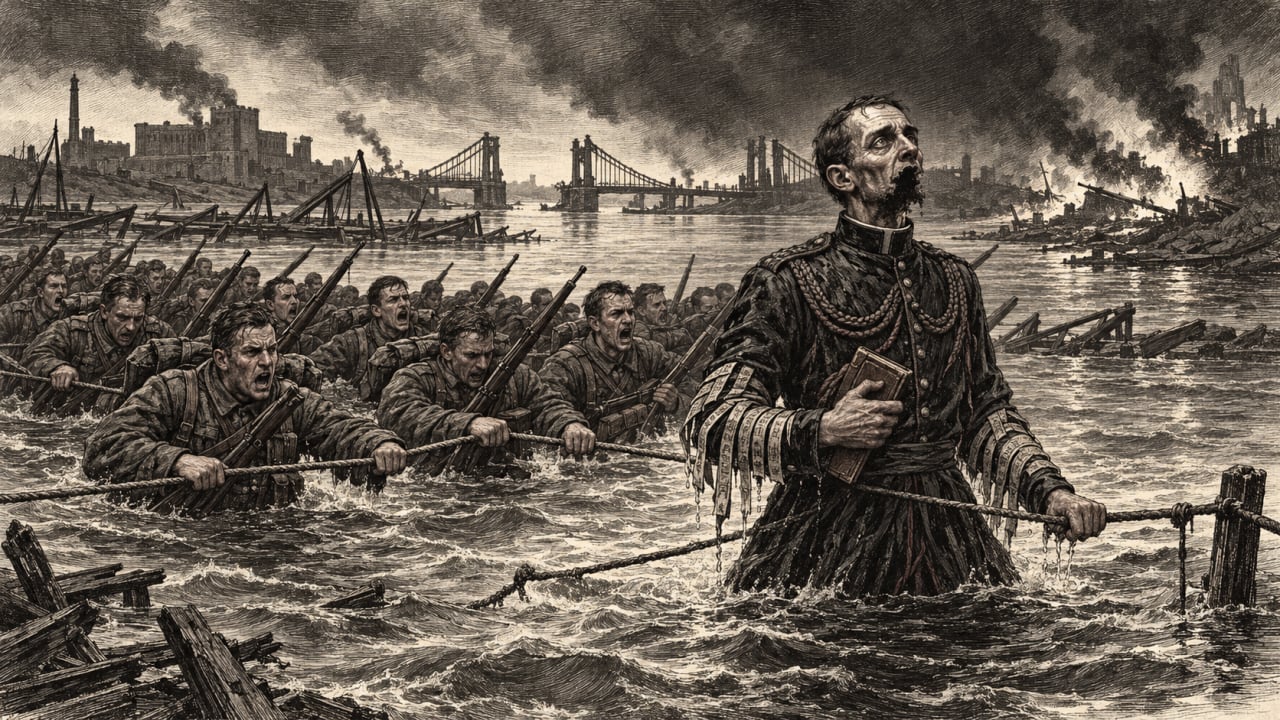
Sorellus fits the formula badly, and War has worked hard to make him fit. A carried column needs no chaplain. A column that keeps singing after its chaplain falls is evidence of instruction, which is a human achievement and so less useful for medals. The Bureau solved this by treating his silence as a moment of transfer: the voice of the office failed, the psalm passed into the ranks, and the ranks were carried. Providence and drill now share the same boots, and nobody has to choose between them.
The veterans' account is more literal. They remember cold water and weight, the men behind pushing and the men in front drowning, the cord under the hand, the standards giving a bearing through the smoke. In that account Sorellus did his work for three verses and part of a fourth, and the work outlasted him because it had been taught well. I record both versions, with one observation. The miracle depends on the veterans' details. Take away the cord, the cadence and the push, and Providence has nothing to carry.
The arithmetic belongs in his file, though not under his name. Earlier dispatches recorded 4,200 casualties for the Night. The revised roll shows 1,800 casualties and 2,400 martyrdom-translations, hydrological theatre. A casualty requires a pension, a family notice, an inventory of effects and a burial allocation. A translation requires a certificate and a hymn. Families may apply for a commemorative ribbon in lieu of pension.
I searched for Sorellus on both sides of that line. The published record places him on neither. It does not say whether he was counted among the 1,800, translated among the 2,400, or listed as wounded and returned. I will not put him in a column the clerks left empty. I mention the reclassification because his cult grew in the same season and in the same offices. It is instructive to watch War turn one man's ruined mouth into doctrine while turning two thousand four hundred others into stationery.
Then came the prints. Cheap devotional sheets show him with uplifted eyes, a clean wound and a jaw fragment shining like a sainted hinge. The Psalm tract calls the actual wound loud, wet and administratively inconvenient, and I see no reason to improve on that. The prints sold well in safe western parishes. Children there learn the softened opening, which ends We are carried, and nobody there has ever been asked to sing through another man's teeth.
#On the Three Claims to His Jaw
Sorellus is venerated in three regimental chapels, and each holds a claim.
The Chapel of Saint Hadrien at Metz holds a jaw fragment it says is his. The river chapel at Budapest holds a jaw fragment it says is his. Strasbourg holds a small silver-mounted bone which the Bureau of Relics describes as "associated with Sorellan utterance."
The claims are not equal, and the differences make up the whole Relics file. Metz and Budapest claim identity: each says, in effect, that this was part of the man's jaw. Relics has accepted neither and condemned neither. Strasbourg claims no identity at all. "Associated with Sorellan utterance" could describe a bone from his jaw, a bone that touched it, a bone present when he sang, or a bone over which the psalm has been sung often enough to earn a reputation. The phrase points in three directions and commits to none, which is how one recognises relic prose written by a committee that wanted to keep a silver mount without signing for what was inside it.
Three claims do not require three jaws. A reliquary may hold a fragment without that fragment implying the whole, and two fragments of one jaw would embarrass nobody. Three claims do not prove fraud either. For the benefit of the pious, I add that a jaw relic does not prove its owner died. A man can lose a jaw and keep the rest of himself. The record of Sorellus's relics, like the record of his body, stops at the fourth verse.
No recovery chain is recorded for any of the three objects. I do not know who took them from the Ford, or from him, or when, or how they reached Metz, Budapest and Strasbourg. I note the gap and decline to invent a heroic surgeon to fill it.
The soldiers have settled the question without Relics. They kiss all three cases before river crossings whenever leave, route and superstition allow. Authenticity matters less to them than sequence. A man who has touched bone and then stepped into cold water has an order of events to follow, and supplying an order of events was the whole purpose of the psalm.
The reader must keep these three chapels apart from three others. Saint Hadrien's Ford has three chapels of its own, western, central-mud and eastern, and they quarrel over the older saint's last crossing, not over Sorellus's jaw. The western chapel keeps a rope end under cloudy glass. The central chapel keeps a basin of river silt, changed monthly. The eastern chapel, when anyone can reach it, keeps whatever the shelling has left. None of them is recorded as holding a Sorellan relic. None should be confused with Metz, Budapest or Strasbourg just because the number matches. Three is a cheap number in a theatre of three passages.
The confusion at the Ford goes deeper than a count of chapels. Saint Hadrien is the disputed river saint of the crossing. The oldest fragment makes him a ferryman-monk; the boatmen make him a toll-keeper's bastard. Either way, he went back into floodwater once too often. Sorellus is the Tribune-Chaplain of A.S. 172 whose broken verse militarised the site. The soldiers keep the two apart in a paired devotion: Hadrien for passage, Sorellus for breath. The river chapels sell stamped cards showing a rope and a jaw-hinge. Before crossings a Tribune-Chaplain may touch river water to the throat and say, Hadrien under foot, Sorellus in mouth, iron in oath. The authorised version leaves out the mouth. The soldiers keep it in.
Several regimental broadsheets identify Saint Hadrien as Tribune-Chaplain Sorellus under a posthumous devotional title.
False. Hadrien is the older river saint of the Ford. Sorellus is the Tribune-Chaplain attested there in A.S. 172. The Codex records no canonisation for him. The broadsheets merged them because one woodcut costs less than two.
#On the Recruits Who Continue
The training houses now teach the Psalm of Iron in three modes. Muster Mode teaches cadence and breath on dry ground. Crossing Mode adds water, load and guide-cord. Broken Mode is for use after the leader has been silenced, and the Psalm tract calls it the Sorellan inheritance.
Broken Mode is simple to describe. The instructor leads the psalm and drops out mid-line, and the recruits complete it. The instructor fires a blank round, and the recruits complete it. A bucket of river water is thrown into the instructor's face, and the recruits complete it or begin again. Proficiency in Broken Mode is required before assignment to river columns.
I have no record that Sorellus designed any of this, and I do not know when the mode was first taught or by whom. The connection is commemorative and doctrinal. Broken Mode rehearses the moment at the Ford from the side of the ranks: the voice stops and the line goes on. It cannot rehearse the moment from his side, because from his side there was nothing left to perform.
War tries anyway. The fourth verse, Sorellus' Break, is sung in training with the jaw held tight. The exercise has so far produced three cracked teeth, one swallowed molar and several excellent sermons on sacrifice. It teaches nothing about crossing a river. It teaches recruits that the fourth verse costs something, which War considers the same lesson.
The Bureau of Mercy once objected to the severity of Broken Mode. War replied with casualty ratios from crossings before A.S. 172. Mercy withdrew its objection and asked for softer buckets. War denied the buckets.
The office carries a separate obligation. The A.S. 201 War-Doctrine review of the Tribune-Chaplains lists jaw-injury continuance as mandatory, alongside silent-command modules and the rule against sermons over three minutes during active assault. The review does not cite Sorellus or give a date of adoption. It does not say who must continue: the wounded chaplain, by whatever means remain to him, or the men around him. Broken Mode answers for the men. The clause in the review is left to answer for the chaplain. I will not cross-file the two under a circular number that neither office has issued. Any reader can draw the line from the Ford to the clause. Every candidate does.
The bodily cost of this memorial discipline is real and small, which makes it easy to mock: cracked teeth, bruised faces, men coughing up river water in yards nowhere near a river. Against the casualty ratios War waved at Mercy, it is a bargain. Against one man's jaw at the Ford, it is a tribute paid in the right coin and the wrong denomination.
#On the Fourth Verse Beneath Water
The psalm did not end at dawn. In A.S. 173, Danubian patrols reported hearing it beneath moving water near Mark Seven. Mark Seven is the drowned pontoon of the Night's third passage, not the Ford where Sorellus sang. The Bureau of Shadows ordered quarterly listening and public silence. The listening annex for A.S. 173 to 176 contains the only entry that touches his file, and it touches it indirectly.
SHADOWS LISTENING ANNEX — MARK SEVEN, A.S. 173–176 (EXTRACT) Repeated sub-current vocalisation matching Psalm of Iron, field recension. Voice Three: repeats fourth verse without consonants. Recommendation: continue listening; ████████████████████; do not permit Sorellan relics within █████ paces of Mark Seven after midnight.
A voice without consonants could be a voice without a jaw, or a voice heard through water, or a voice of the kind rivers keep. The annex does not say which. It does not name Voice Three. The annex identifies only Voice One, which two recovered men attributed to a translated Vexillator whose name is sealed. In no document I have been shown does anyone identify Voice Three as Sorellus.
The resemblance was close enough that Shadows wrote his relics into its recommendation. That is a precaution, and a precaution is not a finding. Mark Seven is not Saint Hadrien's Ford. The Ford has its own listening line and its own voice cluster, which repeats "Fourth passage unpaid" and belongs to the older saint's quarrel with the river. I keep the two files in separate drawers, as Shadows does.
Doctrine classifies the under-river psalm as devotional echo. War classifies it as morale residue. Shadows files it under black wax. Veterans hear it and stop talking.
#On the Present Disposition
As of A.S. 201, Sorellus is invoked before river crossings and kissed in three cases. His broken fourth verse is sung at every river school. He is paired with Hadrien on cards sold at the Ford, and illustrated editions still show him finishing a verse he did not finish. His name sits in the discipline of an office he once held, in the curriculum of a psalm he did not write, and in a listening annex that never names him.
None of that tells me whether he survived the night. Veneration does not require a grave, and a relic does not require a corpse. War has never needed his later life, because the doctrine it built from him ends at the fourth verse. The chapels have never needed it, because a jaw fragment asks nothing of biography. The only people who might have needed it were whoever was waiting for him, and the record does not say who they were.
I file him as the record files him. He was a Tribune-Chaplain who began a psalm in chest-deep water while the cords failed and held, and who stopped on the fourth verse because the enemy took his mouth. The men finished the verse. The Vexillators held a ragged line on the eastern mud by the ninth minute. The first wagon chains were hauling by the fourteenth, and the column was across by dawn. Irongate's southern works held through the winter.