
#On Mercy Spoken Aloud
The Soft Insurgents are the Lantern faction that committed the unforgivable administrative sin: they understood the arrangement and said so.
They emerged from the Cologne Schism of A.S. 178, when three watch circles within the Lantern Brotherhood split over the Mercy Preacher question. The Ward-Soothe Purists severed contact and returned to curfew enforcement with the blank righteousness of a nailed notice. The Lantern Loyalists preserved the routes and misfiled the mercy. The Soft Insurgents declared the obvious: the Brotherhood had always been resistance dressed in permission, and the Preachers merely spoke aloud what the patrol maps had confessed for decades.
Their doctrine begins with a street fact. The Synod cannot be everywhere. The Wardens hold gates, squares, queues, bridges, and public crossings; the alleys belong to whoever keeps them passable after the Ninth Peal. The Brotherhood filled that absence under a writ of toleration, which is to say under a clause so narrow it could garrote a mouse. In doing so, the Brotherhood proved the formal apparatus incomplete. The Soft Insurgent takes this proof, kisses it like a relic, and uses it as a knife.
#On the Theology of the Route Map
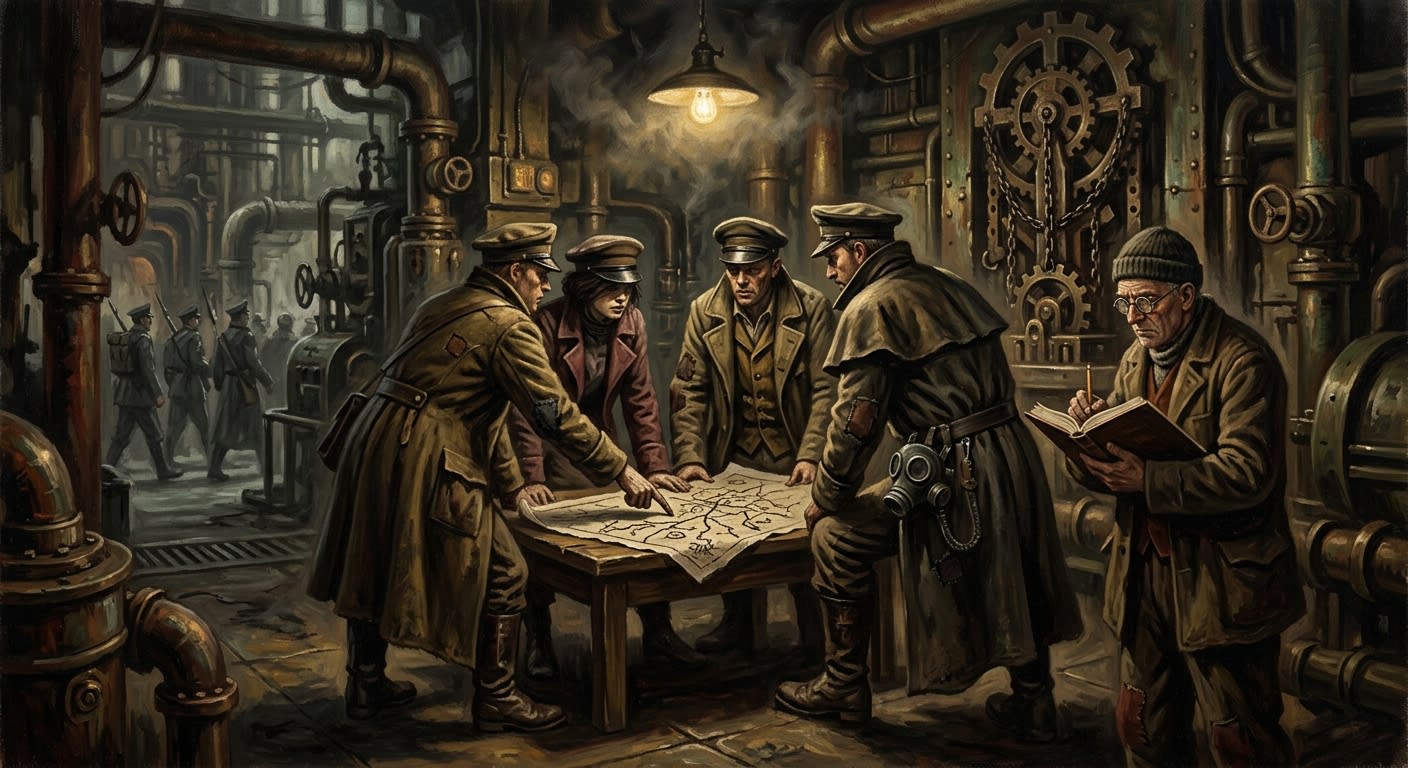
A route map, to the ordinary Brother, is a schedule with streets on it. To the Soft Insurgent it is a confession. Every alley the Brotherhood patrols marks a place where the Synod's own force cannot reach. Every delayed patrol marks a household the Law would have broken had no one slowed the boot. Every Candle-Runner allowed through a rope-road says, in ink no Bureau authorised, that survival sometimes precedes obedience.
This is why Soft Insurgents frighten Loyalists more than Purists do. A Purist is loud, clean, and stupid; he can be endured like rain on a processional canopy. A Soft Insurgent interprets. He sees the hidden theology inside operations. He understands that an Anchor who looks away has preached, that an Echo who records nothing has absolved, that a Blade who sheaths the cudgel has revised doctrine in the street.
They call their work soft because softness passes checkpoints. A shouted revolt receives Lictors. A softened queue receives notes. A barricade draws artillery. A widow taught how to answer a levy clerk draws sympathy, and sympathy is harder to arrest because it keeps changing coats.
#On Mercy as Technique
Soft Insurgents do not confuse kindness with innocence. They are the coldest faction in the warmest vocabulary. Their preferred weapons are comfort, timing, memory, and the small sentence placed in the right ear at the right hour. A grieving father told “your son was counted before he was loved” will not riot that night. He will remember the phrasing when the next levy roll appears. A mother told “sign after bread” will delay a clerk with hunger as her alibi. A queue taught to murmur an approved response in unison can hide one fugitive by becoming thirty obedient mouths.
Earlier Bureau of Purity notes described Soft Insurgent action as emotional excess among undisciplined auxiliaries.
Corrected after District Seven surveillance showed repeated phrasing, coordinated route delays, and sermon echoes across four wards. Emotional excess does not produce matching chalk marks unless the emotion has learned logistics.
The Soft Insurgent admires the Bureau of Shadows more than he admits. Shadows taught the empire that omission is action. Soft Insurgents learned the lesson and vulgarised it for street use. No sound, no record. No order, no conspiracy. No meeting, no cell. Merely people, comforted in sequence, becoming difficult to move.
Their relationship with Mercy Preachers is intimate and dangerous. Some Soft Insurgents remain Brothers who shield Preachers. Some are Preachers whose safe routes depend on Brotherhood lamps. Some are neither, operating as message-brokers between Fog Preachers, Candle-Runners, queue women, ossuary clerks, and exhausted Brothers with just enough conscience left to be exploitable. The Bureau prefers clean categories. Soft Insurgency breeds in the grout between them.
#On the Enemies of Softness
Purists hate Soft Insurgents because Purists can smell sedition but cannot parse it. Loyalists fear them because a Loyalist survives by pretending tactical mercy has no doctrine beneath it. Soft Insurgents ruin that performance. They name the thing. They say mercy is resistance. They say the lantern serves the street because the street came first. They say the Synod tolerates the Brotherhood because Order, in its sacred perfection, lacks enough hands.
The Circle of Mute Radiance is fertile ground for them, silence being both a working method and a political education. The Circle of Nine Wicks produces fewer of them but better ones; market queues teach arithmetic, hunger, patience, and the difference between official bread and edible bread. Rope-Road Lanterns sell passage and accidentally learn who needs it. Even Stained Proof, amid its confiscated miracles and upward-flowing beautiful things, has produced Brothers who noticed that hypocrisy is a door with a handle.
SHADOWS APPENDIX — COLOGNE, POST-SCHISM INTERCEPT Soft Insurgent cell used no names. Identifying phrase recovered from three separate reports: “The lamp is licensed. The mercy is not.” Suspected speaker ███████████ later listed as transferred to trench service. No trench record found. Chalk version appeared outside Saint Gereon eight days later, then on a ration wall, then inside a Warden booth. Recommendation: ████████████████████████████████████████████
The Red Lanterns despise them with special heat. A Mercy Preacher can be branded. A Loyalist can be audited. A Purist can be ignored until he becomes useful as an example. A Soft Insurgent turns enforcement into testimony: every seizure proves fear, every branding proves the words mattered, every erased chalk line leaves a cleaner rectangle that draws the eye.
#On the Problem of Sincerity
The Synod can manage vice. Vice keeps ledgers. It buys, sells, hides, bargains, and signs if squeezed correctly. Sincerity is worse. Sincerity does not invoice. It persists in memory, in repeated phrases, in women who refuse to remember a fugitive's face, in boys who learn three routes home and teach none of them to clerks. The Soft Insurgent is sincerity given patrol discipline.
That is the scandal. The Brotherhood began as tolerated auxiliary force under the curfew settlement of A.S. 94. It became useful, corrupt, deniable, and local. Then, in the Cologne wound, a few Brothers and Preachers announced that the local had always been moral. The Bureau could endure knives. It could endure bribery. It could endure blackmail walls, marrow-wax skimming, and confiscated relic glass circulating through private chapels. It has endured worse before breakfast. Meaning is the infestation.