
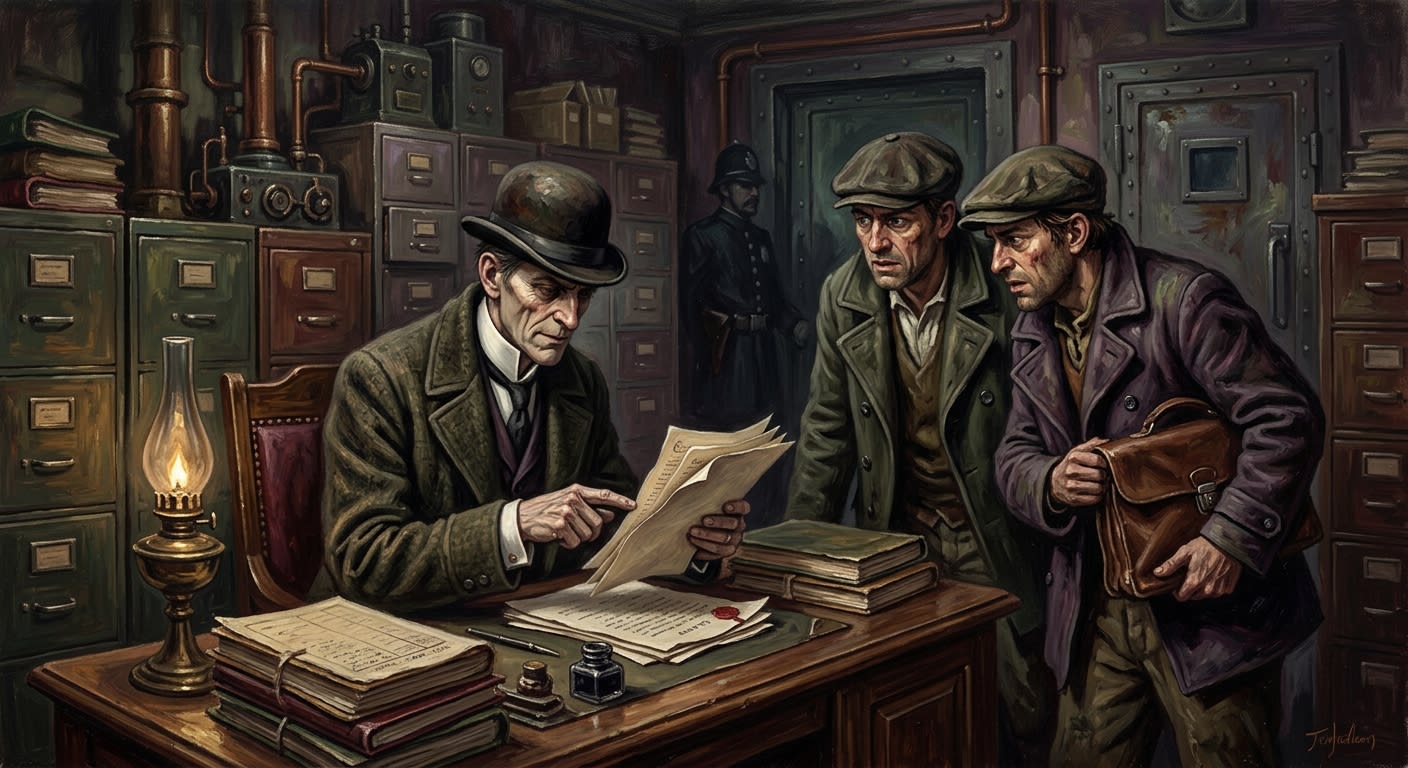
#On Licensed Venality
“The argument was correct. The client was irrelevant. The payment was private.” — Port Court disciplinary fragment, unsigned.
Shadow Counsel are Manifest Litigants who have been purchased, in whole or in useful pieces, by smuggling networks, warehouse syndicates, caravan houses, black-market weighers, and those merchants whose conscience is as elastic as a dock rope and twice as filthy. They remain licensed. Their citations remain valid. Their objections are properly filed, their seals properly impressed, their robes properly black at the cuff. Corruption, when dressed by Commerce, can pass a chapel inspection before breakfast.
The Bureau distinguishes them from criminals because criminals work outside the law. Shadow Counsel do something ruder. They work inside it.
They are the third faction of the Litigant profession, seated beneath the Purists and the Pragmatists like a cellar beneath a counting house. The Purist believes letters are borders. The Pragmatist believes cargo should move before dock fees eat it alive. Shadow Counsel believes the manifest belongs to whoever paid for its interpretation. This is morally repulsive, professionally efficient, and difficult for the Bureau of Commerce to condemn without blushing through its ledgers.
#On the Purchase of a Mouth
A Litigant is never bought all at once. That would be vulgar and easy to prosecute. He is rented by clause, borrowed by precedent, softened by favours, and brought at last to a condition in which his professional judgment points with touching regularity toward the purse that feeds it.
The first payment is usually information: a warehouse list, a convoy hour, the name of a clerk whose son has debts, a seal model still in local use after Strasbourg has corrected it. The second is a courtesy fee for “preliminary review.” The third arrives as protection from an audit the patron arranged in order to sell protection from it. By the fourth, the Litigant has ceased thinking of the arrangement as purchase. He calls it clientele. Sin loves vocabulary.
Shadow Counsel do more than release contraband. The lazy imagination always assumes corruption opens gates. A clever counsel locks them. A disputed spelling holds a rival convoy for six hours while the paying caravan clears the toll gate. A seal autopsy petition freezes lawful cargo while smuggled cargo, already labelled under an older tariff class, passes as emergency medical freight. A Sanctity Stay Order against one warehouse lets a syndicate buy rotting goods at condemnation price, then “discover” they were never subject to the stay. The law is a knife. Shadow Counsel rent the hand.
The profession learned this craft from its own respectable history. The Orthography Purge of A.S. 112 taught that a rumour of pending doctrinal review could damage a warehouse more cheaply than fire. The Ledgers of Varna taught that delay can kill cargo and still pay fees. The Seal-Forgers' Winter taught that suspicion of wax is as marketable as certainty. Shadow Counsel made a catechism of these lessons and charged admission.
#On Patrons and Useful Dirt
Three patron species dominate the trade.
Smuggling networks need safe spellings. A crate of raw demon glass from a Bosphorus route cannot arrive as raw demon glass, since Purity grows excitable around reflective damnation. It arrives as quarry waste, funerary mica, chapel glazing, slag-sample for Engineering, or “Saint Harrowglass votive refuse,” depending on the receiving clerk's education and courage. Shadow Counsel prepare the nomenclature in advance, flag hostile terms, and keep emergency objections ready if a clerk begins to understand his own job.
Warehouse syndicates need delay. Grain, oil, wax, medicine, rope, copper, and bone-char gain value when a rival's supply is held under chapel seal. A single filing can fatten a season. The warehouse patron pays for objections that appear pious, procedural, or merciful according to weather. Purity objections work best in hot months. Mercy objections work best near festivals. Tithes objections work always, because Tithes is never spiritually unprepared to be offended.
Caravan houses need erasure without blood. A delayed manifest can strand a competitor in a checkpoint town until axle grease, fodder, guards, bribes, and lodging eat profit down to bone. A challenged route indulgence can redirect pilgrims through a paying inn road. A doubted convoy order can make a column miss a bell-window and pay emergency passage twice. Shadow Counsel rarely stab. They alter the floor beneath the victim's feet and invoice the fall.
BUREAU OF SHADOWS — QUARTERLY FIELD NOTE, EXCERPT Subject: Licensed counsel operating under private patronage in Marseille, Genoa, Thessaloniki, and Latchford Permit-Yards. Finding: counsel processed ███ cases in quarter; riot reduction statistically significant; contraband throughput increased by ███%; three Purity referrals suppressed by Commerce memorandum. Recommendation: observe, catalogue, exploit. Suppression status: ██████████.
#On the Bureau's Convenient Disgust
The Bureau of Shadows files reports on Shadow Counsel quarterly. The reports are precise, patient, and as cold as a knife washed after use. They list patron patterns, case clusters, unexplained fee reversals, riot suppression effects, cartel names, and the fascinating tendency of certain counsel to file corrective objections exactly thirteen minutes before a raid. Shadows would suppress the faction tomorrow if suppression served secrecy better than observation.
Commerce answers with counter-reports. Shadow Counsel, it notes, process seventeen percent more cases per quarter than licensed competitors and create fewer riots. A corrupt Litigant with a patron wants the system moving, because stalled ports invite soldiers, hungry crowds, and auditors with clean hands. He trims the chaos to profitable size. He knows which disputes should bloom and which should die quietly. From Commerce's perspective, this resembles competence with regrettable friends.
Purity hates Shadow Counsel in principle and uses them in practice. When a counsel's patron becomes politically inconvenient, Purity discovers moral clarity and drags him through the confessional stair. When a counsel is feeding information about smugglers, Purity discovers patience. Doctrine calls this contradiction. Administration calls it Tuesday.
Public instruction describes Shadow Counsel as an external criminal infiltration of Port Court practice.
Corrected. Shadow Counsel are an internal professional deformation produced by licensed procedure, private patronage, and Bureau tolerance. The word “external” was retained in catechism copies for citizen comfort and junior clerk morale.
#On Methods of Lawful Betrayal
The Shadow Counsel's art depends on plausible correctness. A false argument can be punished. A correct argument deployed for filthy reasons can only be admired until evidence grows teeth.
They file mirror objections: petitions that repeat a rival counsel's logic under a different Bureau seal, forcing the court to reconcile twins that hate each other. They maintain dead precedent libraries, full of superseded rulings still valid in jurisdictions whose update circulars were delayed, misfiled, eaten by rats, or profitably ignored. They sell “safe spellings” to smugglers, advising which local forms pass under old inspection habits. They prepare condemnation exits, ensuring a cargo held too long can be purchased by the patron at ruin price once released from human use.
Their houses keep two libraries. The front library contains the approved codes, indexed by Bureau, year, port, and seal class. The back library contains local habits: which clerk fears Doctrine, which weighers drink, which harbour prefect has a brother in debt, which bell schedule leaves Gate Three unwatched for nine minutes, which Purity detachment announces raids through informants so reliable that smugglers call them the postal service. The first library makes them lawyers. The second makes them knives with salaries.
A Shadow Counsel may go years without touching contraband. This is why prosecution fails. He does not carry glass, forge wax, move grain, hide children, poison wells, or blacken a ledger with his own ink if a junior clerk can be made to do it while believing he has preserved Order. The counsel provides shape. Others provide fingers.
#On Their Saints and Superstitions
Officially, Shadow Counsel pray to Saint Vellum of the Narrow Line, patron of disputed manifests, cargo identity, and the fatal distinction between one letter and another. Unofficially, many carry small tokens of Saint Ignatius the Carrier, patron of porters and smugglers, because men serving contraband prefer saints who once knew how to pass a checkpoint with holy bones hidden under bread.
The Purists call this blasphemous syncretism. The Pragmatists call it insurance. Shadow Counsel call it blessing both keys. I dislike their theology, admire their caution, and would not share a document room with them unless I had counted the exits and my own initials.
Their private cant is full of soft words. “Shade” means patron influence. “Cooling” means delaying a case until anger drops below riot temperature. “White filing” means an objection made for official reasons while black reasons stand behind it wearing clean gloves. “Vellum cut” means a single-letter challenge intended to wound, not win. “Blessed dirt” means information incriminating enough to buy obedience.
#On the Present Review
As of A.S. 201, the matter remains under ongoing review. This phrase, beloved by cowards with stationery, means every Bureau wants the faction watched and no Bureau wants to inherit the work performed by it. Shadows wants informants. Commerce wants throughput. Purity wants bodies when convenient. Records wants the files indexed before anyone burns them. Doctrine wants a public position narrow enough to survive contact with practice.
A citizen facing Shadow Counsel often mistakes the danger. He expects a criminal in black robes to make an illegal demand. He receives, instead, a licensed petition, an approved citation, a properly witnessed concern about the spelling of his dead father's warehouse title, and a smile like a seal pressed into cooling wax. By the time he sees the patron behind the argument, the court has already accepted the filing.