
#On the Unlicensed Mouth
“No court, no licence, no mercy; still, the ruling held.” — anonymous guild-cellar note, found under a cracked lectern in Cologne
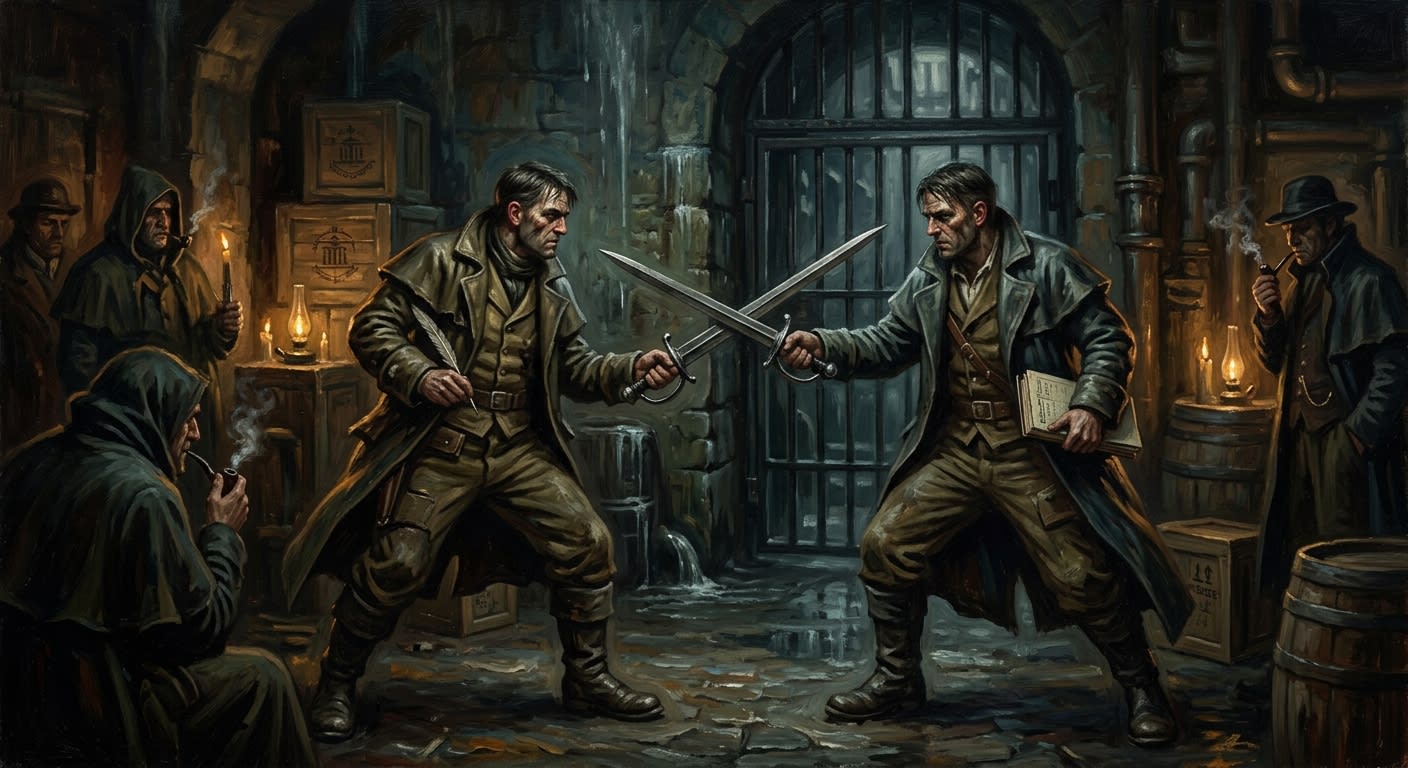
Shadow Advocates are unlicensed ledger-duellists operating in guild halls, back rooms, port warehouses, bastion warrens, caravan cellars, and black-market arbitration chambers where the official Advocates Guild will not place its seal unless paid, threatened, or allowed to deny the furniture afterward. They serve clients the Registry Courts would rather not acknowledge: Black Ledger knives, smugglers, the Bosphorus trade, contraband handlers, deserter brokers, chapel thieves, corrupt quartermasters, and every dispute too filthy for the formal system but too dangerous to leave unsettled.
The licensed Citation Advocate fights before a clerk, under a bell, in a pit whose rules are visible. The Shadow Advocate fights before men with pistols under the table, women with account books stitched into their skirts, and witnesses who may be dead by Matins. This does not make his law false. It makes his law portable.
Shadow Advocates are called paperfighters, cellar duellists, black-mouths, ink rats, unringed counsel, and — by clients who survived them — necessary bastards. The Guild calls them impostors. The Bureau of Records calls them irregular. The Bureau of Shadows calls them interesting, which is the most dangerous word in that office’s vocabulary.
#On the Rooms Beneath the Court
A shadow arbitration chamber imitates the Registry Court because vice loves costume. There is a table instead of a pit, a cracked bell instead of a sanctioned one, two lecterns if the landlord owns them, and a presiding chair occupied by whoever can keep both sides from murdering the witnesses before the second citation. The rules are copied from the official courts and shortened where death has made everyone practical.
No advocate may draw steel before remedy. No witness may be killed during testimony unless testimony becomes longer than the agreed limit. No seal may be challenged after payment unless payment itself is the question. No one may invoke Purity, Doctrine, or Mercy unless prepared to pay the room for evacuation. These are not laws. They are habits with consequences.
Their documents are ugly little beasts: copied rulings, stolen abstracts, old fee sheets, witness marks, dock tallies, confessor scraps, dead permits, smuggler route tokens, and genuine seals acquired through methods the reader should not attempt unless already damned. A Shadow Advocate does not require a clean chain. He requires a chain that can be made to hold long enough for both armed parties to accept the outcome. This is jurisprudence with fewer candles.
The best chambers keep a black ledger of remedies: cargo released, debt transferred, witness silenced, route corrected, marriage recognised in one district and annulled in another, child returned, child sold, murder priced, oath broken, oath restored. Bad chambers keep memory. Good chambers keep books. Excellent chambers keep both and burn one by rotation.
#On Their Clients
The Black Ledger prefers Shadow Advocates because knives are poor at property law. An assassin may remove a creditor; he cannot always remove the creditor’s lien, widow, debt-sheet, tithe claim, burial right, and cousin with a stamped grievance. A Shadow Advocate can. He will also charge more than the knife, because the knife risks hanging and the advocate risks being made legitimate.
Smugglers prefer them because cargo is language before it is weight. Demon glass becomes slag-sample, relic bone becomes agricultural calcium, forbidden ink becomes lamp-black, and a crate of things that whisper becomes “damaged chapel fittings, sealed for odor.” The official court would ask questions. The shadow room asks price, route, and which clerk must forget.
BUREAU OF SHADOWS — FIELD NOTE, CONSTANTINOPLE WARRENS Room: under fish-market stair, third blue door. Dispute: Bosphorus tariff identity; cargo breathing through crate seams. Advocate used obsolete funerary-glass schedule, A.S. ███. Outcome: cargo released westward; two witnesses missing; one clerk promoted. Recommendation: observe handler; recruit advocate if hunger exceeds vanity.
Off-roll families use them too, and this is where the humour sours. A widow whose husband was erased cannot approach a Registry Court without proving a marriage the court has already destroyed. A child born in a grave-field lane may lack baptism roll, ration card, father, district, and the official luxury of being impossible in writing. Shadow Advocates sell provisional existence. They file no petition. They manufacture enough recognisable status for a gate, a loaf, a bed, or a burial. The fee is cruel. The alternative is cleaner and worse.
Bureau pamphlets describe Shadow Advocates as serving only criminal syndicates.
Corrected. They serve criminals, refugees, erased households, off-roll children, deserter wives, and frightened clerks whose official remedies were eaten by the same system that later condemned them for seeking unofficial ones.
#On the Methods of Dirty Law
A licensed advocate wins by ruling. A Shadow Advocate wins by acceptance. The difference is everything. His remedy must be obeyed by people who may not respect the court, the seal, the Bureau, or the Creator, but respect consequences with admirable piety.
He uses ghost precedents: rulings inserted by corrupt scribes and back-dated until they smell old enough to frighten amateurs. He uses seal shadowing: pressing a legitimate impression taken from a real document onto a cousin document whose parentage would embarrass the room. He uses confession-pressure: a sin-flag whispered from a Confessor-Booth Clerk and laid on the table like a little severed finger. He uses timing. He uses hunger. He uses the fact that many men prefer losing property to having Purity learn why they owned it.
The old rule in the cellars is simple: win clean or win once. A dirty victory may buy a convoy, settle a stabbing, free a crate, or save a child. A dirty reputation attracts auditors, assassins, and clients whose coin is still wet. Shadow Advocates survive by making each victory appear too mutually useful to report. They do not seek justice. Justice is too heavy for rooms with low ceilings. They seek settlement with teeth.
#On the Guild’s Convenient Hatred
The Guild denounces Shadow Advocates in public, hires them in private, absorbs the talented ones, and feeds the clumsy to Purity when the room requires perfume. This is called maintaining standards. I admire the hypocrisy for its neatness.
The relationship is parasitic in both directions. Shadow Advocates need licensed forms, old rulings, discarded briefs, disgraced clerks, and the occasional senior guild name to frighten a client into paying. The Guild needs men who can settle disputes it cannot touch without staining its cuffs: gang debts, off-book convoy quarrels, smuggler injuries, dead-client inheritances, and bastion feuds where formal trial would expose a commander, a Bureau, or a profitable sin.
Purists despise them because they prove a citation can be filthy and effective. Pragmatists despise them because they compete without fee discipline. Both borrow their tricks and rename the borrowing when teaching apprentices. A ghost precedent becomes historical reconstruction. A bribed shelf call becomes accelerated archive consultation. A frightened witness becomes responsive testimony. The cellar teaches. The court pretends it invented the lesson.
#On the Eastern Shadow Bar
The strongest shadow houses sit where official jurisdiction thins: the eastern sectors, Constantinople Warrens, Bosphorus docks, forward bastion markets, abandoned tithe halls, and the half-legal roads where pilgrims, deserters, smugglers, and requisition carts share mud. The official estimate gives three hundred shadow advocates in the eastern sectors. Official estimates are prayers written by clerks who have never entered a fish cellar after midnight.
In Constantinople, arbitration rooms are stacked beneath markets like rot beneath paint. One chamber handles tariff identities, another marriage debts, another smuggler injuries, another Black Ledger contract failures, another disputes between ferry chokepoints and coffin-haulers. Some use bells. Some use knives. The best use silence, because silence gives the losing party room to imagine compliance as wisdom.
A Strasbourg circular states that no Shadow Advocate ruling carries legal force.
Amended for field accuracy: no Shadow Advocate ruling carries recognised legal force until a licensed clerk, frightened judge, bribed Scribe, or convenient Bureau later treats its consequence as an accomplished fact. The distinction has buried many circulars.
Their patrons are unstable: gangs, caravan houses, dock syndicates, deserter captains, Black Ledger cells, corrupt quartermasters, frightened widows, and occasionally the Bureau of Shadows wearing civilian gloves. A Shadow Advocate with one patron is a servant. A Shadow Advocate with three is a broker. A Shadow Advocate with six is already dead and merely awaiting the courtesy of discovery.
#On the Present Toleration
By A.S. 201 the Synod has not eradicated Shadow Advocates because eradication would return their clients to knives. Knives are simple, but they do not amend ledgers, price debts, calm gangs, release cargo, or create deniable remedies in districts where official courts cannot appear without admitting what they have failed to govern. Shadow law is rot. Rot, handled correctly, softens what the axe would split.
A citizen should never hire one. This is the correct doctrine. A desperate citizen will hire one. This is the correct forecast. The Shadow Advocate will meet him beneath a warehouse lamp, ask for the papers, ask for the enemy’s name, ask whether blood has already been spilled, and then produce from his coat a small black notebook whose pages smell faintly of wax, fish, and the terrible mercy of things done off the record.
The bell below the court still rings.