
#On the Authorized Form
"Form is Function, Function is Form." — Inscription above the Archive of Prescribed Gesture, Strasbourg Cloister
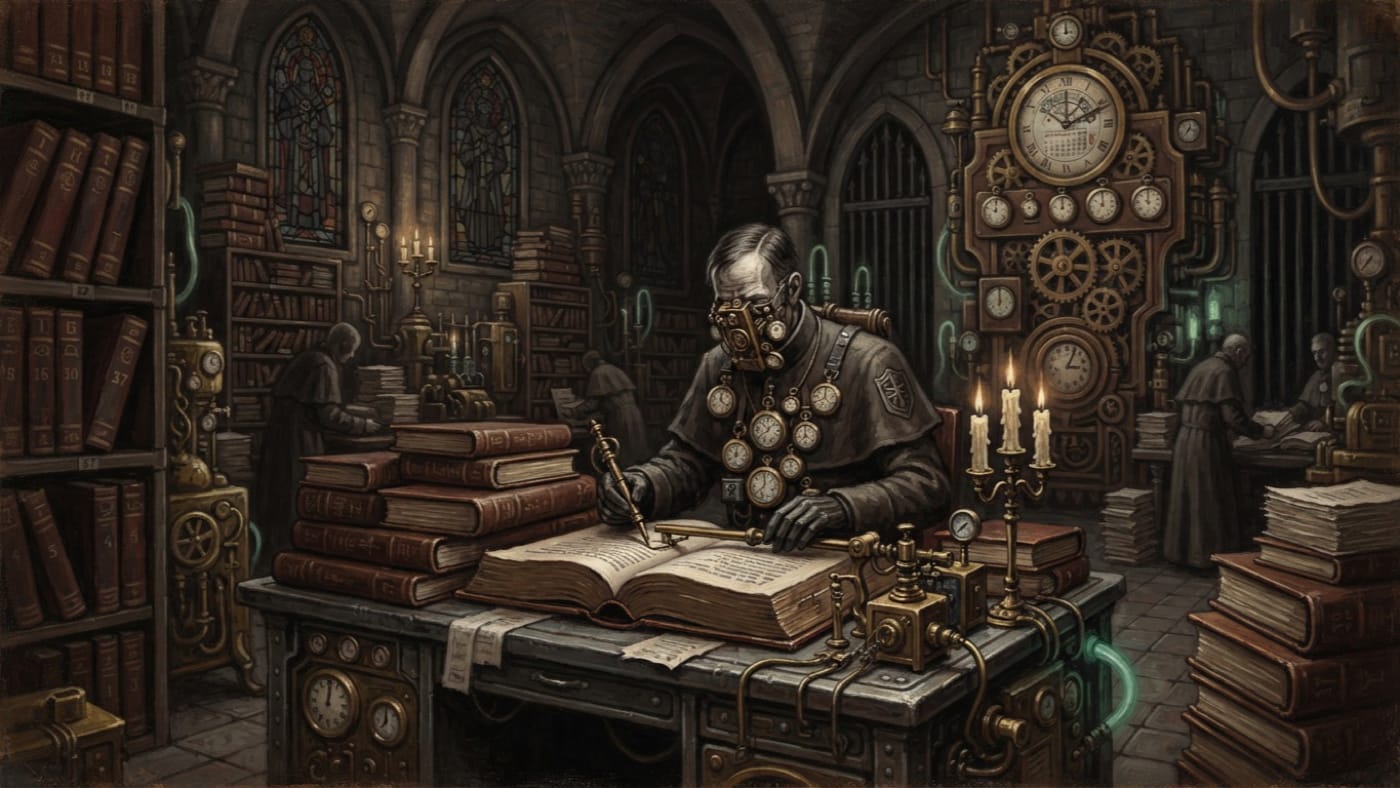
The Codex Liturgiae is the master reference for every rite the Bureau of Rites authorizes. It runs to eleven volumes and thirty-seven supplementary annexes. It is kept in a windowless chamber of the Strasbourg Cloister in Strasbourg, which holds a desk, a chair, and candles lit to schedule. Its custodian is Liturgist-Primus Corvin Marche, Chair of Prescribed Observance, who has held it for nineteen years and has no need of it. He knows it by heart. The books are kept for the rest of us.
The Codex sets down the difference between a rite and its performance, a difference the Bureau holds does not exist. To the layman a prayer is a set of words. The Bureau's doctrine holds that the same words said at the wrong hour, with the hands placed wrongly or in the wrong cadence, are a different prayer, and a different prayer may reach a different listener. The Bureau of Doctrine decides what the Church believes. The Codex Liturgiae decides what the believer's body does about it, to the syllable and to the second.
#On the Substance of Observance
The Bureau divides its remit into seven domains, which it calls the Seven Pillars of Prescribed Form. They are the Sacramental Calendar, the Codex of Gesture, the Canonical Texts, the Fasting Protocols, Penance, the Consecration Protocols, and Supernatural Classification. That makes seven pillars, eleven volumes and thirty-seven annexes. The Bureau has never published how the pillars are distributed among the volumes, and I will not do its arithmetic for it.
The pillars sort more easily by what they claim. Two claim time. The Sacramental Calendar fixes every feast, fast, vigil and ember day, and the Bureau of Festivals only announces what Rites has already fixed. The Fasting Protocols decide who goes hungry, when, and in which of the graded severities. Where a rite needs a bell, the Codex requires the bell. The peal belongs to the Bell Codex, ratified in A.S. 115 and administered by the Bureau of Bells. The two instruments are separate, and the clerks of each will correct anyone who confuses them, by memorandum and at length.
One pillar claims the body. The Codex of Gesture is a body of prescription under its own name. It fixes where the hands go at absolution, how the censer is held, and how many fingers make the sign of the cross. One pillar claims the mouth. The Canonical Texts prescribe each authorized word in its authorized order and cadence, so that a congregation in a cathedral and a congregation in a field chapel are heard to say the same thing, which is the point of the exercise. Penance sets the price of sin. Consecration makes objects, places and persons sacred: bells, reliquaries, and the bastions of the Sagittal Line. Supernatural Classification gives the Bureau the right to name whatever the other six cannot explain.
The Charter of Prescribed Observance is a different document, and readers keep confusing the two. It was ratified in A.S. 58 under Augustinus's seal and countersigned by Kratz, three years after the Common Allegiance, by the authority that later generations would call the Synod. The formal Synod itself was constituted at the Concordat of Strasbourg in A.S. 90, after both founders had died. When we give the bodies of A.S. 58 their later titles we are naming them in hindsight, and we should admit it. The Charter's six hundred and fourteen articles set up the regulatory framework. They do not count volumes, and they say nothing about when the Codex was first compiled. Neither does anyone else in this office.
#On the Exception
A genuflection lasts between four and nine seconds. Nine seconds is lawful. Ten seconds without a dispensation goes past the prescribed range, and the Bureau treats anything past the prescribed range as a breach of form, whatever the knee may say. An infirm worshipper may be granted eleven seconds by dispensation, annotated in triplicate.
That is the whole doctrine of the exception, in miniature. Under the Codex the infirm worshipper is not excused. The infirm worshipper is re-prescribed: given a new measure that has its own paperwork, and that paperwork has its own copies. The exception is added to the rule. The Bureau describes itself as never having compromised, and I record that self-description faithfully. I also record that the Codex is full of compromises, each one written down as a stricter form of obedience.
The dispute over fingers is the textbook case. For three years the Bureau argued whether the sign of the cross should be made with two fingers or with three. The schism that followed lasted a generation. The settlement prescribed three fingers for cathedral rites, as at Strasbourg Cathedral, and two for field worship. It came with a manual of exceptions three hundred pages long. That manual governs a single gesture. Nobody has told me whether it belongs among the thirty-seven annexes, sits beside them, or exists as a separate class of document, and I have learned not to ask the Sub-Priors questions whose answers are longer than the question.
The system works, which is the worst thing I can say about it. In any parish of the Dominion, a priest who follows the Codex on a given feast-day morning performs exactly what a priest two hundred miles away is performing. In thousands of churches the censer rises at the same angle, at the same hour, on the same word. I have stood in the nave and felt that uniformity as a physical force. It is magnificent, and somebody is always kneeling one second too long.
#On Memory and Suppression
Marche's chief distinction is that he has memorized all of it. That includes every rite the Codex authorizes. It also includes the fourteen rites suppressed after the Schism of Avignon in A.S. 111, and the three that were suppressed before anyone thought to write down why. I do not know their names. I have no wish to know their texts. Whether they are still dangerous, or ever were, is a question nobody in Strasbourg has formally put to anyone.
Marche's memory must be kept apart from three other things: the archive, the permission, and the act. A suppressed rite that a man knows is still suppressed. Being able to recite it does not authorize performing it. Keeping it in memory does not restore it. The difficulty is that Marche himself, asked about this, has said that recitation and performance are identical. If that is so, the Liturgist-Primus carries seventeen forbidden rites in a mind that can perform them, and he is the only man in the Dominion qualified to tell us whether he ever has.
The archives behind the Codex are deeper than Marche's memory. The Bureau keeps an inheritance of liturgical variations, each annotated for its theological significance. In these collections, rejected forms lie beside approved ones, and what was condemned beside what replaced it. The seventeen Sub-Priors of Form sit in the cells next to Marche's chamber and talk to one another only through written ritual queries, formatted under Bureau Standard 7-C, revised in A.S. 187. That correspondence is how the Codex is read: one exact question, one exact answer, and a file.
The Bureau of Rites possesses seventeen centuries of liturgical variations.
This inherited wording describes accumulated archival material: variations gathered by the Bureau and its predecessors and kept in its collections. It does not mean the Bureau has governed for seventeen centuries. The formal Synod dates from A.S. 90, and the Church emerged publicly only after the Sundering of A.S. 45. The phrase gives no age for the eleven-volume Codex either, and that age has not been documented. The archive is older than the Bureau that owns it.
#On Present Application
In A.S. 201 the Codex Liturgiae sits where every Bureau depends on it and none of them wants to read it. The Bureau of Doctrine defines what is orthodox, and Rites prescribes how orthodoxy is performed. Bells times the performance, and the Bureau of Records documents that it happened. The Bureau of Purity deals with anyone who did it differently. No one of these bodies holds the whole of it. Every one of them assumes the Codex is correct, because the alternative is that worship across the Dominion has rested on someone else's guesswork, and nobody has budgeted for that.
The faithful pay for the precision. The Bureau records the symptoms of devotional debt in its own careful hand. There is dulled taste, when bread turns to ash on the tongue. There are insomnia hymns, phantom bells ringing in the skull at night. There is brittle joy, laughter that cracks in the throat. Sanctioned grace costs something, and the people who receive it pay. The Codex prescribes the rite but does not set the price. No volume and no annex lists how much a given prayer will take from the person who says it correctly. The rite is performed exactly, and the bill arrives later and is never itemized.
My judgment of the Codex is my own, and I sign it. The Great Ledger of Souls records what the Church claims about its faithful. The Codex Liturgiae records what the Church has made them do. Read it volume by volume and annex by annex and you find a record of institutional conduct. Every hardened rule, every dispensation added under pressure, every rite memorized after its suppression is a dated admission of what the authorities feared and how far they were willing to go about it. The Ledger is what the Church professes. The Codex shows what it actually did.
The Bureau will not accept this reading. It holds that the Codex records only the correct form, unchanged and unchangeable, as prescribed. I accept the Bureau's account as it applies to the Bureau.
The eleven volumes stay on Marche's desk, by candlelight, in a room with no window. The thirty-seven annexes stay with them, along with whatever they still contain.