
I've read the continuity file and the style guides. The draft follows; it uses the planned six sections and the one correction about whether Marche "corresponds."
#On His Station
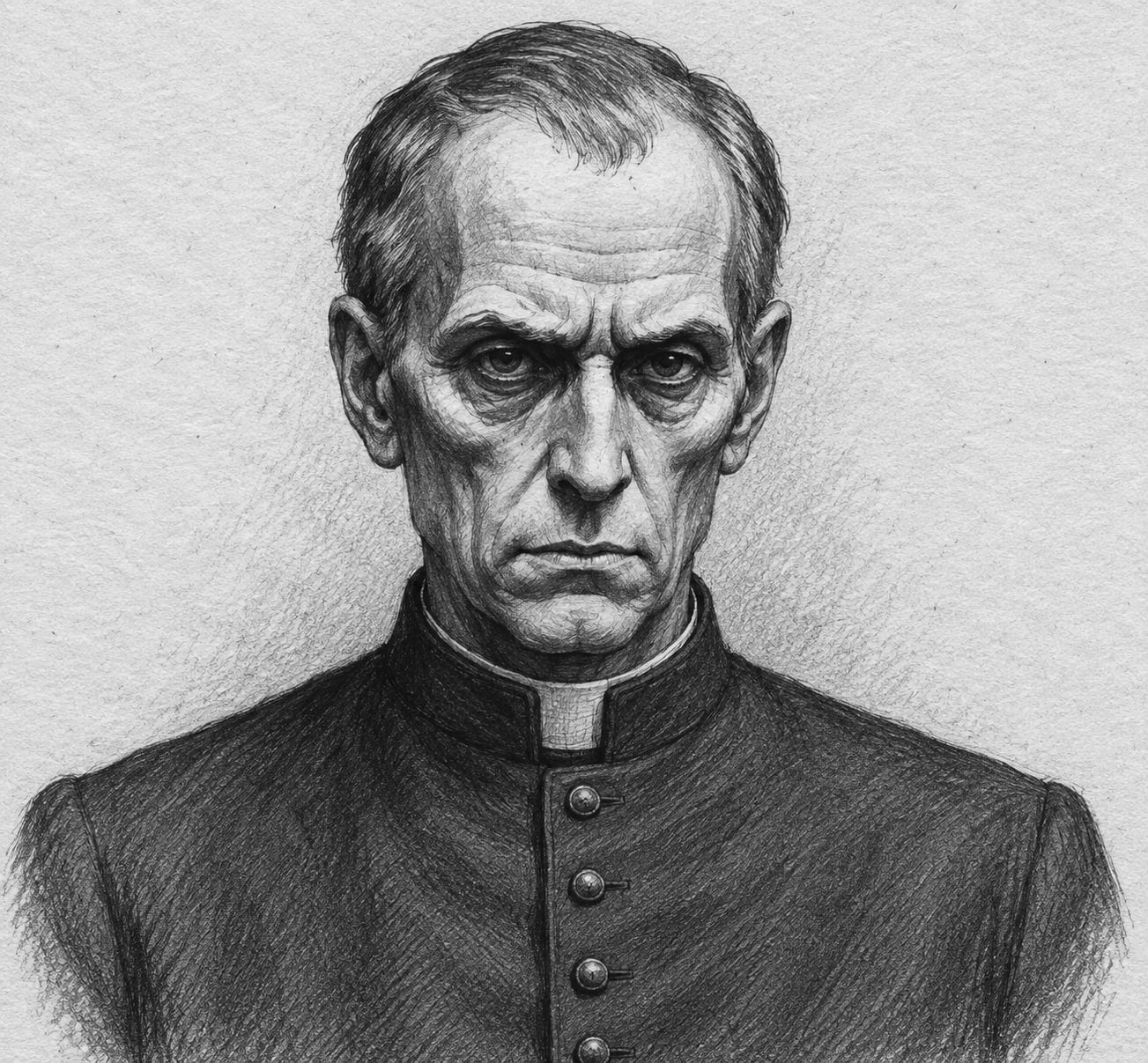
Corvin Marche is Liturgist-Primus of the Bureau of Rites and holds the Chair of Prescribed Observance. When a curate in a frontier chapel lifts a censer, Marche has last checked the angle he lifts it to. He has held the Chair for nineteen years as of A.S. 201. The registers enter that figure beside the thirty-one years of Aldric the Unbending, the longest tenure the Chair has recorded, and leave the difference without comment. The difference is twelve years. Rites never subtracts aloud.
His seat is in the Strasbourg Cloister. He does not need to travel in order to be obeyed. The Codex Liturgiae travels for him, in authorized editions, along every road and rail spur of the Dominion, and each edition carries his corrections pressed into it like a seal into wax. The six hundred and fourteen articles of the Charter of Prescribed Observance are older than his grandfather's grandfather. The present reading of every one of them is his. A sacristan in Saxony who has never heard his name holds a genuflection for as many seconds as Marche has approved. A gunner on the Sagittal Line says the evening prayer at the volume Marche has approved. If the gunner knew the name he would curse it, but he does not know it, and the arrangement depends on his not knowing.
#On the Chamber
The chamber has no window. Marche has given his reason once and does not repeat himself: natural light is "an unregulated illumination source inconsistent with the prescribed candle-schedule." The candles are lit at the hours the schedule fixes and trimmed to the length it fixes. When the last one is pinched out the day is over, whatever the sun has been doing in the street.
The room has not been redecorated since A.S. 72. Nothing in it is decoration. It holds a desk, a chair he never leans back in, and an unoccupied cross on the plaster. On the desk sit the Codex in eleven volumes and the thirty-seven supplementary annexes, bundled in Bureau tape, each bundle squared to the desk's edge. The arrangement is older than his tenure by more than a century. He keeps it as he received it, which is how Rites expresses reverence.
Seventeen Sub-Priors of Form occupy the adjacent cells, each furnished on the same pattern. They do not converse. They exchange written ritual queries under Bureau Standard 7-C, revised in A.S. 187, and the slips go under doors and across the corridor with a sound like a scriptorium in plague season. When Marche wants something from the Archive of Prescribed Gesture, he writes a query too. It travels forty regulated paces. He could walk them faster than he can draft the slip, and he has never walked them.
I have stood in that room. The air tastes of tallow and binder's glue. Marche does not look up when someone enters. He finishes the line, sands it, and only then raises his eyes, and he looks at the visitor the way a proof-reader looks at a misplaced accent. His contempt is wholly impersonal. He does not hate men. He hates the half-degree by which men miss.
#On What He Remembers
Marche carries the entire Codex in his head: every authorized rite, the fourteen rites suppressed after the Schism of Avignon in A.S. 111, and three more that were suppressed before anyone thought to record why. Those three are locked choir-stalls whose keys went into the river, and whoever threw the keys took the reason with him.
I do not know the names of these rites, and I have not asked. The Bureau's position is that a suppressed rite remains suppressed when a man remembers it, because memory is an archive and an archive grants no licence. I hold to that position in public with the firmness of a man who would like it to be true.
Marche does not hold to it. If pressed, he will recite the forbidden texts without emphasis or pause, and without the small lift a priest gives the operative word. A listener cannot tell whether he is demonstrating the rite or performing it. When I raised this ambiguity with him, he denied that it existed. "Recitation and performance are identical. The rite does not require your belief; it requires your compliance."
If that is true, the cost is easy to state. Seventeen rites the Church has put away are held in one mind that, by its owner's own doctrine, cannot speak them without enacting them. The files do not say whether he has ever carried one through to its last syllable, alone, by the scheduled candle. Still less do they say what such a performance would accomplish.
#On the Account of Grace
If Marche's memory stayed in the chamber it would be a curiosity. It leaves every quarter, on Bureau forms, for every parish in the Dominion.
The faithful pay for grace with fasts, tithes, vows and attendance, and the Bureau of Rites keeps the balance. The symptoms of a parish in arrears are catalogued. With dulled taste, bread turns to ash on the tongue. Insomnia hymns are phantom bells that peal backward through the skull at night. Brittle joy is laughter that cracks in the throat at the first pressure. Some districts behind the Line eat their rations gray-faced. They have been heavily devout, and their devotion has been heavily charged.
I once asked Marche whether such debt could be forgiven. He took nine seconds over the question; I counted. "Debt is the structure of grace. To forgive the debt is to collapse the structure. The Bureau does not forgive. The Bureau balances."
By his own doctrine it makes no difference whether he believes this or merely complies with it. The Bureau holds that measured liturgy keeps the Great Deceiver out of the gaps between syllables, and I record that as the Bureau's position. The report that reached my own desk is a smaller thing. A widow in a parish graded Provisionally Indebted was told by an auditing Sub-Prior that her grade required three supplementary masses a week. She asked whether the masses would give her back the taste of salt. The Sub-Prior copied her question onto a 7-C slip and forwarded it to Strasbourg. It came back with her grammar corrected. The question itself was not answered.
#On the Warsaw Cassock
The Rail-Confessor Corps serves permanently in the yards of Warsaw. It answers to the Bureau of Rites in doctrine, to yard dispatch in movement, and to War priority whenever a colonel arrives on the platform shouting. Yard Protocol 7-W allows eleven seconds for the departure blessing and ninety for rapid confession, within a ceiling of one hundred and twenty seconds of clerical contact per train. That leaves nineteen seconds for whatever a man does after confessing his cowardice and before being carried toward Bastion-Königsberg or Bastion-Brest.
The rail-confessors wear grey, and it does not stay grey. Their hems take cinder burn and their sleeves take coal dust, so that by first bell they look like what they are: priests who run.
Marche objected to the soot. The file records the objection but not its text, and I will not supply articles he may never have cited. The Warsaw prior, whom the file does not name, answered by sending Strasbourg a clean cassock, folded to regulation, with one question. Did the Liturgist-Primus wish the trains delayed while his priests changed vestments between platforms?
Marche did not reply.
The yards took this as a victory. Strasbourg took it as nothing at all, since nothing was filed. My reading is that a man had been asked a question in correct form, found it correct, and had no answer of equal exactness to give. The file records no amendment. The priests are still dirty, and the trains still leave on time. The file does not say where the clean cassock went.
#On the Present Incumbent
This Codex has stated, in its entry on the Bureau of Rites, that Marche "does not correspond" with anyone.
Clarified. Marche returns letters, issues corrections, and sends written queries forty paces to the Archive. What he refuses is the exchange itself: the answering letter, the reply to that reply, the courtesy of a second sheet. He sends documents, but he does not correspond. His office supplied this distinction in writing, on request, with my request's grammar corrected.
My entry on his Bureau went to his desk three times. The first draft came back for insufficient citation of canonical precedent. The second came back for improper use of the subjunctive in a declarative liturgical context. The third was accepted with a notation in his hand: Adequate. Narrowly. I have been denounced from pulpits and burned in effigy at a provincial seminary, and I have filed both events under professional recognition. That notation I have filed under nothing. It sits in my desk drawer, and I can feel it whenever the drawer is opened.
The Dominion cannot do without him, which galls me more. Every Bureau's calendar passes across his desk. The Bureau of Bells cannot alter a peal without Rites' countersignature. The Bureau of War cannot open a campaign on a date he has not certified as liturgically permissible. The censer in Saxony, the gunner's evening prayer and the widow's three masses all lead back to one windowless room, one unleaning chair, and one memory that holds seventeen rites the Church has forbidden itself to know.
Aldric held the Chair for thirty-one years and died at his desk with his sentence grammatically complete. Marche has held it for nineteen, and he does not regard the comparison as a contest. When I asked him whether he meant to exceed his predecessor, he told me that duration is not an ambition but the consequence of not stopping. He has not stopped.