

#On a Lane Kept for the Dead
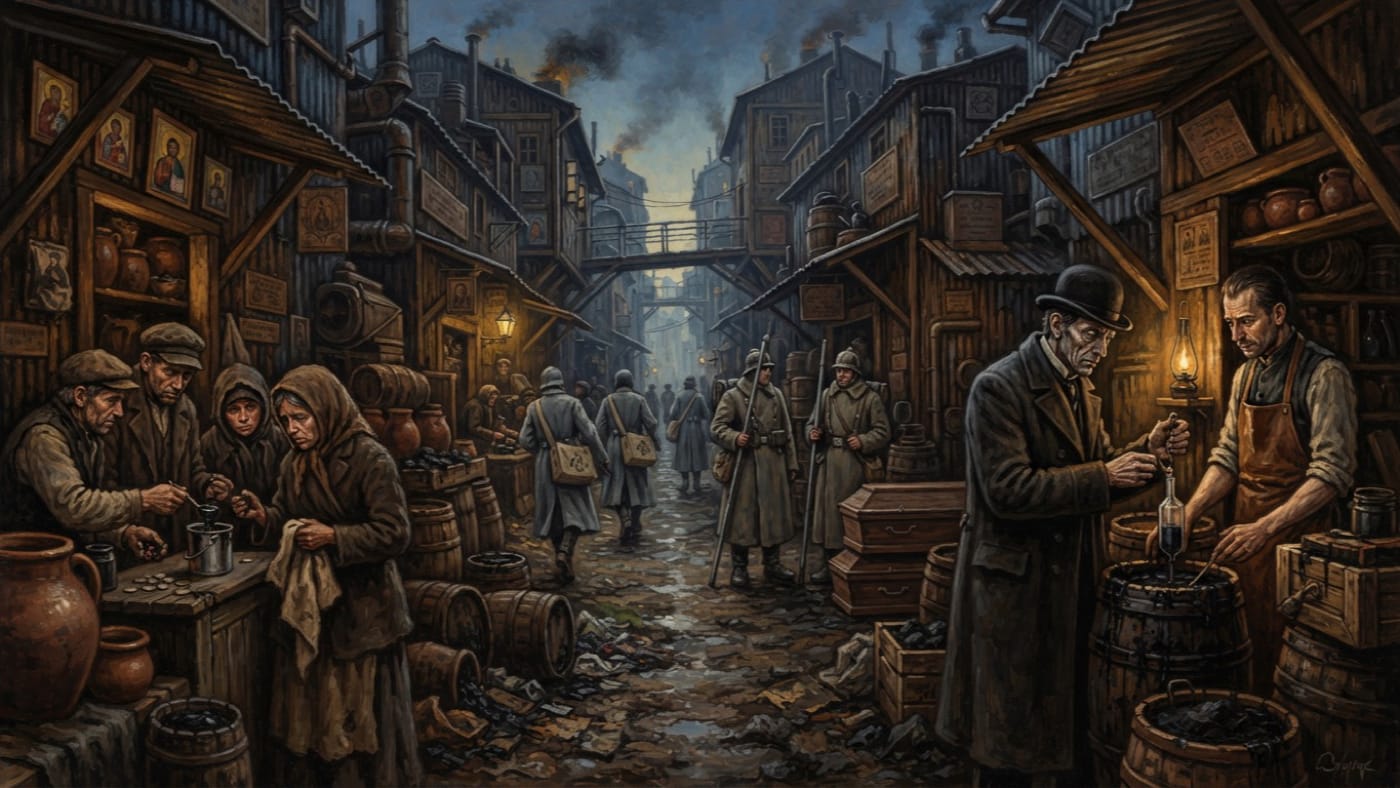
Somewhere among the tubs and wick-racks of the Pitch Markets, between the Chainward Quays and the Maskwright Lanes of Thessaloniki, the shouting drops. Buyers lower their voices and the sellers lower theirs to match. This is Coffin Seal Alley. It belongs to the mortuary suppliers, and it sells something the rest of the harbour would rather not be seen buying: a pitch fit to close a coffin.
This survey is compiled in A.S. 201, which is 1911 CE. That year dates the compilation and nothing else. I hold no founding year for the alley, no founder, no charter and no account of whose barrel first rolled into it. I also hold no measurement of its length, its width or its number of stalls. The Bureau of Records is welcome to supply any of these. It has not. I decline to invent them for its convenience, which is a courtesy Records rarely extends to me.
What the record does hold is short and sufficient. The alley's pitch is darker than its neighbours' and thicker, and it is cut with lime ash. It is sold in quiet voices to undertakers, hospice runners, battlefield ashbinders, and families who cannot afford proper brass but still want the lid to hold.
The whole economy of the place sits in that last clause. I will come to it.
#On Black Goods and Their Several Duties
The Pitch Markets divide themselves by smell, and behind each smell lies a different duty. Every chandler here will tell you, usually while charging you for the lesson, that pitch is many substances sharing one ugly name.
River Tar Row sells heavy caulking pitch in iron-lipped tubs. Hull pitch must flex, because a ship works in the sea, and a seam that cannot give will split. Rope-Seal Yard sells grease, resin dust, tarred hemp and splice wax to the chain crews, whose grease must cling under salt or the winches grind. Wick Court has no interest in holding anything together. It sells candle cords, lantern strips and prayer tapers, and asks of its goods only that they burn.
Coffin seal must harden.
No charter in the Ledger explains the alley half so well as that one requirement. The shipwright wants a seam that forgives the water. The undertaker wants a seam that has stopped forgiving anything. A lid seal that stays soft is a contract whose terms keep changing, and the bereaved have had enough of changed terms for one season.
How the lime ash serves that hardening, I cannot say. The record names the cut and gives no proportion, no heat, no curing time and no method of application. The sellers keep their quantities to themselves. Under every proper Synodal procedure that is called a trade secret. Under some of them it is called fraud, depending on which inspector asks first.
Further up stand the Mask Varnish Steps, climbing toward the Maskwright Lanes. They are a separate supply ground and must not be confused with the alley. Their varnish must dry clear and without fog over leather breathers, and their buyers are maskwrights and the soldiers who wear their work. The Steps sell to the living who mean to stay that way. The alley sells to those who have stopped trying. The two trades stand near each other, and the Steps' troubles belong to another entry.
Early Harbor Ledger notes describe the Pitch Markets as "minor chandlery stalls, locally sufficient."
Corrected at the district level, as the parent entry records. The correction covers this alley too. A city that needs coffin pitch every week of the year has no minor chandlery. It has a funeral supply that the Ledger was too embarrassed to name.
#On Those Who Buy Quietly
The record names four kinds of customer. I take them in order of their reliability as payers. This is the only order a chandler respects.
Undertakers are the alley's regulars, and probably the reason it lasts. When the A.S. 112 / 1822 CE quarantine expansions made the Pitch Markets permanent, the parent account lists among the new demands, plainly and without ceremony, that undertakers needed coffin pitch. Fever wards brought fever deaths, and fever deaths brought lids. The undertaker buys as any tradesman buys stock, without tears and with a sharp eye on the weight.
Hospice runners come next. The record names them and leaves out their masters. I would be pleased to report that every one of them serves the Hospices of Departure, since it would tidy my index considerably. The source does not say so, and I will not file it. A runner is a runner: someone sent down to the harbour by an institution that would rather not send anyone more senior.
Battlefield ashbinders are the customers who most interest an auditor. The Ashbinders are the Church's funeral guild. They burn the dead, sort the ash and sell the comfort, and they hold their cremation monopoly with the tenderness of a moneylender holding a deed. That a guild of pyres should send buyers to a coffin-seal lane is the sort of fact that ought to produce a memorandum. The record says only that they buy. It does not say what they seal. I have learned over many years not to ask a guild what it does with lids.
Families without brass come last in reliability and first in number, if the alley's survival is any evidence. The source does not define proper brass, and I will not pretend it does. What it describes is a household that has priced the decent fitting, found it beyond its means, and walked down to the harbour for the next best thing. They do not come for ornament. They come because they want the lid to hold.
That wish deserves more respect than the Synod usually gives the poor. A rich family buys brass to show the street what it can afford. A poor family buys pitch to make sure the coffin stays shut. Of the two, only the second purchase is entirely about the dead.
#On the Economy of a Small Grief
Coffin Seal Alley is a minor branch of a large district. The Pitch Markets keep Thessaloniki's ships caulked, its chains greased, its quarantine smoked and its lamps lit. Against that, a lane of mortuary suppliers is a small line on the ledger. It is also a very steady one.
Ships arrive with the weather, and shipping has its seasons. The dead arrive in every weather. A chandler on River Tar Row lives by the sailing calendar. A chandler in the alley lives by mortality, and in a harbour city of quarantine wards, chain-works and refugee traffic, mortality is the most dependable customer in the market.
The alley answers to whatever governs the district. The parent record names the Harbor Ledger Office and the Bureau of Tithes for the accounts, and the Bureau of Purity for inspection whenever Purity finds it convenient. I find no regulation, licence or exemption written for this lane in particular, and I have looked. The alley sits under the same smoke, the same corrected account boards and the same inspectors as every other row in the district.
The district also condemns its own necessity, as the Church always does. Tar is filthy, the sellers are profiteers and the whole quarter is a fire waiting for a careless apprentice. Every one of those charges is true, and every official who makes them buys from the quarter anyway. In the alley the hypocrisy takes its gentlest form. Nobody sermonises against the man who sold your mother's coffin its seal. They simply pay him, and look away while they do it.
The parent history gives the alley its ancestors, though it gives no date for the alley itself. Barrel sellers served the A.S. 72 / 1782 CE harbour-chain works. Records entered the chandlers as Auxiliary Maritime Supply, Third Register, by A.S. 93 / 1803 CE. The quarantine expansions of A.S. 112 put undertakers among the district's permanent buyers. Somewhere after that, mortuary supply gathered into a lane of its own. The source does not say when, and I will not stamp a year onto a lane that never asked for one.
#On Present Condition
In A.S. 201 the Pitch Markets remain active, rich, watched, extortionate, necessary and flammable, and Coffin Seal Alley shares the district's condition. Its pitch is still darker and thicker than its neighbours'. Its voices are still low. Its buyers still come down from the hospices and up from the quarantine wards, and in from wherever the battlefield ashbinders have been, with whatever coin a household could scrape together after deciding brass was beyond it.
Each 14 Ashmonth since A.S. 199 / 1909 CE, on the Night of Quiet Bells, the Pitch Markets close after dusk peal without haggling, and their fires are hooded. The alley is part of the district and keeps the district's hour. I have no record of any separate observance among its sellers, and I have no wish to invent one. A lane that already does its business in a murmur needs little instruction in silence.
Of all the commerce in the Pitch Markets, this lane is the hardest to condemn and the easiest to overlook. Its goods conceal nothing but the dead, and the dead are already declared. Its buyers hope for nothing beyond a closed lid. Its single requirement is the most honest specification in the harbour: when the pitch is set, it should stay set.
The customer never returns to complain. The family sometimes returns to buy again.