
#On the Berth
"No ship without psalm. No soul without stamp." — Inscription above the Chainward Quays, attributed to no one, obeyed by all
A hull comes in under the chains with one voice still singing the Passage Psalm from the bow. Regulation requires a choir line audible to the end of passage, and one hoarse bosun satisfies regulation. The ship has now cleared the Elder and Younger Towers. It has not yet arrived. In Thessaloniki arrival is a condition conferred by ink, and the ink is applied at the Chainward Quays.
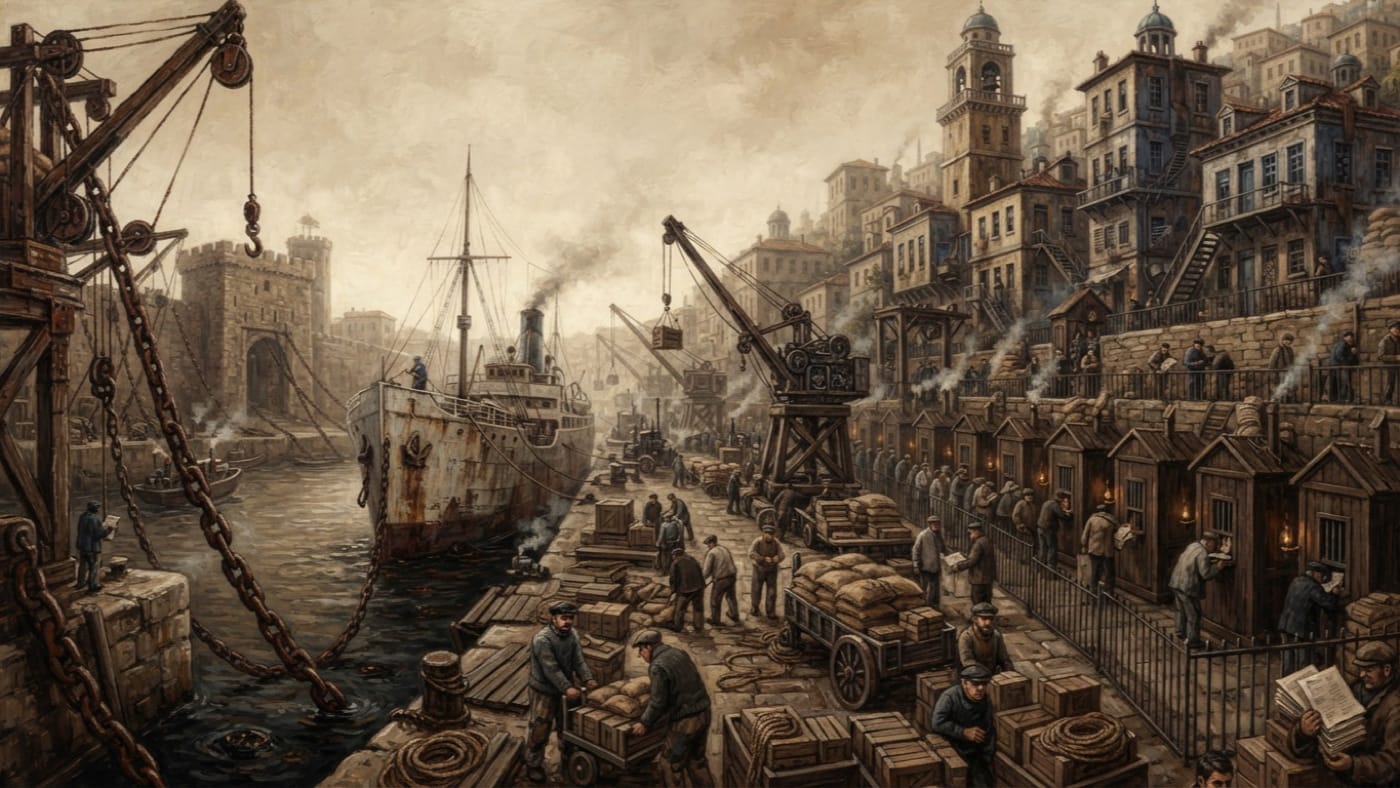
The quays hold the waterfront, the front row of a city that climbs inland by terraces. Behind them the Ledger Steps rise into the clerks' quarter, and above the clerks Bellhouse Heights keeps the hours. The fences of the Quarantine Crescent stand between the inspection frontage and Drowned Row. That is a fact of geography, and the harbour reads it as a sermon. The stone is salt-stained limestone patched with bone-lime mortar. The catwalks are scavenged ship-plank on rusting iron, with brass fittings worn bright where hands take hold. Rope cranes swing over carts of grain and crated shells. The air carries hot tar, brine and ink-wax, with gulls overhead and water slapping at the quay foot. Under all of it, at intervals a newcomer counts and a resident no longer hears, come the stamps: dull wooden blows on damp paper. That is the true liturgy of the place.
Rations bound for the Sister Trenches cross this frontage. So do ammunition, crated masks and replacement conscripts for the southern theatre of the Sagittal Line. The quays are a bottleneck. The Synod keeps the bottleneck on purpose, and it charges for the privilege of being squeezed through.
#On the Three Passes
The order is fixed, and the order is the doctrine. A crew presents first to the Harbor Ledger clerks, second to the inspectors of the Bureau of Purity, and third to the garrison provost. Each pass demands its own stamp, each stamp its own fee, and each fee yields its own receipt. The second pass will accept only the first pass's receipt as proof that the first pass happened. Visitors picture three floors of one building. There is no such building. There is only a sequence, and a sequence is harder to climb.
The clerks belong to the Bureau of Records Harbor Ledger Office, which administers the port together with the Synod Harbor Chapterhouse. Their black cuffs have gone stiff with wax. They want the Chain Passage Permit that licensed the vessel's window and the Docking Manifest for its cargo. For every soul aboard they want an Identity Confirmation Docket. They check all of it against the Harbor Ledger. Above them, on the Ledger Steps, sits Harbor Prefect-Archivist Iolana. She controls the manifests and, more tellingly, the recovery of manifests that have gone missing. A docket lost at sea can be replaced, and a docket lost on the quay can be found again. Both services exist, and neither appears on any list.
Purity's pass is the confession. Arrival Confession Booths are built into the quays themselves: plank boxes with a grille and a lamp. Every crewman kneels in one before his cargo is opened. His confession is logged beside the cargo documentation, and the Cargo Confession Receipt travels with the crate. A sack of hardtack and the sins of the man who loaded it are filed under one reference. The inspectors then open whatever they choose. They look for unregistered demon glass, unstamped vellum, relic dust without a seal, and any crate that rings when struck. Since the Drowned Choir file was opened in A.S. 121, a ringing crate has been presumed to hold something that sings.
The provost is the third pass and the plainest. Soldiers of the coastal garrison check the first two receipts and add their own mark for the Bureau of War. That Bureau wants to know who has arrived, what they carry and which of them can be sent south. A hull from a suspect port also needs a Quarantine Release Seal before anyone walks inland. That seal is medical and doctrinal at once, and it is issued at a pace the harbour calls devotional.
And the man whose papers fail? At first nobody touches him. His name simply goes unentered, and without the entry he draws no ration, signs onto no crew and boards no convoy. A debtor's name can be "paused" so that no office will serve him at all. He stays on the quay, alive, fed by charity or by the tunnels. The Ledger has no column for a man who is merely standing there.
#On Windows and Names
Time is what the quays sell. The bell sets each chain-gate window, and Chainmaster Superior Kosta of the Custodians of the Chain opens it. A docking window follows from the chain window. Crews and soldiers are paid in windows as often as in coin, and a place higher in the queue can be bought. The widows of the divers crushed when the chains were first tensioned draw their pension as one docking window a year. No tariff the Office would admit to puts a better price on a window than that pension does.
A sailor will tell you he would trade his own mother for a dawn window. He is lying. He traded her years ago, and she bought a dusk one.
The rest of the economy runs on paper that is nearly money: ration chits, stamped dock-scrip and witness slips, the signed chits of approved clerks that pass as credit along the Ledger Steps. Dock tithes fall on cargo. Salt-tax falls on fish, rope and pitch. Every household owes labour on the quays by quota. A family that cannot supply its hours falls into ration arrears, and arrears end with the bailiff and the pause. Whatever a crew lacks can be bought: a replacement docket, a witness signature, a shorter quarantine, a new label on the cargo. The Office calls these corruptions. It also processes them.
Below the frontage run the under-quay tunnels. They were built for flood control and are used for everything else. The Drowned Row Syndic sells passage through them: forged manifests, fuel, quarantine shortcuts and pilots for the fog. Purity burns demon-glass masks at noon. By night the masks that matter go out through the tunnels to the coastal regiments, whose officers requisition them under a heading the Bureau of War prefers not to read closely. The tunnels take the quays' overflow. Each price raised at a permit window sends another customer below.
#On the Waiting Room
The Bureau of Bells keeps the quays' time. The dawn peal opens the windows. The dusk peal seals them, and the lamps along the frontage go out in sequence. Every stamp carries an hour, and every hour is counted from the bronze.
At dusk on the fourteenth of Ashmonth, A.S. 198, the bell-wardens struck the Elder and Younger bells, and the bells made no sound. The Silence of Thessaloniki lasted three nights; the reported duration is seventy-two hours and six missed peals. The full account belongs to that file. This one concerns the queue.
Chain-gate protocol requires the dusk peal before the gate can close. No peal had sounded, so Kosta held the gate open. The way was clear, and the captains would not sail. By the theology of every sailor on the Aegean, a passage under silent chains goes uncounted. Pilot-King Nenos, who fears very little, declined to guide a single hull. The gate stood open, and nothing in the harbour moved.
The Chainward Quays became a waiting room. Ships stayed at their moorings. Crews already ashore sat on their crates with receipts in their fists. Clerks stood at the stamp windows with ink and wax and nothing to stamp, because a stamp needs an hour and the hours had stopped. Purity teams patrolled empty corridors between empty booths. Nobody rioted. The city stopped, and the quays, which exist only to move things in a fixed order, stopped hardest.
When the bells sounded again, they had exchanged voices. The Elder now rings the Younger's high note, and the Younger rings the Elder's low one. The Bureau of Doctrine has ruled this a test of fidelity. Diver-Matron Sera reported that the submerged chain-links kept vibrating throughout the Silence while the bronze above stayed mute. The Bureau of Rites holds her report. I record it under her name and no one else's.
#On the Present Condition
In the A.S. 201 assessment the quays are running under the exchanged tones. The windows open at the reversed dawn peal and seal at the reversed dusk. The clerks stamp hours by a clock that keeps correct time in the wrong voice. People here do not ask aloud why the bells reverse. Strasbourg has sent auditors, and the Harbor Ledger Office meets an audit the way it meets everything else: double shifts, and every receipt checked against the receipt before it. Every queue on the frontage has grown longer, and I am told every correction now costs more.
Every year on the fourteenth of Ashmonth the quays fall quiet after curfew with the rest of the city. Crews landing late find the stamp windows shuttered at the usual hour and the quay workers walking home without a word. Throughout the quiet the Refugee Sheds keep up their protective hum. It is a countermeasure, and the Choir does not observe anniversaries. The Night of Quiet Bells is the annual memorial of the Silence, kept by the people who waited it out.
ERRATUM — OFFICE OF THE WARDEN, PER BUREAU OF FESTIVALS CLASSIFICATION The preceding paragraph calls the Night of Quiet Bells a memorial. The Bureau of Festivals recognises no such memorial. The observance appears on no sanctioned calendar and is classified as a tolerated, coincidental pattern of civilian behaviour on or near the fourteenth of Ashmonth. Quay workers who take part are reminded that their coincidence is tolerated, and that tolerance is not recognition. For "memorial," read "coincidence."
At the dawn peal the first manifest line forms. A bosun somewhere off the narrows clears his throat for the psalm. The clerks open their windows, and the first stamp falls.