
#On the Office Above the Wet Stairs
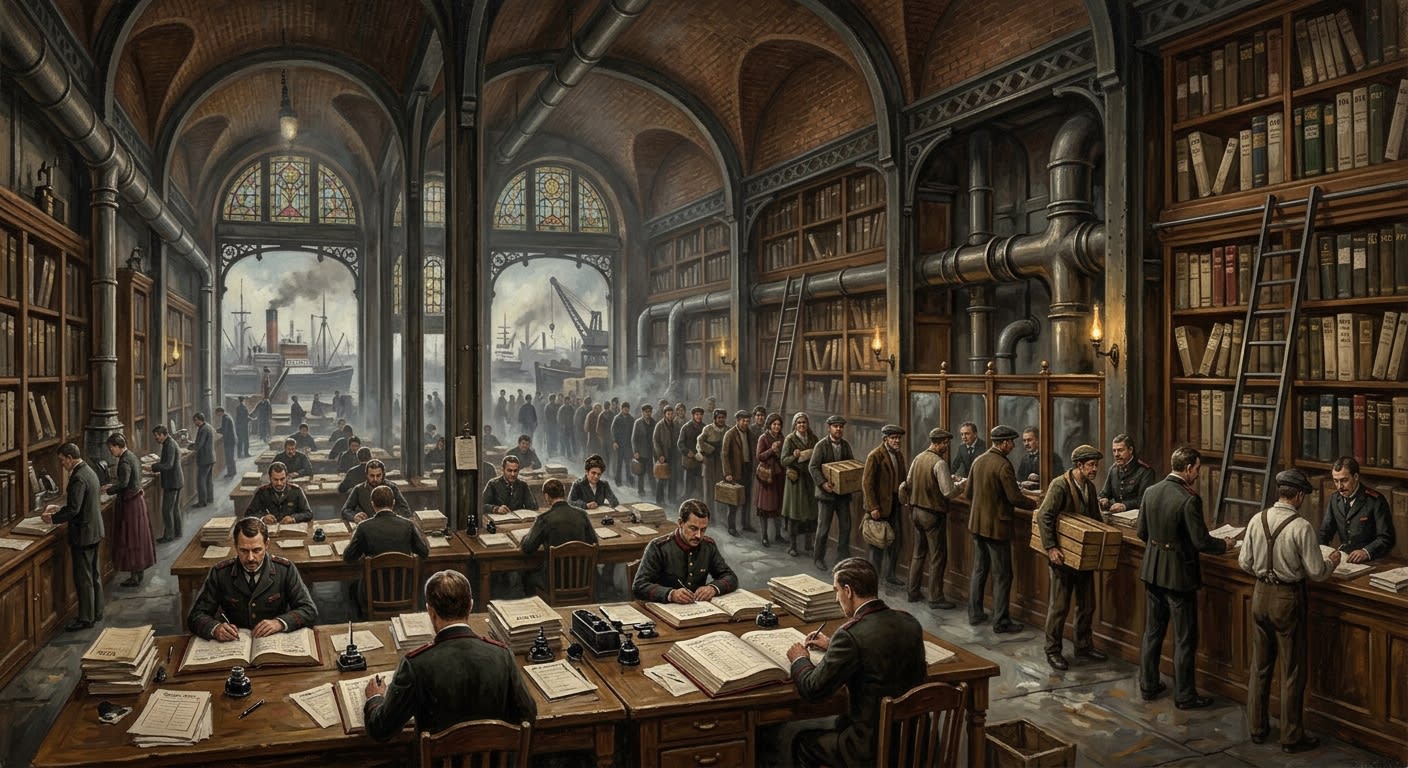
The Harbor Ledger Office of Thessaloniki occupies the Ledger Steps above the Chainward Quays, where the damp climbs through stone, ink thickens in its wells, witnesses sweat through collars, and every arriving ship is translated from wood, hunger, stink, cargo, lies, saints, rats, fever, and rope into the clean tyranny of record.
It is a branch of the Bureau of Records, which means it claims custody over fact after fact has been sufficiently flattened. Its formal jurisdiction is modestly phrased: manifests, passage stamps, cargo witness, legal identity at harbour threshold, quarantine attachment, docking windows, departure seals, and the ancillary correction of errors. This is like saying the executioner maintains neck alignment.
The Office is where Thessaloniki becomes legible to itself. The chain may hold the inlet. The bells may authorise the hour. The garrison may threaten the quay. Kosta may open or hold the gates with iron honesty. Yet a ship not entered by the Office has not arrived. A refugee not named by the Office has not become a person the city must answer. A cargo not witnessed by the Office remains a rumour with crates. A death not accepted by the Office leaves heirs arguing with air.
The Office should not be confused with the Harbor Ledger itself, though the confusion is useful to officials who enjoy hiding behind nouns. The Ledger is the doctrine, the table, the threefold sacrament of Hull, Soul, and Substance. The Office is the apparatus of hands, windows, stools, seals, knives, candles, bribes, runners, dry shelves, wet shelves, torn cuffs, and human malice by which the doctrine becomes a queue.
#On Foundation, Charter, and the First Docket
Thessaloniki's harbour was old before the Synod learned to print inevitability in red. After the Sundering in A.S. 45, the inlet became a fortified necessity: a throat for the southern war, a gate for the Aegean, a sieve for refugees, a trap for contraband, a place where ships entered with crews and sometimes left with fewer names than bodies.
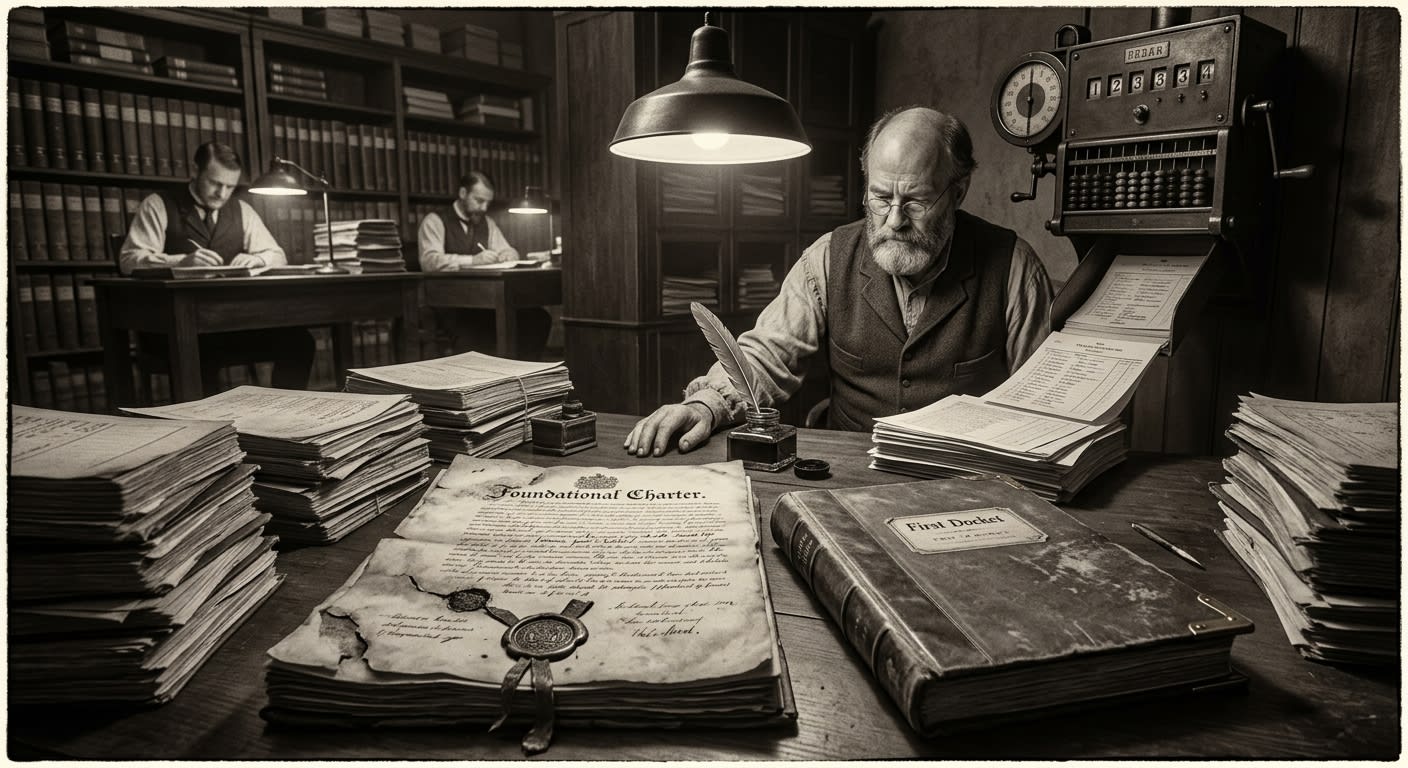
The Harbor-Chain charter (Unregistered) of A.S. 72 gave iron to the mouth. The re-ratification of A.S. 93 gave paperwork to the iron, after the original charter's invisible signature embarrassed several dead men and provided the living with the agreeable pleasure of blaming them. Early chain records sat in tower rooms, ship manifests in quay sheds, confession receipts in chapels, quarantine slips in vinegar-soaked boxes, and cargo tallies wherever the rats had not improved them.
The Office formed because scattered records breed independent reality, and Records hates nothing so much as fact without leash. The first consolidated docket did not abolish local books. It subordinated them by requiring every lesser sheet to feed a principal harbour entry. A tide note became valid only when attached. A cargo tally became taxable only when countersigned. A confession became travel authority only when stamped beside the manifest. A death became inheritance only when the Office agreed the deceased had occupied the proper line while alive.
By A.S. 121, when the Drowned Choir file opened after sailors walked into the surf and a survivor reported his name sung from below, the Office had acquired its modern structure. Chain clerks marked passage vibration. Soul clerks matched arrival confessions to crew lists. Substance clerks sorted cargo into taxable categories and punishable categories, many of which differed only by witness quality. Quarantine attachés learned to write illness in language convenient to delay. Witness-Masters learned that a line read aloud can make a crowd obey faster than a bayonet, if the line contains their names.
Then came the A.S. 145 Crying Choir incident, when refugee children quartered under tower shelter lost their tongues and the Office invented a category ugly enough to hold living children as Port Loss (Unregistered). Offices mature through scandal. Saints mature through suffering. Clerks mature by learning which word makes suffering payable.
#On the Steps, Windows, and Rooms
The Ledger Steps are not a metaphor. They are the terraced clerks' quarter rising behind the Chainward Quays, each landing crowded with counters, benches, lamp cages, testimony rails, rope barriers, complaint boxes, witness stalls, drying racks, and municipal despair. The lower steps handle arrival. The middle steps handle cargo. The upper steps handle corrections, appeals, lost paperwork resurrection, and those restricted rooms whose labels change when auditors are expected.
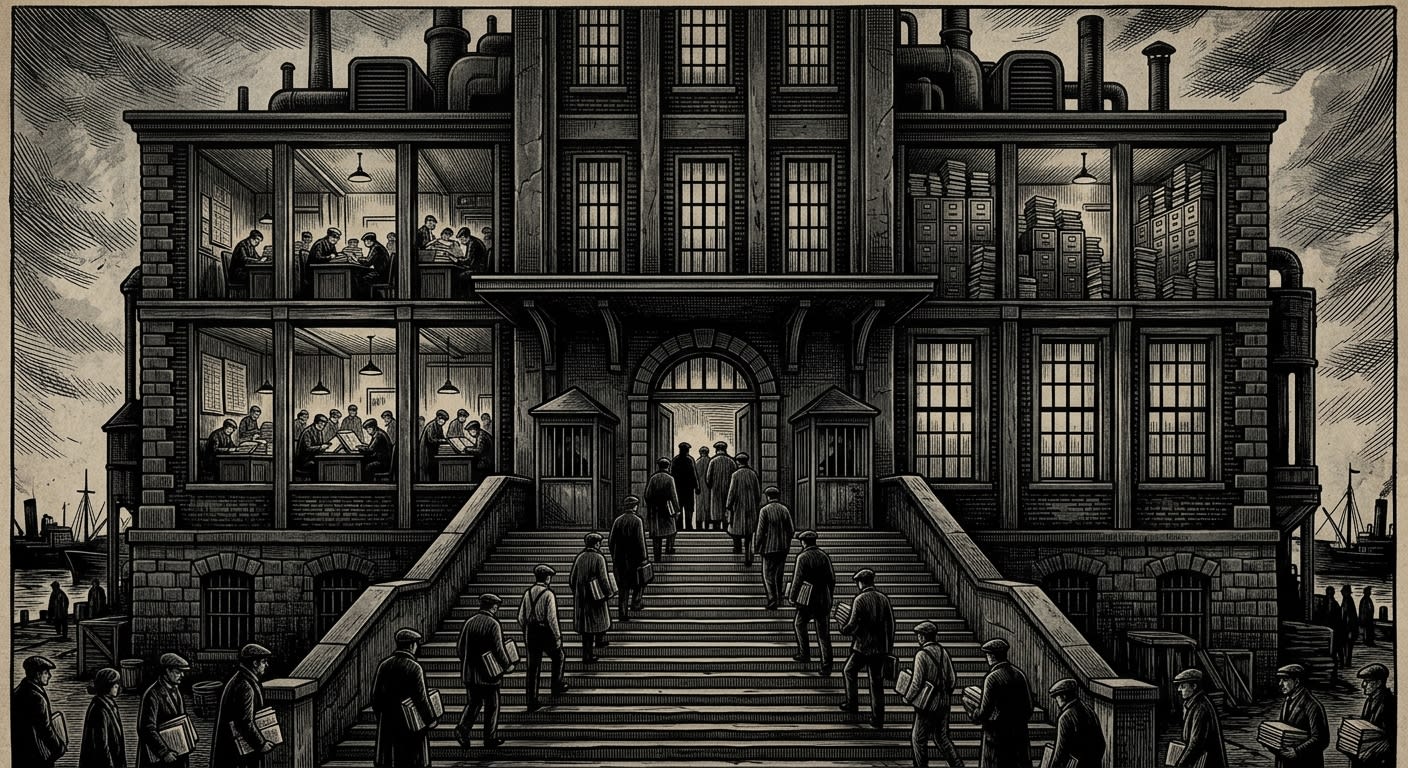
A citizen approaching from the quay meets the Office in layers. First window: Hull. Second: Soul. Third: Substance. Fourth: quarantine. Fifth: witness disputes. Sixth: fee reconciliation. Seventh: complaint intake, which exists to prove complaints may be received, not that they may matter. The eighth window is barred. No one knows its public function. This has not prevented a line from forming before it every Thursday for thirty-seven years.
Behind the windows, rooms multiply with administrative fertility. Recovery Room Three (Unregistered) handles lost paperwork resurrection, which is bribery that has purchased grammar. The Salt Shelf (Unregistered) holds damp slips until they become either evidence or pulp. The Bell Exception Desk (Unregistered) records tone mismatches after the A.S. 198 reversal. The Red Drawer (Unregistered) keeps names paused for service refusal. The Quarantine String Room (Unregistered) ties medical holds to passage records with coloured thread, because nothing says mercy like a fever case knotted to an invoice.
Witness-Master Brencis (Unregistered) patrols these rooms with a smile that ought to be taxed as a weapon. He smiles at widows, captains, monks, quarantined boys, angry soldiers, and fish not yet dead enough for decency. His office is technically subordinate to Iolana's. In practice, he is the hinge between face and file: the man who makes a refusal sound like careful concern and a delay look like disciplined review.
The Office's smells are part of its jurisdiction. Wet paper. Ink-wax. Vinegar smoke from Quarantine. Lamp oil. Salt. Wool. Fear. Fish. Warm metal from stamps used too often. Old rope. New lies. Clerks learn to identify trouble by nose: fever damp, bilge rot, forged ink, panic sweat, demon-glass wrapped under fish, and the sour-sweet odour of a captain who has decided to claim ignorance as legal strategy.
#On Iolana and the Discipline of Continuity
Harbor Prefect-Archivist Iolana commands the Office because she understands the true principle of Records: continuity matters more than truth and must occasionally beat truth senseless in a side room to keep the harbour alive.
Officially, she preserves legality. Actually, she manufactures legal continuity where tide, chain, bell, smuggler, refugee, War, Purity, and the sea have damaged it. She knows which cargo was inspected, which cargo was displayed for Purity's theatre, which cargo mattered enough to disappear into War custody before the theatre began. She knows which families bought sponsor recognition, which widows have sold the same dead husband's docking window three times, which clerks sleep with chandler money under the floor tile, which quarantine releases were medical and which were political.
Her lost paperwork resurrection process is the Office's most profitable sacrament. A document vanishes. A fee is paid. A search is opened. A recovered document appears with appropriate stains, improved seals, and an error small enough to reassure the auditor that discovery has occurred. The citizen receives service. The Office receives money. The archive receives a version of events firm enough to stand trial and soft enough to bend.
A provincial audit characterised lost paperwork resurrection as bribery with liturgical vocabulary.
Corrected. Bribery is crude exchange. Resurrection requires docket number, witness fee, recovery stamp, ink surcharge, appeal interval, and the solemn humiliation of pretending the dead paper returned by grace.
During the Silence of Thessaloniki in A.S. 198, Iolana proved why the Office exists. The bells failed. Chain-gate protocol lost its throat. Kosta ordered gates held open and sent runners upward. Iolana read the first message and began writing before the second arrived. Her emergency memorandum to Rites requested interpretive authority, chain-gate dispensation, duplicate witness acceptance, and a ruling on passage attempted under silence. Rites answered too late. Iolana had already built provisional law from nerve, tables, and contempt.
When the bells returned in exchanged voices, the Office adjusted within days. Forms acquired boxes for Tower struck and Tone received. Cargo schedules gained acoustic cross-references. Delayed movement received categories. Retroactive tonal correction acquired a fee. The city calls this coldness. I call it survival wearing sleeves.
#On Tamsin, Denial, and the Useful Ghost
The Office has an official staff and an effective staff. The difference is where the interesting sins live.
Ledger-Ghost Tamsin does not appear in any official record. Her absence is so productive that it should receive salary. Papers move through the under-quay economy with her weather: false arrivals, corrected manifests, demon-glass mask freight, reliquary crates with hums inside, quarantine substitutions, and those delicate conversions by which a person who officially never arrived becomes cargo, delay, damp damage, archival loss, and finally a corrected entry under another name.
The Office denies her existence because admission would force a choice between prosecution and employment. Prosecution would expose the supply chain by which the Maskwright Lanes serve the coastal regiments while Purity burns decoy crates at noon. Employment would dignify the fact that a denied clerk has solved problems the official office cannot touch without leaving fingerprints. Denial is cheaper. Denial is also, in this case, administratively elegant.
Tamsin is inside the Office's shadow, cast downward through the Ledger Steps into Drowned Row. Iolana cannot acknowledge her. Brencis cannot admit seeing her hand. Junior clerks recognise her corrections by instinct and pretend the instinct is training. Bundles arrive sealed with one page too many. Totals reconcile after midnight. A missing witness mark appears where damp had been. A quarantine hold becomes cargo spoilage. The harbour breathes.
There is a moralist's view that such arrangements prove corruption. The moralist is correct in the small, decorative sense. In the larger, dirtier sense, they prove that law has limits and that ports continue by supplementing law with crimes tidy enough to file later. The Bureau of Shadows understands this. It has not acted. A supply chain visible to Shadows is a supply chain held by the throat.
EXTERNAL AUDIT PREPARATION NOTE — LEDGER STEPS, SEALED COPY Bundle 7-K to be displayed. Bundle 7-K underfloor copy to be moved. All references to Tamsin-type hand to be recoded as senior correction. If asked about vanished thumbprint, answer: salt bloom. If asked about body under Chain Link ███ with berth token dated two days hence, refer to Kosta. If Kosta present, adjourn.
#On Kosta, Nenos, and the Limits of Paper
The Harbor Ledger Office governs movement by recognising it. Two men in Thessaloniki regularly remind the Office that recognition is not the same as command.
Kosta holds the chains. He is no clerk. He writes slowly, stains paper with grease, splits cheap forms with his signature, and has the infuriating virtue of being correct before authorised. During the A.S. 198 Silence, early summaries claimed he requested emergency direction from the Office. Corrected record preserves the sharper truth: he notified the Office after issuing orders. The Office has not forgiven the distinction because the distinction is authority with mud on its boots.
Kosta's official chain ledgers are accurate enough to insult Records. His hidden sea-taken ledger is accurate enough to frighten doctrine. Names appear before drownings. Fourteen names during the Silence year, all alive at writing, all drowned within twelve months. The Office cannot own that ledger. It cannot ignore the pattern. It places the matter in the sacred middle chamber labelled restricted pending non-submission.
Pilot-King Nenos offends the Office differently. Kosta commands iron; Nenos commands practical passage. He knows what the chain-hum says through tooth and keel. He hears cargo lies in vibration. He refused all passage during the Silence because the sea was listening too hard. His explanation entered the Harbor Ledger verbatim, where it now sits like a fishbone in the throat of official reason.
Nenos buys no respectability. He routes under-quay skiffs, contraband masks, false reliquary freight, people with dangerous names, and cargoes whose manifests have been improved by Tamsin before anyone respectable can object. The Office despises him until it needs him. It needs him often.
Internal memoranda describe under-quay pilotage as a criminal distortion of lawful harbour movement.
Clarified. Under-quay pilotage is a criminal distortion of lawful harbour movement frequently used to preserve lawful harbour outcomes when lawful harbour mechanisms are busy preserving their dignity.
The Office survives by negotiating these limits without naming them. Kosta may be ceremonially subordinate to harbour procedure, but when he says the chain will not open, the Office prints delay. Nenos may be unlicensed, but when he says a passage will kill, clerks discover reasons to misplace the departure stamp. Tamsin may not exist, but when her corrected manifest prevents War freight from being seized by Purity's vanity, the Office files the bundle and praises procedural adaptability.
#On Erasure, Service Refusal, and the Pause of Names
The Office's gentlest weapon is delay. Its cleanest murder is service refusal.
Service refusal began as an emergency measure for manifest fraud, quarantine evasion, and repeated cargo misstatement. Emergency measures are larvae; given warmth, ink, and a committee, they become permanent insects. The first pause orders lasted one tide. Then three days. Then until witness correction. Then until superior review. By A.S. 201, a pause may last long enough for children to learn that their parent's name is something adults lower their voices around.
A name can be paused. The phrase appears mild, suitable for a clerk with tidy nails and no imagination. A paused name cannot claim ration, berth, wage, release, marriage witness, burial right, passage, complaint standing, or debt correction. The person continues to breathe. The city stops answering. Friends may bring food, provided their own names are stable. Employers may offer work, provided the wage need not be entered. A paused widow can still weep, but grief without standing is noise.
Name-pausing began as fraud control after bulk blank-paper seizures. It spread because officials adore tools that punish without spectacle. Purity loves public flame. Records loves the closed window. A closed window produces no martyr, no crowd, no ash, no song. It produces a citizen standing in the rain with papers becoming less useful by the minute.
Quarantine makes the pause medical. Tithes makes it fiscal. War makes it logistical. Doctrine makes it moral. The Office makes it continuous. A sailor with fever suspicion cannot leave. A refugee with sponsor discrepancy cannot enter. A chandler with tithe arrears cannot sell fuel. A witness with an unstable name cannot testify. Each bureau touches the throat. The Office tightens the cord.
There are appeals. Of course there are appeals. Appeals are the Bureau's way of allowing despair to queue indoors. A paused person may petition at the fifth window, then the seventh, then Recovery Room Three, then the upper appeals chamber if two witnesses certify prior service attempts. Witnesses cost money. Service attempts require receipts. Receipts require an unpaused counterparty. The system is not circular. Circles are elegant. This is a noose drawn by committee.
Families develop counter-liturgies. A wife keeps two cups on the table so neighbours remember the paused husband. Dockmates say a man's name while lifting rope, quietly, as if sound could keep service alive where paper refuses. Children scratch initials under benches outside the Office and return after rain to see which marks survived. The Office scrapes the benches clean every week. The initials return with the piety of mould.
Service refusal also generates commerce. Witnesses sell presence. Priests sell memory statements. Chandlers sell dry storage for papers waiting on review. Brencis's clerks sell advice phrased as procedural education. The under-quay sells escapes. Tamsin sells re-entry through routes no honest file should know. Iolana tolerates some of this economy because total suppression would make the paused visible as a class, and visible injury seeks banners.
The worst pauses are inherited. A man delayed at Hull dies before Soul correction. His child seeks ration under a father whose harbour status remains unresolved. The child receives provisional standing, then conditional standing, then service subject to paternal correction. By then the father is bones, the mother has pawned her witness slips, and the Office has become guardian of a dead man's unfinished arrival. This is how bureaucracy raises orphans without feeding them.
#On Clerks, Witnesses, and the Human Machinery
The Office is often described through Iolana, Brencis, Tamsin, and the great named irritants who make history tolerable to readers with short attention and expensive lamps. This is unjust to the lesser clerks, who do most of the work and receive little beyond damp sleeves, ink cough, ration preference, wrist pain, and the exquisite privilege of being blamed by everyone above and below them.
A junior Hull clerk begins before dawn by copying tide tables onto slate and warming stamp blocks over a coal tray. Warm stamps bite paper cleanly. Cold stamps bruise. A bruised stamp invites challenge, challenge invites delay, delay invites crowd pressure, crowd pressure invites provost intervention, and provost intervention invites blood on forms that were nearly finished. The clerk learns this by watching one mistake travel through the room like fever.
Soul clerks are worse paid and better hated. They match faces to names, names to confession receipts, confession receipts to berth claims, berth claims to sponsor seals, sponsor seals to the dreadful question of whether the person before them ought to continue being administratively real. They become intimate with grief through bad handwriting. A mother gives three versions of a child's name because the old language has sounds Records does not honour. A sailor forgets the baptismal name of a dead brother and remembers only the dock name. A deserter uses a saint's name because saints receive kinder windows. The Soul clerk must correct them without appearing to notice the mercy.
Substance clerks smell of fish, oil, and suspicion. They jab cargo hooks into sacks, tap crates for hollow prayer-plates, note grain weight, count rope coils, and write the harmless words under which useful crimes travel. They know demon-glass by the way nearby candles lean. They know reliquary fraud by the confidence of the courier. They know hunger by how captains watch flour. Their pens feed Tithes, War, Quarantine, Purity, and every rat within fifty paces.
Witnesses are the Office's paid conscience. No passage without witness, no correction without witness, no resurrection without witness, no grief without witness if grief expects service. A witness does not need to understand. Understanding slows the line. A witness needs eyes, mark, fee, and the ability to swear with enough boredom that truth itself becomes embarrassed and sits down.
The best witnesses are dockwives, retired provosts, failed seminarians, and old chandlers with hands too stiff for rope. The worst are young men who believe accuracy is a virtue independent of survival. Accuracy is a tool. Use it on the wrong crate and a soldier goes blind in fog. Use it on the wrong family and a child enters Quarantine for a spelling dispute. Use it on the wrong Purity officer and your own name develops a pause. Clerks learn discretion. Those who do not become examples with neat personnel files.
#On the Present Audit
As of A.S. 201, the Harbor Ledger Office is preparing for the first external inspection in eleven years. The preparation has produced the usual liturgy: shelves rearranged, junior clerks threatened, old bundles aired, damp pages recopied, dangerous pages moved, harmless pages made to look dangerous so auditors may earn their supper, dangerous clerks made to look harmless, harmless clerks made to look busy, busy clerks made miserable for symmetry.
Iolana will show the auditors what they are authorised to understand. Brencis will smile them past the parts they are vain enough to think beneath them. Kosta will present official chain records and keep the sea-taken book under the floorboards. Nenos may vanish on his fresh-pitched skiff. Tamsin will improve at least one document after the audit seal has dried, purely to prove that absence has a sense of humour.
The auditors will measure the wrong things with excellent instruments. Chain corrosion. Bell reversal forms. Quarantine timing. Cargo reconciliation. Port Loss categories. Tone-reassignment compliance. They will ask why the Office keeps so many lesser books. They will receive an answer involving redundancy, salt damage, operational necessity, and no mention of distributed memory as defence against seizure by sea, smuggler, or Bureau.
The Office will survive because it is guilty in the exact way the Synod requires: indispensable guilt, documented guilt, guilt with receipts. It has erased families and preserved convoys. It has delayed medicine and kept plague from the Line. It has sheltered useful criminals and exposed useless ones. It has lied for War, priced grief for Tithes, staged obedience for Purity, corrected terror for Records, and kept Thessaloniki legally breathing while the bells spoke in the wrong throats.
External inspectors always bring a theory of cleanliness. They imagine that corruption appears as stain, contradiction as a torn page, fraud as bad spelling, and danger as a locked drawer marked danger by some helpful provincial. The Office will disappoint them. Its worst pages are written beautifully. Its cleanest bundles stink. Its honest clerks lie by omission with the serenity of choirboys. Its criminals preserve continuity. Its saints, if any are present, have learned to charge witness fees.
At first bell the lower windows open. Hull. Soul. Substance. Quarantine. Witness. Fee. Complaint. The eighth window remains barred, and the line before it lengthens by three citizens and one man no clerk remembers seeing arrive. Brencis smiles. Iolana signs without looking up. Beneath the Steps, water touches stone in a rhythm too regular for tide.