

#On a Lane Named for Water It Does Not Show
This survey of River Tar Row is compiled in A.S. 201, which is 1911 CE. The year belongs to the compilation. It marks no founding, inspection, fire or charter, and any clerk who copies it into a dateline as the Row's birthday will get a letter from me on heavy paper.
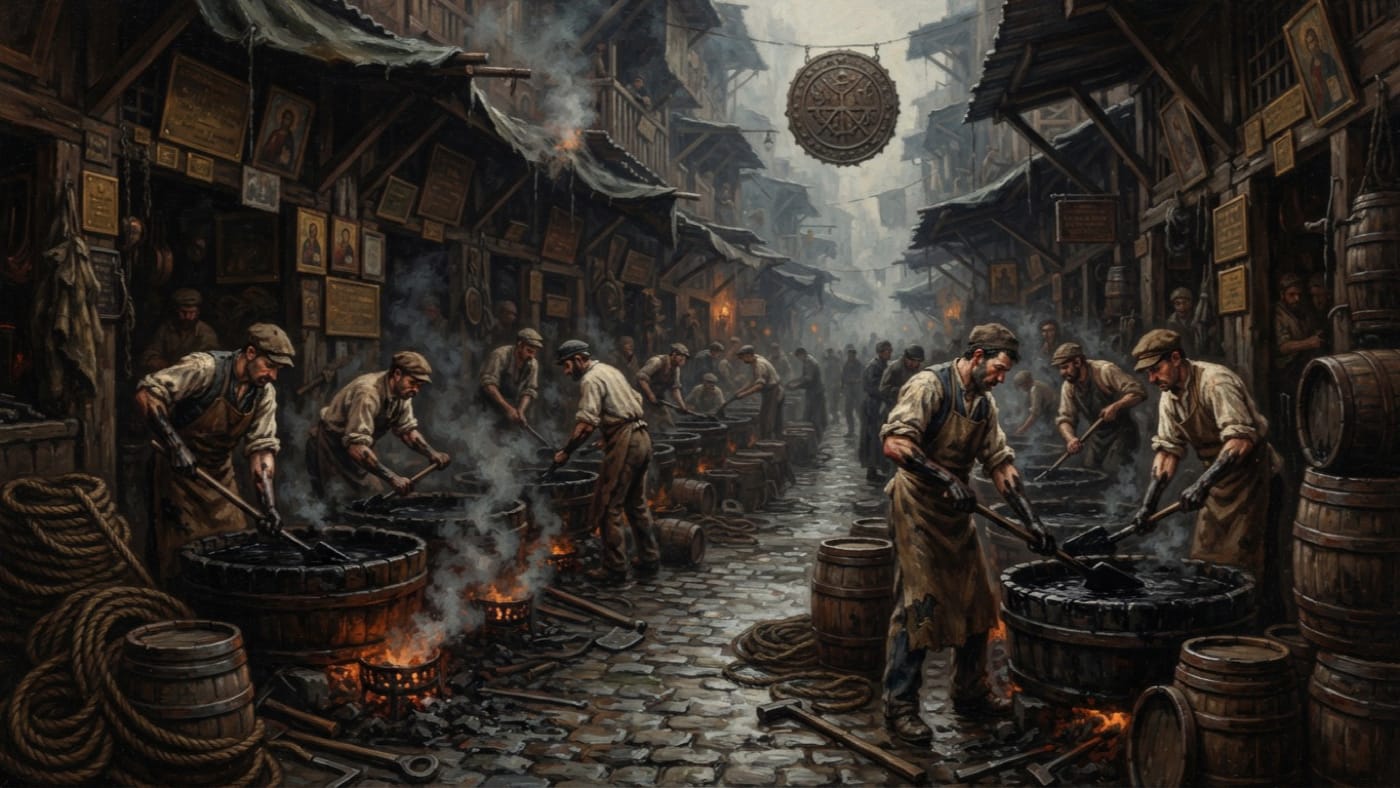
The Row lies within the Pitch Markets of Thessaloniki, the chandlers' district between the Chainward Quays and the Maskwright Lanes. That is as far as I can place it. I hold no plan of its length, no count of its stalls, and no record of which corner it turns or which lane it meets. The record gives the Row's commerce a single sentence. Its substance is this: River Tar Row sells heavy caulking pitch in iron-lipped tubs, stirred by men whose arms are black to the elbow.
That is the whole deposition. A lazier archivist would give it a founder, a feud and a well-loved fountain. I prefer to work the sentence. A sentence of that length, read slowly enough, gives away more than most witnesses do under the screen.
#On the Tub, the Pitch and the Arm
Start with the tub. The record says iron-lipped, and it gives no reason. A rim that takes scraping wears out first, and iron is what a cooper spends where he expects wear. That is a cooper's reasoning. I file it as mine, not the Row's, and I would withdraw it at once if anyone produced a better one under seal.
Next, the pitch. The record calls it heavy, and it is sold for caulking. The district's inspection note asks three things of hull caulk: it must be black-brown, flexible and salt-tolerant. This is the Pitch Markets' standard for the class. It does not prove that every tub on the Row meets it, and it says nothing about how any tub was brought to it. It tells a buyer what to complain about.
The three conditions are easy enough to defend. A hull works in the sea, and a seam that cannot give will split. The water here is the Aegean, and salt finds out every bad seal at the cost of the man who paid for it. The colour is the market's own test, the first one anyone can apply in daylight without a ledger or a priest.
Then the arm. Pitch that has to be stirred would otherwise do something its seller does not want. It might settle, skin over, stiffen or separate. I do not know which. The record does not say what the stirring prevents. It shows only that the stirring is constant enough to blacken a man to the elbow, and pitch on skin does not come off with a prayer and a basin. These men carry their trade up their forearms through every confession, every ration line and every Purity checkpoint in the city.
The rest of the Row's preparation is missing from the record. It names no ingredients and no proportions, gives no heat and no hour, and sets down no order of work. No stirrer is named. No wage is recorded and no sale is entered under a buyer's name. The district as a whole sorts its sources by colour: pine black from inland caravans, fish-oil tar from the Aegean boats, ash-resin from burned coastal groves. Some or all of these may pass into a Row tub, but the record does not say which or how much, and I will not issue a recipe on the district's behalf. A standard recipe for River Tar Row would be the first such document in the history of Thessaloniki, and I would expect it to be forged within a week.
#On the Neighbours, Kept in Their Own Ledgers
The Pitch Markets sort themselves by smell, which costs less than signage and survives the rain. Every trade answers a different requirement, and the requirements must not be confused, because a buyer who confuses them pays twice.
Wick Court sells dipped candle cords, storm-lantern strips, smoked prayer tapers, quarantine blue-wicks and cheap devotional lights. All it asks of its goods is that they burn. Rope-Seal Yard sells grease, resin dust, tarred hemp and splice wax to the chain crews, whose grease must cling under salt or the winches grind. Coffin Seal Alley sells a darker, thicker pitch cut with lime ash to undertakers and to families who cannot afford brass, and its seal is meant to harden. The Mask Varnish Steps climb toward the Maskwright Lanes and sell varnish that must dry without fog over leather breathers.
The Row's requirement sits between the alley's and the Yard's. Coffin seal is meant to stop forgiving. Hull pitch has to go on forgiving for a whole sailing season while the timbers flex beneath it.
I file these as trades and nothing more. Whether the Yard stands at the Row's shoulder or three lanes off, I do not know. Any reader who draws a map from this paragraph has drawn it alone.
#On Hulls, Ledgers and the Order of Payment
Thessaloniki eats by ship. Grain and hardtack convoys, lamp oil, coal, medicine and munitions come in by water, and the city's own reckoning holds that if the chain-gates slow, the city starves within a week. A city that lives by its hulls lives by its caulk as well. Among Thessaloniki's listed exports are pitch and repaired hulls, side by side. Somewhere between those two entries, men with black arms are stirring.
The published survey of Coffin Seal Alley says that a chandler on River Tar Row lives by the sailing calendar. I take that as the alley entry's description of the trade, not as the life of any particular chandler. It still fits the goods. Ships come and go with the seasons, and a seam is wanted before a run, not after one. The parent entry lists captains among the district's customers, demanding cheap sealant before a winter run. Such a demand would fall on the Row's goods, but the record never puts a captain at a Row tub, so I leave the captains standing at the district's edge where the record left them.
The accounts belong to the district. The parent record places the Pitch Markets under the reckoning of the Harbor Ledger Office and the Bureau of Tithes, with inspection by the Bureau of Purity whenever Purity finds it convenient, and counts the district useful to the Bureau of War and the Chainwrights. The city's tax schedule levies a salt-tax on pitch along with rope, preserved foods and dried fish. Its guild quotas name pitch next to rope and iron. Its licensed guilds of rope, pitch, iron and masks receive steady rations and constant inspection. That is the city's settlement, and the Row is under it like every other pitch-seller. I find no licence, exemption or levy written for this Row alone. Before any reader asks, I find no shipment, seizure or illicit sale assigned to it either.
The Mavra Demonstration of A.S. 199 / 1909 CE brought a Purity disposal fire to the Pitch Markets. Its day, month and hour are unknown. Its own entry records losses in the district and says nothing about this Row. I mention it because a survey of a lane of heavy pitch that ignored the district's best-known fire would look like negligence. I do not move a single burned stall onto these tubs.
#On the Quiet Nights
In A.S. 198 / 1908 CE came the Silence of Thessaloniki. For seventy-two hours the tower bells did not ring, and when they rang again they had exchanged tones. The published account says the chandlers of the Pitch Markets kept their fires burning and their voices low. It does not separate the Row's stirrers from the rest. I have no Row witness and I will not write one in. I note only that a trade which cannot let its tubs go untended through the night had particular reason to keep its fires lit while the bells said nothing.
Since 14 Ashmonth A.S. 199 / 1909 CE, Thessaloniki has kept the Night of Quiet Bells. Each year after the dusk peal the Pitch Markets close without haggling and hood their fires, while the Refugee Sheds keep up their hum. The Row is part of the district and keeps the district's hour. I hold no record of any rite of its own, and I would think less of any chronicler who supplied one. What becomes of a heavy tub left unstirred under a hooded fire for one night of the year, the record does not say. The men who know have not filed it.
#On Present Condition
As of this compilation in A.S. 201 / 1911 CE, River Tar Row sells heavy caulking pitch in iron-lipped tubs, and men whose arms are black to the elbow stir it. That much the record supports. The district standard asks of the goods that they be black-brown, flexible and able to stand the salt. The city taxes them and the guilds count them. Ships leave the quays with them pressed into their seams.
The Row's origin is unknown. The parent history traces the district to barrel sellers serving the A.S. 72 / 1782 CE harbour-chain works and dates the Bureau of Records' entry of the chandlers as Auxiliary Maritime Supply, Third Register, to A.S. 93 / 1803 CE. Those dates belong to the Markets as a whole, and the Row has not inherited them. When heavy caulk first gathered into a lane of its own, and why that lane was named for a river, are questions for a source I do not have.
I have read longer entries on less useful places. The Chapter House at Strasbourg has a whole folio on its own hand-basins. Not one of those basins has kept a ship afloat.