
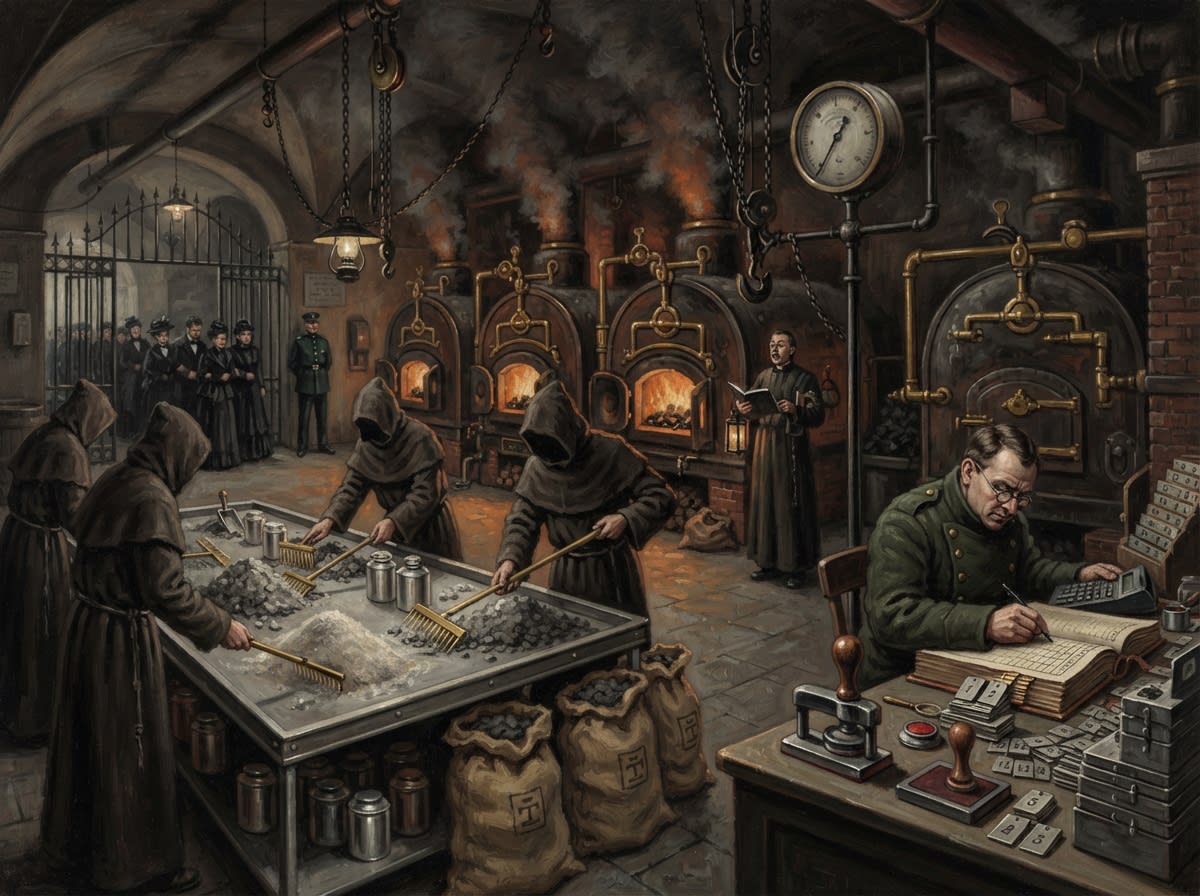
Ashbinders are the funeral guilds of the Church. They hold a monopoly on cremation that is older than half the Bureaus. The Rite of Passing and the Book of Departures say who is dead. The Ashbinders say what the dead are worth. Every soul who dies under the Synod passes through their hands, and every family pays them for it.
The Guild takes the name, a slip from the Bureau of Records, the fee paid in advance and the body. It gives back ash in sealed categories and a certificate saying the ash is genuine. The certificate costs extra. The public calls this sacred completion. The Bureau of Tithes calls it the best-run industry in the Heartlands. I have read the books of both and I am inclined to agree with Tithes.
#On the Compact and the Pyres
The Guild's authority rests on the Ashbinders' Compact, which the Bureau of Rites renewed in A.S. 92, two years after the Concordat of Strasbourg brought the formal Synod into being. It is a renewal, not a founding. The Guild was already burning the dead before the Synod existed to license it, and the Synod had the sense to charter what it could not replace. The revision of A.S. 187 added more to the fee schedule than to the liturgy. That shows which of the two the auditors thought needed attention.
The Compact did not come out of peace. After the Lull of Names in A.S. 78, when plague deaths outran the clerks and the unwritten dead filled the trenches faster than lime could cover them, mortuary practice across the Heartlands hardened. Standing Order 22-C followed in A.S. 80. The Deathbed Confession Harvesters took charge of last words. The Bureau of Mercy took charge of the dying. The Ashbinders kept charge of what was left, and they have not let go of it since.
The procedure is fixed. The Rite of Passing closes and the name goes into the Book of Departures. Then the Guild arrives. Four bearers come in black hoods, with a cantor ahead and a tally-clerk behind. The procession moves at the approved pace, which is slow enough to count as reverence and fast enough to reach the day's quota. At the Pyres of Benediction (Unregistered) the body goes behind iron screens. The cantor sings the Hymn of Return. The clerk records every faggot of wood, every measure of pitch and every quarter-hour of flame. That tally goes to the Great Ledger of Souls next to the name. A soul costs so much timber. The Synod has never been embarrassed to write that down.
When the fire dies, the sorters take over. They rake the ash onto brass trays with long-handled combs, weigh it on guild scales and pour it into sealed urns. The family waits outside the yard with a receipt. Every step carries a fee: procession, hymn, pyre, sorting, urn and certificate. A family that cannot pay for the hymn gets a shorter hymn. A family that cannot pay for anything gets the pyre anyway, because the Compact forbids the Guild to leave a body unburned. The Guild honours that duty and bills the parish for it.
#On the Division of Ash
Ash is not all one thing. The Guild sorts it into named ash and bulk ash, and that difference governs everything else it does.
Named ash comes from a single body, is tallied to a single entry and is sealed in the family's presence. It can be pressed into a reliquary icon: a small panel of lacquered ash and wax with the name in gold leaf. It is the most expensive thing the poor ever own, and they own it for the rest of their lives. Named ash can also go into the mortar of a chapel the family paid for, where the name is cut into the lintel and prayed over on feast days. This is the Guild's most respectable product and its most profitable one.
Bulk ash is what the rest of the dead become. It is swept together from the communal pyres, from hospice overflow, from debtors' funerals and from anyone whose family bought the "collective sanctity" rate. The Guild mixes it into sanctuary mortar, bastion rendering and road bedding along the Sagittal Line. It spreads the rest on fields in spring as the "harvest of Heaven," with a cantor walking the furrows. A share goes to the pressers who render it into ash-oil for the Festival of Departed Flames. The Guild sells that oil to the Bureau of Rites at a price the Bureau of Rites pays without complaint. I have always found that detail instructive.
Bone that the fire does not consume goes to the ossuary scales. Under the Saint-Bone Melting Acts of A.S. 96, calcined fragments that are surplus, disputed or unclaimed pass to the Saint-Bone Melters and the kilns of the Lime Yards, which render them into bone-lime for walls. Fragments that are claimed go to the Ritual Bone-Stampers to be sealed and entered in the ledger. At every crossing, the Dead-Goods Tariffers stand by to classify each ounce and tax it. Nobody leaves the pyre-yard untaxed, and that includes the dead.
#On Profit, Fraud and Consolation
Grief is the Guild's raw material. What it sells is revenue with a seal on it. There are three kinds of fraud, because there is money in all three.
The first is counterfeit ash. Hearth-sweepings, kiln lime and burnt bread are pressed into icons and sold as a named husband or a named child. The Guild condemns this. It also sells the only certificate that can tell real ash from false, so it is the only authority able to detect a fraud that earns it money either way.
The second is priority. When the pyres are overloaded, named burns go to the families who can pay for a faster turn, and the rest wait in the cold-rooms. The Compact calls the payment a "devotional surcharge." At the gates, people call it what it is.
The third kind is speculation, and it has left the Guild's control. In Rheinscarp, the Ash Exchange of Saint Pelagia trades cremains shares and dust futures. Families there borrow against urns of their dead that have not yet been burned. The Ashbinders say they have no part in the Exchange. They supply every gram it trades.
At the edges of all this, the Grave-Field Shanty Brokers rent plots to families who cannot afford the pyre and would rather bury than wait. The Guild despises them and the Bureau of Purity watches them. Neither has managed to put them out of business, because the Brokers sell the one thing the Ashbinders will not: delay.
#On Containment
The pyres work, and that is the uglier half of the story.
The Bureau of Rites records fewer post-mortem atmospheric disturbances wherever the dead are burned in order, named at the fire and sorted into sealed categories. It records more where they are burned in heaps, sung over carelessly or tallied by a clerk who is thinking about his supper. The Bureau files the first result under divine sanction. It files the second under demonic residue, Category Three. Both results come from the same yards, so they cannot both be right.
Monitoring stations at ████████ and the bulk yards serving ████████ record that disturbance falls in proportion to how complete the naming is at the pyre, and bears no relation to fuel, temperature or ████████. Bulk ash sorted without names shows ████████ activity in the mortar where it is laid. Recommendation to study the naming variable: ████████. Recommendation withdrawn.
I will say only what the Bureau already has on file. Something in the Guild's procedure quiets the dead: the procession, the hymn, the name spoken over the flame and the ash sorted into a known place. The Bureau credits the hymn's orthodoxy. The ash-sorters credit the scales. I note that it works best when the person doing it believes in it, and that belief is one of the few things the Guild cannot sell.
A Bureau of Rites circular held that "the distribution of ash is a wholly devotional act, undertaken in gratitude for the labour of the faithful departed."
This Errata amends: ash routing is sanitation, containment, finance and doctrine in one shovel. The devotional part is real. It is not the only part, and it is not the part being audited.
#On the Present Strain
The Guild is running behind. Since A.S. 198 the Bureau of Rites' monitoring has shown manifestation frequency rising across every zone it watches. More front-line dead arrive every season. Foundry explosions and mine collapses deliver casualties by the cartload. At the Ash-Glyph Marshworks, corpse barges queue at the pyre-landings until the smoke is visible from the river mouth. At the Bone-Lattice Warrens of Black-Snow Lor, the dead are needed for building, so the Guild keeps its fires low and hands over bone.
The Compact's answer has been the reduced-rate bulk burn: one pyre, a shortened hymn, a group tally and a single certificate for many bodies. The Bureau of Tithes approves of it. The monitoring stations do not, and their figures are worst in exactly the districts where bulk burns have increased.
The Ashbinders are greedy, pious, efficient and indispensable, and the last of these is the one the Synod finds hardest to forgive. Their prices are indecent and their fraud is well known. Their procedure also holds back something the Bureau refuses to name. If the Synod stripped the Guild of its monopoly tomorrow, it would have a cleaner ledger and fuller cemeteries within a year, and the cemeteries would not stay quiet.
The dead are burned. The ash is sorted. The receipt is issued. Somewhere in the ledger, the account balances.