
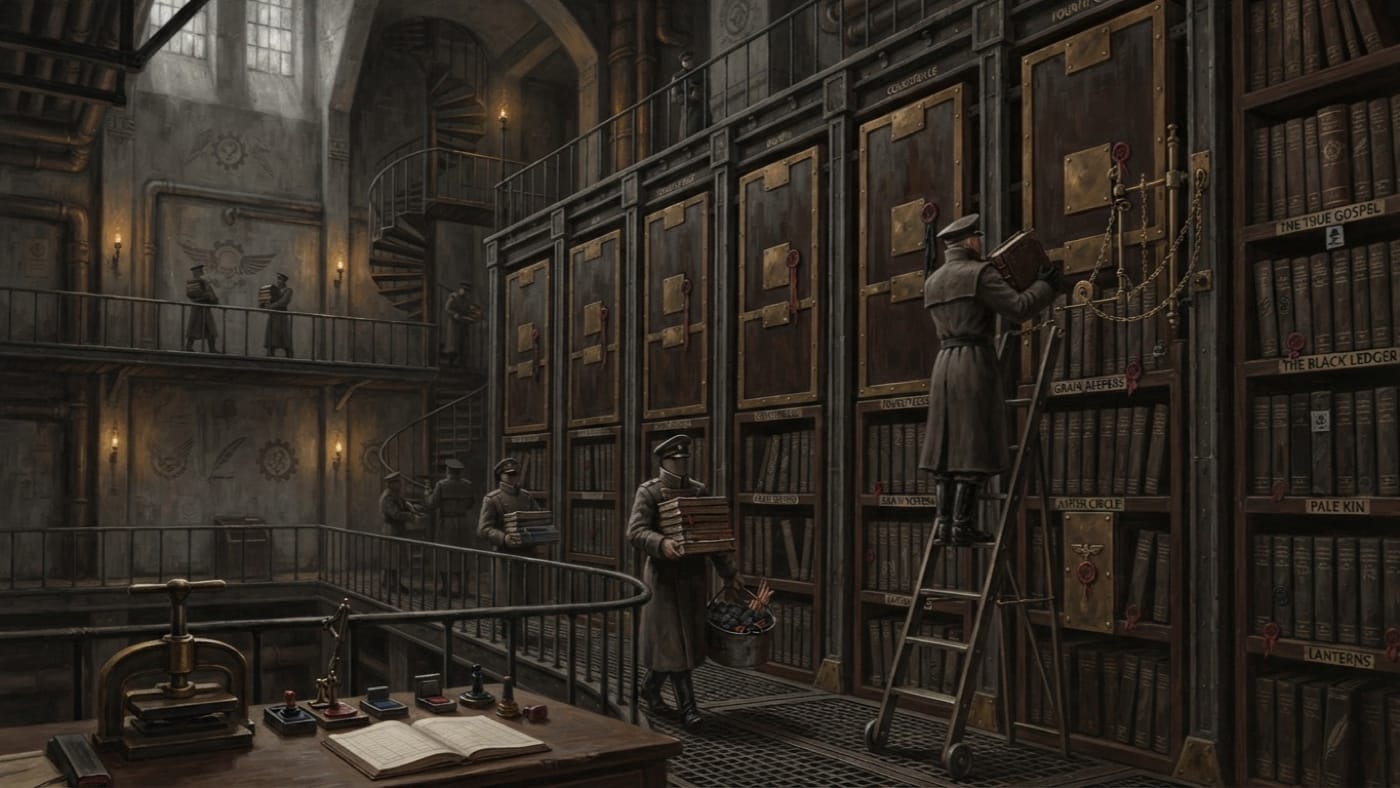
#On the Register's Authority
The Compendium of Proscribed Errors is where the Bureau of Doctrine sets the eight proscribed heresies in order. Each one gets its place in the sequence and a classification saying what kind of error Doctrine judges it to be. Clerks open the register when a sermon has to be measured, when a confession has to be weighed, or when an examiner needs to know whether the wretch in the chair is guilty of a sin, a crime, or a heresy that already has its own entry. These three burn at different temperatures. The Compendium tells the clerk which kindling to fetch.
I am Archivist of the Bureau that keeps the register, so I write as the man who knows where the book lies and who is allowed to open it. The second qualification is worth more than the first.
I cannot tell you who first compiled it. The record I am permitted to cite does not say, and I will not pad my report with a founder the Ledger never named. The Bureau has never needed one. A definition binds because Doctrine has sealed it, and a seal does not need a grandfather. This survey covers the register as it is consulted in the present year, A.S. 201, within the Synod and wherever its judgments are carried out.
The register's work is simple, and it is terrible. It turns a grievance into a category. A hungry miller, a frightened mother and a weary staff officer each have their reasons. The Compendium gives each of them a shelf. Once a thing is shelved, it can be indexed, investigated, preached against and, if the paperwork agrees, burned. Before that it is only a complaint. There is no end to complaints. Heresies come in eights.
#On the Errors It Arranges
Any parish catechist knows the movements that answer to the eight. I give them as the seminaries recite them. I do not quote the register's own leaves, which are not for your eyes.
The True Gospel clings to inherited scripture and rejects the Synod's interpretation. In other words, it prefers a dead book to a living Bureau. The Black Ledger robs caravans, slits Wardens' throats in the dark, and calls the proceeds redistribution. The Silent Godless meet in cellars to deny the Creator outright. Fourth stands Coexistence, the creed of the Crimson Concord, which holds that mankind should bargain with demons rather than destroy them. The Grain Keepers hide food from the ration accounts. The Ashen Circle hoards forbidden histories and condemned sciences. The Pale Kin keep children back from registry and levy. The Lanterns preach a mercy that undermines the authority to punish. I mean the rebel preachers here. They are distinct from the tolerated Lantern Brotherhood and from the inquisitorial Red Lanterns, and any clerk who mixes them up in a report will be corrected in red.
Look at the range. One error concerns whether the Creator exists. Another concerns a sack of barley. One is murder with a knife. Another is a lullaby sung in a crawlspace while the census clerk knocks at the door. The Compendium puts them side by side because the Synod treats any rival claim on bread, children, scripture, mercy or memory as a rival claim on the soul. Within its covers, theology and grocery are the same jurisdiction.
Coexistence stands between the Silent Godless and the Grain Keepers. I have called that placement cowardice elsewhere, and I see no reason to soften the word. Beside the cellar atheist and the loft hoarder, the heresy of the tired officer looks like one modest sin among others. Doctrine likes it to look that way.
#On the Fourth Error
The Coexistence Heresy is the best demonstration of what the register is for, because it is the entry Doctrine has had to correct most openly.
Its proposition is short. Bargain with demons. Treat with the generals of the Great Deceiver as one would treat with a hostile crown. Accept that the war along the Sagittal Line can be negotiated. The idea does not start among recruits. It starts in men who have outlived their own enthusiasm and read too many casualty columns. It reaches them as a question, and the question is enough.
Doctrine assigns the heresy's patronage to Velkara. She is the Sin-General of Lust, and her influence spreads through the interior instead of pressing against one fixed bastion. Doctrine's reasoning is that the Coexistence doctrine is seduction turned into policy. The Velvet Choir works on the flesh, and the Concord works on the office. Both promise relief. Both tell the exhausted that their burden is unnecessary. By the time the proposal reaches a staff table at Bastion-Constantinople, the southern anchor of the Line on the Bosphorus, it smells of lamp oil and sensible arithmetic. The Bureau holds that it never smelled of anything else, which is precisely the danger. Doctrine teaches that Hell does not negotiate. It digests, and what passes for a treaty is only digestion slowed down enough to look like diplomacy. I hold that teaching with full conviction. I note that Doctrine is the one teaching it.
The register's first entry on the subject mislabeled the error twice. Seminary summaries once filed Coexistence as "pacifist deviation." That label is withdrawn. A pacifist refuses violence. The Concord welcomes violence as a bargaining instrument, a shell fired to improve the terms, and that is a much uglier creature in a much better coat.
Classification: Argumentative Error, Contained.
Revised: Structural Heresy, Active. The former classification assumed the error needed an identifiable recruiter to keep it alive, so that if the advocate were removed the argument would die with him. That assumption is struck. The error survives as a question nobody confesses, held by competent men who are loyal in every visible particular. They defend the wall, file accurate returns and attend the correct chapel. They have no handler to arrest and no cell to break. The entry now classifies the condition as well as the conspirator.
That revision is what the Compendium does at its most exact. One line changed, and Doctrine moved the heresy out of the debating hall and into the barracks.
#On Interpretation and Enforcement
Doctrine defines. That is the whole of our office, and it is enough. The Bureau of Purity takes the definition into the street wearing white mantles. The Bureau of Records keeps what Purity finds in triplicate, under seals that sometimes contradict each other. The Compendium hands Purity a category and gives Records a heading to file the consequences under. It does not carry out the arrest. A register does not walk.
Do not confuse it with the indexes. The Index Damnatus is Purity's ever-swelling blacklist of forbidden texts, condemned names, relics, songs and disapproved incense. The Index Claritatis governs which words may be spoken at all. Those instruments list objects. The Compendium judges errors. A pamphlet goes on the Index. The belief that wrote the pamphlet goes in the Compendium. A clerk who files a seized hymnal under a heresy, or a heresy under a hymnal, will learn the difference from my margin.
The grain keeper shows where definition meets need. Doctrine names concealed stores heresy. The ration is mercy, and hoarding refuses mercy. Purity sends its probes. Records sends its auditors, whose stamps never quite match the sacks. Then a lean winter comes, the licensed granaries rot, and the hidden loft keeps a district alive. The questions stop for a season. The entry stays in the Compendium, unchanged, while the parish eats from the error it condemns. The Ashen Circle earns a similar silence whenever some condemned engineer remembers a technique that lawful scholarship forgot. The register is never amended for these mercies, and nobody records that they took place.
Before the earnest reader leaps to a conclusion, I will close it off. None of this makes every condemned practice harmless, and it does not make every dissident a demon's creature. The Compendium makes no such claim, and I make none either. It says what an error is. Purity decides when that matters, and Records keeps the accounts of what it decided.
#On Its Present Application
The entry on Coexistence is in use this year with unusual force. In A.S. 199, Purity issued an advisory for the southern theater. It examined officers on whether they had ever thought a negotiated end to the war possible. Purity called the officers it flagged at-risk personnel and kept them apart from confirmed Concord assets. That distinction was taken from the revised classification. A structural heresy produces men at risk long before it produces traitors, and the Compendium now says so.
In A.S. 201 the Bureau of Doctrine condemned the heresy in full. No treaty with Hell may be proposed, drafted, witnessed, archived or imagined as policy. These rules govern this entry. They do not extend to the other seven, each of which carries its own restrictions under its own heading. Note the fourth verb. I am an archivist, and I am now forbidden to archive a particular kind of document. I record this prohibition in a register whose entire purpose is to preserve definitions of what may not be kept. If the irony troubles you, take it to confession.