
#On the Offering
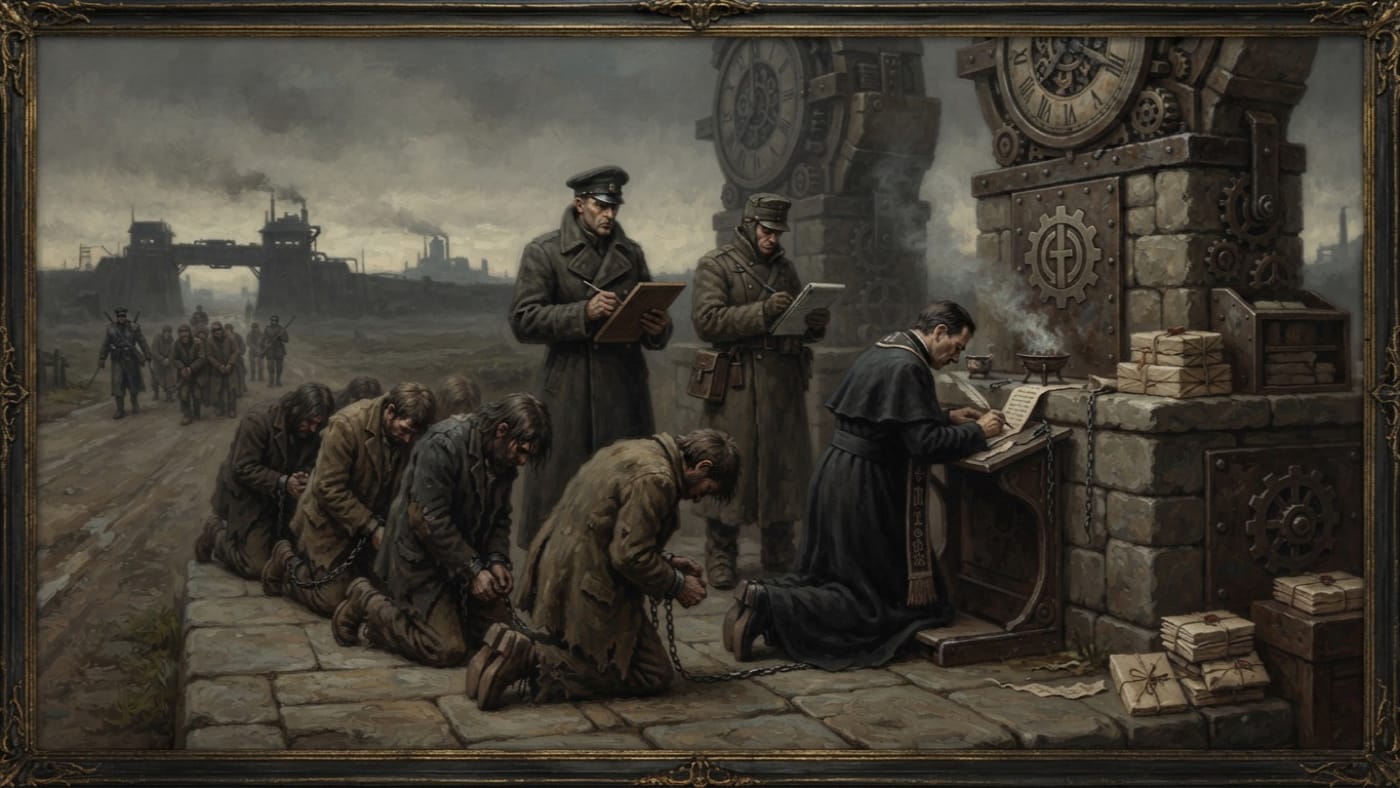
The column halts at the shrine-post and kneels in the order it was chained. No other order is possible. Iron joins each wrist to the next, so the fourth penitent can bow only as low as the third allows, and a man who wants to strike his breast must ask the woman beside him for slack. In front of a roadside shrine the stone has been worn into shallow troughs by this procedure. I have measured them with my palm. They fit a knee.
The Peregrine Jubilee calls what follows an offering. Each penitent is offered the chance to confess before the Creator and the shrine, aloud, in the hearing of the column, the escort, the Route-Stamper, any villagers who neglected their shutters, and the priest who writes it all down. Nobody is compelled. The Handler stands at the head of the kneeling line with the tally slate and makes sure that every penitent understands how voluntary it is.
Not every speaker is a heretic. A Jubilee chain holds the condemned, people offered by their families for a lighter tithe or a commuted sentence, and the dwindling few who came because they believed. All three kneel on the same stone and are offered the same opportunity. The vellum does not record which kind of penitent produced which name.
#On the Hands at the Shrine
Four offices meet at a checkpoint, and none of them may do another's work. The Pilgrim-Chain Handler presents the slate. The Route-Stamper counts heads against it, and that count is a separate audit with its own ink, concerned only with whether the bodies agree with the numbers. Then the shrine-priest takes the speech. The Handler hears it too, since everyone hears it, but holds no authority to hear confession, grant absolution, or perform any sacramental act whatever. The Handler's office at the shrine is enforcement: the penitents kneel, they speak, the strips are collected and sealed, and any refusal goes on the slate. The fourth office is absent. Records waits at the end of the road.
The chains came in A.S. 109. Handlers were licensed as a profession in A.S. 112. The Bureau of Pilgrimage was formally constituted under the Harmonized Routes Edict only in A.S. 123, and anyone who credits Pilgrimage with the escorts of the earlier years is describing them retrospectively. Those columns travelled under rite and escort warrants, which the new Bureau took over and then claimed to have written.
Nobody has documented when shrine-priests began writing more than they absolved. The Confession Reform of A.S. 104 standardised intake at the parish booths and says nothing about roads. I have not been permitted to see any founding instrument for the harvest. Either Records holds one, or nobody ever thought one necessary.
#On the Strip and the Packet
The strips are thin vellum, pre-ruled so that a hurried hand stays on its lines. The priest writes kneeling or standing, depending on the shrine and the state of the priest's knees, and writes quickly. Penitents rarely confess in order. They begin with the theft of a hen and end with a cousin's cellar. The ruling imposes a sequence on the speech that the speech never had, and the cellar sits on the vellum looking exactly as weighty as the hen.
Lime-dust settles on wet ink. Sweat from the priest's wrist blooms in the margin. Incense from the shrine brazier drifts across and makes everybody cough, which the strip does not record. When the speaking is done, the strips are collected under the Handler's eye, sealed, and bundled into packets. The packets go with the column. They walk the same road as the people who produced them, from the departure yard at Strasbourg through the corridor's long middle to destinations as far east as Bastion-Przemyśl, and they are counted at least as faithfully as the people.
Records files them on arrival. I have described Records' filing methodology elsewhere at a cost to my health that I will not repeat. It is enough to say that Records wants a usable entry, meaning a name, a place, and an act that can be indexed under all three. Contrition cannot be indexed, and a strip that is mostly contrition goes into the drawer reserved for paper that is technically complete.
None of this should be confused with the deathbed harvest, whose paper, witnesses and rules belong to the bedside. Nothing from a bedside travels the road.
"The shrine-priest receives confession strips." — Codex entry on the Peregrine Jubilee, "On the March and Its Machinery."
The shrine-priest receives speech and produces strips. A penitent chained at both wrists does not arrive at the shrine with anything in writing. The Jubilee entry has been left as published, because by the time anyone reads it the strips have been written.
#On Refusal and Bell-Time
A penitent who kneels and says nothing gets a mark on the slate. Silence at a second shrine gets another. A penitent who refuses at three shrines is transferred to the attention of the Bureau of Purity, and pilgrims do not come back from that transfer. Nobody tells me what happens next, and I have stopped asking at dinner.
The Jubilee keeps a fixed order at every checkpoint: headcount, then confession, then water, then departure. I note that the order is published. I note that the mercy gourd hangs at the Handler's hip through the whole of the second item, full, its every cup already allotted by the quota formula adopted in A.S. 141 after the Road-Mercy Scandal of A.S. 136. No regulation that I know of withholds water from a man who keeps his mouth shut. The order simply puts the water where he can see it.
Then there is the bell. Since the Bellway Harmonisation of A.S. 148, every column has had to reach its next shrine within a window measured by the Bureau of Bells, so confession takes place against a clock. When the interval closes, confessions are cut short. A priest who insists on finishing one can be charged with interval obstruction, and the Bell-Masters have learned to enjoy those charges. The result is a peculiar kind of contrition. The penitent hurries, the priest writes faster, and the parts that get cut are the ends of sentences, where the qualifications usually come.
#On the Names Beyond the Chain
The harvest does not exist to save the people who are kneeling. Their road is already settled. It exists for the people who are not there.
A penitent on the stone names a household that sheltered him, a teacher who lent him a book, a cousin who kept something in a cellar, a guild warden who looked away at the right moment. The priest writes the names down. The packet carries them east. Records enters them in the Great Ledger of Souls, where a name once written never leaves, whatever happens to its owner, and Purity reads what Records has entered. Inquiries follow, and some of those inquiries end with new families kneeling in a new departure yard, wrist to wrist, ready to be offered the opportunity.
What does a strip prove? A man in chains, a bell running down, water waiting just beyond his last sentence, every Purity question he has ever heard of ahead of him on the road: when that man names his cousin, the strip proves that the name was spoken. Purity treats the strip as the start of an inquiry. Records treats it as an entry. Neither office has claimed that it settles the cousin's guilt, and neither has any reason to, because the inquiry and the entry work equally well either way.
I admire the system. I say so plainly, as a Doctrine archivist who has spent his career praising instruments that work, and this one works. Paper bearing a wax seal and a ruled line, written in a public place before witnesses in the Church's own shrines, comes into the archive in better order than most testimony I am sent from cathedral chapters. I have cited harvest strips in my own reports. Their cleanliness has never once embarrassed me.
The sacramental seal remains. The Confessarii entry records the Church's teaching that the seal of confession is inviolable, and that teaching has not been revoked. I have asked Doctrine whether the speech given on a shrine-step is sacramental confession, or some other kind of public speech that happens to take place in front of a priest and a brazier. The reply affirmed, at length and in fine Latin, that the seal is inviolable. It did not answer the question. The packet is sealed with wax, and the strips inside travel to Purity. I have filed the reply alongside them.
#On the Continuing Return
The last full Jubilee was observed in A.S. 193. As of this survey in A.S. 201, sealed preparation for the next one continues under Pilgrimage. Its date is not mine to announce, and I have learned to distrust anyone who works it out by arithmetic. The roadside shrines still stand, and the stone in front of them still holds its troughs. The packets from the last observance have been filed, read, and used again in Purity's work, and the names they carried have produced investigations that do not wait for the decennial calendar.
The shrine-priests' wrists will be ready when the vellum is, and so will the bells and the slates. Nobody has yet drafted a regulation for the speech, because nobody has needed one.