
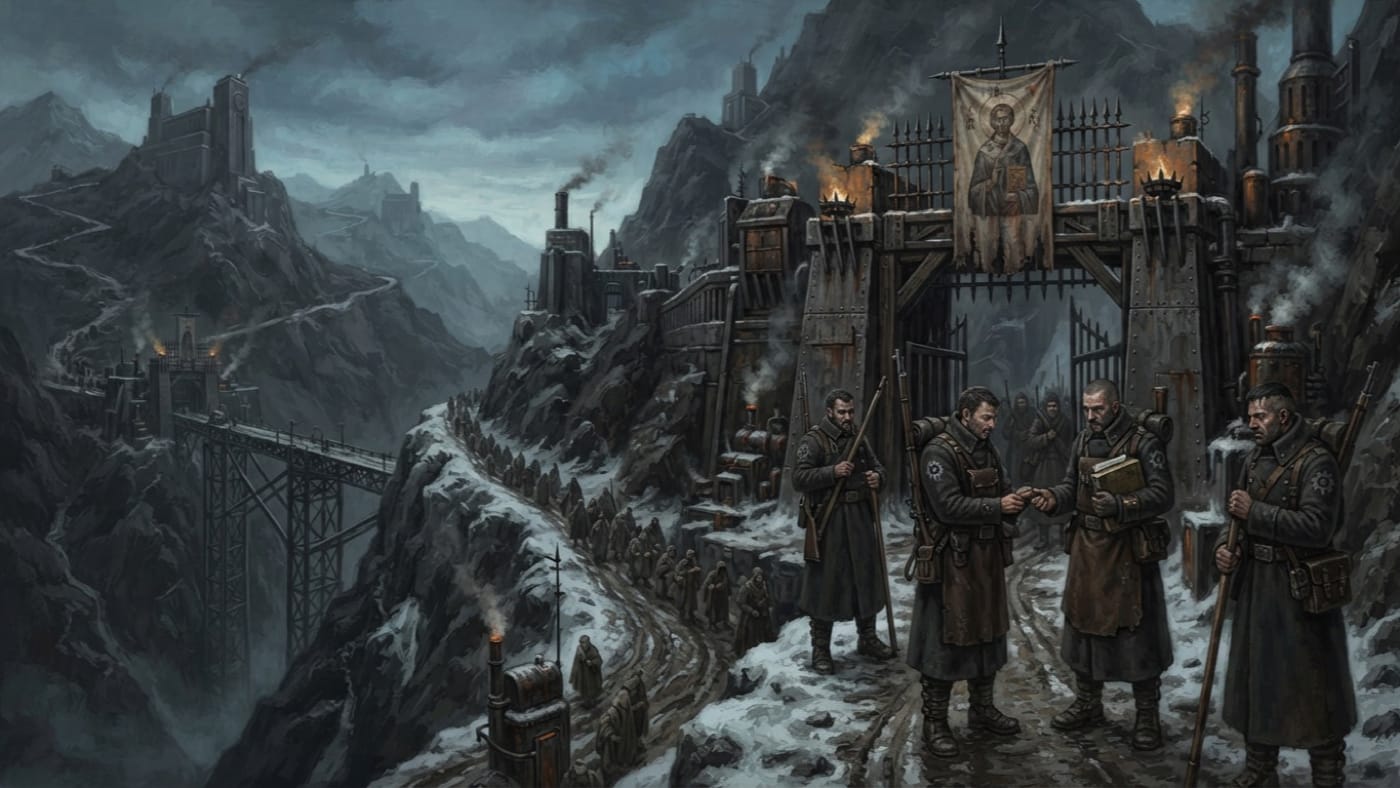
#On the Carpathian Claim
"The Confraternity of Saint Edras held the Carpathian passes." — Bureau of Pilgrimage, account of its own founding
"The Confraternity of Saint Edras claimed the Carpathian passes." — Harmonized Routes Edict, register of the summoned guilds
Two filings, one verb apart. I prefer the second. A claim is what a private body makes when it wants something nobody has given it. Holding is what the Synod does once the paperwork is complete. The Confraternity of Saint Edras lived its whole recorded life in the first condition and died in the second.
It was one of eight. Before A.S. 123 the pilgrim roads of the Church were divided among eight private guilds, each self-appointed, self-financed and more territorial than a diocesan boundary commission. The Guild of the Golden Sole took the Rhineland approaches. The Peregrine Brotherhood took the Iberian coast. The Brotherhood of the Blessed Foot took Flanders, and nobody contested it. The Edrasians took the mountains.
More precisely, they asserted passage authority over the Carpathian passes, the approach roads that now feed the Carpathian Gates, Bastion-Przemyśl, Bastion-Sibiu and the Carpathian Corridor. No surviving instrument shows that they owned an acre of that rock, governed a single hamlet, or kept a brother at every saddle in the range. They claimed the road, and on a mountain the road is the only thing worth claiming.
Their origins are a blank. The Bureau of Records holds no founding charter, no founder's name, no mother-house and no roll of masters. I have read too many guild histories to supply a legend for one that never filed its own. A fraternity that neglects to register its beginnings forfeits the right to have them written for it.
#On the Saint and the Passes
The name was the capital. Saint Edras carried more road authority than any charter the Confraternity could have drafted. His reliquary became the rallying point for pilgrim fury after the Massacre at Saint-Malo in A.S. 10, the bones around which the first angry columns gathered. His name is cut into the ration-stones that mark the pilgrim miles: One meal to Saint Edras. Processions in his name have walked in Strasbourg and in Iberia, and one, called up against a locust swarm, marched a thousand children barefoot over hot iron. Wherever a pilgrim counts distance, fasts against it or bleeds to shorten it, Edras is somewhere in the sum.
A guild that wore that name at a mountain gate wore all of it. In the pilgrim's untrained theology, refusing the Edrasian brother at the narrowing meant refusing the saint of lawful walking on his own road.
Here I must be exact, because the Edrasians never were. Nothing in the record shows that the saint founded the Confraternity, that the Confraternity kept his bones, or that the processions of Strasbourg and Iberia answered to its masters. The guild borrowed a patron. The patron was not consulted.
The mountains did the rest. In the lowlands a pilgrim can scatter across a ploughed field to avoid a toll-man. A pass offers one road, with rock on one side and air on the other, and whoever stands at the narrowing never has to run after anybody. Cold and exposure kept walkers on the track. Relic convoys had no second route. The Reliquary Switchbacks now show the principle in its finished form, with nailed femurs and a shrine at every turn. Their porters and registry clerks belong to the licensed order, though, and I will not lend them to the Edrasians after the fact.
The record does not say what the Confraternity charged, where its brothers stood, or whether it lodged, fed or dug out anyone in return. I decline to invent it. Any clerk can see the rest. After the Belgrade victory of A.S. 120, the faithful began walking east in tens of thousands. The mountain approaches became the most valuable stretch of devotional road in the Church, and the guild astride them had every reason to defend its claim and no superior to answer to.
#On Santiago
The Confraternity survives in the Bureau's files chiefly because of a city nowhere near its mountains.
In A.S. 121, processions associated with three guilds converged on Santiago de Compostela on the same feast day: the Peregrine Brotherhood, the Tongues of the Blessed Way and the Confraternity of Saint Edras. The surviving accounts do not settle how the Edrasians were represented there, or by whom. They settle only that the Confraternity's name stood among the claimants. Each party claimed toll authority over the approach, and pilgrims were charged twice for the same road. A third collection was attempted, and the procession became the Riots of Santiago. Forty-one died. The shrine was damaged.
I do not enter those forty-one in the Edrasian ledger. Nobody has proved whose staff came down first. The Bureau of Purity, which reported the affair, preferred to indict the whole private devotional sector rather than apportion the blame. On this point Purity was right. One guild charging a pilgrim is extortion. When two guilds charge him for the same yard of road, the matter becomes a jurisdictional dispute, and Synods exist to end jurisdictional disputes.
Santiago gave Strasbourg its precedent. Before the riot, eight private guilds could pass for custom. Afterwards they were a hazard with a body count, and such a hazard may be dissolved without debate.
#On the Settlement of A.S. 123
In A.S. 123 the Synod ratified the Harmonized Routes Edict at Concordat Hall, Strasbourg, and summoned the masters of all eight guilds. They came in ceremonial cloaks, expecting to bargain. The Edict offered absorption into the new Bureau of Pilgrimage or dissolution, and a dissolved guild still has a master to dispose of.
Three masters signed. They were made route inspectors and posted to stations so remote that the appointment amounted to exile with a stipend. The Golden Sole's master was sent above the Carpathian snow-line to a waystation whose nearest shrine was a painted boulder. The former toll-lord of the Rhineland spent his remaining years inspecting mountains a rival fraternity had once claimed. I call that a sound posting.
Three refused. They were walled alive into the foundations of the Bureau's southern headquarters at Marseille, which still groans in humid weather. Two fled to England, where the British Crown granted them asylum and has not been forgiven.
The record does not say which of these fates belonged to the Edrasian master.
The Confraternity's authority ended whatever became of its master. Control of passage through the mountains passed to Bureau licensing. Enforcement passed to the Peregrine Wardens, constituted under the same Edict with power to void road papers and dissolve unauthorised processions. The Wardens also remind local toll-keepers that the Synod tolerates competition only when the Synod is the competitor. The passes are now in Bureau custody, kept by Wardens, Route-Stampers, local bell-keepers and armed escorts. The record does not show whether any of them descends from an Edrasian brother. The Bureau took over the guilds' functions and was under no obligation to say whose.
Certain inherited summaries place the Harmonized Routes, and with them the Confraternity's suppression, in A.S. 238.
A.S. 238 has not yet occurred. The Edict was ratified in A.S. 123, and the Confraternity's independent authority ended that year. Neither 238 nor the previously rejected 38 dates the Confraternity's foundation, which remains unrecorded. The summaries have been withdrawn, and their copyists have been reminded which century they work in.
#On the Remaining Name
Saint Edras has comfortably outlived the people who borrowed him. Pilgrims still kneel at the ration-stones that carry his name, and Saint Edras' Triumph still stands on the Synodical calendar. None of this proves the Confraternity survived. As of A.S. 201 the Bureau of Records holds no active chapter, no surviving officer, no secret successor and no exile house in England bearing the Edrasian name. Devotion to a saint does not make a man a member of a guild. Purity would happily confuse the two, but it has never produced a document that does.
Some have called the old arrangement and the new one the same thing in different robes. I have heard this from pilgrims, from tavern-keepers below the passes and once from a Route-Stamper who has since been reassigned. The Confraternity stood at the narrow places and charged in the saint's name with no authority but its own. The Bureau stands at the same narrow places and charges in the same saint's name with the authority of the Synod. The pilgrims ask me what difference that makes. The difference is the stamp.