
#On the Southern Spur
A shrine on rails can go only where the track has been laid for it. — Guild proverb, section-house variant
In A.S. 191, 1901 by the old reckoning, the Sepulcher Locomotive was run down an emergency southern spur to relieve Bastion-Constantinople, the Bosphorus lock at the bottom of the Sagittal Line. The Bureau of War could have phrased the event that way, and when it did phrase it, it used fewer words than that. Everything else in this entry is attributed. The relief appears in three published Codex entries, and all three are in my hand. Count them as one witness who signed three times.
That year two pressures lay on the southern approach. Kargath's famine-pressure worked on ration confidence before it reached the bread. Maldrake's Thracian heat lay beyond the plain like an open firebox in a shed full of cartridge paper. The published Sepulcher account also records that the Vigil Ark of Saint Uriel sat grounded in the Foundry Quarter during the action. It records the condition and gives no reason for it. I once wrote that the Sepulcher ran because the sky would not. That was a sentence. War keeps the requisitions, and none it has shown me says so.
The machine moved under four seals. The Bureau of Engineering designed it. The Bureau of Doctrine blessed it. The Bureau of War requisitioned it. The Guild of Rails maintained the iron underneath it, which was the only one of the four duties that had to be done again that morning. The Bureau of Relics held custody of the cases in the chapel carriage, and the Bureau of Bells governed the choir measures. That made six offices and one train. The timetable answered to none of them.
#On the Track Repaired That Morning
A cathedral can sit on bad ground for a century and only lean. A Sepulcher on bad rail turns over. All the armour, all the bone-lime and every blessed rivet depend on two strips of steel spaced 1,435 millimetres apart and on whether anyone has checked them since the last heat.
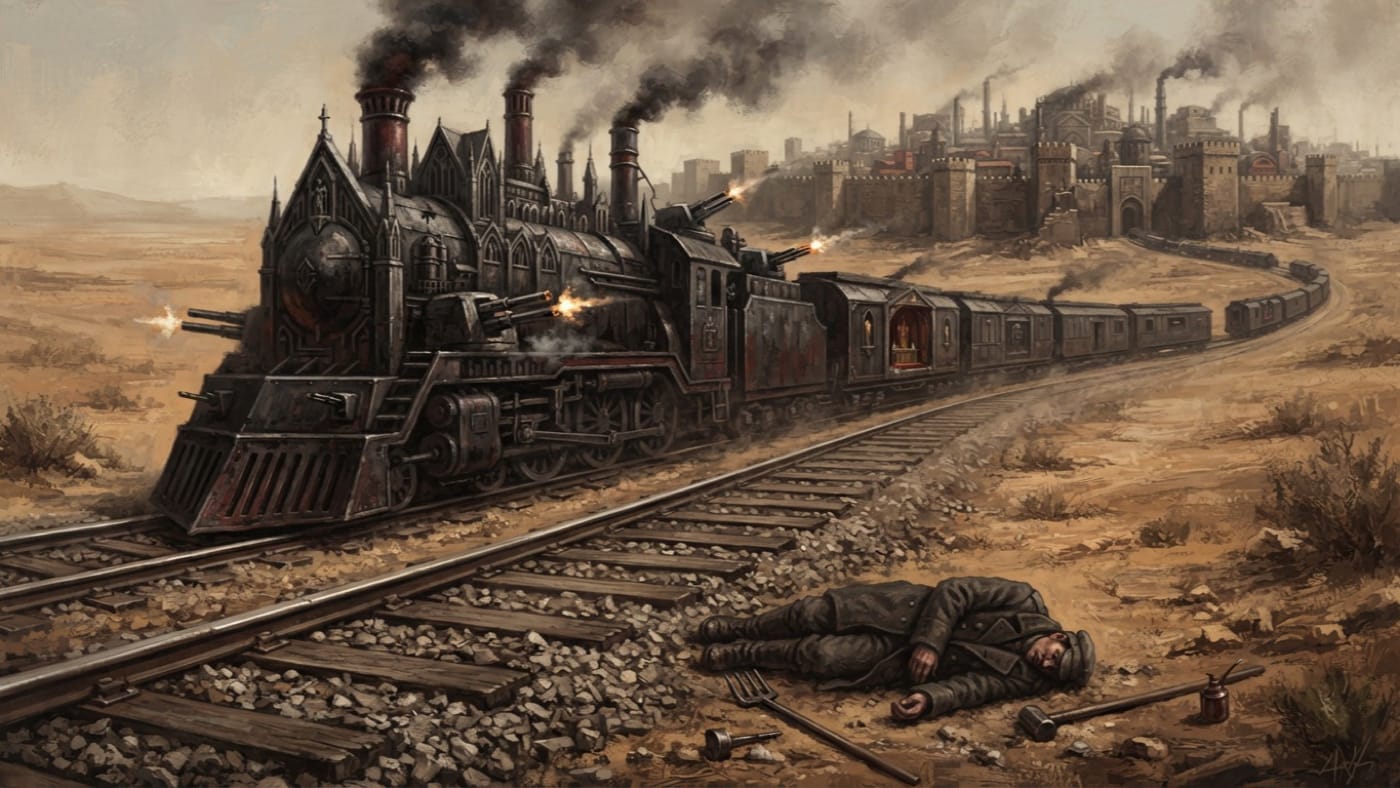
On the morning of the relief, someone had. The Guild and Railway Track Engineer entries agree that a Military Track Corps crew repaired the route ahead of the train. The Corps is the Guild's labour under fire. War requisitions it, and the Stationmasters choose its men by a mix of skill, debt and spite that no regulation describes. Corps crews carry the ordinary kit of the track engineer: gauge rod, spike maul, tie tongs, ballast fork and oilcan. I cannot say which man carried which tool, how many men there were, or who led them, and I will not invent a roster to make the morning tidier.
The Sepulcher account gives the defects as the Guild report described them. One rail section had buckled under heat and prayer-jam vibration. One bridge plate had walked three fingers out of alignment. One switch had fused to its housing. Three fingers is the measure as filed. I will not convert it into millimetres. The fingers were there and the millimetres were not.
The account records the switch in two forms.
Guild report, as quoted in the published Sepulcher account: the switch had fused to its housing "like a kneeling man."
Revised to "thermal distortion" after the Bureau of Doctrine objected to kneeling without approval. The switch kept its shape through both versions. Only the description was corrected.
The account does not say how the defects were mended, and neither will I. The Guild has its methods. Doctrine has a standing order about which of them may be published. The train passed over the result, and that was the only inspection War required.
#On the Passage
The Sepulcher account says the train passed at third bell. That is the only clock I can give. Third bell marks the passage. It does not tell you when the operation began or ended, and anyone who builds a timetable of the day from it should send it to Records, who will love it.
I was aboard. My recollection is already published in two places, and I will set it down a third time without improving it.
One Corps man lay beside the ballast as we went by. From a moving carriage I could not tell whether he was dead or asleep. I saw a man lying in work clothes at the edge of a line his crew had just made fit to carry us. Then I saw the embankment, because the train kept going.
The conductor did not stop. When the matter was raised, he said, "They'll send someone." In my published recollection nobody sent anyone, and I stand by what I remember. It remains my recollection. I was on a train heading south, in no position to audit the ballast behind it. The Guild ledger available to me does not name him. War's abstract does not count him. No document I have seen buries him, carries him to Mercy, or puts him back on his feet to curse the Stationmaster. His condition is unknown. I have looked for an answer and not found one.
#On the Guns, the Choir, and the Wrong Peal
From here the narrative belongs to the published Sepulcher account, and I attribute it each time so that a careless reader cannot mistake it for revelation.
According to that account, the forward guns fired seventy-three consecrated rounds over two hours. Two hours covers the firing only and says nothing about the length of the relief. Doctrine observers watched the gun crews, as they always do, so every round had a gunner, a loader and one unnecessary witness.
The account reports three direct impacts on the chapel carriage, where the altar rides on recoil springs and the reliquary cases sit in brass cradles under straps that Relics blesses and mechanics tighten. One case cracked. Relics later certified the crack as devotional rather than structural. The account does not identify the relic, and nobody has asked me to.
The account also reports that the choir bay lost two voices to heat collapse. Cantors in that bay stand harnessed against the sway and sing the measures that Bells prescribes for damaged rail and contested ground. The account says collapse. It does not say death, and I will not turn two fainting cantors into martyrs to improve a paragraph. They fell silent in the heat, and that is all the record supports.
The last episode is the strangest. The account says the engine screamed through the southern approach so loudly that the wall crews at Constantinople took it for a Bellway alarm. They answered with the wrong peal for seven minutes. That peal sent a magazine convoy into the wrong tunnel, and the account says the error saved the convoy. That is the account's judgement. It names no tunnel, cargo or attacker, and I add none. Seven minutes of the wrong bells did, in that telling, more good than many years of the right ones.
#On the Finding of Acceptable Loss
The relief ends where all such things end, in an abstract. It is reproduced here as published in the Sepulcher entry. I have added nothing to it and found nothing to remove.
"Relief achieved" is the abstract's finding. The abstract does not define it. It gives no enemy losses, no ground held, no casualty total and no account of the city on the day after. Under the Bureau's rules of evidence it is a true statement with no contents.
"Rail losses acceptable" is War's assessment, and the judgement belongs to War. The Guild laid the spur, and the Corps repaired it under heat. War looked at the cost and judged it bearable. The abstract does not say how much rail was lost, how many sleepers, plates or switches, or whether the phrase covers any men. I cannot tell from it whether the man beside the ballast is one of those rail losses or is missing from the record entirely. I have read the abstract many times, and on this point the stamp says nothing.
I have served the Church for most of my life by writing exactly this kind of sentence. I know how it is built. You choose a noun broad enough to hold whatever the day cost. You add an adjective that closes the question. Then you seal it before anyone asks what the noun contains. "Acceptable" does that work very well. It needs no witness and no burial detail, and it never has to explain itself to a crew that comes back one man short.
The Sepulcher reached Constantinople and the guns fired. The bells rang wrong, and the account says that helped. A case cracked and was declared holy. Two voices fell silent, and a man lay beside the track while the timetable went on south.
War found it acceptable. The finding stands. I do not endorse it.