
#On the Designation
"Court-Adjacents" is a filing term. It belongs to the Bureau of Shadows, which coined it for human beings reported to work as diplomats among the servants of the Great Deceiver. The term describes where they stand. It is not what they call themselves. If they have a name of their own, the Bureau has never heard it. Nobody can say whether they form an order, a household, a guild, or only a habit shared by desperate men. The Bureau knows what they do, and it has firmly declined to call it diplomacy.
It is diplomacy all the same. The Bureau will not use the word "ambassadors," and it has a reason. An ambassador is accredited by a sovereign, and the Church does not concede that the enemy has one in any sense a chancery could recognize. I grant the point and keep the job description. A man who carries sealed letters between hostile powers, bows to the correct depth and comes back with terms is doing an ambassador's work, whatever the Bureau files him under.
This tract surveys the reports on file as of A.S. 201. That date belongs to the survey. Nobody has recorded when the Court-Adjacents first appeared.
The Lore Book's reference is terse: humans serve as diplomats in the Court, wearing masks of flayed saints.
I wrote that sentence in my entry on the Shadow Court. Every word I quoted was faithful. The word I left out was not. The Lore Book's chapter outline files the line under "Rumor," and I printed the rest as though it were a finding. The label is restored. The rumor is still a rumor. The Bureau of Shadows dossier that came after it is better evidence, and it is still only a dossier.
#On the Office
The Shadow Court has no capital, and so its envoys have no embassy. The Bureau of Shadows reports them moving between the domains of the Seven Sin-Generals. They carry messages, negotiate truces and broker short alliances. Such an alliance lets one General throw his whole strength at the Line while his rivals are busy with one another. What the file holds is a pattern of conduct, and the conduct is professional. It holds no treaties, no signatories and no named missions.
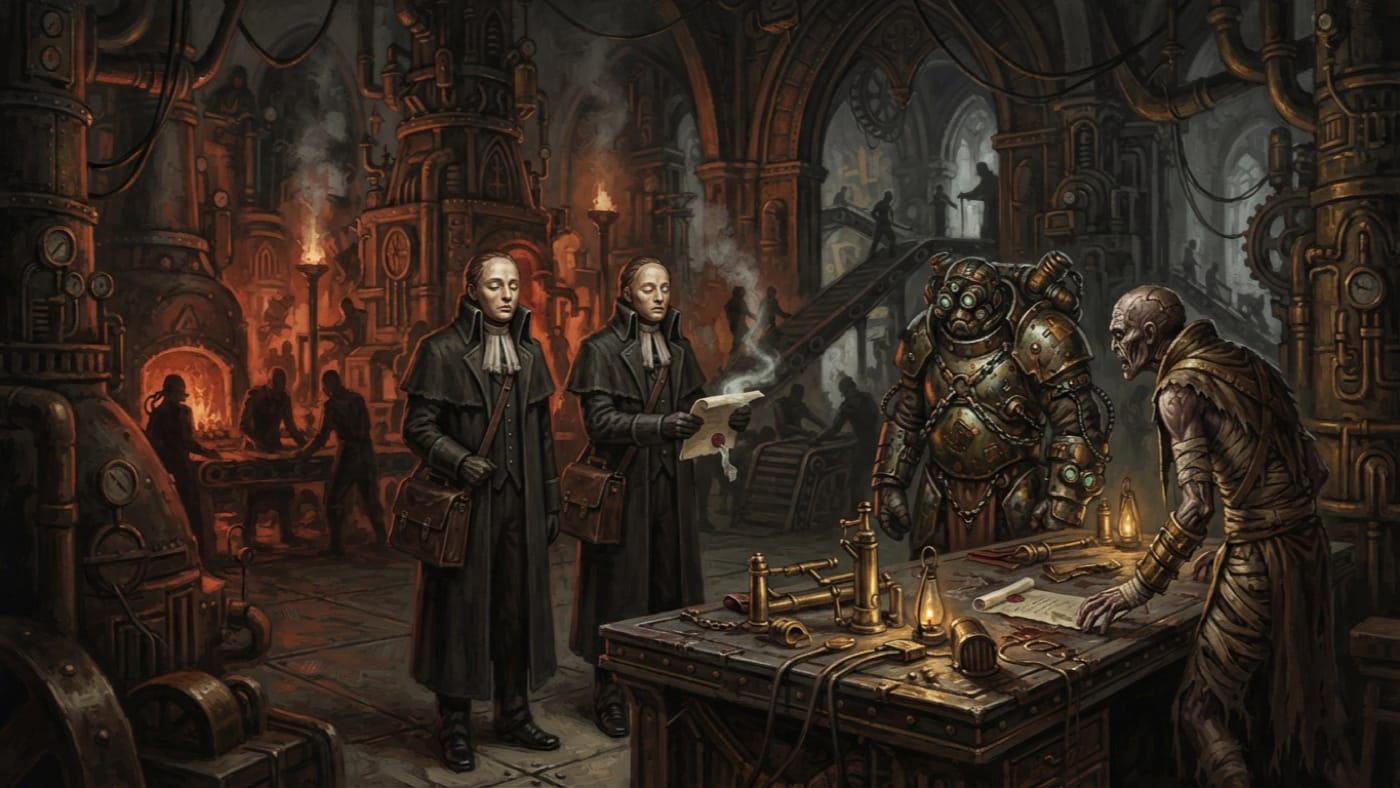
They bow. They observe precedence. They carry writs, and witnesses who came close enough to smell the seals say the wax gives off the odour of chrism. Bureau linguists describe their speech as "Old Synodic inverted." It is the formal tongue of our own chanceries, run backward through a grammar that ought to fall apart in the mouth and does not. I asked for a specimen. I was told that none is held in readable form. Given the alternatives, I accepted the answer.
The Great Deceiver himself signs nothing. I said so in my entry on the Court and I say it again here. He is a Will acting through proxies, and a Will keeps no chancery. His servants are another matter. Somewhere beneath the absent throne, writs are drafted, sealed and sent, and mortal hands carry them. The Court has no constitution I could print. It does have a postal service.
The need for envoys is the easiest question in the file, because the Seven cannot share a table. Kargath devours what Velmora would hoard, and to him a hoard is a larder he has not yet reached. Maldrake lives for endless violence and Syrion for stillness, so any truce between them insults one nature and suits the other. Atheron treats every arrangement as a step toward the Black Throne and accepts no equal at any table. Morwen imitates, and a letter that anyone might have written is worth no more than the hand that carries it. Someone has to walk into all this with a sealed writ and a level voice. That work falls to mortals. The Bureau has not learned why, and the Generals have not offered to explain.
Every one of these arrangements is temporary. The Bureau cannot say whether that is by design or by temperament. Seen from our side of the Sagittal Line, a truce that frees one General to concentrate his assault looks exactly like a coordinated campaign for as long as it holds. The Synod teaches that the Line survives because the Seven attack piecemeal. In my judgment, each Court-Adjacent who finishes an errand makes that teaching a little less true for a season.
#On the Masks
The masks are why anyone has heard of them at all.
According to the Bureau of Shadows, a Court-Adjacent's mask is a human face, taken whole rather than carved. The dossier links these faces to saints, specifically to saints whose reliquaries the Church has lost. It states that individual faces can be matched against pre-Sundering iconography. The dossier does not say how the faces were removed, when, or what state the bodies were in at the time. The Lore Book's rumor uses the word "flayed." I repeat it because it is the source's word, and I add nothing to it.
The clearest single observation on file dates from A.S. 188. A Bureau of Shadows operative identified a particular saint's face on a living man who was in the company of Velmora's representatives. In the operative's judgment, the man carried himself like someone presenting a trade proposal. The terms are unknown, and so is the outcome. The operative recorded one more detail, which the Bureau has quoted ever since. The mask's eyes were open. The man's were closed.
These two facts must be kept apart, which the Bureau has not always managed. The face has been identified. The wearer has not. The file records no sign that the man became the saint, spoke in the saint's name or was received as the saint by anyone in that company. It makes no claim that anything of the saint remains in the mask. A stolen relic was worn by an unnamed man, and the file goes no further.
Two Bureaus have explained the masks, and they disagree. The Bureau of Doctrine calls the practice "desecration as diplomacy." In its reading, the enemy sends his messages wearing our dead so that every audience opens by showing that nothing in our reliquaries is beyond his reach. The Bureau of Shadows proposes "operational camouflage." Its working hypothesis is that the masks give some protection, letting mortal flesh survive near the Court's altered conditions. Armed and hymning expeditions have not survived those conditions well. Doctrine's reading is a claim about intent. Shadows' is a guess at a mechanism, and no mechanism has been confirmed.
My own judgment is that both are probably correct, and I sign it as mine. The Great Deceiver has never been content to make a blasphemy do only one job. A face that insults the Church and also keeps its wearer breathing would be exactly his kind of thrift. Doctrine finds this suggestion indecorous. Doctrine has not offered a better one.
#On Willing Service
The dossier says the Court-Adjacents appear to serve willingly. The Bureau chose the word "appear" carefully, and I keep it.
What witnesses have seen is competence. Thralls are driven and the Hollowed are herded, but the Court-Adjacents arrive on their own feet, bow, deliver and leave. Their conduct is orderly in the way a good clerk's is, which shows that they know the work. It shows nothing about how they came to it. Recruitment, payment, threats against their families, debts inherited or incurred: any of these would produce the same bow. A man may walk freely into a room because he wants to be there. He may also walk in because he knows what will happen to his daughter if he does not.
Doctrine teaches that the Adversary cannot take a human will. He can only keep making offers until the wrong choice feels inevitable. The Court governs by invitation, and the Court-Adjacents are the clearest evidence on file that its invitations are sometimes accepted. Velmora deals in obligations that compound over years. Velkara works on what men want and on what they owe. No report shows either of them recruiting or commanding these envoys. I name them only to show how many different roads end in the same bow.
Here is what troubles me. I will say it plainly, because nobody else at the Bureau will. I have spent my life among clerks. I can recognize a man trained to carry a sealed document into a hostile room and keep his hands still. Someone has trained the Court-Adjacents to the standard of a good Records clerk, and several reports suggest a higher one. The protocol they follow had to be learned, and it was learned from us. The enemy did not invent the bow, the writ or the formal register. He took them from the Church as he took the faces, and he has staff who use them better than half the chancery at Strasbourg.
The operative wrote that the man's eyes were closed. I do not know whether that was prayer, exhaustion, horror or discipline. I have stood before Doctrine boards with my own eyes closed for all four.
#On the Present File
As it stands in A.S. 201, the file contains a function, a set of manners and a description of masks. It contains no names. It contains no headcount, and the Bureau will not guess whether there are a dozen Court-Adjacents or several hundred. It records no leader, no seat, no founding, no mandate and no instrument of appointment. It cannot say how a mask is obtained, whether it does anything to the person wearing it, or whether service ends in retirement, defection or the grave. If a Court-Adjacent has ever been taken alive and questioned, the dossier I have read does not mention it.
The Bureau of Shadows goes on recording their work under a heading that refuses to name it: messages carried, truces arranged, alliances made for one campaign season and broken after it. That is an embassy's record, entered line by line by a hand that declines the title. I have read worse administrative fictions. I have signed several.