
#On the Forbidden Device
"Read the beast before you read the bearer."
The crimson boar of Saxony is a picture. It has no lair, no cult and no throne, and it has never drawn breath. It is a red animal with a lowered shoulder and a forward tusk. It was once painted on the convoy markings of a Saxon supply guild that died in A.S. 30. It is also the only device in the Armorial of the Faithful that the Bureau of Heraldry has condemned by name.
A Sigil Inspector at a gatehouse does not start by asking who flies it. Owners lie. Owners have grandmothers, guild charters, war service and tears. The shoulder does not lie, and neither do the tusk or the bristled ridge. The Inspector reads all three before he learns the wagon-master's name. The bearer's turn comes later, at the hearing table, after the scraper has been heated and the cloth has come down from the pole.
#On the Guild and Its Wagons
"Dead guilds keep excellent records."
Before A.S. 106 the boar meant one thing: these wagons belong to us. The old Saxon supply guild marked its convoys with it, and teamsters, toll-keepers and depot clerks learned to wave the red beast through. I cannot cite any document that says who drew it first, in what year the guild took it up, what the guild called itself in its own charter, or how the full blazon read. I will not improvise a pedigree for an animal the Bureau has since sentenced.
The guild was defunct by A.S. 30. No living office answered for its charter after that. The mark outlived the institution, as marks do. Old drivers remembered it, and their sons remembered the old drivers. People kept recognising the beast long after anyone had the authority to fly it.
In A.S. 106 a quartermaster at Essen revived the boar on the wagon banners of a supply convoy. The city has been entered in the registers as Essen-of-Hymnsteel since its renaming in A.S. 118. According to the published account of the riot, he worked from family papers and old convoy rolls. That is the account's claim, and I report it as such. His name is withheld from public record. Nothing I have read shows that a dead guild's charter licensed a living man to fly its beast. He called it tradition. Heraldry has a shorter word for unregistered memory.
#On the Crimson Gate
"A banner is an order with no officer attached."
In A.S. 106 Essen was a rear garrison of furnaces and depots. It was far from the Line and close enough to its news. That season the news came from Thrace, where Maldrake was advancing. Rear echelons hear such reports late and imagine them early.
Then wagons came through the gate under clean red cloth. Some of the garrison believed the old dynasty had returned. Others believed something was wearing that dynasty's face. The rest only knew that their neighbours believed one or the other, and that was enough. Loyalists struck at the banners. Men of Saxon blood defended them. Men who had never given Saxony a thought in their lives picked a side because sides were on offer and the bell was ringing.
The Crimson Gate Riot lasted four hours. Eighty-seven people are confirmed dead. The wagons burned, and the depot they had been sent to feed lost their supplies.
The riot file holds one statement, which I have read only in copy. It says the boar moved when the first hook struck the pole, "as an animal deciding whether to charge." The witness acknowledged the penalty for false visual testimony and repeated the claim anyway. It is testimony. Nobody has confirmed it, and I do not confirm it here.
What the mark did is easier to establish. It gave a crowd's conflicting fears one object to fix on. A man afraid of demons and a man proud of his grandfather could look at the same cloth and both feel vindicated. The boar held no hook and rang no bell. It let a crowd agree that something was happening without agreeing what.
#On the Condemnation
"Beasts belong to wildness, not banners."
In A.S. 108 the Bureau of Heraldry issued the Beast Proscription. The boar's sentence deserves quoting in full: "an emblem of wrath, a heraldic heresy, and a provocation against the Faithful."
Read the formula as a Bureau writes it. "Emblem of wrath" files the device in the ledger of the sins, beside Maldrake's reported progress through Thrace. That is Heraldry's judgment. It does not certify possession or demonic allegiance, and it does not establish that anyone at the Crimson Gate served the General of Wrath. "Heraldic heresy" was a new phrase. The Proscription is the first and only formal Bureau decree to use it. Inspectors have used it ever since, in citations, in hearings and in arguments with cobblers. A decree's phrase soon becomes a clerk's habit.
The decree is precise, and people routinely mangle it. Lions, eagles and stags survive in stylised canonical form, ground into angles by the Chancellery of Permitted Animals. Wolves and serpents are banned outright. Bears are suspended pending review, and in A.S. 201 they are still waiting. The crimson boar of Saxony is condemned by name. The decree leaves the pig in a butcher's window alone. A red door is a matter for the Chancellery of Colors and its line between sanctioned crimson and tolerated vermillion. Sanctioned crimson remains lawful wherever the Armorial places it. The sentence attaches to this boar, in this colour and this posture, carrying this inherited claim.
"The Crimson Gate Riot: a banned crest appeared on ration wagons; a crowd assumed the old dynasty had returned — hundreds died."
Withdrawn from this Warden's own working notes on the Inspectorate's turning points. No decree touched the crest until the Proscription of A.S. 108, so it was lawful cloth when it came through the gate in A.S. 106. The wagons belonged to a supply convoy. The confirmed dead number eighty-seven. A riot does not need its symbol outlawed in advance. My notes banned the boar two years early because a clerk wanted the story tidy. The clerk was me, and the correction is entered here.
#On Keeping the Prohibited Image
"Learn the lie before the law."
The Bureau scrapes the boar from every public surface it can reach, and it keeps one.
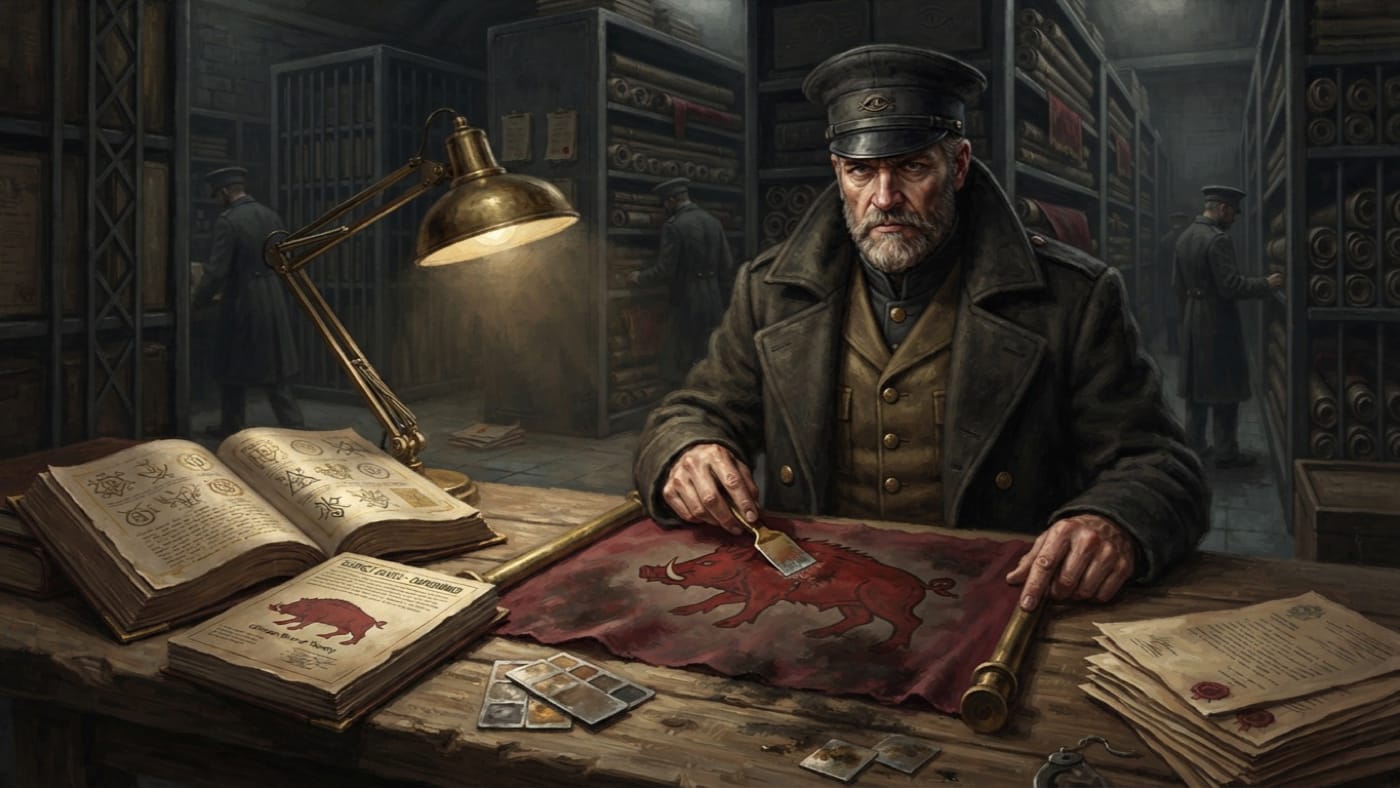
The Armorial Vault beneath Strasbourg has a counterfeit annex, and in that annex is a lead-lined rack of confiscated banners rolled tight as bandages. Among them is the flag taken from a burned wagon at Essen in A.S. 106. The annex warden answers personally to Casselius of Mainz, who now holds Heraldry, and nobody enters without a warrant, a summons or an assignment. The custody involves no ceremony. The banner is kept because nobody can prosecute a forgery that nobody can compare against the real thing. An Inspector who has never seen the true boar's shoulder will miss the next one cut from memory.
Apprentices are brought down to see the cloth. The pigment has darkened where the smoke reached it, and the tusk still points forward. Then they climb back up to the light and are issued the Codex of Permitted Symbols, whose appendix of suspect devices carries the boar plate. It is the dirtiest page in the book. Instructors press it under recruits' fingers, and the recruits flinch.
#On the Scraper and the Memory
"Scrape it now or bleed later."
The procedure has barely changed since A.S. 110. That year forty-three licensed Heraldic Examiners of the Inspectorate of Visual Compliance took the field to enforce the Proscription, each with the first Codex, a swatch set and a scraper blade. Geometry comes first: shoulder, tusk, ridge and the drop of the head. Colour comes second, checked against the swatch. Changing its coat does not make the boar lawful, and a pink pig on a sausage-maker's board is only a pig until its posture says otherwise. Registration comes third. The Armorial licenses no such device, and a family paper is not the Armorial. Context comes last. A boar on a wagon banner at a gate speaks to a different crowd than one scratched into a tavern bench, and the citation has to say which.
The first Codex was wrong in eleven entries. The errors were found by A.S. 114, after three guilds had already been fined on its authority. The Inspectors who levied those fines were certain. Certainty comes issued with the coat.
The boar waited seventy-six years between the death of its guild and the morning at the Crimson Gate. The Inspectors have carried it for longer. A man who has scraped for twenty years starts reading every surface as a statement. The profession has a name for the last stage of that condition: the man sees the crimson boar of Saxony in every sunset. Nothing supernatural is meant by it. It is what the eye does after enough red has been ruled on. The Bureau reassigns such men to the archives, where the vellum is approved and the geometry holds still.