
#On the Book That Teaches Surfaces to Obey
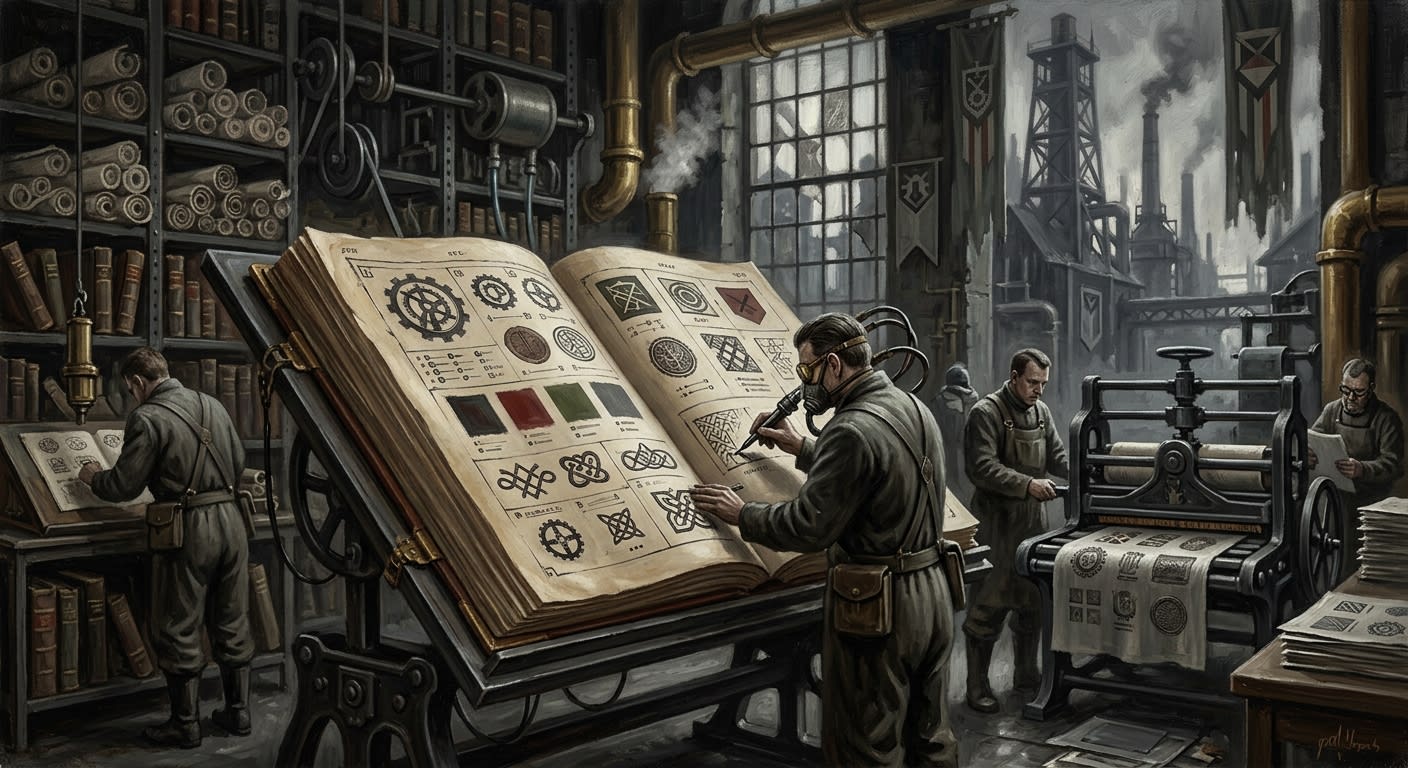
The Armorial of the Faithful is the vast registry by which the Bureau of Heraldry determines what loyalty may look like. A lesser civilization would call it a catalogue of coats of arms. Strasbourg, having been spared modesty by the Creator and good paper supply, calls it an instrument of visual obedience.
Every banner, crest, seal, guild mark, processional standard, ration stamp, absolution token, muster badge, funeral lozenge, alms-house plaque, bridge toll emblem, licensed mask rim, and permitted dyer’s palette under Synodal jurisdiction must appear in the Armorial. The registry contains 347,211 entries as of the A.S. 200 audit, a number the Bureau recites with the swelling pride of a bishop naming martyrs and the flat terror of a clerk who knows the next audit has already begun. Each entry states province, district, function, colour, geometry, motto, sanctioning office, permitted material, permitted scale, approved occasions for display, and punishments for inaccurate enthusiasm.
The Armorial does not beautify the Synod. It disciplines sight. A citizen may pass a gate, read no proclamation, hear no sermon, and still know where he stands because the wall has been made literate on his behalf. Three loops above a doorway. Crimson trimmed to the licensed shade. A black chevron of mourning slanted at the sanctioned angle. A ration mark stamped in lawful tin. The eye kneels before the tongue has caught up.
#On the First Desk and the Appetite of Ink
The Armorial began in A.S. 58 as a desk in the back of the Records chancery, assigned to catalogue the six hundred and eleven banners carried at the Night of Black Decrees. I admire the optimism of that first assignment. It was expected to take a fortnight. Men who expect heraldry to end quickly have never met a banner or a clerk.
The banners contradicted one another with aristocratic confidence. Fourteen displayed arms belonging to dead houses. Three displayed arms belonging to houses that had never existed, which in heraldic matters is often an advantage. One bore a device so poorly drawn that the recording clerk classified it as obscene in order to avoid admitting it was merely incompetent.
By A.S. 72, the desk had swollen into a division. By the Concordat of Strasbourg in A.S. 90, it had acquired such arrogance, ink consumption, and furniture that Records expelled it with the solemn relief of a monastery releasing a goat from the refectory. The new Bureau of Heraldry received its own charter, its own seal, and its first Archon, Theobald of Worms, who understood that symbols are never small. A symbol is a command made portable.
Theobald’s first command was accumulation. He ordered every diocese, guild, chapter, ferry company, infirmary, conscription depot, orphan house, cemetery, and ration mill to submit impressions of its marks. Wax arrived by cart. Painted boards arrived by mule. Embroidered banners arrived wrapped in oilcloth, smelling of old rain and noble delusion. The first Armorial vault filled in eleven months.
Earlier school primers state that the Armorial was founded with the Bureau of Heraldry in A.S. 90.
Corrected. The Armorial predates the Bureau as a working registry. The Bureau merely arrived later to claim parentage, as institutions and bad fathers often do.
#On the Triune Knot and Permitted Geometry
At the Armorial’s centre sits the Triune Knot: three loops, one law, angles measured by men who would rather die than permit an untidy salvation. The Knot appears on official documents, gate lintels, ration loaves, soldiers’ wrists, coffin plates, ferry tags, bridge toll tokens, reliquary crates, and the confession desks of booths from Brest to Constantinople. It is the most reproduced sign in the Synod’s history, which is another way of saying that no one has been allowed to forget who owns the surface beneath his hand.
The Armorial’s geometry tables are among the great works of theological pettiness. A bend may descend at one of seven sanctioned angles. A chevron may open according to class, grief status, or proximity to the Sagittal Line. A circle is permitted only when broken, enclosed, haloed, or assigned to a relic office; free circles encourage unlicensed completeness. Spirals are suspect. Natural curves require review. A triangle is safe until inverted. Two triangles may be devotional, punitive, or both, depending on whether the lower point has been granted absolution by the Chancellery of Permitted Forms.
Standing Order 14-C, revised A.S. 187, tightened the registry after sigil-smugglers discovered that minor deviations could pass through older inspection charts. Forty-seven variants of the Knot became forty-three after four were deemed insufficiently angular. Craftsmen who had carved the withdrawn variants into lintels were told their errors were administrative inconveniences. Heraldry has a tender heart: it postpones damnation until the paperwork is dry.
#On Beasts, Colours, and Other Disobedient Animals
Before A.S. 108, the Armorial still carried the zoological vanity of old Europe: lions rampant, eagles displayed, bears lumbering across shields, serpents biting their own impious tails, wolves, boars, stags, fish, cocks, hounds, and other creatures through which nobles announced that the Creator had blessed them with excellent embroidery and little judgment. The Sundering made beasts dangerous in retrospect. Hell used animals, corrupted animals, animal shapes, animal memories. A painted boar on a wagon could stir panic when Maldrake’s reports came west. A serpent over a guildhall could smell suddenly of Greed. The eye, once frightened, reads teeth everywhere.
The Crimson Gate Riot of A.S. 106 settled the matter. A supply convoy reached Essen-of-Hymnsteel under a crimson boar, the old mark of a dead Saxon guild revived by a quartermaster with tradition in his skull where prudence should have lodged. The rear echelon saw wrath in the paint. Eighty-seven died. Wagons burned. Supplies vanished into smoke. Two years later, the Beast Proscription entered the Armorial in a hand so severe that even the ink appears to be standing at attention.
Lions, eagles, and stags were reduced to stylised canonical forms, angular enough to look embarrassed by their ancestry. Wolves and serpents were banned. Bears were suspended pending review, which is the Bureau’s chosen method of killing a thing without the vulgarity of burial. The crimson boar was declared a heraldic heresy.
The Beast Proscription banned all animals from faithful display.
Incorrect. The Bureau did not ban animals. It corrected them into geometry. The distinction matters, especially to the lions, who now resemble ambitious hinges.
Colour required equal discipline. The Chancellery of Colors maintains tables for sanctioned crimson, tolerated vermillion, penitential black, mourning black, clerical black, ration black, ash-grey, bell-grey, permitted bone, forbidden bone, and the blue that may be used only by Mercy wards and widows who have filed Form 19-Mourning. Unauthorized brightness is treated as vanity. Unauthorized dullness is treated as despair. The middle is billed annually.
#On the Inspectors and the Price of Looking Wrong
The Armorial would be a noble corpse without the Sigil Inspectors who carry it into the streets. Grey-coated, brass-badged, ink-stained, they pass through gates, markets, guild districts, muster yards, funeral lanes, and ferry queues with chromarch codices under one arm and scraper blades at the belt. Their trade is lawful vandalism. They inspect wagon crests at dawn, guild signs at noon, soldiers’ patches before dusk, and wet alley glyphs at night, when solvent smell betrays the amateur rebel as surely as incense betrays a chapel.
To register a symbol requires seven forms, three endorsements, a wax impression, a colour proof, a geometry sheet, a fee assessed by Tithes, and the patience of someone already half-dead. To display an unregistered symbol requires chalk. This imbalance explains much of history.
Inspection Report 44-K, Weaver’s Quarter, Cologne: unauthorized mark found beneath permitted dyer’s sign; scraping revealed older mark; second scraping revealed ████████████; third scraping stopped after Inspector Marn’s blade began copying the sign onto his palm. Wall requisitioned. Household reclassified from textile to evidence.
Punishments vary by category. A first error in angle may draw a fine. A repeated colour deviation may close a shop. A proscribed beast may bring Purity. A false seal, counterfeit muster badge, or inverted Knot moves quickly from Heraldry to the Index Damnatus, and from the Index to a room where men ask questions over heated iron. The Armorial itself records the correction: sign removed, banner confiscated, wall scraped, offender branded, district cleared for repainting.
#On the Armorial Vault
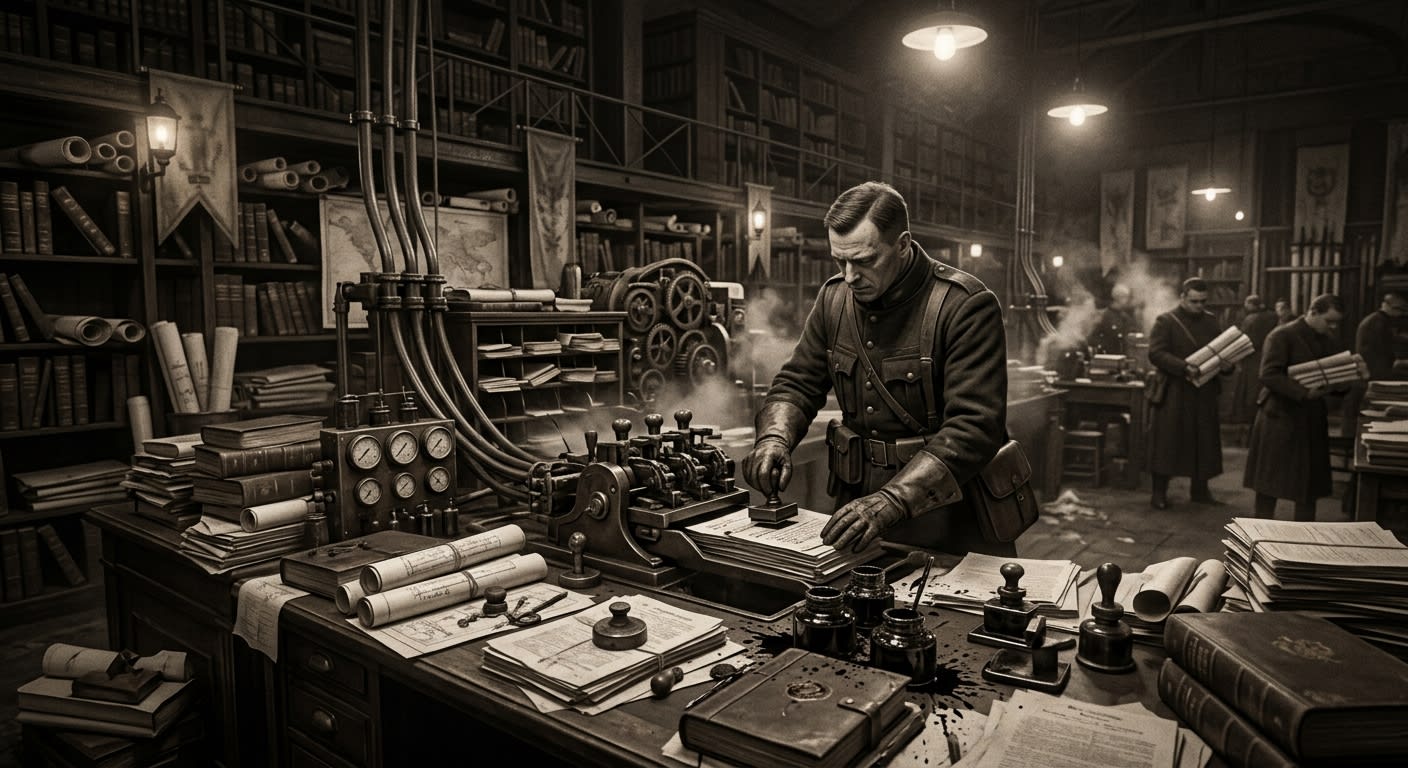
The primary Armorial Vault lies under Strasbourg, in a suite whose shelves groan beneath folios taller than choirboys and less prone to doctrinal error. Entries are chained by district. Colour plates are stored flat in cedar drawers. Wax impressions hang in numbered cabinets. Counterfeit examples occupy a sealed annex, because the Bureau believes a false symbol must be preserved in order to be destroyed correctly.
Every quarter, supplements are issued to provincial inspectorates: additions, withdrawals, corrections, reclassifications, and those sly little “clarifications” by which the Bureau changes yesterday while insisting today has always been well dressed. The quarterly chromarch codex is out of date by the time it reaches most districts. This is intentional enough to be holy. A citizen may violate the Armorial before receiving the supplement that would have saved him. Responsibility, of course, belongs to the citizen. The mail coach is innocent.
CHROMARCH SUPPLEMENT — SPRING A.S. 201 — OUTDATED UPON RECEIPT — STILL BINDING.
The Armorial’s largest current dispute concerns unregistered symbols in active circulation: roughly forty thousand, by the Bureau’s own estimate, though Heraldry distrusts estimates almost as much as it distrusts children with chalk. Some are criminal marks. Some are old guild signs revived in cellars. Some belong to refugee houses whose original arms were lost east of the Line and reconstructed badly from grandmother stories. Some are nothing more than scratches given meaning by frightened inspectors and later punished because the punishment made them meaningful.
That is the Armorial’s secret sacrament. It recognizes symbols and fattens them. A chalk mark on a door becomes rebellion when the Bureau scrapes it, files it, names it, and sends three men to find who drew it. The sign enters history through its wound.
#On Present Authority
Under Casselius of Mainz, who holds both Heraldry and Masks and Seals in personal union, the Armorial has become more than a registry. It is the Synod’s vocabulary and printing press fused into one beautiful inconvenience. Casselius controls what may be drawn and the instruments that authenticate what is drawn. He controls the word and the stamp, the face and the mask, the banner and the hand permitted to raise it.
This concentration of authority alarms no one officially. Unofficial alarm has several registered forms, each requiring a fee.
The Armorial of the Faithful remains open, hungry, and chained. New pages are inserted daily. Old pages are corrected with knives so fine the scraped vellum looks flayed. Provincial registers arrive with mud on their edges and rebellion in their margins. The Bureau files all of it: the authorized, the forbidden, the corrected, the ugly, the almost loyal, the loyal in the wrong shade.
Look up from this page. Whatever mark is nearest you has a number. If it lacks one, do not admire it aloud.